
Life coach versus therapist: find your right path

TL;DR:
- Most people should seek therapy for emotional distress or trauma, while coaching is best for goal-oriented growth. Both fields serve distinct purposes, with therapy being regulated and focused on mental health, and coaching emphasizing performance and personal development without regulation. Integrating both supports offers a comprehensive approach to navigating complex life challenges effectively.
Over 70% of coaching clients achieve their stated goals, yet most people facing real conflict, stress, or personal stagnation still don’t know whether to book a life coach or call a therapist. That uncertainty is not a personal failure. The two fields look similar on the surface, sound similar in marketing language, and sometimes even use similar techniques. But the differences in training, regulation, clinical capacity, and intended outcomes are significant. Getting this choice right can accelerate your growth or, if you get it wrong, leave a genuine mental health need untreated.
Table of Contents
- What is the difference between a life coach and a therapist?
- How effective is life coaching compared to therapy?
- Regulation, ethics, and client safety: Why credentials matter
- When should you choose a life coach versus therapist?
- Why most people overlook the value of integrated support
- Find support tailored to your unique situation
- Frequently asked questions
Key Takeaways
| Point | Details |
|---|---|
| Know the difference | Life coaches and therapists serve distinct roles—understanding them will help you make a confident choice. |
| Check credentials | Life coaching is unregulated, so always verify training and ethical standards before choosing a coach. |
| Evaluate effectiveness | Coaching data shows strong results for goal achievement, while therapy is best for mental health challenges. |
| Choose support wisely | Use practical frameworks to decide whether coaching or therapy fits your needs and situation. |
| Integrated support works | Combining coaching and therapy can be especially valuable during conflicts or periods of change. |
What is the difference between a life coach and a therapist?
Life coaches and therapists both work with people who want to improve their lives. But their roles, training, and purposes are quite different. Understanding those differences is the first step to making a smart decision for yourself.
A life coach focuses on the future. The core work involves identifying goals, building motivation, creating accountability structures, and supporting personal development. Life coaches work with clients who want to move forward, whether that means advancing a career, improving relationships, overcoming procrastination, or navigating a major life transition. They ask powerful questions, challenge limiting beliefs, and help you design a plan.
A therapist or licensed counselor works differently. Their primary focus is on diagnosing and treating mental health conditions, processing trauma, resolving emotional pain, and healing psychological wounds. Therapists are trained to assess clinical symptoms and provide evidence-based interventions. They are legally licensed, supervised, and held to strict ethical codes.
Here is a clear breakdown of where each professional typically operates:
- Life coach: Goal setting, performance, motivation, career direction, relationship dynamics, life transitions, personal growth
- Therapist: Depression, anxiety, trauma, grief, anger disorders, relationship dysfunction, personality disorders, crisis intervention
- Overlapping zone: Communication skills, self-awareness, stress management, navigating conflict, building resilience
“Empirical data supports coaching efficacy for non-clinical growth, but direct comparisons to therapy remain limited. This means coaching works well for people who are already functioning well but want to do better.”
One of the most important distinctions is that therapy is a regulated profession. To call yourself a therapist or licensed counselor, you must complete a graduate degree, supervised clinical hours, and pass licensing exams. Life coaching has no such requirement. Anyone can legally call themselves a life coach tomorrow.
Understanding the coaching vs therapy differences at a practical level helps you avoid choosing the wrong form of support when you need it most.
How effective is life coaching compared to therapy?
Understanding their roles is only part of the equation. Now, let’s compare their effectiveness based on real data. Because when you are deciding how to spend your time, money, and emotional energy, you deserve actual evidence.
The coaching numbers are strong for goal-focused work. A large dataset drawn from 12,000 coaching engagements showed goal achievement rates between 70% and 71%. Meta-analyses also show a moderate effect size of g=0.59 on goal attainment and self-efficacy improvements among coaching clients. In research terms, that is a meaningful result.
Here is a side-by-side comparison of what the current evidence tells us:
| Measure | Life coaching | Therapy |
|---|---|---|
| Goal achievement rate | 70 to 71% (12,000 engagements) | Varies by condition and approach |
| Effect size on self-efficacy | g=0.59 (moderate) | Strong for clinical conditions |
| Best suited for | Non-clinical growth goals | Mental health disorders, trauma |
| Regulation of practitioners | None required | Legally required and state-regulated |
| Session structure | Flexible, forward-focused | Structured, evidence-based protocols |
| Outcome measurement | Goal attainment, client satisfaction | Symptom reduction, clinical assessment |
Therapy’s effectiveness is well-documented for clinical needs. Cognitive behavioral therapy (CBT), for instance, has decades of research supporting its outcomes for anxiety, depression, PTSD, and anger disorders. The data for therapy is condition-specific and clinically validated in ways that coaching research is still catching up to.

What does this mean practically? Coaching works well when you have a clear goal and your mental health is stable. Therapy works well when emotional distress, trauma, or clinical symptoms are getting in the way of your daily life. For many people dealing with conflict, the gap between these two situations is not always obvious from the inside.
The emotional growth data available from behavioral health research shows that unaddressed emotional patterns consistently undermine goal achievement. In other words, if you hire a coach to help you improve your relationship but you are actually carrying unresolved trauma, the coaching process may stall. That is not a failure of coaching. It is simply the wrong tool.
Explore additional perspective on choosing the right support and the practical differences in a therapy versus coaching guide to dig deeper into matching your needs to the right professional.
Regulation, ethics, and client safety: Why credentials matter
While effectiveness is important, credentials and regulation critically influence client safety and ethical conduct. This section matters especially if you are in conflict, emotional distress, or dealing with sensitive personal issues.
Therapy is a licensed profession. In every U.S. state, practicing as a therapist requires a graduate degree in a mental health field, thousands of supervised clinical hours, passing a licensing exam, and ongoing continuing education. Therapists are also mandated reporters, meaning they are legally required to report child abuse, elder abuse, or imminent danger. Their clients have formal legal protections, including confidentiality rights codified in HIPAA.
Life coaching is completely unregulated. There is no law preventing anyone from calling themselves a life coach, charging for sessions, and working with vulnerable clients. Some coaches pursue voluntary credentials through organizations like the International Coaching Federation (ICF), but this is optional. Vetting credentials before working with any coach is essential because therapy’s oversight ensures safety for vulnerable clients in ways that coaching currently does not.
Here is a direct comparison of the ethical and regulatory landscape:
| Category | Life coaching | Therapy |
|---|---|---|
| Licensing requirement | None | State-required license |
| Graduate education | Not required | Master’s or doctoral level required |
| Supervised clinical hours | Not required | 2,000 to 4,000 hours required |
| Confidentiality protections | Varies by contract | Legally protected (HIPAA) |
| Mandated reporter obligations | None | Yes, legally required |
| Ethics oversight body | Voluntary (e.g., ICF) | State licensing boards |
| Discipline for misconduct | Limited | License suspension or revocation |
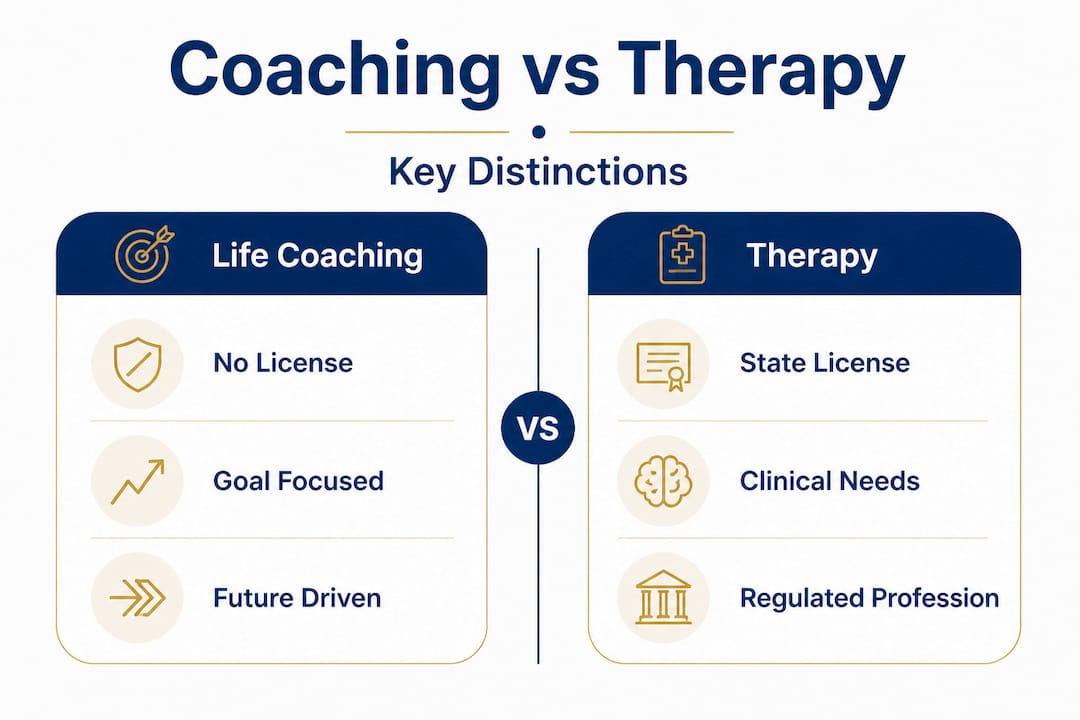
If you are working through conflict in your relationship, processing workplace stress, or managing emotional reactions that feel out of control, these distinctions matter enormously. Exploring coaching conflict resolution methods can help you evaluate what kind of professional engagement makes sense for your situation. And if you are considering online services, understanding online therapy confidentiality is an important part of making a safe choice.
Key protections to look for in any support professional:
- Verified license or certification, available through state licensing boards
- Clear disclosure of training, experience, and scope of practice
- A written confidentiality policy or agreement
- Ethical guidelines from a recognized body, whether a state board or credentialing organization
- A process for handling complaints or concerns
Pro Tip: Before your first session with any coach or therapist, ask directly: “Can you share your credentials and explain the ethical guidelines you follow?” A qualified professional will welcome this question. Someone who deflects it is a red flag.
When should you choose a life coach versus therapist?
Finally, having covered roles, evidence, and regulation, let’s focus on practical guidance for making your own choice. The goal here is a clear framework you can actually apply to your own life.
Choose a life coach when:
- You are feeling stuck in your career or unsure of your next professional direction
- You want to build better habits or improve your daily performance
- You are navigating a major life transition, such as a career change, relocation, or new relationship, and you are emotionally stable
- You have specific, concrete goals you want to achieve with accountability support
- You want to improve communication patterns or leadership skills in a non-clinical context
- You are not experiencing active symptoms of a mental health condition
Choose a therapist when:
- You are experiencing persistent sadness, anxiety, anger, or emotional numbness that affects your daily function
- You have experienced trauma, whether recent or from the past, that continues to influence your behavior or relationships
- You are in conflict with a partner, family member, or colleague and the dynamic has become toxic or unsafe
- You have been diagnosed with a mental health condition or suspect you may have one
- You are using substances, engaging in self-harm, or having thoughts of hurting yourself or others
- Previous attempts at personal growth have stalled because of emotional blocks you cannot identify or move past
Empirical data supports coaching for non-clinical growth, but limited direct comparisons to therapy means you should err toward clinical support when in doubt. The cost of choosing a coach when you actually need a therapist is far higher than the reverse.
Dig deeper into choosing the right support for your specific situation, or read through a detailed breakdown of coaching vs psychotherapy to clarify where the lines fall.
Pro Tip: Still unsure which path fits you? Write down your three biggest concerns right now. If any of them involve emotional pain, past trauma, clinical symptoms, or safety, start with a therapist. If all three are about future goals, growth, and direction, a coach may be the right first call.
Why most people overlook the value of integrated support
Here is a perspective that rarely shows up in mainstream conversations about coaching versus therapy: these two approaches are not competing services. They are complementary tools. And treating them as mutually exclusive is one of the most common and costly mistakes people make when seeking personal growth.
Most people approach this choice as binary. Either they see a coach or they see a therapist. But human experience is not binary. You might need a therapist to work through the emotional aftermath of a painful divorce, and a coach to help you rebuild your professional identity once the healing work has progressed. You might need therapy to stabilize chronic anxiety, and coaching to channel your recovered energy into meaningful goals.
In our work with clients navigating conflict, we consistently see how unresolved emotional wounds undermine goal achievement, and how lack of forward-focused structure can stall therapeutic progress. The two practices can genuinely reinforce each other when they are coordinated well. Some therapists and coaches actively collaborate, sharing high-level (non-confidential) insights about a client’s direction to provide more coherent support.
The challenge is that the wellness industry tends to market these services as separate products rather than components of a broader growth strategy. Coaches want to attract clients who see them as the primary solution. Therapists operate within clinical frameworks that sometimes do not account for goal orientation. The result is that clients end up choosing one or the other based on marketing, not clinical wisdom.
What we believe, based on years of work in this field, is that the most effective path for someone dealing with real conflict or significant life challenges is a thoughtful assessment first. Understand what you are actually dealing with. Then choose the support that matches that reality. And stay open to shifting that support as your needs change.
Learn more about how conflict coaching explained can serve as a practical companion to clinical therapy, rather than a replacement for it.
Find support tailored to your unique situation
Navigating the coaching versus therapy decision is not something you should have to figure out alone, especially when conflict, emotional distress, or significant life challenges are already weighing on you.
At Mastering Conflict, our clinical services are built to meet you where you are. Whether you need a thorough clinical assessment to understand what kind of support fits your needs, a licensed therapist for individual or couples work, or a coaching program designed for conflict resolution and personal growth, we have structured pathways for all of it. Our teletherapy counseling makes it easy to access professional support from anywhere in North Carolina, South Carolina, Florida, or beyond. Not sure where to start? Take our anger assessment to get concrete data on your emotional patterns and a clear direction for your next step.
Frequently asked questions
Is life coaching regulated like therapy?
No, life coaching lacks formal regulation unlike therapy, so it’s essential to vet credentials carefully before committing to work with any coach, regardless of how professional they appear.
What types of goals are best addressed by a life coach?
Life coaches excel at helping clients achieve personal growth, career advancement, and overcoming stagnation in non-clinical areas, with goal achievement rates reaching 70 to 71% across large client datasets.
When should I seek a therapist instead of a coach?
Choose a therapist if you are experiencing emotional distress, trauma, or symptoms of a mental health disorder, since coaching efficacy is supported primarily for non-clinical growth rather than clinical treatment.
Can coaching and therapy be combined for better results?
Yes, combining coaching and therapy often provides broader support, especially during major life changes or conflict, because each approach addresses different but complementary dimensions of personal growth and emotional health.
Recommended
- Life coach vs therapist: Choose the right support – Mastering Conflict
- Life Coach vs Therapist: Choosing the Right Support – Mastering Conflict
- Coaching vs Therapy: Difference between Coach and Therapist?
- Coaching vs Psychotherapy: What’s Right for You? – Mastering Conflict
- How to seek help for your mental wellbeing | Level Up Spot