Mediation training to transform your conflict skills

TL;DR:
- Mediation training develops essential conflict resolution skills applicable in legal, family, workplace, and personal contexts. State requirements vary, with Florida, North Carolina, and South Carolina enforcing distinct standards for certification, hours, and mentorship; these programs emphasize practical skills like active listening, neutrality, de-escalation, and domestic violence screening. Beyond certification, the training itself fosters life-changing emotional intelligence and better communication across all relationships.
Most people assume mediation training belongs in law schools and courtrooms. That assumption leaves a lot of value on the table. Whether you are a couple in Charlotte working through communication breakdowns, a family in Miami navigating a painful separation, or a professional in Columbia trying to manage a difficult team dynamic, mediation training offers practical, life-changing skills that extend far beyond legal settings. This article breaks down exactly what mediation training involves, what each state requires, and how you can choose the right path to build conflict resolution skills that actually stick.
Table of Contents
- What is mediation training?
- State-by-state requirements in North Carolina, South Carolina, and Florida
- Choosing the right mediation training for your goals
- Key skills and nuances: What sets successful mediators apart
- Our take: Mediation training isn’t just professional—it changes lives
- Take the next step: Find the perfect training or support
- Frequently asked questions
Key Takeaways
| Point | Details |
|---|---|
| State-specific requirements | Mediation training and certification differ in North Carolina, South Carolina, and Florida, so check your local guidelines. |
| Court vs. private training | Court-certified programs are rigorous and recognized for official referrals, while private options offer flexible learning for personal and workplace goals. |
| Key practical skills | Effective mediation relies on neutrality, active listening, and handling high-conflict or DV cases with sensitivity. |
| Mentorship matters | Observation and mentoring are crucial parts of most state-certified mediation tracks. |
| Training transforms relationships | Mediation skills can enhance couples, family, and interpersonal relationships beyond professional mediators. |
What is mediation training?
Mediation training is the structured process of learning how to guide two or more parties through a disagreement so they can reach a mutual agreement without a judge or arbiter making the decision for them. The term ADR (Alternative Dispute Resolution) refers to any method that resolves conflict outside of court, and mediation is one of the most widely used ADR methods.
Training programs vary widely in scope. Foundational training typically covers 20 to 40 hours and introduces you to core mediation concepts. Advanced training builds on that foundation with continuing mediation education (CME), more complex case types, and deeper skill refinement. Some programs are designed for court certification, which means they meet strict state standards. Others are private or workplace-focused programs with more flexibility in length and format.
Court-certified mediation requirements differ significantly from private training. Court-certified programs are state-specific, rigorous, and required for anyone seeking court referrals. Private and workplace programs, which often run 20 to 40 hours, are designed for business settings, family communication improvement, or personal development.
Here is a look at the core skills you build through quality mediation training:
- Active listening: Learning to hear not just the words spoken, but the needs and fears underneath them
- Neutrality: Maintaining an impartial stance even when one party seems clearly more sympathetic
- Reframing: Helping parties shift from positional arguments to interest-based conversations
- De-escalation: Recognizing when tension is rising and using verbal and nonverbal tools to bring it down
- Caucusing: The practice of meeting separately with each party to build trust and surface deeper concerns
- Agreement drafting: Guiding parties toward clear, actionable, and mutually acceptable outcomes
These skills are not just useful in formal mediation rooms. Couples use them to stop arguments from spiraling. Parents use them to resolve sibling conflicts more effectively. Managers use them to handle team friction before it damages productivity.

State-by-state requirements in North Carolina, South Carolina, and Florida
Once you understand what mediation training is, it is crucial to grasp how requirements differ based on your location. Each of the three states covered here has its own certification body, hour requirements, and application process.
Florida
Florida operates one of the most structured court mediation systems in the country. Basic certification requires 40 hours of training through a Florida Supreme Court certified program. Family mediation takes a different path, requiring 30 hours of specialized training, plus additional education requirements and 40 mentorship points earned through supervised co-mediations. County court mediation follows a similar model: 30 hours of training plus points. Each track has its own application, fee structure, and renewal requirements tied to CME hours.
If you are in Florida and exploring how teletherapy options or online formats might fit into your training, it is worth noting that the Florida Supreme Court has approved some online training delivery for certain requirements.
North Carolina
North Carolina certifies mediators through the Dispute Resolution Commission (DRC). Applications and fees vary by program type. The Superior Court Mediated Settlement Conference (MSC) program is one of the most sought-after credentials in the state. Each program specifies its own training hour requirements, and prospective mediators must submit detailed applications that include background information, training records, and in some cases references.
South Carolina
South Carolina certifies mediators under the Supreme Court’s ADR Rules, administered through the Board of Arbitrator and Mediator Certification. Civil court mediation training is 40 hours, delivered through approved providers. Family mediation carries additional requirements, particularly for cases involving children, where the stakes and complexity increase substantially. Understanding marriage counseling requirements in the context of family mediation can help couples and practitioners recognize the overlap between clinical and mediation approaches.
Here is a summary comparison of core requirements across the three states:
| State | Program type | Training hours | Mentorship/points | Certification body |
|---|---|---|---|---|
| Florida | Basic | 40 hours | Varies | FL Supreme Court |
| Florida | Family | 30 hours | 40 points | FL Supreme Court |
| Florida | County | 30 hours | Points required | FL Supreme Court |
| North Carolina | Superior Court MSC | Program-specific | Application required | DRC |
| South Carolina | Civil Court | 40 hours | Application required | SC Supreme Court Board |
Key considerations across all three states:
- All three require applications and fees paid to the certifying body
- Renewal typically involves ongoing CME hours
- Family and domestic mediation tracks often carry stricter prerequisites
- Mentorship and observation requirements are common for family tracks
“Court-certified mediators must meet state-specific training, background, and continuing education requirements that private programs are not obligated to mirror.” This distinction matters enormously when you are deciding which training aligns with your goals.
For a deeper look at how mediation in families differs from formal court processes, you will find that the practical communication patterns carry across both contexts.
Choosing the right mediation training for your goals
Now that you know state requirements, here is how to select the training option that best fits your needs. This decision comes down to two things: your intended outcomes and your current context.
If your goal is court referrals, you need state-certified training. Period. In Florida, North Carolina, and South Carolina, earning court referrals requires completing an approved program, submitting an application, and meeting ongoing CME requirements. Going through a private provider without state approval will not get you there.
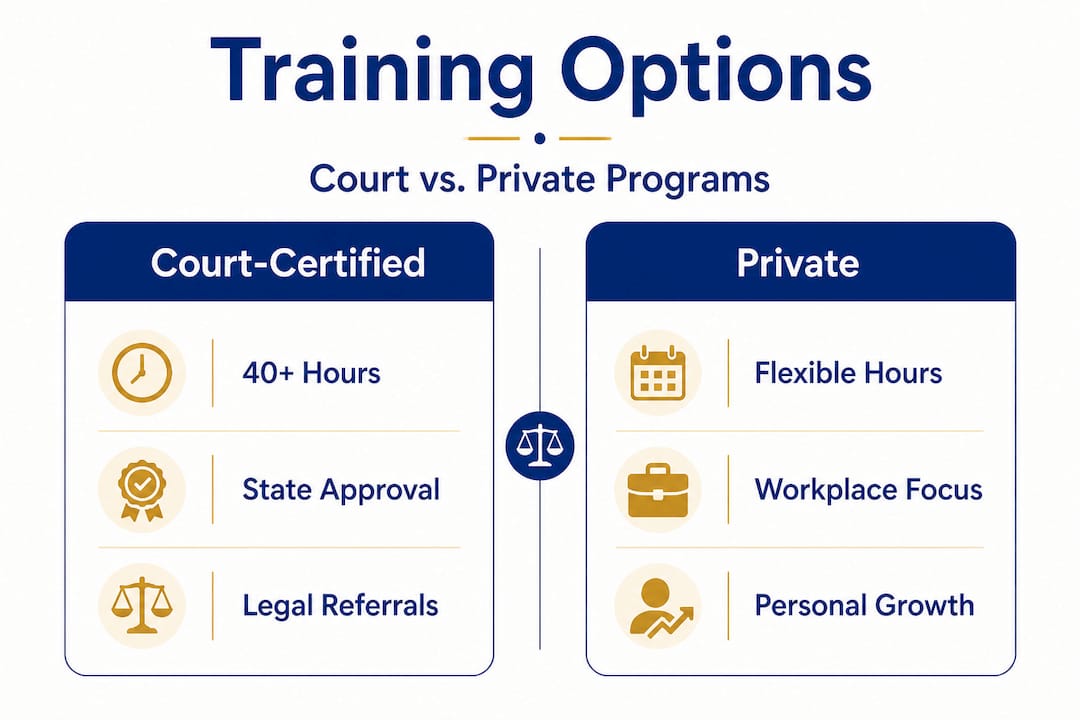
If your goal is personal growth, relationship improvement, or workplace conflict management, private programs offer tremendous value at a lower time and financial cost. State-certified family mediation training runs 30 to 40 hours or more, while private courses for business and family settings often fall in the 20 to 40-hour range with more flexible formats. Providers like virtual mediation platforms have made entry more accessible for busy couples and working professionals.
Here is a step-by-step approach to choosing your training:
- Define your goal clearly. Are you seeking a career path, improving your relationship, resolving a specific workplace conflict, or developing a new professional skill set?
- Check your state’s official requirements. If you are in FL, NC, or SC, visit the official court websites before committing to any program.
- Evaluate training formats. Online training is convenient but may not satisfy all state requirements for in-person hours. Hybrid formats offer balance.
- Consider focus areas. Family mediation training emphasizes emotional dynamics. Workplace and civil mediation focus more on interests and agreements.
- Review instructor credentials. Strong programs are led by experienced, practicing mediators with real-world case backgrounds.
Pro Tip: If you are a couple or individual seeking to improve your relationship communication rather than become a certified court mediator, family-focused private training combined with professional therapy conflict methods gives you a more complete skill set than either approach alone.
| Training type | Best for | Typical hours | Format options | Cost range |
|---|---|---|---|---|
| Court-certified | Legal/court practice | 30-40+ hours | In-person or hybrid | $500 to $2,000+ |
| Private/family | Couples, personal growth | 20-40 hours | Online, in-person | $200 to $800 |
| Workplace/business | Managers, HR, teams | 20-30 hours | Online or in-person | $300 to $1,000 |
Understanding workplace conflict resolution is particularly valuable for professionals who discover that mediation skills reduce both individual stress and team dysfunction simultaneously. Organizations that invest in mental health coverage strategies as part of their employee benefits often see measurable drops in HR escalations when staff receive conflict training.
Key skills and nuances: What sets successful mediators apart
Once you pick a training path, understanding these advanced skills ensures you get the full value from your program. The difference between a mediator who gets agreements and one who transforms conflict lies in the nuances.
Role-play is the core training engine. Theory matters, but training through practical role-plays is what actually builds mediator competence. Good programs spend the majority of contact hours in structured simulations where trainees practice handling angry parties, impasses, and last-minute breakdowns.
Neutrality is not the same as passivity. This surprises many trainees. Being neutral does not mean sitting back and saying nothing. It means actively facilitating without taking sides, validating emotions without endorsing positions, and guiding process without controlling outcomes.
Domestic violence screening is non-negotiable. Specialized DV screening training of 4 to 8 hours is required in states like Florida and Virginia for family mediators. This training teaches mediators how to identify signs of coercive control, assess whether mediation is appropriate at all in a given case, and respond safely when a party discloses abuse. High-conflict couples present unique challenges, and without this training, a mediator can inadvertently create an unsafe dynamic.
Power imbalances require active management. When one party dominates the conversation, the entire process breaks down. Training covers specific techniques for evening the playing field: private caucuses, structured turn-taking, and clear ground rules enforced consistently. Cultural awareness plays a major role here as well. Successful mediators recognize how cultural background shapes communication styles, decision-making norms, and expectations around authority.
Here are the distinguishing skills you will encounter in quality programs:
- DV screening protocols with specific safety planning steps
- Caucusing techniques for parties with significant power differentials
- Cultural competency frameworks for working across diverse backgrounds
- Self-represented party support without crossing into legal advice
- IPV (intimate partner violence) awareness as a precondition for safe mediation
- Observational mentorship where you watch experienced mediators handle real cases before managing your own
Pro Tip: When evaluating training programs, ask specifically how many hours are devoted to role-play and live observation versus lecture. A ratio of at least 60 percent experiential to 40 percent instructional indicates a program that builds real-world readiness.
Developing these conflict resolution steps does not just make you a better mediator. It makes you a more effective communicator in every context of your life.
“The most effective mediators are not those with the most legal knowledge. They are the ones with the deepest emotional intelligence and the strongest commitment to a fair process.”
Our take: Mediation training isn’t just professional—it changes lives
Here is something the standard training brochures rarely say plainly: certification is not the most important reason to pursue mediation training. The skills themselves are.
We have worked with countless couples and individuals in North Carolina, South Carolina, and Florida who came to us after years of repeated conflict patterns. They had tried arguing more forcefully, avoiding issues entirely, or waiting for the other person to change. None of it worked. What finally moved the needle was learning how to listen differently, reframe differently, and stay regulated enough to stop escalating. These are mediation skills.
The official state certification path is rigorous and worthwhile if you intend to practice as a professional mediator. Florida’s certifying authority maintains strict standards, and that rigor exists for good reason. But for couples and individuals, the training itself, not the certificate, is where transformation happens.
It is also worth being honest: couples-focused programs, including approaches grounded in the Gottman Method or Relational Life Therapy (RLT), are distinct from mediator certification. They are not interchangeable. Mediation teaches process facilitation. Therapy and couples coaching address the emotional and relational roots of conflict. The most powerful outcomes we see come when people do both.
We always point clients toward family mediation insights as a starting point, because understanding how mediation works in a family context helps people recognize which type of support they actually need. Official state sites including flcourts.gov, nccourts.gov, and scbar.org remain your best reference for current certification requirements.
Take the next step: Find the perfect training or support
Mediation training opens doors, but the right support system helps you walk through them with confidence.
At Mastering Conflict, we understand that conflict is rarely just about the words exchanged. It is about the patterns underneath them. Whether you are a couple looking to rebuild communication, an individual ready to transform how you handle tension, or a mental health professional seeking clinical supervision to deepen your practice, we have resources built specifically for your needs. Explore our couples packages for structured relationship support, or connect through our teletherapy counseling platform for flexible, accessible care from anywhere in North Carolina, South Carolina, or Florida.
Frequently asked questions
How many hours of mediation training are required in Florida?
Florida requires 40 hours for basic certification through a Supreme Court approved program, with family mediation requiring 30 specialized hours plus 40 mentorship points. Each track carries its own additional education and application requirements.
What is the difference between court-certified and private mediation training?
Court-certified programs meet strict state requirements needed for court referrals, while private programs focus on workplace or relationship skill-building and typically run 20 to 40 hours with more flexible delivery formats.
Are there specific skills taught for handling high-conflict or domestic violence cases?
Yes. Quality programs include DV screening modules of 4 to 8 hours, practical role-play for high-conflict situations, power imbalance management techniques, and mandatory observational mentorship before trainees handle independent cases.
Where can I find the most reliable info about mediation requirements in NC, SC, and FL?
Official state certification pages at flcourts.gov, nccourts.gov, and scbar.org provide the most current and authoritative training requirements, as these standards are updated regularly by each state’s governing body.
Recommended
- Master Conflict Resolution Skills for Real-Life Success – Mastering Conflict
- Conflict Management Training Courses: Skills for Real Life – Mastering Conflict
- Conflict Management Skills: Enhancing Therapy Outcomes – Mastering Conflict
- Master Assertive Communication Skills for Conflict Resolution – Mastering Conflict