
Understanding Black Mental Health Stigma and How to Break It

TL;DR:
- Stigma, including public, self, and structural types, significantly limits mental health care access in Black communities.
- Culturally tailored psychoeducation and faith partnerships effectively reduce mental health stigma.
- Addressing systemic barriers and combining faith with professional support are key to improving mental health outcomes.
Black adults are 20% more likely to report serious psychological distress than white adults, yet only 39 to 56% ever receive treatment. That gap is not random. Stigma, in all its forms, is a major reason why so many Black individuals and families suffer in silence. And stigma is not just about what people think or say. It is a system of barriers, beliefs, and structures that actively block access to care. This article explains how stigma works, who it hits hardest, what it costs in real human terms, and what actually reduces it.
Table of Contents
- What drives mental health stigma in Black communities?
- Who is most affected? Education, ethnicity, faith, and intersectionality
- How does stigma impact seeking and receiving mental health care?
- Evidence-based strategies for reducing stigma and improving access
- Breaking the cycle: What most guides miss about stigma and resilience
- Get support and take action
- Frequently asked questions
Key Takeaways
| Point | Details |
|---|---|
| Stigma is multifaceted | It includes social prejudice, internalized shame, and structural barriers that block access to care. |
| Disparities persist | Black adults and youth are far less likely to receive treatment for mental health conditions than other groups. |
| Nuances matter | Education, ethnicity, faith, and intersection with racism all shape stigma and treatment decisions. |
| Solutions exist | Evidence-backed strategies like tailored psychoeducation and community engagement can reduce stigma. |
| Community action is key | Integrating professional care with faith and increasing representation helps break stigma for lasting change. |
What drives mental health stigma in Black communities?
Stigma does not work in a single, simple way. Researchers identify three distinct types: public stigma, self-stigma, and structural stigma. Understanding all three matters because each one requires a different response.
Public stigma refers to the negative attitudes that communities hold toward people with mental illness. Self-stigma happens when a person internalizes those attitudes and feels shame about their own struggles. Structural stigma is built into systems, policies, and institutions that limit resources and opportunities for people with mental health conditions. As research on race and mental health stigma shows, all three types interact and reinforce each other, making it harder for Black individuals to seek and receive care.
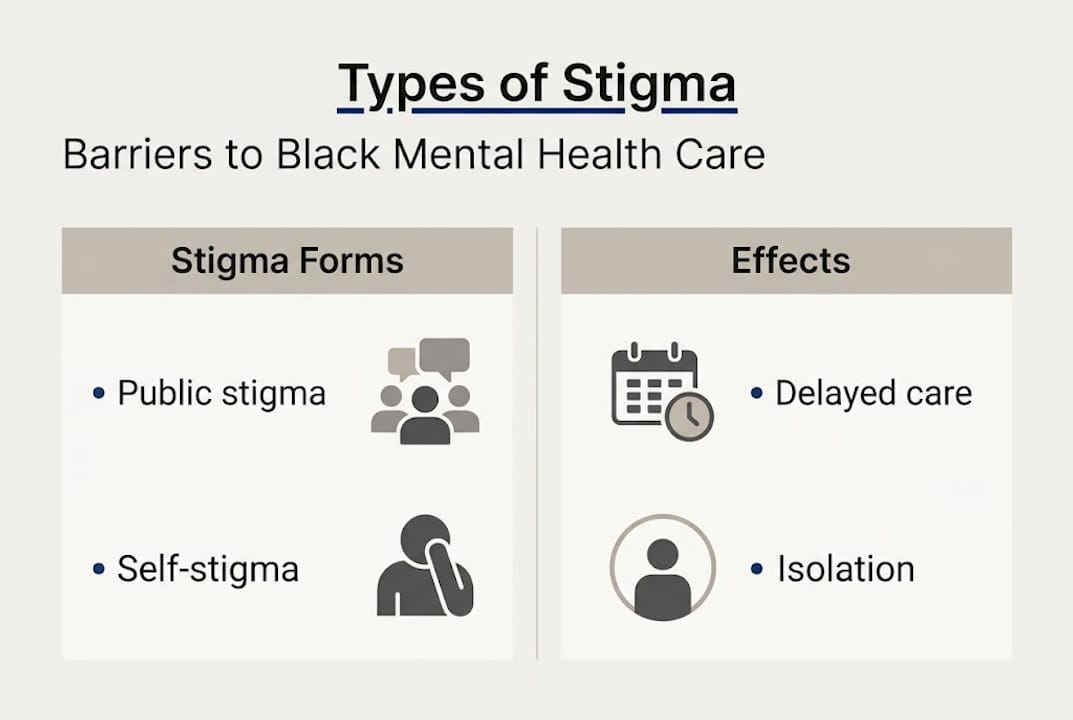
In Black communities, these forces carry extra weight. Historical trauma, including centuries of medical mistreatment and systemic racism, has created deep and justified distrust of healthcare institutions. Combine that with cultural expectations of strength and self-reliance, and you get a powerful set of barriers to help-seeking that go far beyond simple attitude problems.
Here is how the three types of stigma compare across groups:
| Type of stigma | Impact on Black communities | Impact on other groups |
|---|---|---|
| Public stigma | Amplified by cultural silence and strength norms | Present but less compounded by historical trauma |
| Self-stigma | Reinforced by “strong Black” identity expectations | Varies widely by culture and gender |
| Structural stigma | Magnified by systemic racism and under-resourced care | Exists but less intersected with racial discrimination |
The practical effects are serious. Stigma leads to:
- Delayed or avoided treatment, even during crisis
- Shame that prevents honest conversations with family
- Misdiagnosis because providers lack cultural competence
- Increased suicide risk for Black men, who are especially likely to avoid care
Only 39% of Black adults with a mental illness receive any care at all. That number should stop you cold. It means the majority of people who need help are not getting it, and stigma is one of the biggest reasons why.
Who is most affected? Education, ethnicity, faith, and intersectionality
You might assume that higher education reduces stigma and increases help-seeking. The data says otherwise. Young, educated Black adults are actually less likely to seek mental health services than their less-educated peers. One reason is that achievement pressure creates a stronger need to appear capable and in control. Asking for help feels like admitting weakness, and that feeling is more intense when you have worked hard to prove yourself in spaces that were not built for you.
Ethnicity within Black communities also matters. Nigerian youth, for example, tend to carry different cultural frameworks around mental illness than African American elders. What counts as distress, who is trusted to address it, and whether professional care is even considered a valid option all vary by cultural background. This means that a single, one-size approach to reducing stigma will not work across the full diversity of Black and African American communities.
Faith is another major factor, and it cuts both ways. Religious involvement is linked to lower depressive symptoms and provides genuine community support. But it can also delay professional care when spiritual explanations replace clinical ones. When depression is framed purely as a spiritual failing or a test from God, people may pray instead of calling a therapist, sometimes until a crisis forces their hand.
Consider these key patterns across subgroups:
- Black women face both racial and gender-based stigma, often expected to carry family burdens silently
- Black men are socialized to suppress emotional expression, raising their risk of untreated trauma
- Black LGBTQ+ individuals face compounded stigma from multiple directions
- Older Black adults may view mental health services as culturally foreign or unnecessary
“The intersection of race, gender, and faith does not just add up, it multiplies the weight that individuals carry.”
For families navigating these layers, culturally centered healing approaches that honor both cultural identity and clinical expertise make a real difference. Knowing where to find mental health resources that speak to your specific experience is a critical first step. If you are in the Charlotte area, connecting with Black therapists in Charlotte who understand these nuances can change everything.
How does stigma impact seeking and receiving mental health care?
Stigma does not just shape attitudes. It changes behavior in measurable, sometimes devastating ways. Here is how it typically shows up in real life:
- Avoidance: People delay or skip appointments because they fear being judged or labeled.
- Minimizing: Individuals downplay symptoms to family and providers to avoid appearing weak.
- Dropout: Even when people start treatment, stigma-related shame causes them to stop before completing it.
- Silence: Family members avoid discussing mental health, leaving struggling loved ones isolated.
- Self-medication: Without access to care, some turn to substances or other coping mechanisms that worsen outcomes.
The consequences are not abstract. Stigma perpetuates disparities and delays intervention, directly increasing suicide and trauma risks across Black communities. When depression goes untreated for months or years, it deepens. When anxiety is never addressed, it can escalate into crisis.
The numbers on youth are especially alarming. An estimated 58% of Black youth with depression remain untreated. That means more than half of Black children and teenagers who are struggling never receive professional support. The long-term consequences include academic failure, relationship problems, and higher risk of adult mental illness.

Understanding the barriers and support for Black men is essential because men in particular tend to show up in crisis rather than early in their distress. And crisis care is more expensive, more traumatic, and less effective than early intervention. Learning what impactful mental health counseling actually looks like can help people recognize that getting support is a sign of strength, not weakness.
Pro Tip: If someone in your family is resistant to therapy, start with a single educational conversation rather than pushing for an appointment. Reducing stigma at home often opens the door to professional care.
Evidence-based strategies for reducing stigma and improving access
The good news is that stigma can be reduced. Research points to several strategies that actually work, especially when they are designed with Black communities in mind rather than adapted from approaches built for other populations.
Culturally tailored psychoeducation is one of the most powerful tools available. In structured programs designed for Black adults, stigma scores dropped from an average of 62.4 to 48.9 after culturally adapted psychoeducation. That is a significant shift, and it happened because the content spoke directly to participants’ lived experiences rather than using generic mental health language.
Community engagement and faith partnerships are equally important. When churches, barbershops, and community centers become spaces where mental health is discussed openly, stigma loses its power. Pastors who frame therapy as a complement to faith rather than a replacement for it can shift entire congregations. Co-produced community interventions and structural change are key to making these gains last.
Here are the core strategies with the strongest evidence:
- Culturally centered psychoeducation that uses familiar language, stories, and examples
- Peer support programs that feature Black individuals sharing their own recovery stories
- Integrated behavioral health in primary care settings, so mental health feels like a normal part of healthcare
- Increasing the number of Black mental health providers to reduce cultural mismatch
- Policy advocacy to address structural stigma in healthcare funding and access
For families looking for practical next steps, exploring mental health counseling solutions and therapy resources designed for Black communities is a strong starting point.
Pro Tip: Combining faith community involvement with professional therapy produces better long-term outcomes than either approach alone. You do not have to choose between your faith and your mental health.
Breaking the cycle: What most guides miss about stigma and resilience
Most articles about Black mental health stigma focus on education as the solution. Teach people what mental illness is, reduce shame, and they will seek help. That logic is incomplete.
Education matters, but it is not enough on its own. We have seen too many communities receive information without structural support, and nothing changes. Reducing stigma requires changing systems, not just minds. That means funding Black-led mental health organizations, reforming insurance policies that limit therapy access, and training providers in cultural humility, not just cultural competence.
There is also a real danger in over-spiritualizing mental health. Faith is a genuine source of resilience, and we respect that deeply. But when spiritual frameworks are used to avoid professional care entirely, people suffer. As critiques of over-spiritualizing make clear, integrating faith with professional care produces better outcomes than treating them as opposites.
Resilience in Black communities is real and remarkable. But resilience is not the same as not needing help. True healing comes from combining the strength of community and faith with the tools of culturally centered healing that professional care provides. That integration is what lasting change actually looks like.
Get support and take action
Understanding stigma is the first step. Taking action is the next one. At Mastering Conflict, we offer clinical mental health services specifically designed for Black individuals, couples, and families who are ready to move from awareness to healing.
For women leaders carrying the weight of professional and personal demands, our burnout recovery coaching program provides targeted support that honors both your strength and your limits. If location or schedule is a barrier, our online teletherapy options make it possible to connect with a culturally responsive clinician from anywhere. You deserve care that sees all of you.
Frequently asked questions
Why do so few Black adults seek mental health treatment?
Barriers include public and self-stigma, deep distrust of healthcare systems rooted in historical mistreatment, and a shortage of culturally responsive services. Only 39% of Black adults with mental illness receive treatment.
How does religious faith impact mental health stigma?
Faith provides real protection against depression and offers community support, but it can delay professional care when mental health struggles are framed as purely spiritual issues. Religious involvement works best when paired with professional therapy rather than used as a substitute.
What proven strategies help reduce stigma in Black communities?
Culturally tailored psychoeducation, integrated behavioral health care, and faith-based community partnerships are among the most effective approaches. Psychoeducation programs have shown measurable reductions in stigma scores in Black adult populations.
Does mental health stigma affect Black youth differently than adults?
Yes. Black youth face compounded barriers including higher stigma, limited access to culturally competent providers, and family silence around mental health. 58% of Black youth with depression remain untreated, making early intervention especially critical.
Recommended
- Black male mental health: addressing barriers and support – Mastering Conflict
- Best Black mental health resources for anger and counseling – Mastering Conflict
- Men’s Mental Health Issues – Key Risks and Solutions – Mastering Conflict
- Communication Barriers: Everything You Need to Know – Mastering Conflict
- Why Naming Your Feelings Helps — The Caia Journal