
Managing anger in parenting: 5 strategies that work

TL;DR:
- Managing parental anger involves understanding triggers, practicing self-awareness, and using evidence-based techniques.
- Modeling emotional regulation and showing self-compassion are essential for positive parent-child relationships.
- Professional support and structured therapies like PCIT can help parents handle recurring conflict and stress.
Parenting is one of the most rewarding things you can do, and also one of the fastest routes to losing your cool. When a toddler throws a full-scale meltdown in the grocery store or a teenager slams a door and shouts “I hate you,” the anger that rises up can feel overwhelming and instant. Unchecked, that anger chips away at trust, communication, and your child’s emotional development. The good news is that evidence-based strategies can help you recognize what’s happening inside you, interrupt the cycle, and respond in ways that actually strengthen your family rather than fracture it.
Table of Contents
- Understanding anger triggers in parenting
- Preparing to respond: Tools and strategies every parent should know
- Addressing conflict: Parent-child interaction techniques
- Modeling emotional regulation and self-control
- Our perspective: What most guides miss about anger in parenting
- Next steps: Support and clinical options for parents
- Frequently asked questions
Key Takeaways
| Point | Details |
|---|---|
| Identify anger triggers | Recognizing your personal anger triggers is crucial for avoiding escalation and improving responses with your children. |
| Use evidence-based techniques | Cognitive restructuring, positive reinforcement, and problem-solving help parents manage anger effectively. |
| Try Parent-Child Interaction Therapy | PCIT offers structured phases to improve parent-child relations, reduce stress, and manage disruptive behavior. |
| Model emotional regulation | Authoritative parenting and emotional self-control teach children resilience and reduce family conflict. |
| Seek specialized support when needed | Clinical services and teletherapy options are available for parents struggling with recurrent anger or family conflict. |
Understanding anger triggers in parenting
Before you can manage anger, you have to know what sets it off. Most parents share a surprisingly short list of core triggers, even though every family looks different on the surface.
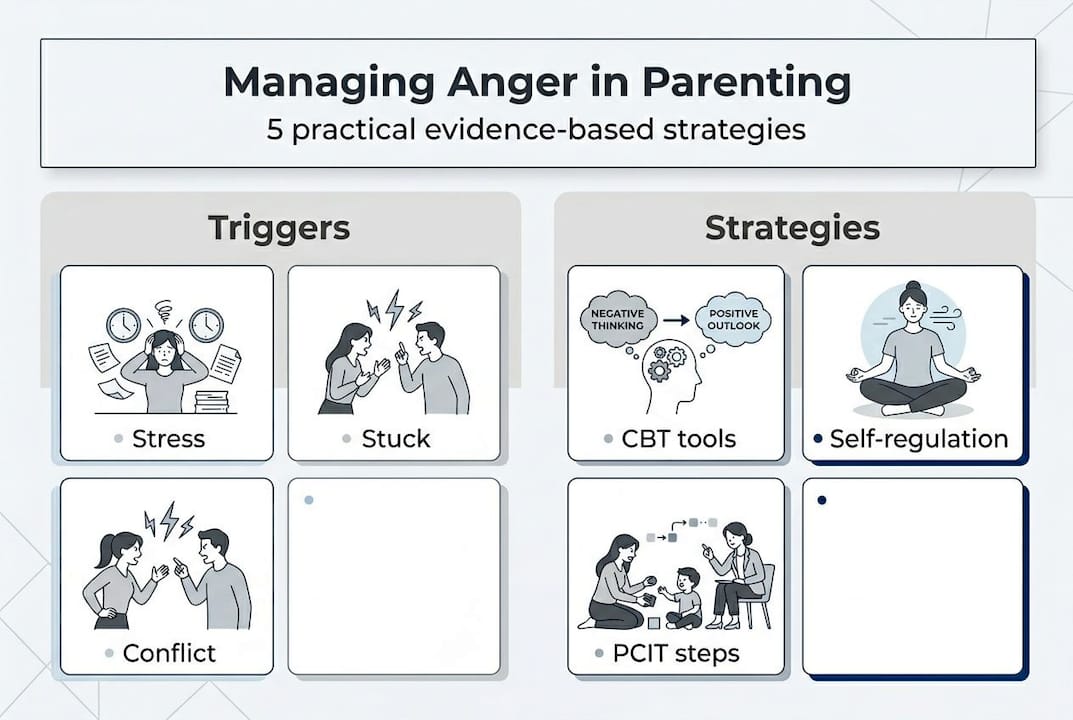
Common parenting anger triggers include:
- Defiance and repeated non-compliance (“I told you three times!”)
- Tantrums, whining, or crying that won’t stop
- Sibling fighting that pulls you in as referee
- Feeling disrespected or ignored by a teenager
- Exhaustion, work stress, or financial pressure bleeding into home life
- Feeling like nothing you try is working
The tricky part is that triggers are rarely just about the child’s behavior. Your own personality traits play a significant role. Trait anger in fathers increases negative infant appraisals and anger intensity when exposed to infant crying, which means a parent’s baseline temperament can amplify an already stressful moment. This is not a character flaw. It is biology and psychology working together in a high-pressure environment.
Stress from outside the home piles on top of in-the-moment frustration. A rough day at work, a fight with your partner, or even poor sleep can lower your anger threshold dramatically. You may snap at your child for something that would not have bothered you at all on a better day. Recognizing this pattern is the first step toward breaking it.
Anger escalation often follows a predictable arc: a trigger fires, physical tension builds (tight chest, clenched jaw, raised voice), and then the response happens before rational thinking catches up. Learning to spot the early physical signs gives you a window to intervene before things spiral. Exploring anger management techniques designed specifically for parents can help you map your personal escalation pattern and interrupt it earlier.
Pro Tip: Keep a simple “trigger log” for one week. Write down what happened, what you felt in your body, and how you responded. Patterns will emerge quickly, and patterns are manageable.
If you have a teenager at home, the triggers often shift from physical chaos to emotional conflict. Understanding parent support for teen anger can help you navigate the unique push-pull dynamic of adolescence without letting your own anger run the show.
Preparing to respond: Tools and strategies every parent should know
Knowing your triggers is preparation. What comes next is building a toolkit you can actually use in the heat of the moment.
The most well-researched approach for parental anger is cognitive-behavioral therapy, or CBT. CBT reduces parental anger escalation through cognitive restructuring, positive reinforcement, and problem-solving skills. In plain terms, that means learning to catch distorted thoughts (“My child is doing this on purpose to ruin my day”), replace them with realistic ones (“My child is overwhelmed and doesn’t have the skills yet”), and then choose a deliberate response.

Comparing key anger management approaches for parents:
| Approach | Core mechanism | Best for | Time to results |
|---|---|---|---|
| Cognitive-behavioral (CBT) | Thought restructuring and behavior change | Recurring anger patterns | 6 to 12 weeks |
| Mindfulness-based | Present-moment awareness, breath work | Reactivity and stress | 4 to 8 weeks |
| Problem-solving skills | Structured conflict resolution steps | Specific recurring conflicts | Immediate to 4 weeks |
| Positive reinforcement | Rewarding desired child behaviors | Defiance and non-compliance | 2 to 6 weeks |
Here is a step-by-step process you can start using today:
- Pause before responding. Take one slow breath before you say anything. This is not weakness. It is a neurological reset.
- Name what you feel. Silently say to yourself, “I am angry right now.” Labeling an emotion reduces its intensity.
- Challenge the story. Ask, “Is my interpretation of this situation accurate, or am I catastrophizing?”
- Choose your response. Pick a behavior that matches your values as a parent, not the intensity of your emotion.
- Repair if needed. If you did lose your temper, come back later and acknowledge it. Repair is part of the process.
For a broader look at what the research supports, proven anger management strategies offer a solid evidence base for each of these steps. You can also layer in mindfulness practices for anger to build the pause reflex over time, and anger management exercises that have strong clinical outcomes.
Addressing conflict: Parent-child interaction techniques
Sometimes general strategies are not enough, especially when conflict with your child is frequent, intense, or tied to diagnosable behavioral challenges. That is where structured clinical approaches come in.
Parent-Child Interaction Therapy (PCIT) is one of the most rigorously studied interventions available. It works in two phases. The Child-Directed Interaction (CDI) phase teaches parents to follow the child’s lead, using praise, reflection, and warmth to build the relationship. The Parent-Directed Interaction (PDI) phase introduces consistent, calm discipline techniques. Together, these phases reduce parental stress and manage disruptive child behaviors, particularly for children ages 2 to 7.
PCIT compared to other structured approaches:
| Technique | Age range | Primary focus | Parental role |
|---|---|---|---|
| PCIT | 2 to 7 years | Relationship and behavior | Active, coached in session |
| Triple P (Positive Parenting) | 0 to 16 years | Behavior and parenting skills | Self-directed or group |
| Incredible Years | 2 to 12 years | Social skills and behavior | Group-based training |
| Family therapy | All ages | Systemic family dynamics | Collaborative |
Practical tips when using clinical approaches:
- Be consistent. Clinical techniques lose effectiveness when applied only some of the time.
- Practice outside of conflict. Role-play calm interactions so the skills feel natural when things get heated.
- Track small wins. Progress in parent-child dynamics is often gradual. Noticing small improvements keeps you motivated.
- Involve your co-parent. Consistency across caregivers dramatically improves outcomes.
Pro Tip: If your child resists the shift in your parenting style at first, that is normal. Children test new patterns. Hold steady for at least two weeks before evaluating whether an approach is working.
For younger children, anger management activities for kids can complement clinical work by giving children their own tools. Building emotional regulation tools into daily routines also supports the work you are doing in sessions. And when you are ready to look at the bigger picture of family dynamics, parenting conflict resolution steps offer a structured path forward.
Modeling emotional regulation and self-control
Here is something most parents underestimate: your child is watching how you handle your own anger far more than they are listening to what you say about it. Modeling emotional regulation is not just a nice idea. It is one of the most powerful parenting tools you have.
Authoritative parenting promotes self-control and emotional management in children, and it mediates reduced externalizing behaviors. Authoritarian styles, by contrast, tend to increase them. The difference is not about being permissive. Authoritative parenting still has clear expectations and consequences. It just delivers them with warmth and explanation rather than fear and control.
Steps to model emotional regulation at home:
- Narrate your own process out loud. “I’m feeling frustrated right now, so I’m going to take a minute before I respond.”
- Apologize when you get it wrong. Children learn that repair is possible when they see you do it.
- Celebrate emotional effort, not just behavior. “I noticed you took a breath before answering. That was really mature.”
- Create a calm-down space for the whole family, not just the kids.
Signs your modeling is working:
- Your child starts naming their emotions instead of acting them out
- Conflict de-escalates faster than it used to
- Your teenager comes to you rather than shutting you out
- You notice yourself catching anger earlier in the cycle
“Agreeable fathers show greater responsiveness to anger-prone infants, while maternal distress reduces responsiveness, especially toward those same infants.”
This finding matters because it tells us that your emotional state is not neutral. It shapes how your child experiences you, and ultimately how they learn to experience themselves. Understanding the emotional regulation impact on relationships can help you see why this work extends far beyond parenting. And if anger is affecting your relationship with your partner as well, controlling anger in relationships offers targeted strategies for that context too.
Our perspective: What most guides miss about anger in parenting
Most anger management guides for parents are heavy on technique and light on something equally important: self-compassion. We have worked with enough families to know that the parents who struggle most are often the ones holding themselves to an impossible standard. They believe that good parents do not get angry, so every moment of anger becomes evidence of failure.
That shame loop is more damaging than the anger itself.
What actually works is flexibility paired with accountability. Parents who adapt strategies to their real life, rather than following a rigid script, see better long-term results. They also model something invaluable for their children: that imperfection is survivable and growth is always possible.
Evidence-based anger management is not about becoming a different person. It is about building a slightly larger gap between what you feel and what you do. That gap is where your best parenting lives.
Next steps: Support and clinical options for parents
If you have tried the strategies in this guide and still find yourself overwhelmed by anger, that is not a sign of failure. It is a sign that you may need more personalized support, and that support is available.

At Mastering Conflict, we offer specialized clinical services for parents dealing with recurring anger, family conflict, and the stress that comes with raising children at any stage. Our team works with individuals, couples, and families using evidence-based approaches tailored to your specific situation. If getting to an office is a barrier, our teletherapy counseling options make it easy to access professional support from home. Reach out today and take the next step toward a calmer, more connected family life.
Frequently asked questions
What is the most effective way to manage parental anger during a child’s tantrum?
Using cognitive restructuring and problem-solving skills from CBT helps parents interrupt anger escalation and respond to tantrums constructively rather than reactively.
Are certain parenting styles better for preventing anger escalation?
Authoritative parenting encourages emotional self-management in children and reduces externalizing behaviors, making it more effective than authoritarian approaches at preventing escalation.
How does Parent-Child Interaction Therapy (PCIT) help manage family conflicts?
PCIT improves parent-child relations, reduces parental stress, and addresses disruptive behaviors in children primarily between ages 2 and 7 through its structured CDI and PDI phases.
Does parent temperament impact anger response to children?
Yes. Trait anger in fathers intensifies negative responses to infant crying, and maternal distress reduces responsiveness particularly toward anger-prone children.
Recommended
- Anger Management Techniques for Parents: Building Family Resilience – Mastering Conflict
- Best Ways to Manage Anger: Proven Tips for 2025 – Mastering Conflict
- Teen Anger Management: 35% Better Outcomes With Parent Support – Mastering Conflict
- Managing anger at work: proven strategies & steps – Mastering Conflict
- How to Calm Racing Thoughts — The Caia Journal