
How family therapy empowers blended families to thrive

TL;DR:
- Blended families face unique challenges with loyalty conflicts and role confusion.
- Therapy approaches like Structural Family Therapy and Bowen Family Systems are effective.
- Long-term commitment and cooperation are essential for lasting positive change.
Blended families in North Carolina, South Carolina, and Florida are reshaping what it means to be a family, but the journey is rarely smooth. Merging households, navigating stepparent roles, and managing loyalty conflicts can push even the most committed families to their limits. Children in stepfamilies experience higher rates of emotional and behavioral difficulty than those in first-marriage households, yet many families try to push through without professional support. This guide breaks down the specific therapy methods that work for blended families, what the process actually looks like, and the practical steps you can take to build something lasting.
Table of Contents
- Why blended families face unique relationship challenges
- Core family therapy approaches for blended families
- What to expect from the therapy process
- Maximizing success: Evidence-based strategies for blended families
- What most guides miss: Therapy is a long-term partnership
- Find support for your blended family journey
- Frequently asked questions
Key Takeaways
| Point | Details |
|---|---|
| Specialized therapy is critical | Blended families benefit most from approaches tailored to their unique relationship dynamics. |
| Success takes patience | Achieving unity in blended families often requires years, not quick fixes. |
| Unified parenting matters | Clear, consistent parenting and couple alignment significantly improve outcomes. |
| Evidence supports family therapy | Systemic therapy methods are proven to reduce child difficulties and improve family harmony. |
Why blended families face unique relationship challenges
Blended families are not simply two families pressed together. They are a completely new system with its own rules, loyalties, and growing pains. Understanding why these families struggle is the first step toward changing the pattern.
One of the most overlooked stressors is the pressure on stepparents to immediately act like a parent. Children who already have a biological parent in another household often resist this, not out of defiance, but out of loyalty. Loyalty conflicts and triangulation are among the most common and emotionally charged issues families bring into therapy. When a child feels they must choose sides, everyone loses.
Role confusion is another major driver of tension. Who disciplines the kids? Who makes school decisions? When these boundaries are unclear, small disagreements can escalate quickly. Add in co-parenting across two households, and you have a system with multiple competing authority figures, communication styles, and expectations.
Research confirms that challenges in stepfamilies are measurably higher than in first-marriage families, but parental esteem acts as a significant buffer. When parents feel confident in their role and supported by their partner, children adjust better. This is why therapy that focuses on the couple’s relationship, not just the children, tends to produce stronger outcomes.
You can also explore navigating family conflict for additional context on how conflict patterns form and shift within family systems.
Here are the most common challenges blended families report:
- Stepchild resistance to the stepparent’s authority
- Loyalty conflicts between biological and stepparents
- Sibling and stepsibbling rivalry over space, attention, and resources
- Inconsistent discipline across two households
- Grief and loss tied to the original family structure
- Financial stress related to child support or split expenses
- Communication breakdowns between co-parents
“The first year in a blended family is often about survival, not structure. Expecting instant bonding or immediate authority is one of the fastest ways to create lasting resentment.”
Recognizing these patterns early gives families a real advantage. Therapy works best when families come in before the cracks become fractures.
Core family therapy approaches for blended families
Not every therapy model fits every family. Blended families have specific needs that require specific tools. Fortunately, several evidence-based approaches have proven effective for exactly these situations.
Primary methodologies used with blended families include Structural Family Therapy, Bowen Family Systems, Narrative Therapy, Solution-Focused Brief Therapy, and Emotionally Focused Family Therapy. Each takes a different angle on the same core problem: how do we help this family function as a unit?
Here is a quick comparison to help you understand how they differ:
| Therapy model | Core focus | Best for | Key strength |
|---|---|---|---|
| Structural Family Therapy (SFT) | Family roles and boundaries | Role confusion, authority issues | Reorganizes hierarchy clearly |
| Bowen Family Systems | Multigenerational patterns | Deep-rooted loyalty conflicts | Reveals invisible family scripts |
| Narrative Therapy | Rewriting family stories | Shame, blame, identity struggles | Separates people from problems |
| Solution-Focused Brief Therapy (SFBT) | Present goals, quick wins | Families needing fast traction | Builds momentum early |
| Emotionally Focused Family Therapy (EFFT) | Attachment and emotional bonds | Stepparent-child bonding | Deepens emotional connection |
Structural Family Therapy is often the starting point for blended families because it directly addresses the confusion around who holds authority and how subgroups within the family relate to each other. Bowen Family Systems adds depth by exploring how patterns from previous relationships or families of origin are being replicated in the new household.

Narrative Therapy is especially powerful when family members have developed fixed, negative stories about each other. It helps everyone see that the problem is the problem, not the person. This can be transformative for stepchildren who feel like outsiders.
Understanding the couples therapy benefits alongside family work is important because the couple’s relationship is the foundation of the blended family. You can also explore family therapy tools and reach out for family counseling support if you are ready to take the next step.
Pro Tip: Most therapists working with blended families do not stick to a single model. They pull from multiple frameworks based on what the family needs at each stage. Ask your therapist which models they integrate and why.
What to expect from the therapy process
Many families walk into therapy expecting fast results. The reality is more nuanced, but also more rewarding when you understand the journey ahead.
The therapy process typically unfolds in stages, each with its own purpose and expected outcomes. Here is what that progression generally looks like:
- Assessment: The therapist gathers information about each family member’s history, relationships, and current stressors.
- Family mapping: A visual or conceptual picture of the family system is created, showing alliances, tensions, and boundaries.
- Goal-setting: The family collaborates with the therapist to identify specific, measurable outcomes.
- Subgroup sessions: Couples, siblings, or stepparent-child pairs meet separately to work on targeted issues.
- Whole-family sessions: The full family unit practices new communication patterns and resolves conflicts together.
- Skill-building: Communication tools, conflict resolution techniques, and role clarity are reinforced.
- Integration and review: Progress is assessed and the therapy plan is adjusted as the family grows.
The stepparent role should shift gradually from supportive and relationship-building in year one to a more active parenting presence in later years. Trying to fast-track this transition is one of the most common mistakes families make.
Here is a general timeline of what to expect:
| Stage | Timeframe | Key milestones |
|---|---|---|
| Early phase | Months 1 to 3 | Trust established, goals set, patterns identified |
| Middle phase | Months 4 to 12 | Subgroup work, communication improvements, role clarity |
| Integration phase | Year 2 and beyond | Unified parenting, stronger bonds, reduced conflict |
Exploring family therapy benefits can help you set realistic expectations before your first session. If sibling dynamics are a major concern, sibling rivalry strategies offers targeted guidance.
Maximizing success: Evidence-based strategies for blended families
Therapy is most effective when families actively apply what they learn between sessions. Here are the strategies that research and clinical experience consistently point to as most impactful.
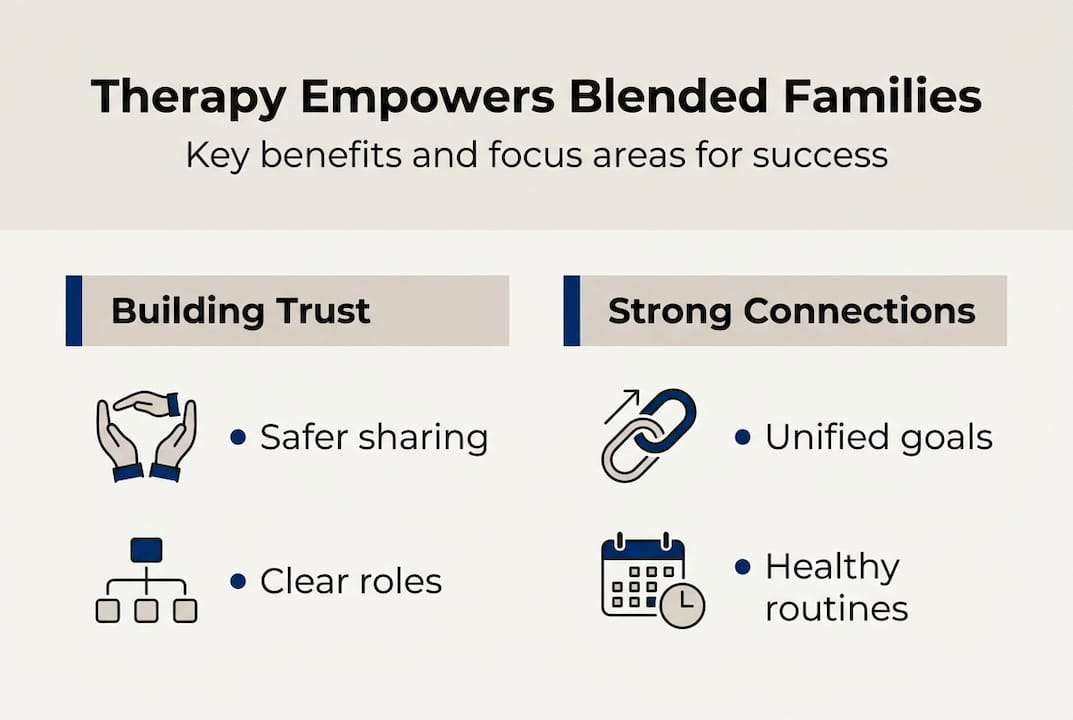
Systemic family therapy is most effective when paired with high parental esteem and a unified parenting approach. When both partners are aligned on values, rules, and discipline, children feel more secure and less likely to exploit inconsistencies.
Evidence also shows that therapy success rates reach up to 64% improvement over no treatment when families commit to the process. That is a significant number, and it reflects what happens when families show up consistently and apply what they learn.
Here are the top strategies to maximize your results:
- Build a unified parenting plan. Both partners agree on rules, consequences, and expectations. This removes the gap children often exploit between households.
- Prioritize the couple relationship. A strong partnership between the adults is the single most stabilizing force in a blended family. Date nights are not optional, they are strategic.
- Establish clear communication routines. Weekly family check-ins, even brief ones, create a culture of openness and reduce the buildup of unresolved tension.
- Respect loyalty binds. Never ask a child to choose between parents. Acknowledge that loving a stepparent does not mean betraying a biological one.
- Reduce open conflict in front of children. Disagreements between co-parents should be handled privately. Children who witness repeated conflict show higher rates of anxiety and behavioral problems.
For practical tools on aligning your parenting approach, co-parenting strategies offers a strong foundation. You can also review conflict resolution steps and explore how teletherapy outcomes compare to in-person sessions if flexibility is a concern.
Pro Tip: Keep a simple journal between sessions noting what worked, what did not, and what questions came up. Sharing this with your therapist keeps the work focused and prevents sessions from drifting into unproductive territory.
What most guides miss: Therapy is a long-term partnership
Most articles about blended family therapy focus on techniques and timelines. What they rarely say out loud is this: real change in a blended family takes years, not weeks, and setbacks are not failures. They are data.
Blended families evolve. A strategy that works when a stepchild is nine may fall apart at fourteen. Success in blended family therapy requires a long-term view and a strong couple alliance that can flex as the family changes. Therapists who understand this do not just hand you a communication script. They partner with you through each developmental stage.
We have seen families come in after years of trying to force unity and leave with something more honest: a realistic, workable relationship built on mutual respect rather than forced closeness. That is often better than the idealized blended family image many couples carry into the process.
Patience and flexibility are not soft skills here. They are clinical necessities. If you are parenting through divorce or navigating a new household merger, give yourself permission to take the long road. It is the one that actually leads somewhere.
Find support for your blended family journey
If you have read this far, you already know that blended family life requires more than goodwill. It requires strategy, support, and someone who understands the specific terrain you are navigating.
At Mastering Conflict, we specialize in helping blended families in North Carolina, South Carolina, and Florida build the kind of relationships that hold up under real pressure. Whether you are looking for clinical services tailored to your family’s needs, curious about how coaching vs therapy might fit your situation, or a practitioner seeking clinical supervision in this area, we have structured pathways for each. Reach out today and take the first step toward a family system that actually works.
Frequently asked questions
What therapy approach works best for blended families?
Systemic family therapy and structured models like Structural Family Therapy and Bowen Family Systems are widely recommended because they address the unique role, boundary, and loyalty dynamics that define blended family life.
How long does blended family therapy take to show results?
Changes in communication and conflict patterns may appear within a few months, but stepparent integration and unified parenting typically develop over years as trust and new roles are established gradually.
Can family therapy help with co-parenting issues across households?
Yes. Co-parenting across households is a central focus in blended family therapy, helping families set boundaries, align on discipline, and reduce the conflict children experience when moving between homes.
Are therapy outcomes for blended families effective?
Research shows therapy improves outcomes significantly, with success rates up to 64% better than no treatment and measurable reductions in child behavioral difficulties across multiple studies.
Recommended
- Top Couples Therapy Benefits for Families in 2025 – Mastering Conflict
- Family Counseling Benefits: Support, Healing, and Connection 2025 – Mastering Conflict
- Best Family Therapy Services for Couples – Expert Comparison 2025 – Mastering Conflict
- Navigating Family Conflict for Positive Relationships – Mastering Conflict
- Relationship therapy explained: proven methods for couples