
Confidentiality in online therapy: what every client should know

TL;DR:
- Online therapy confidentiality depends on secure platforms, encryption, and informed client participation.
- Risks include platform breaches, human errors, and insecure practices by clients.
- Transparency, education, and proactive measures build trust despite no absolute confidentiality guarantee.
Online therapy has made mental health care more accessible than ever, but a quiet concern follows many clients into their first virtual session: is this actually private? The answer is more layered than a simple yes or no. Telehealth privacy breaches have risen sharply over the past five years, with digital platforms accounting for the vast majority of reported incidents. For individuals carrying sensitive personal struggles, and for couples navigating conflict together, understanding exactly what protects your sessions, and what does not, is not just helpful. It is essential.
Table of Contents
- What does confidentiality mean in online therapy?
- How online therapy protects your privacy: Technology, legal, and platform standards
- Real-world risks and special cases: Where online confidentiality can break down
- What clients and therapists should do: Practical steps for strong confidentiality
- A reality check: Why confidentiality is never absolute (and what actually builds trust)
- Get support you can trust: Explore secure teletherapy options
- Frequently asked questions
Key Takeaways
| Point | Details |
|---|---|
| Online therapy can be secure | With proper platforms and consent, online therapy protects your confidentiality. |
| Be aware of your environment | Using private devices and networks helps reduce confidentiality risks in virtual therapy. |
| Consent and transparency are key | Always discuss privacy boundaries and obtain clear informed consent in online sessions. |
| No system is perfect | Stay proactive and informed—both clients and therapists share responsibility for privacy. |
What does confidentiality mean in online therapy?
Confidentiality in therapy means your therapist is legally and ethically bound to keep what you share private. In a traditional office, that means locked files and soundproofed walls. In an online setting, it means encrypted data, secure platforms, and careful handling of digital records. The concept is the same. The risks, however, look very different.
When you connect with a therapist over video, your words travel through servers, apps, and internet connections before they reach another person. Each step in that chain is a potential vulnerability. That is not a reason to avoid online therapy. It is a reason to understand it.
Confidentiality in online therapy covers:
- Session content: what you say, share, or disclose during appointments
- Clinical notes: written records your therapist keeps about your care
- Intake forms and assessments: personal history and mental health information
- Billing records: diagnosis codes and payment details
- Communications: emails, messages, and voicemails exchanged with your provider
What is not automatically confidential includes information shared on non-secure platforms, anything disclosed in a group setting without explicit agreements, and certain legally mandated disclosures such as imminent danger to self or others.
“Confidentiality is the foundation of the therapeutic relationship. When clients fear their disclosures will be exposed, they share less, heal less, and sometimes stop seeking care entirely.”
This is not a small concern. Therapy leaks deter future care, creating a chilling effect that keeps people from getting help they need. Mental health stigma already creates barriers. A breach can make those barriers feel permanent.
Understanding the confidentiality basics in counseling helps you know what questions to ask before your first session. Informed clients are better protected clients.
How online therapy protects your privacy: Technology, legal, and platform standards
The good news is that strong protections exist. The challenge is knowing which platforms and therapists actually use them.
The most important legal framework is HIPAA, the Health Insurance Portability and Accountability Act. HIPAA requires that any provider handling your health information use specific technical and administrative safeguards. For online therapy, HIPAA-compliant platforms must include end-to-end encryption, multifactor authentication, and a signed Business Associate Agreement, known as a BAA, with any third-party vendor.
Here is a quick comparison of what separates compliant from non-compliant platforms:
| Feature | HIPAA-compliant platform | Non-compliant platform |
|---|---|---|
| End-to-end encryption | Yes | Often absent |
| Business Associate Agreement | Required | Not required |
| Multifactor authentication | Standard | Optional or missing |
| Audit trails | Maintained | Rarely tracked |
| Data storage location | U.S.-based, secured | May be offshore or unclear |
| Session recording policy | Explicit consent required | May record by default |
Beyond HIPAA, the 2024 APA Guidelines emphasize that therapists must use secure platforms, obtain dual informed consent (meaning consent both for treatment and for the specific technology being used), and be transparent about how data is stored and who can access it.
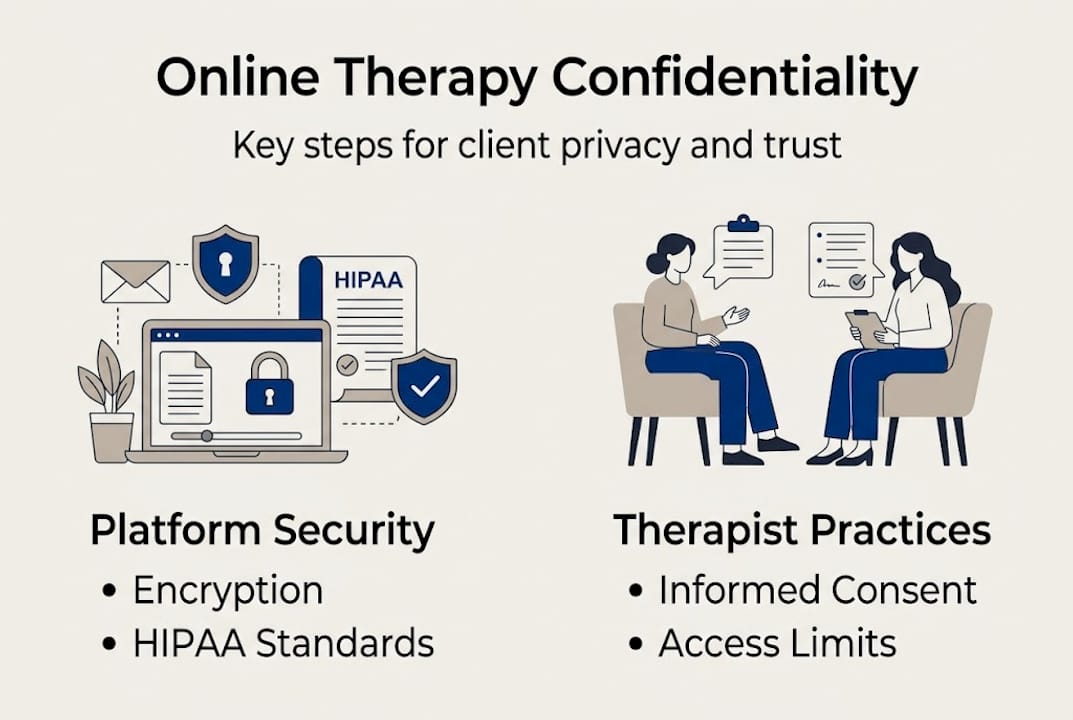
Role-based access is another layer worth understanding. In a well-run telehealth practice, only your direct care team can view your records. Audit trails log every time someone opens your file, creating accountability.
Pro Tip: Before your first session, ask your therapist two direct questions: “What platform do you use, and is it HIPAA-compliant?” and “Can I see your privacy policy?” A therapist committed to teletherapy best practices will answer both without hesitation.
For clients wondering whether virtual care can actually fit their lives, understanding how teletherapy fits busy lives is a great starting point alongside these privacy considerations.
Real-world risks and special cases: Where online confidentiality can break down
Even the most secure platform cannot protect you from risks on your end of the connection. This is where most real-world breaches actually happen.
Common patient-side vulnerabilities include using a shared household device where session history or browser data auto-saves, connecting from public Wi-Fi at a coffee shop or library, using a non-HIPAA app because it was more convenient, and joining sessions in a room where others can overhear.

Here is a breakdown of where risks tend to originate:
| Risk type | Example | Who is responsible |
|---|---|---|
| Shared device | Family member finds session history | Client |
| Public Wi-Fi | Unencrypted connection at café | Client |
| Wrong app | Using standard Zoom instead of secure version | Client or therapist |
| Platform breach | Server hack at therapy company | Platform |
| Therapist error | Sending notes to wrong email | Therapist |
| AI data handling | Chatbot stores sensitive disclosures | Platform/AI vendor |
Special cases add more complexity. In couples therapy, many therapists use a “no-secrets policy,” meaning anything one partner shares individually may be disclosed to the other. This is not a breach. It is a clinical boundary. But it must be explained clearly before sessions begin.
For teens, parental access to records creates tension between a minor’s privacy and a parent’s legal rights. Laws vary by state, and therapists must navigate this carefully.
AI-powered therapy apps are a growing concern. AI privacy mismatches research shows that many users do not realize their conversations with AI tools may be stored, analyzed, or used for training data in ways that do not meet HIPAA standards.
- Always verify whether an AI tool is covered by a BAA
- Read the terms of service before sharing anything sensitive
- Ask whether your data is used to train AI models
Pro Tip: Check the online therapy advantages of reputable platforms, which often publish their security certifications publicly. If a platform does not, that is a red flag worth taking seriously.
What clients and therapists should do: Practical steps for strong confidentiality
Knowing the risks is only useful if it leads to action. Here are concrete steps both clients and therapists should take.
For clients:
- Verify that your platform is HIPAA-compliant before your first appointment
- Use a personal device that no one else accesses for therapy sessions
- Connect using a private, password-protected Wi-Fi network
- Find a private space where you cannot be overheard, even if that means sitting in your car
- Ask your therapist to walk you through the consent process, including what data is collected and how long it is kept
- Review the platform’s privacy policy at least once
- Ask specifically how your psychotherapy notes are stored and who can access them
For therapists:
- Complete a formal risk assessment before offering telehealth services
- Separate psychotherapy notes from general medical records, as HIPAA affords them stronger protection
- Use only HIPAA-compliant platforms with signed BAAs
- Update informed consent documents to address technology-specific risks
- Participate in ongoing training on data security and telehealth regulations
- Communicate transparently with clients about any platform changes or updates
For couples and families, therapists should document the specific confidentiality agreements made with each participant. For interjurisdictional cases, meaning clients and therapists in different states, verify licensure requirements and applicable privacy laws.
Pro Tip: The Office for Civil Rights maintains a public database sometimes called the “Wall of Shame” that lists healthcare organizations with significant HIPAA breaches. Checking it before choosing a platform takes less than five minutes and can save you significant stress. You can also review teletherapy best practices and how online therapy works to build a clearer picture of what responsible providers do.
A reality check: Why confidentiality is never absolute (and what actually builds trust)
Here is something most articles on this topic will not tell you directly: no system, no platform, and no therapist can guarantee that your information will never be exposed. Technology evolves. Human error happens. New threats emerge faster than regulations can respond.
The uncomfortable truth is that chasing perfect digital security is not the goal. The goal is informed, active participation in your own care. Confidentiality concerns are real and they do keep people from seeking help. But the response to that reality should not be paralysis. It should be preparation.
What actually builds trust in a therapeutic relationship is not a flawless privacy guarantee. It is transparency. It is a therapist who explains their systems clearly, answers your questions without defensiveness, and updates you when anything changes. It is a client who asks those questions and takes responsibility for their side of the connection.
The evidence for teletherapy consistently shows that outcomes are strong when the therapeutic alliance is strong. That alliance is built on mutual honesty, not just technical compliance. Stay curious, stay involved, and treat confidentiality as an ongoing conversation rather than a one-time checkbox.
Get support you can trust: Explore secure teletherapy options
If you have been hesitant to start therapy because of privacy concerns, that hesitation makes complete sense. And it does not have to stop you. At Mastering Conflict, our secure teletherapy services are built around HIPAA-compliant platforms, transparent consent processes, and providers who take your privacy as seriously as you do.
Whether you are an individual working through personal challenges or a couple navigating conflict, our clinical services are designed to meet you where you are, securely and professionally. Not sure where to start? Our anger management assessment is a straightforward first step toward understanding your needs and connecting with the right support. Booking is simple, and your questions about confidentiality are always welcome.
Frequently asked questions
How do I know if my online therapy platform is HIPAA-compliant?
Ask your therapist directly and look for documentation of end-to-end encryption and a signed Business Associate Agreement. Most compliant platforms publish their privacy policies openly.
Can my therapist share my information with my partner in couples therapy?
Therapists often use a no-secrets policy in couples therapy, but this must be disclosed and agreed upon before sessions begin. Always ask about this boundary in your first appointment.
What steps should I take to protect my side of online therapy confidentiality?
Use a private device, connect through a secure network, and avoid shared devices or public computers where session data could be saved or accessed by others.
Are AI-powered therapy apps less secure than human therapists?
Many AI therapy tools have privacy mismatches and may not meet HIPAA standards. Always review their terms of service and ask explicitly whether your data is stored or used for AI training.
What should I do if I think my confidentiality has been breached?
Contact your therapist immediately, document everything you observed, and report the incident to the platform. If needed, file a complaint with the Office for Civil Rights, which resolved over 31,000 HIPAA cases in a single fiscal year.
Recommended
- Understanding Confidentiality in Counseling – Mastering Conflict
- Teletherapy Best Practices: Effective Online Counseling – Mastering Conflict
- Online Couples Therapy: Transforming Relationships – Mastering Conflict
- 5 real benefits of online therapy for couples in 2026 – Mastering Conflict
- Privacy & Safety — How Caia Keeps Your Conversations Private