
The 5 Stages of Conflict in the Workplace, Explained

Workplace conflict usually moves through five stages: latent, perceived, felt, manifest and aftermath. The model comes from organizational researcher Louis Pondy, and it still gives managers and employees the clearest map of how a quiet tension becomes an open fight. The earlier you recognize where a conflict sits on that map, the cheaper and calmer the fix.
This guide walks through each stage with workplace examples, the warning signs that show you which stage you are in, and what to do next. It also covers what happens when conflict turns hostile, and when to bring in outside help.
TL;DR
- Pondy’s model describes five stages: latent, perceived, felt, manifest and aftermath. Conflict is a series of episodes, not a single event.
- Most damage is avoidable at stages one to three, when the problem is still hidden, misunderstood or private.
- Manifest conflict is the visible stage: arguments, sabotage, or quieter forms like apathy and rigid rule-following.
- The aftermath decides what comes next. Real resolution can build cooperation, while suppression feeds the next round.
- Match the response to the intensity: team-building, coaching, a neutral facilitator, or formal HR involvement.
Table of Contents
- Where the five-stage model comes from
- The five stages at a glance
- Stage 1: Latent conflict
- Stage 2: Perceived conflict
- Stage 3: Felt conflict
- Stage 4: Manifest conflict
- Stage 5: Conflict aftermath
- Matching your response to the stage
- Stages, levels and types: how they differ
- Our perspective
- Support when workplace conflict follows you home
- FAQ
- Sources
Where the five-stage model comes from
In 1967, Louis R. Pondy published an article in Administrative Science Quarterly that described five sequential stages of a conflict episode: latent conflict, perceived conflict, felt conflict, manifest conflict and conflict aftermath. Business schools still teach it, and university programs on organizational conflict use it as the standard framework.
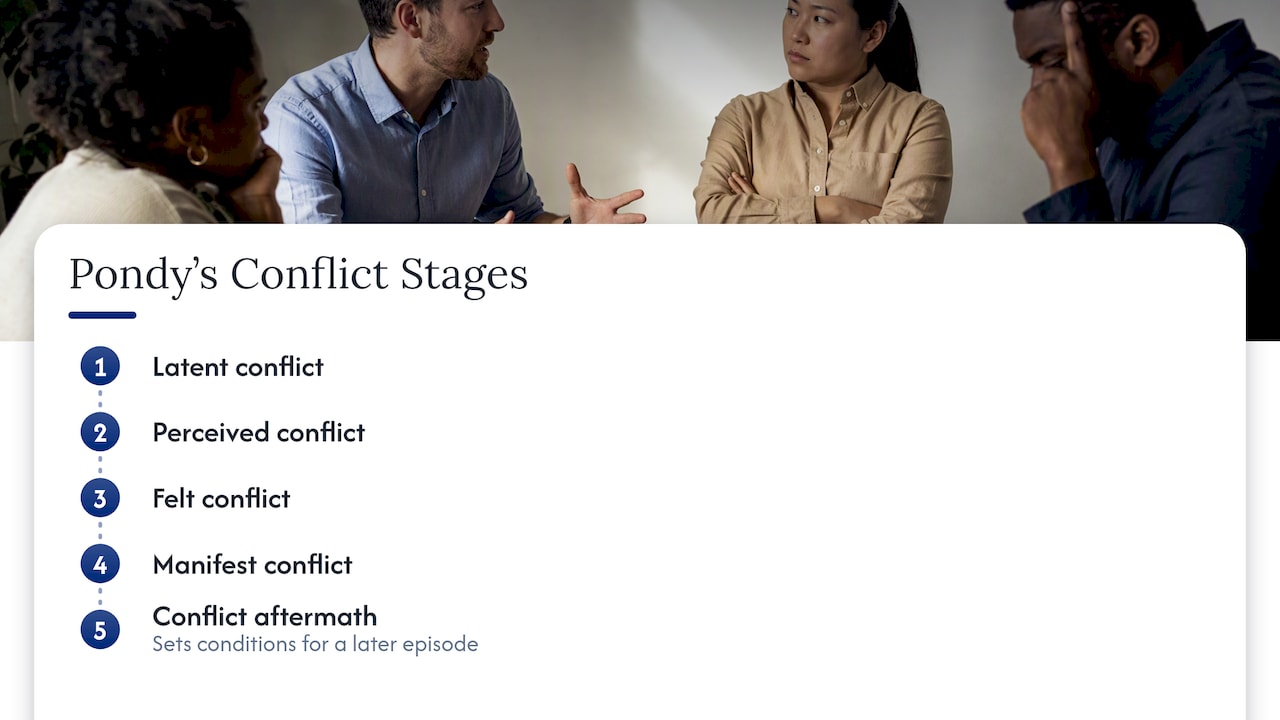
The most useful idea in the paper is easy to miss. Pondy argued that conflict in organizations should be seen as a series of episodes rather than one event. That changes how you handle it. If you treat a shouting match as the whole problem, you deal with the symptom. If you treat it as one episode in a sequence, you start looking for the conditions that produced it, and for what the aftermath will set up for next time.
Another point from the research: conflict is not proof that someone is a bad manager or a bad employee. Cromie and Lundy argued back in 1980 that conflict between workers and management is often a normal, inevitable part of organizations, rather than a sign of poor management or bad intent. The goal is not to prevent every disagreement. It is to catch each one while it is still easy to handle.
The five stages at a glance
| Stage | What is happening | What it looks like at work | Best first move |
|---|---|---|---|
| 1. Latent | Underlying conditions exist, but nobody has noticed | Two teams share a shrinking budget; an employee gets conflicting demands from two bosses | Fix the structure: clarify roles, goals and resources |
| 2. Perceived | One or more people become aware of a disagreement | A misunderstanding about who owns a task | Clarify facts and expectations in a short conversation |
| 3. Felt | The issue becomes personal; tension and anxiety appear | Dreading a coworker, rehearsing arguments at home | Coach the person, then bring the parties together |
| 4. Manifest | Behavior openly blocks the other side’s goals | Arguments, sabotage, withholding information, malicious compliance | Bring in a neutral facilitator; document |
| 5. Aftermath | The episode ends, and its legacy shapes the next one | Better cooperation, or a grudge that goes underground | Debrief, follow up, confirm the agreement holds |
Stage 1: Latent conflict
No one is arguing yet. The conditions for an argument are simply in place. Pondy condensed these underlying conditions into three main types: competition for scarce resources, drives for autonomy, and divergence of subunit goals.
In a modern workplace, that looks like:
- Scarce resources: Two departments both need the same headcount, budget line or shared developer.
- Drive for autonomy: A new manager introduces approval steps for a team that used to decide on its own.
- Divergent goals: Sales is rewarded for closing deals fast, while operations is rewarded for delivering without errors.
Pondy also flagged role conflict as a major form of latent conflict. It occurs when a person receives incompatible demands or expectations from others in their role set. Picture an analyst whose director wants thorough work and whose project lead wants it by Friday. Nobody is angry yet, but the analyst is carrying a problem.
What to do: Latent conflict is a design problem, not a people problem. Review whether goals, incentives and roles line up across teams. Ask employees which expectations clash. Managers who do this regularly prevent a surprising amount of later drama. Our article on why anger and conflict still exist in the workplace covers the common root causes in more depth.
Stage 2: Perceived conflict
Perceived conflict begins when one or more parties become aware that a disagreement exists. According to CSP Global’s overview of the model, this stage may arise even without latent conditions in place, sometimes from a simple misunderstanding.
That matters because many workplace fights are not about real incompatibility. A coworker reads a curt email as dismissive. A manager assumes a missed deadline was carelessness when the employee was never told about the change. The conflict is perceived, and it may not be real, but it will act real if left alone.
Signs you are here:
- Someone says “I think we’re not on the same page,” or the equivalent in a hallway.
- People start double-checking each other’s work.
- Messages get more formal or more cautious.
What to do: Check the facts. A five-minute conversation that restates each person’s understanding of the task, the timeline and the decision often ends the episode right here. Ask open questions: “What did you expect to happen?” beats “Why didn’t you do it?” For ready-to-use wording, see our clinician-backed scripts for managers.
Stage 3: Felt conflict
Felt conflict is where the issue becomes personal. Perceived conflict is awareness of a disagreement, while felt conflict is its personalization, with reactions such as tension or anxiety. The question shifts from “we disagree about the plan” to “this person is a problem for me.”
This is the stage most managers miss, because it is internal. Nothing may show on the surface. But the employee is already losing sleep, rehearsing comebacks, avoiding the kitchen or dreading the Monday meeting.
Signs you are here:
- A normally engaged person goes quiet in meetings.
- Someone avoids a particular coworker, or copies a manager on every email as protection.
- Irritability, sick days, or venting to others about one person.
- Physical stress signals: tension, headaches, trouble concentrating.
What to do: Talk to each person privately first. Listen for the emotion under the complaint: feeling disrespected, excluded, blamed or overloaded. A manager can coach a problem-solving approach: name the issue, describe the impact, propose what you need. Then bring the parties together for a structured conversation. The state of Minnesota’s conflict guidance for supervisors recommends exactly this kind of coaching for mild conflict.
If the person’s anger is the main obstacle, because they flare quickly or can’t calm down enough to talk, skill-building helps. Our piece on anger management training for employees explains the triggers and methods that work.
Stage 4: Manifest conflict
Now it shows. Manifest conflict is defined as behavior that frustrates the goals of another participant, and it becomes observable through verbal arguments, physical confrontation or covert sabotage.
Not all of it is loud. The same source notes that manifest conflict includes open aggression and covert attempts to sabotage or block another person’s plans, and that lower-level participants may use apathy or rigid rule-following. In practice:
- Open: Raised voices, public blame, ultimatums, name-calling in a meeting.
- Covert: Withholding information, “forgetting” to invite someone, undermining a project, spreading rumors.
- Passive: Doing only what the job description says, following every rule to the letter to slow things down, going through the motions.
The passive forms are easy to mistake for low motivation. If a previously strong performer has become strictly literal, ask what changed before you write them up.
When manifest conflict turns hostile
Some manifest conflict escalates beyond disagreement into aggression. Esther Fleurimond of Workplace Safety & Prevention Services describes a four-stage pattern of aggression: early warning signs, hostile, threatening and assaultive behavior. This is a different scale from Pondy’s. Pondy’s stages track the life of a conflict episode, while the aggression model tracks how dangerous a single person’s behavior is becoming. A manifest conflict can sit at any point on the aggression scale.
If behavior reaches threats or violence, stop treating it as a communication problem. Follow your safety and harassment procedures and involve HR or security. In Ontario, Canada, for instance, employers must have a plan to protect workers from violence and harassment, including de-escalation training and risk assessments. In the US, check your own employer’s policy and your state’s rules, and if you are in immediate danger, call 911.
What to do at the manifest stage:
- Separate and cool down. Do not mediate in the heat of the moment. Give both people time.
- Document facts. Dates, behaviors and effects, not interpretations.
- Bring in a neutral facilitator. Minnesota’s guidance suggests a neutral facilitator for strong conflict, and for dysfunctional conflict, interrupting the pattern with multiple tools, including HR involvement.
- Be careful with bullying. Mediation is widely accepted for early-stage conflict, but Pamela Pryor notes in the OHS Body of Knowledge that there is significant debate over using it in severe workplace bullying cases. Where one person has been targeted, a formal investigation usually comes before any joint conversation.
Our workplace conflict examples show what three common manifest scenarios look like and how managers have handled them.
Stage 5: Conflict aftermath
Every episode ends, and how it ends is a setup for the next one. The aftermath is the legacy of the episode: genuine resolution may support a more cooperative relationship, while suppression can aggravate latent conflict and lead to more serious conflict. Pondy made the same point in his original article, noting that suppressed conflict can trigger further latent conflicts.
This is the loop that makes the model a cycle. A manager who orders two people to “just get along” has not resolved anything. The latent conditions (the same scarce resource, the same unclear roles) are still there, and now there is also resentment.
Signs of a healthy aftermath:
- Both people can describe what changed, in their own words.
- The underlying issue (roles, resources, goals) was actually adjusted.
- Collaboration resumes without the tension in the room.
Signs of a suppressed aftermath:
- Surface politeness, but avoidance continues.
- The same argument returns under a different topic.
- Others on the team start taking sides.
What to do: Check in two to four weeks later. Ask each person separately whether the agreement is holding. Then go back to stage one: what condition produced this, and can you change it? Conflict that is handled well can be an opportunity. Minnesota’s guidance notes that productive conflict can lead to growth, innovation and stronger team relationships when managed with a problem-solving mindset.
Matching your response to the stage
The single most practical lesson from the research is about timing. Pryor stresses that early intervention is critical for lower-level conflicts, to keep them from becoming more serious psychosocial hazards such as bullying or physical violence.
A simple way to apply it:
- Stages 1 and 2 (latent, perceived): Structural fixes and clarifying conversations. Cost: minutes to hours.
- Stage 3 (felt): Private coaching, then a facilitated talk between the two people. Cost: a few hours of a manager’s time.
- Stage 4 (manifest): Neutral facilitator, documentation, HR where behavior is dysfunctional. Cost: days to weeks, plus possible turnover.
- Stage 5 (aftermath): Follow-up and structural repair. Cost: low, if done; high, if skipped.
Notice how steeply the cost rises. That is the argument for training managers to notice stage three, not just stage four.
Stages, levels and types: how they differ
Searches for this topic often mix three different ideas, so here is the distinction:
- Stages describe time. They show how one conflict episode moves from hidden conditions to aftermath.
- Levels describe who is involved: within one person, between two people, within a group, or between groups.
- Types describe what the fight is about: tasks, relationships, processes, values.
A single conflict has all three at once. A disagreement over process (type) between two team leads (level) might be sitting at the felt stage (stage). Naming all three tells you what to do. Our guide on what conflict management is and which tools help puts these pieces together.
Our perspective
We see the same pattern again and again in our work with individuals, couples and professionals: people come to us at stage four or five, when the fight has already cost them a relationship, a promotion or their sleep. Almost nobody comes at stage three, even though that is when the person felt it most clearly and could have changed the course with a single honest conversation.
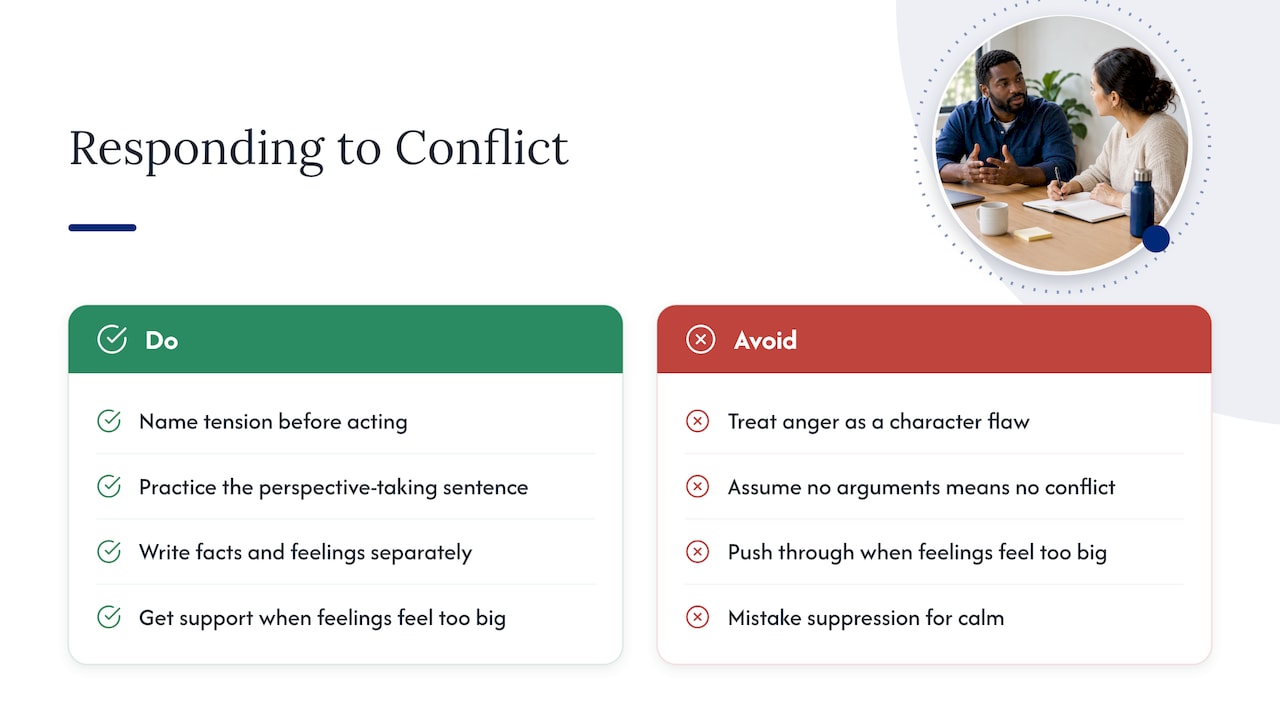
Two things stand out from a clinical perspective. First, the felt stage is an emotional skill test. The person who can notice “I’m tense, my jaw is tight, I’m rehearsing what I’ll say” and name it before acting has a huge advantage over the one who only notices at the shouting stage. Anger is information, not a character flaw. Second, suppression is not calm. A team that never argues is not necessarily a team with no conflict. It may be a team in permanent aftermath, where everything is latent again and waiting.
If you manage people, practice the sentence “Help me understand how this looks from your side” until it comes out naturally. If you are the one caught in it, write down the facts and your feelings separately before the conversation. Facts go to the other person. Feelings go to a trusted friend, a coach or a therapist. When the feelings are too big to separate, that is the time to get support, not to push through.
— Carlos
Support when workplace conflict follows you home
Sometimes the stress of a stage-three or stage-four conflict does not stay at the office. If you notice anger spilling into your relationships, or you want practical skills to manage it, our online classes are built for that. A 1 Hour Anger Management Class is $24.99, a 6 Hour class is $79 and an 8 Hour class is $85, and you can see the options on our anger management classes page. If you would rather work one to one with a licensed clinician, our clinical services include individual counseling and online anger management.
If you are a manager, or you are building skills for a team, our guide to coping with workplace conflict lays out practical steps you can use this week.
FAQ
What are the five stages of conflict in the workplace?
They are latent, perceived, felt, manifest and aftermath, a model Louis Pondy published in 1967. Latent means underlying conditions exist, perceived means someone notices a disagreement, felt means it becomes personal, manifest means it shows in behavior, and aftermath is the legacy that shapes the next episode.
What is the difference between perceived and felt conflict?
Perceived conflict is awareness that a disagreement exists. Felt conflict is when you take it personally and feel tension or anxiety about it. You can perceive a conflict calmly, but once it is felt, emotions start steering your behavior.
What are signs that workplace conflict has become manifest?
The clearest signs are arguments, public blame and open confrontation. Less obvious signs include sabotage, withholding information, apathy and rigid rule-following used to block someone. If behavior includes threats or violence, treat it as a safety matter and involve HR or security.
At which stage should a manager step in?
As early as possible, ideally at the perceived or felt stage, when a short conversation or a bit of coaching can still resolve it. Waiting until the manifest stage usually means a neutral facilitator, documentation and sometimes formal HR involvement.
Can a conflict skip stages?
Pondy’s model describes a typical sequence, but real conflicts do not always follow it neatly. Perceived conflict can arise from a misunderstanding even without latent conditions, and a suppressed aftermath can send a conflict back to the latent stage. Use the stages as a map, not a script.
Sources
- Phases of Organizational Conflict, CSP Global
- Organizational Conflict: Concepts and Models, Louis R. Pondy (1967)
- Conflict Continuum and Conflict Resolution Principles, State of Minnesota
- De-escalating high-stress situations at work: 4 stages to aggression, Workplace Safety & Prevention Services
- Bullying and Violence, OHS Body of Knowledge (2021)
- Labour Management Conflict: A Model and an Approach, Cromie and Lundy (1980)