Anger Management Classes for Youth: 6 Signs, Questions for Parents

Anger management classes for youth teach children and teens specific coping and regulation skills, and they help most when outbursts, aggression, or repeated conflict start interfering with school, friendships, or family life. The strongest programs draw on cognitive behavioral therapy (CBT) and bring parents into the process, because skills practiced only in a classroom rarely survive a heated moment at home.
TL;DR:
- If anger includes safety risks, talk of harm, or signs of depression, anxiety, or attention problems, seek a clinical evaluation before enrolling.
- Choose a program that uses CBT and parent management training, assigns practice, and tracks progress; parent involvement helps skills carry over at home.
- Available classes cost $24.99 for 1 hour, $79 for 6 hours, and $85 for 8 hours; longer sessions offer more practice time.
- At home, prompt one coping tool calmly, praise specific effort, rehearse during calm moments, and coordinate with teachers so the same skills get reinforced.
Table of Contents
- What anger management classes for youth are and what they aim to change
- Signs your child or teen may benefit from an anger management class
- What high-quality classes teach: the active ingredients
- Formats, durations, and what to expect from sessions
- How to choose the right class: a checklist and questions to ask
- How parents reinforce and maintain gains at home
- Why you can trust this guide
- Our take: evaluate the parent role before the curriculum
- Mastering Conflict classes and next steps
- FAQ
- Sources
What anger management classes for youth are and what they aim to change
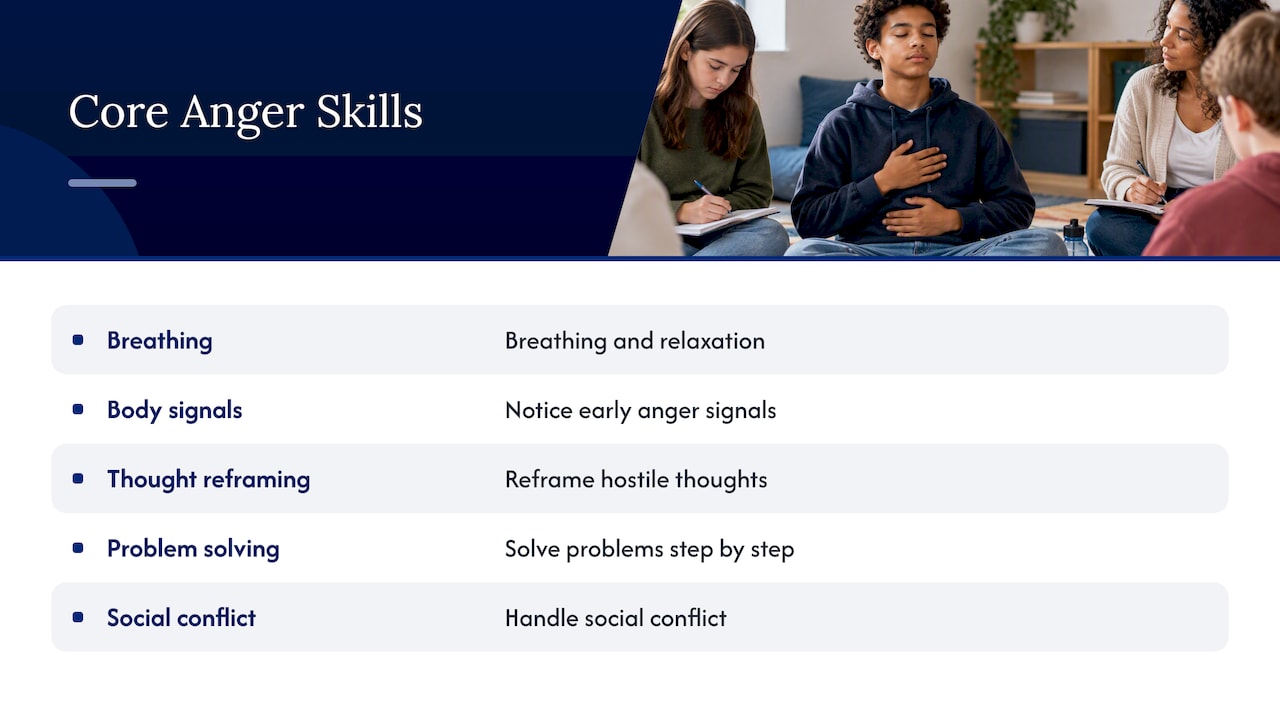
These classes are educational and skills-based. A good one teaches breathing and relaxation, spotting early body signals of anger, reframing hostile thoughts, solving problems step by step, and handling social conflict. The goal is not a child who never gets angry. It is a child who gets angry and still chooses a safe, workable response.
A class is not a substitute for clinical therapy, and parent reinforcement at home is essential for lasting gains. That makes a class a sensible first step when anger is disruptive but not tied to a larger mental health concern. Reviews find that cognitive-behavioral and skills-based approaches are the most widely studied treatments for youth anger and aggression, so that is the style of program to look for.
Signs your child or teen may benefit from an anger management class
Most children lose their temper sometimes. A class becomes worth considering when the pattern is frequent, intense, or costly. Watch for these signs:
- Frequent angry outbursts that seem out of proportion to the trigger
- Hitting, kicking, throwing things, or damaging property
- Verbal aggression, threats, or constant arguing with parents and siblings
- Trouble at school, such as detentions, calls home, or fights with classmates
- Friendships that keep breaking down because of temper
- Difficulty calming down once upset, even after the situation has passed
Age changes how this looks. Younger children tend to show anger through tantrums, crying, or physical lashing out. Teens are more likely to show it through sarcasm, defiance, slammed doors, or withdrawal.
If you have safety concerns, if your child talks about hurting themselves or others, or if anger comes with signs of depression, anxiety, or attention problems, start with a clinical evaluation. A class can follow, but a clinician should weigh in first. Our guide to children’s anger outbursts goes deeper on what to look for at different ages.
What high-quality classes teach: the active ingredients
When you compare programs, look for the elements that research keeps tying to better outcomes:
- Affective education: learning to name feelings and notice early warning signs in the body
- Relaxation and breathing: quick tools a child can use in the middle of an escalating moment
- Cognitive restructuring: catching thoughts like “they did that on purpose” and testing them
- Social problem-solving: generating options, picking one, and reviewing how it went
- Role-play: rehearsing skills with feedback before they are needed for real
How the program is delivered matters as much as the content. A meta-analysis of CBT for anger in children and adolescents found that skills training and multimodal approaches were most effective, and homework, modeling, and feedback were positively related to outcomes.
Parent involvement is the other big lever. Parent management training and CBT are the most empirically validated approaches for youth anger, and CDC guidance on behavior therapy notes that including parents creates consistent reinforcement at home. One study of a combined program found that parent and child pairs who stayed regulated during interactions reported larger drops in externalizing symptoms.
The meta-analysis behind CBT for youth anger reported a pooled effect size of mean d = 0.67 across measures. That points to a meaningful benefit on average, though results vary by program and child.
Formats, durations, and what to expect from sessions
Programs range from a quick introduction to a multiweek course. Here is how the common formats differ:
- Short workshops (1 to 3 hours): an introduction to core ideas and a few practice prompts
- One-day intensives (6 to 8 hours): more time for demonstration, rehearsal, and discussion in a single sitting
- Multi-session groups: repeated practice across weeks, often with parent components
- Self-paced online classes: flexible for busy families, best when a parent works through the material alongside the child
- Individual therapy as an add-on: useful when anger overlaps with other concerns
Shorter formats mostly introduce skills and give you prompts to keep practicing. Longer programs build in rehearsal and parent training, which is where habits tend to form. A typical first session covers a brief assessment of what is going on, an orientation to the program, and clear expectations about practice between sessions.
How to choose the right class: a checklist and questions to ask
Use this checklist to compare programs:
- Instructor credentials: a licensed mental health professional or someone supervised by one
- Evidence base: CBT and parent management training, not just motivational talks
- Parent involvement: a defined role for you, not an optional extra
- Age fit: content designed for your child’s developmental stage
- Format and duration: a schedule your family can actually keep
- Homework expectations: structured practice between sessions
- Safety and escalation plan: what happens if a child becomes aggressive or reveals a serious concern
- Cost and refund policy: clear terms before you pay
Then ask the provider directly. What does the curriculum cover, session by session? How do you measure progress? What exactly will parents be asked to do? What happens if my child is not a good fit?
Pro Tip: Ask for a short intake call or a look at a sample session. How the instructor talks to kids, and to you, tells you more than any brochure.
Parent coaching can also help alongside a child’s class, and this overview of parent coaching services explains what that support looks like.
How parents reinforce and maintain gains at home
Classes teach the skills. Home is where they become habits. Expecting a quick fix is a common pitfall: anger regulation is a long-term developmental process, and programs work best when parents stay involved after classes end.
These practices make the difference:
- Prompt in the moment, calmly. Early in an escalation, remind your child of one tool, such as slow breathing, rather than lecturing.
- Praise skill use specifically. “You stepped away and breathed before answering. That took control” lands better than “good job.”
- Schedule short practice. Role-play on a calm evening beats trying to teach during a meltdown.
- Keep consequences consistent. Predictable responses from every adult in the home matter more than severity.
- Loop in teachers. Share the one or two skills your child is working on so school reinforces them.
- Model it yourself. Children copy how you handle frustration, so our tips on managing anger in parenting are worth a read.
For teens, anger activities that calm the storm can make practice feel less like homework, and our guide to emotional regulation skills for teens adds more at-home ideas.
Pro Tip: Keep prompts short and neutral: “What is your body telling you right now?” followed by “Which tool do you want to try?” Say it once, then give space.
Why you can trust this guide
This guide comes from our team at Mastering Conflict, founded by Dr. Carlos Todd, a licensed clinical mental health counselor and psychologist. Our recommendations follow peer-reviewed research showing that CBT and parent management approaches work for youth anger, and we link that research throughout. We also offer several anger management class formats.
Our take: evaluate the parent role before the curriculum
Most parents compare classes by topic list, price, and schedule. We think that is backward. Nearly every reputable program teaches roughly the same core skills, so the curriculum rarely separates a good class from a mediocre one. What separates them is whether the program treats you as part of the intervention.
The evidence points the same way. Parent reinforcement shows up again and again as the factor behind lasting change, and dyadic regulation, how well you and your child stay steady with each other, tracks with better results. A class that drops your child off and hands back a certificate is selling hope, not a method.
So prioritize first: does the provider give you a defined role, practice tasks, and a way to see progress? Second, be wary of promises of fast transformation, because regulation develops over months. Third, look at your own responses honestly. Changing how you react to an outburst is often the quickest win available.
— Carlos
Mastering Conflict classes and next steps
We offer anger management classes in several formats, so you can match the class to your family’s needs. Our 1-hour, 6-hour, and 8-hour classes start at $24.99 for the 1-hour option, $79 for the 6-hour, and $85 for the 8-hour. If a single intensive day suits your schedule, explore our anger management classes.
A quick way to choose: start with the 1-hour class if you want an introduction to the core ideas, and pick the 6-hour or 8-hour class if outbursts are frequent and you want more practice time. If anger comes with safety concerns or other symptoms, our team can guide you toward a clinical option. Visit the page above to book, or request an intake and we will help you pick.
FAQ
Can kids take anger management classes?
Yes. Programs exist for both children and teens, and CBT is particularly relevant from about age 7 and through adolescence, often combined with parent training. Content should be matched to your child’s age and maturity.
What is the best therapy for children with anger issues?
CBT and parent management training are the most empirically validated approaches for youth anger and aggression. The best fit depends on your child’s age and whether other concerns are present, so a clinical evaluation helps when anger is severe.
What are the 3 R’s of anger management?
They are Recognize, Respond, and Regulate. Children learn to spot their triggers, use a coping tool, and stay calm. Like any skill, they need regular practice and parent reinforcement to carry over to daily life.
Are online anger management classes effective for teens?
Online classes can work well when they teach CBT-style skills and include practice between sessions. Teens do best when a parent stays involved and checks in on homework, since support at home helps new skills stick.
Sources
- Pubmed
- Cdc
- Cognitive-behavioral therapy for anger in children and adolescents: a meta-analysis – Database of Abstracts of Reviews of Effects (DARE): Quality-assessed Reviews – NCBI Bookshelf
- Behavioral Interventions for Anger, Irritability, and Aggression in Children and Adolescents