
How to Forgive Others: Steps for Emotional Healing

TL;DR:
- Forgiveness is a conscious decision to release resentment toward someone who has caused harm, improving mental and physical health. It is a process that starts with acknowledging pain and involves structured models like REACH and Enright’s stages, emphasizing mindset shifts such as separating the act from the person. Maintaining forgiveness requires daily effort, mindfulness, and boundaries, and professional support can enhance healing when needed.
Forgiveness is defined as the conscious decision to release resentment toward someone who has hurt you, regardless of whether they deserve it or have apologized. Learning how to forgive others is one of the most direct paths to emotional freedom available to you. Holding grudges causes chronic stress and physical harm over time, while forgiveness measurably improves health outcomes. Forgiveness does not excuse the offense. It frees you from carrying the weight of it.
How to forgive others: mindset shifts you need first
Before any technique works, your mindset has to be right. Forgiveness is not a single moment of grace. It is a process, and treating it as anything less sets you up to feel like you have failed when anger resurfaces.
Start by fully acknowledging your pain. Suppressing hurt does not speed up healing. It buries the wound where it festers. Sit with the anger, name it, and let yourself feel it without judgment. This is not weakness. It is the honest starting point.
Several mindset shifts matter before you begin:
- Forgiveness is for you, not them. Carrying resentment drains your energy and peace of mind. The offender often moves on while you absorb the cost.
- You do not need to reconcile. Forgiveness is an internal process independent of the other person’s actions or apologies. You can forgive someone you never speak to again.
- Safety and boundaries come first. Forgiveness without accountability can expose you to repeated harm. Establish what is safe before any emotional reconciliation.
- Self-forgiveness is foundational. Harsh self-judgment makes forgiving others harder. When you extend compassion to yourself first, you build the capacity to extend it outward.
- Forgiveness and anger can coexist. You do not need to stop feeling angry before you begin. The decision to forgive comes first; the feeling follows with time and practice.
Pro Tip: Write a letter to the person who hurt you that you never send. Getting the full weight of your feelings onto paper, without filtering for their reaction, often unlocks emotions that are blocking your progress.
What are the most effective forgiveness techniques?
Research has produced structured forgiveness models that outperform vague advice like “just let it go.” Two of the most studied are the REACH model and Enright’s four-stage process.
The REACH model
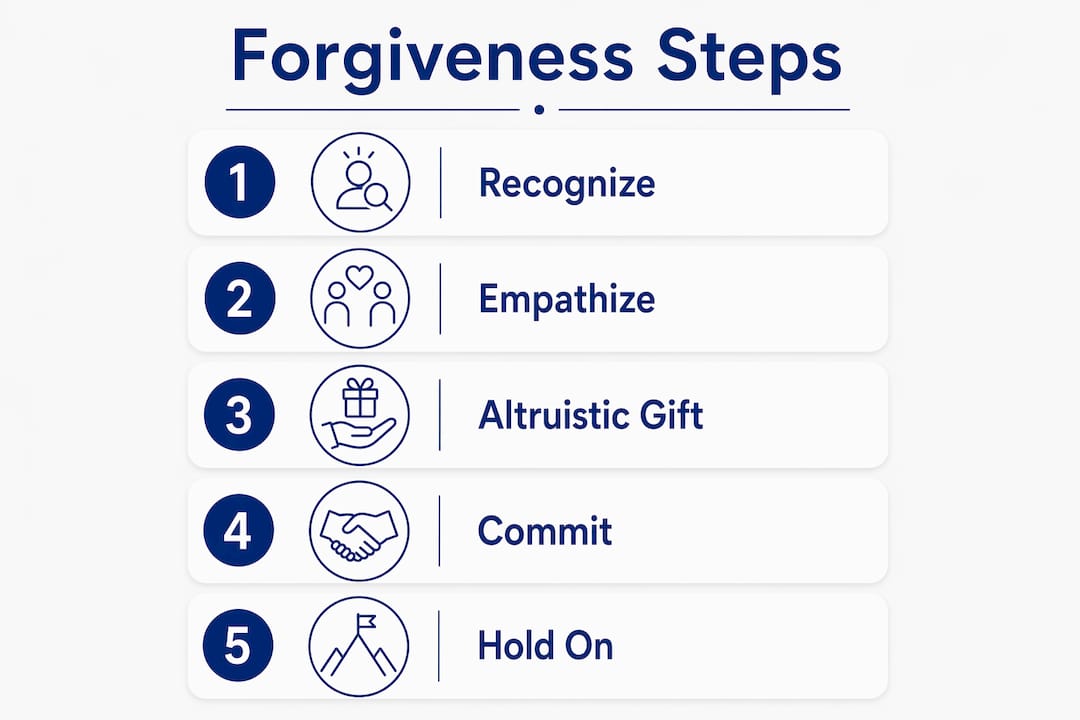
The REACH model reduces anger and aids emotional healing through five concrete phases. Each letter stands for a specific action:
- Remember the hurt objectively, without minimizing or catastrophizing it.
- Empathize with the offender’s perspective. This does not excuse them. It helps you understand the human context behind the harm.
- Altruistically offer forgiveness as a gift, recalling a time you were forgiven for something you did wrong.
- Commit to forgiveness publicly or in writing. Journaling this commitment makes it more durable.
- Hold on to forgiveness when doubt or anger returns, which it will.
The REACH model works because it treats forgiveness as a skill, not a feeling. You practice each step deliberately, and the emotional shift follows the behavioral commitment.
Enright’s four-stage process
Robert Enright’s model, developed at the University of Wisconsin, moves through four stages: uncovering your anger, deciding to forgive, working toward understanding, and deepening your own meaning from the experience. The final stage is where lasting healing happens. You move from victim to someone who has grown through the experience.

Releasing unenforceable rules
One hidden barrier most people overlook is what researchers call “unenforceable rules.” These are rigid expectations about how others should have behaved. Letting go of these rigid expectations stops rumination and reclaims emotional energy. When you catch yourself thinking “they should have known better” or “a good friend would never,” you are holding an unenforceable rule. Naming it and releasing it is a concrete forgiveness technique on its own.
Pro Tip: Pair your forgiveness work with anger reduction techniques that address the physical side of resentment. Breathing exercises and progressive muscle relaxation reduce the body’s stress response while you do the emotional work.
| Approach | Core Focus | Best Used When |
|---|---|---|
| REACH model | Structured five-step emotional processing | You want a clear, repeatable framework |
| Enright’s four stages | Meaning-making and personal growth | The hurt was deep or long-standing |
| Releasing unenforceable rules | Stopping rumination and reclaiming energy | You keep replaying what “should” have happened |
| Journaling and affirmations | Processing emotions and reinforcing commitment | You need a private, ongoing practice |
What makes forgiving someone so hard?
The biggest obstacle to forgiveness is a set of beliefs that feel true but are not. Clearing them up does not make forgiveness easy, but it removes the false barriers that keep you stuck.
- “Forgiving means I’m saying it was okay.” It does not. Forgiveness separates the person from the act and releases your resentment without endorsing the behavior.
- “I have to feel ready first.” Waiting for anger to fully subside delays forgiveness indefinitely. The decision to forgive is made before the feeling arrives, not after.
- “Forgiving means I have to trust them again.” Trust is rebuilt through consistent behavior over time. Forgiveness is a separate internal act. You can forgive someone and still choose not to let them back into your life.
- “I can’t forgive myself, so how can I forgive them?” Self-forgiveness and forgiving others are linked. Self-forgiveness correlates with reduced depression and higher self-esteem. Working on one strengthens the other.
- “If I forgive, I lose my leverage.” Resentment is not leverage. It is a cost you pay alone. The other person rarely feels the weight of your grudge the way you do.
Forgiveness also does not mean you drop your boundaries. Forgiving someone does not obligate ongoing contact or acceptance of further harm. You can forgive and still walk away. Both things are true at the same time.
How do you maintain forgiveness over time?
Forgiveness is not a one-time event. Choosing to forgive daily is a deliberate, high-effort psychological process that leads to healing even while anger lingers. This is the part most guides skip, and it is where most people feel they have failed when they have not.
When anger resurfaces, treat it as information, not evidence that you have not truly forgiven. A memory, a song, or a conversation can bring old hurt back to the surface. That is normal. The question is what you do next.
Pro Tip: Create a short forgiveness affirmation you can return to when anger resurfaces. Something specific works better than something generic. “I am releasing what happened on that day because carrying it costs me more than it costs them” is more effective than “I forgive and forget.”
Techniques for sustaining forgiveness over time include:
- Mindfulness practice. When a painful memory arises, observe it without engaging the story. Notice the feeling, name it, and let it pass without adding new resentment on top.
- Journaling progress. Track moments when you felt lighter or less reactive. Recognizing partial forgiveness as real progress keeps you moving forward.
- Redirecting emotional energy. Channel the energy that was going into resentment toward a personal goal, a relationship that matters, or a creative outlet. This is not avoidance. It is reclaiming your bandwidth.
- Revisiting your commitment. Longer-term, process-focused forgiveness supports durable emotional healing. Return to your written commitment or your REACH journal when doubt creeps in.
| Strategy | What it does | When to use it |
|---|---|---|
| Mindfulness | Interrupts rumination without suppressing emotion | When a memory surfaces unexpectedly |
| Journaling progress | Reinforces how far you have come | When you feel stuck or like nothing has changed |
| Affirmations | Restates your commitment in your own words | Daily, or when anger flares |
| Redirecting energy | Converts resentment into productive focus | When you notice yourself replaying the offense |
For couples and close relationships, the work of rebuilding trust after forgiveness follows its own structured path. Forgiveness opens the door. Consistent, accountable behavior over time is what walks through it.
Key Takeaways
Forgiveness is a deliberate, ongoing decision to release resentment that protects your health, restores your energy, and does not require reconciliation, condoning the offense, or waiting until anger disappears.
| Point | Details |
|---|---|
| Forgiveness benefits the forgiver | Releasing resentment lowers chronic stress and improves long-term physical and mental health. |
| Mindset precedes technique | Acknowledge pain fully and accept that forgiveness is a process before applying any structured method. |
| REACH model provides structure | The five-step REACH framework gives you a repeatable, research-backed path through emotional healing. |
| Misconceptions block progress | Forgiveness does not mean trust, reconciliation, or condoning harm. Clearing these beliefs removes false barriers. |
| Maintenance is required | Forgiveness needs daily reaffirmation. Anger returning does not mean you have failed. |
Forgiveness takes more courage than most people admit
People often come to me expecting forgiveness to feel like relief from the start. It rarely does. The first honest attempt usually feels more like grief than peace. That is because real forgiveness requires you to fully face what happened, not soften it or explain it away.
What I have seen consistently, both personally and in clinical work, is that the people who struggle most with forgiveness are often the ones who care most about doing it right. They want to forgive completely and immediately, and when anger returns, they conclude they have failed. They have not. Forgiveness is empowerment, a reclaiming of your power to cope, not a performance of virtue.
The most important thing I can tell you is this: forgiveness and boundaries are not opposites. The healthiest forgiveness I have witnessed always includes a clear-eyed assessment of what is safe going forward. You can hold someone in compassion and still refuse to let them hurt you again. That combination is not a contradiction. It is wisdom.
If you are working through a relationship where trust was broken, I encourage you to explore forgiveness-based approaches within therapy as a structured support. The process is hard enough without doing it alone.
— Carlos
Clinical support for forgiveness and emotional healing
Forgiveness work is real psychological work. When the hurt runs deep, or when anger keeps returning despite your best efforts, professional support makes a measurable difference.
Masteringconflict offers clinical services that address anger, trauma, and the emotional complexity of forgiving others. Whether you are working through a painful relationship, processing old wounds, or trying to rebuild after a serious breach of trust, the clinical team at Masteringconflict provides evidence-based support tailored to your situation. If you are unsure where to start, an anger management assessment can clarify what you are dealing with and point you toward the right path forward.
FAQ
What is the definition of forgiveness?
Forgiveness is the conscious decision to release resentment toward someone who has caused you harm. It is an internal process that does not require an apology, reconciliation, or condoning the offense.
Does forgiving someone mean you have to trust them again?
No. Forgiveness and trust are separate. Trust is rebuilt through consistent behavior over time, while forgiveness is an internal act you complete for your own well-being.
How long does it take to forgive someone?
There is no fixed timeline. Durable forgiveness is a process tailored to the individual and the severity of the hurt. Rushing it leads to superficial healing that does not last.
Can you forgive someone and still end the relationship?
Yes. Forgiveness does not obligate ongoing contact or acceptance of further harm. You can release resentment and still choose to walk away for your own safety and well-being.
What is the REACH model of forgiveness?
The REACH model is a five-step forgiveness framework: Remember the hurt, Empathize with the offender, Altruistically offer forgiveness, Commit to it, and Hold on when doubt returns. Research shows it effectively reduces anger and supports emotional healing.
Recommended
- Coping with Grief: Effective Steps for Healing After Loss – Mastering Conflict
- Mastering Empathy in Conflict Resolution: A Step-by-Step Guide – Mastering Conflict
- How to Forgive in Relationships and Rebuild Trust – Mastering Conflict
- Rebuilding Trust After Betrayal: A Step-by-Step Process – Mastering Conflict