
What anger management classes actually teach you

TL;DR:
- Structured anger management programs effectively improve communication, conflict resolution, and emotional regulation skills.
- They primarily use CBT and DBT frameworks, focusing on trigger identification, cognitive restructuring, and mindfulness.
- Active participation, real-world practice, and personal reflection are key to lasting anger management success.
Most people assume anger management is about learning to take a deep breath and count to ten. That picture is incomplete. Research shows that structured programs can improve communication and problem-solving to statistically significant degrees, with participants showing measurable gains in conflict resolution and emotional regulation. If you live in North Carolina or Florida and you’re considering an anger management class, whether by personal choice or court order, understanding what actually happens inside those sessions will help you get far more out of them.
Table of Contents
- Core methodologies and frameworks in anger management
- Class structure: What to expect session-by-session
- Measuring success: Outcomes, benchmarks, and personal progress
- Nuanced approaches: Trauma, court requirements, and adapted techniques
- A more practical approach to anger management: What most guides miss
- Next steps: Find the right anger management resource
- Frequently asked questions
Key Takeaways
| Point | Details |
|---|---|
| Evidence-based methods | CBT and DBT techniques anchor anger management classes for proven skill-building. |
| Practical skills focus | Sessions prioritize emotional regulation, conflict resolution, and real-world practice. |
| Court and personal growth | Programs support both legal requirements and lasting personal improvement. |
| Measurable outcomes | Progress is tracked with standardized assessments and feedback, showing significant improvements. |
| Customization needed | Special cases like trauma or county mandates require tailored approaches; adaptive expression matters most. |
Core methodologies and frameworks in anger management
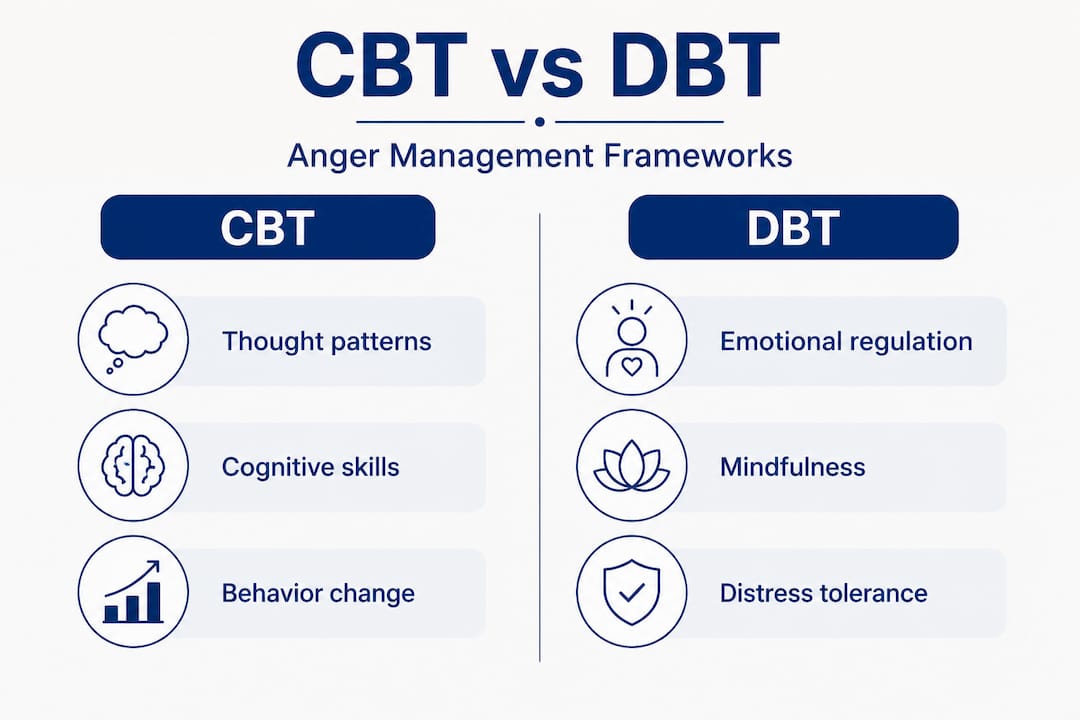
Modern anger management classes are not built on pop psychology. They draw from well-researched clinical frameworks, primarily Cognitive Behavioral Therapy (CBT) and Dialectical Behavior Therapy (DBT). Understanding the difference between these two approaches helps you know what you’re signing up for.
CBT is the backbone of most anger management programs. It works on the premise that your thoughts, feelings, and behaviors are all connected. When you experience anger, CBT teaches you to slow down and identify the trigger, examine the automatic thought or belief that fired up, recognize any cognitive distortion (an exaggerated or irrational thought pattern), and then choose a more adaptive response. For example, if someone cuts you off in traffic and your first thought is “That person is disrespecting me on purpose,” CBT helps you recognize that assumption as a distortion and replace it with something more realistic. Evidence-based strategies like these form the core of most reputable programs.
DBT adds a layer of emotional depth. Originally developed for borderline personality disorder, it has proven highly effective for anger regulation. DBT introduces four skill sets: mindfulness, distress tolerance, emotional regulation, and interpersonal effectiveness. Practical tools within distress tolerance include TIPP (Temperature, Intense exercise, Paced breathing, Progressive relaxation) and opposite action, which means doing the behavioral opposite of what your anger impulse tells you to do. Mindfulness practices from DBT are particularly helpful for people whose anger spikes fast and hard before they even have time to think.
Anger management techniques are evidence-based, centering on CBT trigger identification and cognitive distortions, while DBT adds mindfulness, distress tolerance, and interpersonal skills like DEAR MAN (Describe, Express, Assert, Reinforce, Mindful, Appear confident, Negotiate), a structured communication script that helps you ask for what you need without escalating conflict.
Comparison: CBT vs. DBT in anger management classes
| Feature | CBT | DBT |
|---|---|---|
| Primary focus | Thought patterns and beliefs | Emotional regulation and skills |
| Core tools | Trigger mapping, cognitive restructuring | TIPP, DEAR MAN, opposite action |
| Best suited for | Habitual anger patterns | Intense or rapidly escalating anger |
| Mindfulness emphasis | Moderate | High |
| Communication training | Yes | Yes, structured via DEAR MAN |
Most classes blend both, tailoring their curriculum to what participants actually need. Court-mandated programs may follow a more standardized format, while voluntary classes often allow for more individualization.
Pro Tip: Before enrolling, ask the provider whether their curriculum includes both CBT and DBT components. A program that uses only one framework may leave gaps in your skill set.
Explore anger management exercises that draw from both frameworks to get a preview of the kind of work you’ll be doing inside a structured class.
Class structure: What to expect session-by-session
Knowing the frameworks is one thing. Knowing what a Tuesday evening session actually looks like is another. Most well-structured anger management classes follow a predictable but progressive rhythm that builds skills over time.

Sessions typically open with a brief check-in where participants share how their week went in terms of anger episodes and coping attempts. This is not just warm-up chatter. It serves as real-time data collection so the facilitator can adjust the session’s focus based on what participants are struggling with. Anger management tips for between-session practice often come directly out of these check-ins.
Here is the general sequence most programs follow across their sessions:
- Intake and baseline assessment — You complete standardized questionnaires that measure your current anger frequency, intensity, and expression style. This gives the program a starting point to measure your progress against.
- Trigger mapping — Sessions focus on helping you identify your personal anger triggers, whether those are interpersonal conflicts, perceived disrespect, injustice, or specific environments.
- Cognitive skills practice — You learn to spot and challenge distorted thoughts in real time, not just in theory.
- Behavioral skill building — Role-play scenarios and small group problem-solving help you practice new responses before you need them in the real world.
- Communication drills — Structured exercises like DEAR MAN rehearsals or assertiveness practice sharpen how you express needs without aggression.
- Adaptive response reinforcement — Final sessions focus on applying everything to real-life situations you bring from your own experience.
Research on anger management program outcomes shows measurable improvements across key areas, as shown in the table below.
Outcomes measured in structured anger management programs
| Outcome area | Pre-program average | Post-program score | Significance |
|---|---|---|---|
| Problem-solving ability | Below baseline | 81.66 ± 4.81 | Statistically significant |
| Communication skills | Below baseline | 82.40 ± 3.82 | Statistically significant |
| Anger level | Elevated | Reduced | Confirmed via RCT |
| Adjustment behaviors | Impaired | Improved | Confirmed |
Pro Tip: Keep a personal log between sessions. Write down anger episodes, your initial thought, and what you did. Bringing this to class dramatically accelerates your progress because the facilitator can coach around your real scenarios, not hypothetical ones.
The most important thing to understand is that skill-building in these sessions requires active participation. Passive attendance will not produce lasting change. The group discussion and role-play elements exist precisely because you cannot rewire behavioral patterns by listening alone.
Measuring success: Outcomes, benchmarks, and personal progress
One of the most common questions people ask before enrolling is simple: does this actually work? The short answer is yes, and the longer answer is that effectiveness depends on how consistently you engage with the material.
Programs use standardized behavioral assessments and self-report measures at intake and at completion to track change. These are not subjective impressions. They are scored instruments that capture shifts in anger frequency, intensity, expression style, and related behaviors like hostility and impulsivity.
“Randomized controlled trials confirm significant reductions in both state anger (anger you feel in the moment) and trait anger (your general tendency to get angry). Improvements are seen through mechanisms including better emotional regulation and reduced hostile attribution bias.” Statistical improvements in anger management
What gets measured in most programs includes:
- Anger frequency: How often episodes occur each week
- Anger intensity: How severe episodes feel on a self-rated scale
- Hostile attribution bias: The tendency to assume others have bad intentions
- Communication effectiveness: How clearly and calmly you can express needs
- Conflict resolution skill: How often conflicts de-escalate versus escalate
- Relationship quality: Self-reported relationship satisfaction after the program
The anger management benefits extend well beyond the classroom. Participants report improvements in workplace relationships, family dynamics, and personal stress levels. Those who practice the skills consistently after graduation tend to maintain gains over the long term.
For court-mandated participants, there is sometimes an assumption that the class is just a box to check. But research consistently shows that even mandated participants who engage genuinely show the same statistical improvements as voluntary enrollees. Building emotional control is a skill, not a personality trait, and skills can be developed regardless of why you started the class.
The improvements also touch relationships directly. Specific relationship techniques practiced in class help participants de-escalate conflict with partners, family members, and coworkers rather than defaulting to the same reactive patterns. For those in professional environments, these skills translate directly into workplace harmony and reduced interpersonal friction.
Nuanced approaches: Trauma, court requirements, and adapted techniques
Not every participant walks into an anger management class with the same backstory. Some people’s anger is rooted in unresolved trauma. Others are navigating specific court requirements that add a layer of complexity to which program they can attend. Both situations deserve careful attention.
Trauma-linked anger operates differently than typical situational anger. When the nervous system has been shaped by repeated trauma, anger responses can feel faster, more intense, and harder to interrupt. Standard CBT techniques alone may not fully address this. Programs that incorporate polyvagal theory (which addresses how the nervous system responds to perceived threat) alongside DBT skills create a more complete framework for people in this situation. Integrated approaches that avoid simple suppression and instead focus on adaptive expression are the clinical gold standard here.
Suppression is worth naming directly because it is one of the most common mistakes. Suppression means pushing anger down and pretending it is not there. This does not resolve anything. It often leads to larger explosions later or physical health consequences like chronic tension and elevated blood pressure. Good anger management teaches you to express anger adaptively, meaning you acknowledge it, regulate the intensity, and communicate your underlying need clearly.
Key considerations for special populations and circumstances:
- Trauma backgrounds: Look for programs that explicitly integrate somatic or polyvagal-aware techniques alongside CBT and DBT
- Court mandates: Always confirm with your attorney or probation officer that the specific program you’re considering is accepted by your county court before you enroll. Requirements vary significantly between North Carolina and Florida counties.
- Teen participants: Adolescent anger has its own developmental dimension; programs designed for teens differ from adult formats in pacing, language, and group dynamics. Reviewing teen anger management resources before choosing a program for a young person is strongly recommended.
- Individuals needing deeper work: Group classes are powerful, but some participants benefit from combining them with individual therapy to address personal history that cannot be fully explored in a group format.
Pro Tip: If your anger is frequently tied to memories, nightmares, hypervigilance, or panic, mention this to the program intake coordinator before you start. A skilled facilitator will adapt their approach or recommend parallel individual sessions to support your progress.
A more practical approach to anger management: What most guides miss
Here is something most articles do not say plainly: awareness alone does not create change. Many people complete an anger management class, leave with a new vocabulary about triggers and distortions, and then return to the same patterns within weeks. The reason is not that the class failed. It is that they treated learning about skills as a substitute for actually practicing them.
Real progress in anger management is built through repetition in real conditions, not rehearsal in ideal ones. You need to practice the TIPP technique when you are genuinely escalated, not just when it’s calm and hypothetical. You need to use DEAR MAN in an actual difficult conversation, not only in a role-play exercise. That gap between classroom knowledge and real-world application is where most people stall.
Another thing most guides miss is that the goal is not to become someone who never gets angry. Anger is a valid emotion with important functions. It signals boundary violations, injustice, and real threats. The goal is to express it in ways that serve you rather than harm your relationships, career, or legal standing.
We also see a common pitfall with court-mandated participants who focus entirely on completing the program rather than internalizing the material. The requirement gets met, the certificate gets filed, but nothing changes internally. That missed opportunity matters because the same triggers, the same relationships, and the same circumstances will be waiting on the other side of the program.
The most lasting change we observe comes from people who combine evidence-backed change techniques with honest personal reflection and consistent practice between sessions. Think of it less like taking a class and more like training a new physical reflex, one that requires repetition over time before it becomes automatic.
Next steps: Find the right anger management resource
If you’re ready to move from understanding to action, the next step is finding a program that fits your specific situation, whether that’s a voluntary choice for personal growth or a mandated requirement with specific compliance criteria.
At Mastering Conflict, we offer structured, evidence-based anger management services for individuals in North Carolina and Florida, both in-person and online. Starting with a clinical anger assessment helps establish a clear baseline and identifies which skills and approaches will serve you best. For those whose anger is affecting an intimate relationship, couples therapy can work alongside individual anger management work to address dynamics that classes alone may not fully resolve. Whether you’re coming voluntarily or fulfilling a court requirement, our programs are designed to deliver real, measurable change. Contact us to learn more about fit and scheduling.
Frequently asked questions
How long do anger management classes typically last?
Most programs run between 6 and 12 weekly sessions, though program length can vary depending on court mandates, program intensity, and participant needs.
Are anger management classes effective for trauma-linked anger?
Yes, programs that integrate polyvagal and DBT methods alongside standard CBT are well-suited for trauma-related anger; program adaptation to the individual is the critical factor.
Do anger management classes meet court requirements in North Carolina and Florida?
Requirements differ by county, so you should confirm court acceptance with your attorney or probation officer before enrolling in any specific program.
What skills are gained from anger management classes?
Participants build emotional regulation, adaptive expression, assertive communication, and conflict resolution skills, all backed by statistically significant outcomes in peer-reviewed research.
Recommended
- Anger management classes: Build emotional control that lasts – Mastering Conflict
- How Long Are Anger Management Classes: What to Expect – Mastering Conflict
- 26 Signs You Need Anger Management Classes
- 7 Ways Local Anger Management Classes Help Adults Grow – Mastering Conflict
- Everything You Need To Know To Address Workplace Bullying