
Life coach vs therapist: Choose the right support

TL;DR:
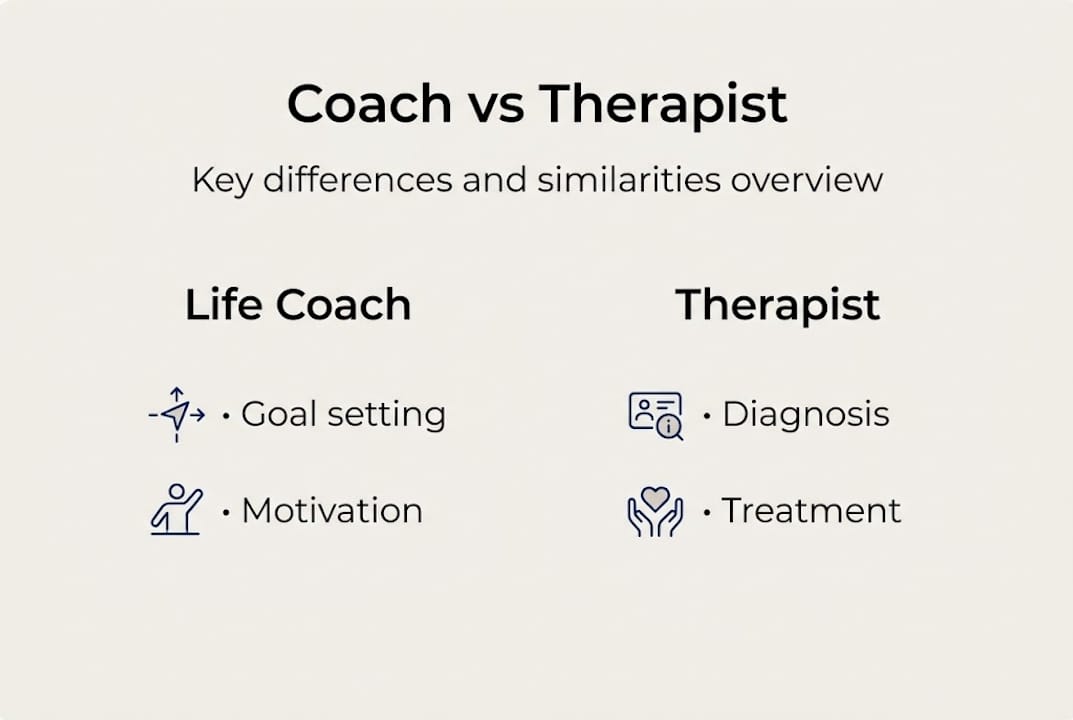
- Life coaching focuses on goal achievement and personal development without diagnosing mental health conditions.
- Therapists are licensed professionals who diagnose and treat mental health disorders and emotional issues.
- Choosing the right professional depends on whether your primary concern is goals or mental health.
Knowing whether to call a life coach or book a session with a therapist is genuinely confusing, and most people get it wrong the first time. Some people spend months in coaching when they actually needed clinical treatment for anxiety or depression. Others wait in a therapist’s waiting room when what they really wanted was a structured accountability partner to help them hit career goals. Both experiences are costly in time, money, and emotional energy. This article breaks down what each professional actually does, where the real differences lie, and how to make a smart, confident decision based on your specific situation.
Table of Contents
- What does a life coach do?
- What does a therapist do?
- Key differences between life coaches and therapists
- How to decide: Which is right for you?
- A fresh perspective: Why the lines between coaching and therapy matter more than ever
- Explore next steps with Mastering Conflict
- Frequently asked questions
Key Takeaways
| Point | Details |
|---|---|
| Distinct roles | Life coaches focus on goals and growth, while therapists address mental health. |
| Evidence-based benefits | Coaching is proven to boost goal attainment and self-efficacy; therapy is essential for mental health recovery. |
| Decision framework | Clarify your goals and needs to choose the right support, or combine both approaches. |
| Know when to seek help | Choose therapy for mental health struggles, and coaching for motivation or life direction. |
What does a life coach do?
Life coaching is a forward-focused partnership. A coach works with you to identify where you want to go, uncover what is holding you back, and build a practical action plan to get there. The key word is “forward.” Coaches do not dig into your past trauma or diagnose what is wrong with you. They ask powerful questions, hold you accountable, and help you see your own blind spots.
People typically seek out a life coach when they are:
- Stuck in a career and ready for a meaningful change
- Starting a business and need structure, focus, and accountability
- Trying to improve relationships without a clinical mental health diagnosis
- Going through a major life transition like divorce, relocation, or retirement
- Feeling unmotivated or unclear about their purpose and personal values
The research actually supports coaching’s effectiveness. Meta-analyses show moderate effects with a standardized mean of g=0.59 on goal attainment and self-efficacy, while workplace coaching shows meaningful improvements in stress levels and overall health. That is not a trivial finding. A well-run coaching engagement can measurably change how confident you feel in pursuing goals and how effectively you handle day-to-day pressure.
Coaching is not regulated the way therapy is. Anyone can technically call themselves a life coach, though reputable coaches often hold credentials from organizations like the International Coaching Federation. This is important to know when you are shopping around. The quality of coaching varies far more than the quality of licensed therapy, simply because there is no state licensing board enforcing minimum standards.
“A good coach doesn’t give you answers. They ask questions so well that you find your own answers, and those tend to stick much longer.” This is the core of what separates coaching from consulting or mentoring.
Understanding conflict coaching explained is especially useful for people dealing with chronic interpersonal tension at work or at home. And if you are a working professional feeling overwhelmed, stress management for professionals offers targeted guidance on using structured support to reduce burnout before it gets clinical.
Pro Tip: Before you hire a coach, ask directly: “Do you have experience with clients who have active mental health concerns?” A skilled coach will be honest about their limits and refer you out when therapy is the better fit.
What does a therapist do?
A licensed therapist is a trained clinician. They can assess, diagnose, and treat recognized mental health conditions. This is not a small distinction. It means they went through graduate-level education, supervised clinical hours, and state licensing requirements that govern how they practice, what they can say, and how they must protect your information.
Therapists treat a wide range of concerns, including:
- Depression and mood disorders
- Anxiety disorders, including generalized anxiety, panic disorder, and social anxiety
- Post-traumatic stress disorder and trauma-related conditions
- Relationship conflicts, communication breakdowns, and attachment issues
- Grief, loss, and adjustment disorders
- Substance use and co-occurring mental health conditions
Therapy can be short-term and solution-focused, like cognitive behavioral therapy for a specific phobia, or longer-term and exploratory, like psychodynamic therapy for deep-rooted patterns. The approach depends on the therapist’s training, your goals, and the nature of your concerns. Most evidence-based approaches show strong, durable results for a wide variety of conditions.

What many people overlook is that therapy is also protective. Therapists are bound by confidentiality laws, mandatory reporting requirements, and ethical codes enforced by licensing boards. This legal and ethical scaffolding creates a container where you can genuinely say anything without fear. A coach cannot offer that same level of legal protection.
For a grounded comparison, reading about coaching vs therapy can help you understand where clinical treatment ends and personal development coaching begins. If you are ready to take action, knowing how to find a therapist makes the first step feel less overwhelming. You can also explore specific therapy outcomes for conflict-related concerns to see what evidence-based treatment typically looks like in practice.
Pro Tip: If you have experienced something traumatic or you notice your mood consistently interfering with daily life, relationships, or work, start with a therapist. You can always add coaching later once you have a stable foundation.
Key differences between life coaches and therapists
Side by side, the contrast becomes very clear. Here is how the two roles compare across the most important categories:
| Category | Life coach | Therapist |
|---|---|---|
| Credentials | No required license; optional certifications | State-licensed; graduate degree required |
| Regulation | Largely unregulated | Regulated by state licensing boards |
| Primary focus | Goals, growth, performance | Mental health diagnosis and treatment |
| Time orientation | Present and future | Past, present, and future |
| Insurance coverage | Rarely covered | Often covered with diagnosis code |
| Confidentiality | Contractual | Legal and ethical requirement |
| Can diagnose? | No | Yes |
This table makes one thing obvious: the stakes of choosing wrong are not symmetrical. If you hire a coach when you needed a therapist, you may feel temporarily motivated but leave underlying mental health issues untreated. If you see a therapist when coaching would have served you better, you might feel pathologized for challenges that are actually developmental and normal.
Research continues to show that goal attainment through coaching produces statistically significant improvements, but those results are strongest when clients enter coaching without an active, untreated mental health condition. That is a critical nuance the coaching industry rarely advertises loudly enough.
Here are four situations where the choice becomes clearer:
- You want to change careers and feel stuck. A life coach is a strong fit. The challenge is goal clarity and action planning, not a clinical disorder.
- You have panic attacks that stop you from going to work. This calls for a therapist. Panic disorder is a diagnosable condition that responds well to specific clinical interventions.
- You and your partner argue constantly and want to communicate better. A therapist who specializes in couples work is the right choice, especially if the conflict is deeply entrenched.
- You recently got promoted and want to level up your leadership. An executive or life coach is ideal here. This is a performance and growth challenge, not a mental health concern.
Understanding the difference between coaching and psychotherapy can also help you see why some practitioners offer both, and what to look for when evaluating their qualifications and approach.
How to decide: Which is right for you?
Now that you understand what each professional does and how they compare, the decision comes down to an honest look at your current situation. Ask yourself these questions before you book anything.
Start with these self-assessment questions:
- Am I dealing with a diagnosable condition like depression, anxiety, or trauma? If yes, start with a therapist.
- Is my primary goal to achieve something specific, like a promotion, a healthier relationship, or a new business? If yes, coaching is likely the better fit.
- Have I ever been in therapy before? Did it help stabilize me enough to focus on growth goals? If yes, you may be ready for coaching.
- Am I in crisis or experiencing suicidal thoughts? If yes, please contact a licensed mental health professional immediately.
- Is my daily functioning impaired by emotional symptoms? If yes, therapy comes first.
Choosing the right support does not have to be permanent. Many people start with therapy to process what is weighing them down, then transition into coaching once they have more emotional stability. This sequential model works especially well for people recovering from burnout, grief, or relationship breakdown.
Some people benefit from both at the same time. There is nothing wrong with seeing a therapist weekly to work through anxiety while also working with a coach on career transitions. The two approaches are not competitors. They can be genuinely complementary when the practitioners involved communicate ethically and stay in their respective lanes.
A comprehensive therapy vs coaching guide can walk you through specific scenarios in more detail if you are still uncertain after asking yourself these questions.
Research confirms this nuance. The same meta-analytic evidence that validates coaching’s positive effects also makes clear that coaching works best for people who are psychologically stable and goal-ready. If that is not where you are right now, that is important information, not a personal failure.
Pro Tip: Write down your top three goals for seeking support. If any of them include words like “heal,” “stop hurting,” “understand why I keep doing this,” or “feel normal again,” a therapist is almost certainly the right starting point.
A fresh perspective: Why the lines between coaching and therapy matter more than ever
Here is the uncomfortable truth most articles skip: the boundary between coaching and therapy is not just a professional distinction. It is an ethical and safety issue. When a coach works with someone experiencing undiagnosed depression and frames it as a “mindset problem,” they are not just being ineffective. They may be actively delaying care.
That said, the cleanest reading of this issue is not always the most useful one. From our experience at Mastering Conflict, clients rarely show up as pure cases. A person working through a career transition is also processing grief. A couple seeking communication coaching may be sitting on layers of unresolved trauma. Real human needs spill across the neat categories professionals create.
The most effective practitioners we have seen are not rigidly siloed. They know their scope, refer when necessary, and communicate across disciplines when a client is working with multiple providers. What truly serves clients is a professional who is honest about their limits and genuinely committed to the client’s wellbeing, not just their engagement.
Choosing the right support sometimes means choosing the professional who is honest enough to say, “I’m not the right fit for where you are right now.” That kind of integrity is rarer than credentials, and worth looking for in any practitioner.
The field is moving toward more integration, not less. Mental health and personal development are converging in interesting ways. The key is making sure ethical boundaries move with that evolution, not against it.
Explore next steps with Mastering Conflict
If any part of this article felt familiar, there is a reason. Whether you are navigating communication breakdowns, managing your anger, or figuring out whether therapy or coaching fits your current chapter, taking a concrete next step matters more than having the perfect answer.
At Mastering Conflict, we offer both clinical therapy and structured coaching programs, so you do not have to figure out the right door to knock on alone. Start with our anger management assessment if conflict or frustration is showing up in your daily life in ways you cannot fully explain. If family stress is at the center of what you are carrying, explore our family counseling services designed to restore communication and connection. Dr. Carlos Todd and our clinical team are here to guide you toward the support that actually fits.
Frequently asked questions
What is the main difference between a life coach and a therapist?
A life coach supports goal achievement and personal growth, while a therapist is licensed to diagnose and treat mental health conditions. Research shows coaching produces moderate positive effects on goal attainment, but it is not a substitute for clinical care when a mental health condition is present.
When should someone see a therapist instead of a coach?
See a therapist when your challenges include depression, anxiety, trauma, relationship crisis, or any emotional pattern that consistently disrupts your daily life. Coaches are not trained or licensed to treat these conditions.
Can you work with both a coach and a therapist at the same time?
Yes, and many people find the combination powerful. Therapy addresses mental health foundations while coaching builds forward momentum, and when both professionals respect their scope, the combination can accelerate growth in ways neither could achieve alone.
Is life coaching backed by evidence?
Yes. Coaching meta-analyses show a standardized effect size of g=0.59 on goal attainment and self-efficacy, and workplace coaching shows measurable improvements in stress and health outcomes. These are meaningful, research-supported results for the right population.