
What Is Conflict Management? Tools for Better Relationships

TL;DR:
- Conflict, when managed effectively, can strengthen relationships and build resilience.
- Effective conflict management emphasizes communication, empathy, and problem-solving over winning disputes.
- Practicing conflict skills reduces stress, promotes trust, and improves emotional and physical health.
Conflict gets a bad reputation. Most people treat it like a warning sign, something to silence, avoid, or win at all costs. But what if disagreements, when handled well, actually brought you closer? This article covers what conflict management really means, why your default approach to arguments might be working against you, and the practical tools that can shift your relationships from tense to trusting. Whether you’re dealing with a partner, a family member, or your own anger, understanding how to navigate conflict effectively is one of the most valuable skills you can build.
Table of Contents
- What is conflict management?
- Types of conflict management styles
- Why conflict management matters for mental health and relationships
- Key conflict management techniques
- A fresh perspective: Why embracing conflict can actually strengthen your bond
- Finding support for your conflict management journey
- Frequently asked questions
Key Takeaways
| Point | Details |
|---|---|
| Conflict is natural | Disagreements happen in every relationship, but managed well, they can lead to growth. |
| Management styles vary | Recognizing your conflict style helps you adapt and handle tough conversations better. |
| Skill-building works | Techniques like active listening and assertive communication can turn conflict into connection. |
| Mental health impact | Unresolved conflict may harm emotional well-being and relationship satisfaction. |
| Help is available | Professional guidance in therapy or coaching can make a big difference for lasting change. |
What is conflict management?
Conflict management is not about eliminating disagreements. Every relationship, workplace, and family will have them. The real goal is handling those disagreements in a way that doesn’t destroy trust or shut down communication. Simply put, the conflict management method is “the ability to handle disagreements with effective communication, empathy, and problem-solving.”
That definition matters because it shifts the focus from winning to working through. Conflict management is constructive by design. It acknowledges that people have different needs, values, and perspectives, and it creates a structure for navigating those differences without tearing the relationship apart.
Common sources of conflict show up in predictable places:
- Miscommunication or assumptions about what someone meant
- Differing expectations around household responsibilities, finances, or parenting
- Unmet emotional needs that go unspoken until they explode
- Stress from outside the relationship spilling inward
- Past unresolved issues surfacing during new arguments
- Differences in values, priorities, or communication styles
Conflict management connects deeply to emotional health. When you consistently avoid addressing issues, resentment builds. When you escalate instead of listening, the nervous system stays in a state of chronic stress. Neither pattern is sustainable. Learning conflict management skills gives you the tools to stay regulated, stay connected, and stay respectful even in hard moments.
“Healthy conflict resolution is not a personality trait you either have or don’t. It is a skill, and like any skill, it can be learned, practiced, and strengthened over time.”
This is one of the most important reframes in clinical work with couples and individuals. The ability to navigate disagreements is not fixed at birth. It is shaped by upbringing, modeled behavior, and lived experience, which means it can also be reshaped with the right guidance and practice.
Mutual respect sits at the core of effective conflict management. That means listening even when you disagree, expressing your own perspective without contempt, and staying focused on the issue rather than attacking the person. These are learnable behaviors, not innate gifts.
Types of conflict management styles
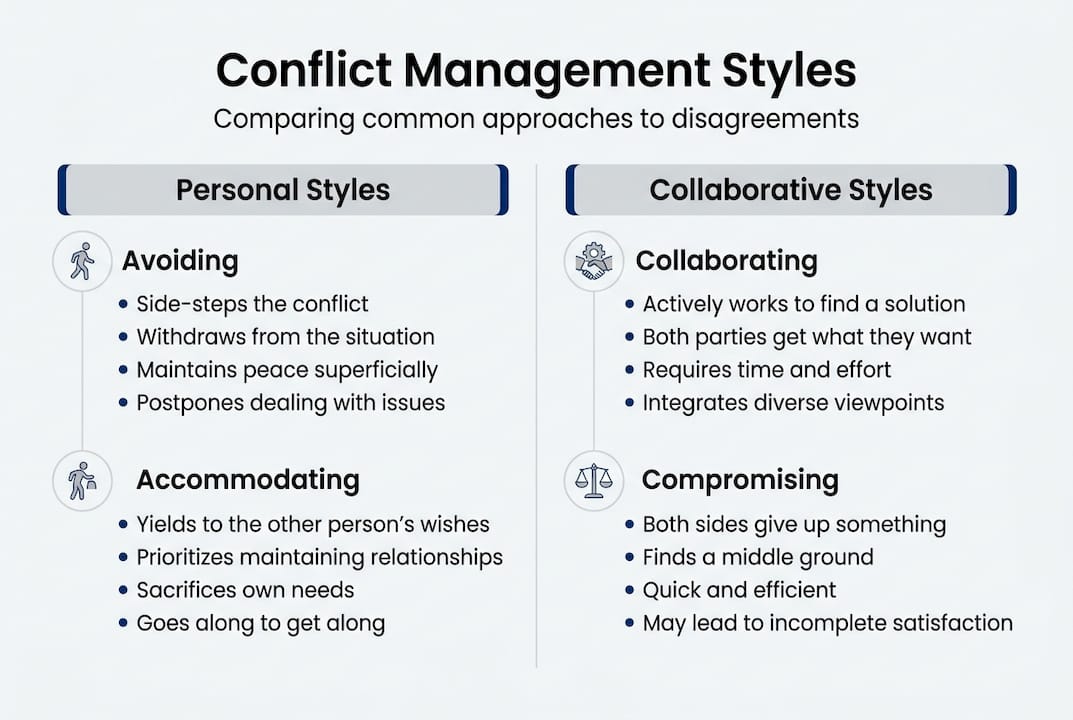
Now that you know what conflict management is, it is important to recognize the different styles people use to handle disagreements. There are several recognized approaches to managing conflict, including avoiding, accommodating, competing, compromising, and collaborating. Each one has its place, and each one carries both strengths and real drawbacks depending on when and how it is used.
Here is a quick comparison to help you see the full picture:
| Style | When it works best | Potential drawback |
|---|---|---|
| Avoiding | Minor issues not worth addressing | Problems grow when consistently ignored |
| Accommodating | Preserving peace in low-stakes situations | Your needs go unmet over time |
| Competing | Emergencies needing quick decisions | Damages trust and shuts others down |
| Compromising | Time-limited situations needing middle ground | Neither person fully satisfied |
| Collaborating | Complex issues where both needs matter | Requires time, energy, and willingness |
Most people develop a default style early in life, often based on what they witnessed growing up. If your household dealt with conflict by going silent, you likely learned to avoid. If arguments meant someone always had to win, you may lean toward competing. Recognizing your pattern is the first step toward changing it.
Steps to identify your primary conflict style:
- Think back to your last three significant arguments. What did you do first: pull back, push harder, give in, or try to find middle ground?
- Ask someone you trust how they would describe your behavior during disagreements. Outside perspective is often clearer than self-reflection alone.
- Notice your body’s response. Avoidance often shows up as shutting down. Competing shows up as heat, urgency, and a need to make your point immediately.
- Consider outcomes. Are your conflicts usually resolved? Does one person consistently feel unheard? The pattern reveals the style.
- Take a structured assessment or explore conflict management training to get a clearer picture with professional support.
Pro Tip: Most people shift styles depending on the situation. You might collaborate at work but default to avoiding at home, or accommodate with your partner but compete with your siblings. Knowing your tendencies in each context helps you adapt intentionally rather than react automatically.
Why conflict management matters for mental health and relationships
Knowing your conflict style is useful, but why does managing conflict really matter? The impact goes far beyond just resolving arguments. Research and clinical practice consistently show that how you handle disagreements shapes your emotional health, your relationship satisfaction, and even your physical well-being.

Here is a stark reality worth sitting with: ongoing, poorly managed conflict can contribute to anxiety, depression, and decreased relationship satisfaction. This is not just discomfort. Chronic, unresolved conflict creates a loop where stress hormones stay elevated, sleep suffers, connection erodes, and the emotional distance between partners or family members widens over time. Left unaddressed, it becomes a defining feature of the relationship rather than a solvable problem.
Emotional and relational benefits of effective conflict management include:
- Reduced anxiety because issues are addressed rather than stored
- Greater emotional intimacy when both people feel genuinely heard
- Improved communication that transfers across all areas of the relationship
- Increased trust because repair after conflict is possible
- Stronger self-esteem from knowing you can advocate for your needs respectfully
- Healthier co-parenting when children see conflict handled well
The contrast between unresolved and resolved conflict tells a clear story:
| Factor | Unresolved conflict | Resolved conflict |
|---|---|---|
| Mental health | Higher rates of anxiety and depression | Lower stress, improved mood |
| Relationship quality | Growing resentment and emotional distance | Deeper trust and connection |
| Physical health | Sleep disruption, elevated cortisol | Better sleep, lower stress response |
| Communication | Shutting down or escalating | Open, productive dialogue |
| Parenting impact | Children model unhealthy patterns | Children learn constructive skills |
Understanding unresolved conflict effects on relationships is often the wake-up call that motivates people to seek help. But you don’t have to wait for a crisis.
Watch for these signs that unresolved conflict may already be affecting your relationship: you find yourself dreading conversations with your partner, small disagreements spiral into old arguments, one of you frequently shuts down or walks away, there is a persistent sense of walking on eggshells, or physical symptoms like tension headaches or stomach problems appear before difficult conversations. These are signals worth taking seriously.
Building on that awareness, conflict resolution steps give you a structured path forward so those patterns can actually change, rather than just be identified.
Key conflict management techniques
Understanding why conflict management is important sets the stage for learning practical techniques. These are not theoretical concepts. They are behaviors you can practice starting today, in real conversations with real stakes.
Practical techniques such as active listening, using “I” statements, and scheduled breaks can transform unproductive conflict into solutions. Here is how to put them into a step-by-step process:
Step-by-step approach to handling conflict:
- Identify the real issue. Before you say anything, pause and ask yourself: what is this argument actually about? Often, surface arguments about dishes or schedules are really about feeling unappreciated or unseen. Naming the real issue changes the conversation.
- Create space to listen. Before responding, make a genuine effort to hear the other person out completely. No interrupting, no planning your rebuttal while they talk. Assertive communication skills include the ability to receive, not just express.
- Express your experience, not your accusations. Use “I” statements instead of “you” statements. “I feel dismissed when decisions are made without me” lands very differently than “You never include me.” One opens dialogue; the other triggers defensiveness.
- Brainstorm solutions together. This is where collaboration becomes active. Both people throw out possible approaches without immediate judgment. The goal is generating options, not selecting the winner.
- Agree on a specific, realistic solution. Vague agreements fall apart. Make the solution concrete. Who will do what, by when, and how will you both know it is working? Write it down if that helps.
- Check in after implementation. Many couples and families skip this step and wonder why the same issue resurfaces. A brief follow-up conversation a week later can catch problems before they grow.
Developing strong couple communication techniques takes consistent practice, not perfection. The goal is progress over time, not flawless execution in every argument.
Pro Tip: Schedule a weekly 20-minute check-in with your partner or family member to address smaller friction points before they pile up. Treating this like an appointment, not an optional activity, normalizes the idea that relationships require ongoing maintenance. Most couples only talk about problems when they have already hit a breaking point.
Knowing when to seek outside help is also part of the process. If you and your partner keep cycling through the same arguments without resolution, if anger regularly gets out of control, or if you notice emotional numbness or withdrawal becoming the norm, those are clear signals that conflict resolution skills may need to be built with professional support. A therapist or coach can help you identify blind spots, practice new patterns, and rebuild trust where it has been damaged.
A fresh perspective: Why embracing conflict can actually strengthen your bond
Here is the part most articles skip: the goal should never be a conflict-free relationship. That sounds ideal, but in practice, relationships with zero conflict usually mean one or both people have stopped being honest. Real intimacy requires the courage to disagree, and the safety to do so without fear of punishment or abandonment.
One of the most persistent myths in relationship culture is that healthy couples never argue. Clinical experience says the opposite. Couples who never argue are often couples where someone is consistently suppressing their needs. The suppression does not make conflict disappear. It stores it, and stored conflict tends to surface later with far more damage.
What actually strengthens a relationship is the process of working through disagreement with respect and intention. When two people can fight, stay in the room, listen to each other, and find their way back to connection, they build something that easy times never could: resilience. They learn that the relationship can survive difficulty. That safety becomes the foundation of genuine trust.
Consider a couple who started therapy in a state of constant gridlock, arguing about finances every week. What they discovered in sessions was that the arguments were never really about money. One partner grew up in scarcity and carried deep anxiety about financial security. The other grew up in a household where money was never discussed. Their conflict was a collision of two very different emotional histories. Once they understood why they were fighting, the fights themselves lost their grip. Understanding that dynamic through conflict resolution for families is often the turning point for lasting change.
Conflict, handled well, is not a sign that something is broken. It is proof that two real people with real needs are still engaged and still trying.
Finding support for your conflict management journey
You don’t have to figure this out alone. Learning to navigate conflict more effectively is real work, and having skilled support can accelerate your progress in ways that self-help alone often cannot.
At Mastering Conflict, we offer a range of services designed to meet you where you are. If you are not sure whether you need therapy or coaching, exploring the difference between coaching vs therapy can help clarify which path fits your situation. If anger is a recurring problem in your conflicts, starting with an anger management assessment gives you a clear picture of where to focus your energy. For individuals, couples, and families ready to go deeper, our clinical services provide evidence-based, professionally guided care. Take the next step when you are ready. Support is here.
Frequently asked questions
How is conflict management different from conflict resolution?
Conflict management focuses on handling disagreements constructively over time, while conflict resolution aims to fully resolve a specific issue. Management is an ongoing practice; resolution is a targeted outcome.
What is the best conflict management style for couples?
Collaboration is generally most beneficial because it prioritizes both people’s needs. Collaboration involves working together for solutions that benefit all parties, rather than one person winning at the other’s expense.
How can I tell if my arguments are harming my mental health?
Watch for persistent stress, trouble sleeping, anxiety before conversations, or emotional numbness toward your partner. Ongoing, poorly managed conflict can contribute to anxiety, depression, and decreased relationship satisfaction.
Can conflict management help with anger issues?
Yes. Learning structured conflict management techniques gives you tools to pause, regulate, and respond rather than react. Over time, this reduces both the frequency and intensity of anger responses during disagreements.
When should I seek professional help for conflict?
If repeated efforts at resolution leave you stuck, if conflict is affecting your sleep, your mental health, or your children, or if anger regularly feels uncontrollable, those are strong signs that working with a therapist or coach is the right next step.
Recommended
- Conflict Management Method: Enhancing Therapy Outcomes – Mastering Conflict
- Conflict Management Skills: Enhancing Therapy Outcomes – Mastering Conflict
- Master Conflict Resolution Skills for Real-Life Success – Mastering Conflict
- Conflict Management Training Courses: Skills for Real Life – Mastering Conflict