
Effects of Anger in the Workplace: Costs, Warning Signs, Fixes

Anger at work lowers performance, strains relationships, raises stress-related health risks and, at scale, drives absences and turnover. It is not always purely destructive: research shows anger can sometimes help people push for fairness or reach a goal. But that depends on how it is expressed and what happens afterward. This guide covers the effects on individuals, teams and organizations, the signs to watch for, and practical ways to handle it.
TL;DR
- Workplace anger is linked to weaker task performance, more withdrawal, more absences and higher turnover, in individuals and across teams.
- Chronic anger and workplace stress are tied to anxiety, depression, burnout and cardiovascular risk.
- Anger is not always harmful: the 2025 research suggests the way you cope (ruminating versus moving to action) matters more than the feeling itself.
- Taking a pause, naming the need behind the anger and using “I” statements are the most consistently recommended tools.
- If anger feels out of control or affects your job or relationships, it is time to talk to a professional.
Table of Contents
- How anger affects work performance
- Effects on teams and the organization
- Effects on mental and physical health
- Can anger at work ever help?
- What triggers workplace anger
- Warning signs in yourself and others
- How to manage anger at work
- Our perspective
- When to get professional help
- Anger management support from Mastering Conflict
- FAQ
- Sources
How anger affects work performance
The short version: anger tends to diminish functioning. The American Psychological Association’s book Anger at Work describes it as a source of reduced performance with negative consequences for individuals, teams and organizations, and notes the consequences are especially serious in high-risk jobs such as policing, firefighting and the military.
The largest body of evidence is on aggression, which is anger’s behavioral form. A meta-analysis of 405 articles covering 36 countries or regions (more than 149,000 people) found that workplace aggression harms task performance, citizenship behavior (the voluntary extra help that keeps teams running) and increases deviant behavior.
Anger also bends judgment. Writing in Harvard Business Review, Jennifer Lerner and Katherine Shonk explain that leftover anger from before work keeps coloring decisions without the person realizing it. A meeting that goes badly at 9 a.m. can quietly shape the choices someone makes at 3 p.m.
Three patterns show up again and again:
- Slower, narrower decisions. Angry people judge faster and with less care, and they rarely notice.
- Withdrawal. A 2018 study of incivility found that anger translated into lower feelings of empowerment and more job withdrawal, and that guilt predicted lower performance as rated by coworkers.
- Lost goodwill. People stop volunteering ideas, help and information to someone they find volatile.
Effects on teams and the organization
When anger is repeated or severe, the damage spreads past the person feeling it. A CPD Online overview lists a toxic environment, lower productivity, lower morale, strained team dynamics and more absences among the consequences.
The hardest numbers come from a CDC-hosted study of 1,136 employees across 21 stores of a U.S. retail organization. At the store level, anger had direct negative effects on inventory loss and turnover. It also partly explained how low perceived organizational support turned into turnover intentions, absences and on-the-job accidents. In other words, anger was a link in the chain between feeling unsupported and actually leaving, staying home or getting hurt.
Here is how the effects tend to stack up:
| Level | Common effects |
|---|---|
| Individual | Reduced focus, impaired judgment, withdrawal, stress, strained relationships |
| Team | Tension, less cooperation, less information sharing, lower morale |
| Organization | Absences, turnover, accidents, lost inventory, a reputation as a hard place to work |
Punishment is not a reliable fix. The Cornell FSAP guide on anger at work reports that researchers at the Fox School of Business found no positive effect on office morale when angry employees were punished or even fired. Teams do better when the cause is addressed and skills are built.
Effects on mental and physical health
Anger rarely stays at the office door. Anger, stress and burnout feed one another.
The International Labour Organization notes that high stress levels can contribute to exhaustion, burnout, anxiety and depression, along with physical problems such as cardiovascular disease and musculoskeletal disorders. It describes burnout as exhaustion from long-term involvement in emotionally demanding work, driven mainly by psychosocial factors such as heavy workload, unclear roles, poor relationships and workplace violence.
The heart is the best-studied example:
- A 2013 review found a 1.3-fold excess risk of coronary heart disease linked to workplace stress, and a pooled relative risk of 2.5 for acute coronary syndrome onset preceded by stress.
- A 2017 review reported that in the Jackson Heart Study, African Americans with high “anger-out” scores had a 20% increased risk of blood pressure progression compared with those with low scores. Anger-out means anger that is expressed outward rather than held in.
- In the retail study above, anger had direct and indirect effects on alcohol consumption and health-related risk taking.
These are associations, not guarantees for any one person. They are good reasons to treat chronic anger as a health matter and not just a personality quirk.
Can anger at work ever help?
Yes, in specific conditions, and an honest answer has to include them.
A 2025 Frontiers in Psychology study followed 214 full-time employees for two weeks (1,611 daily observations). It found no significant link between workplace anger and resource depletion, and a positive link between anger and goal achievement, depending on coping. Ruminative coping (replaying the grievance) was tied to more depletion and less goal attainment. Confrontative coping showed no significant association with either outcome. The authors suggest anger can help people reach goals, especially when they are well integrated in the organization and avoid rumination.
Other findings point the same way, with limits:
- Peter O’Connor, writing in The Conversation, says angry negotiators tend to get better outcomes, but usually only when they hold more power or the other side has poor alternatives. He also cites a 2016 study in which anger made leaders look more powerful but less effective, and made subordinates work harder but also act more deviantly.
- A 2023 meta-analysis of 67 studies found that expressing anger led to more negative evaluations of the person expressing it. Interpersonal anger improved recipients’ work performance but reduced their willingness to help others.
- Liz Fosslien and Mollie West Duffy write in SHRM that justified anger is healthier than fear because it brings certainty and control, while chronic venting makes both the venter and the listeners feel worse.
The practical takeaway: anger that points toward a specific fix can be useful. Anger that loops, explodes or gets aimed at people tends to cost more than it earns.
What triggers workplace anger
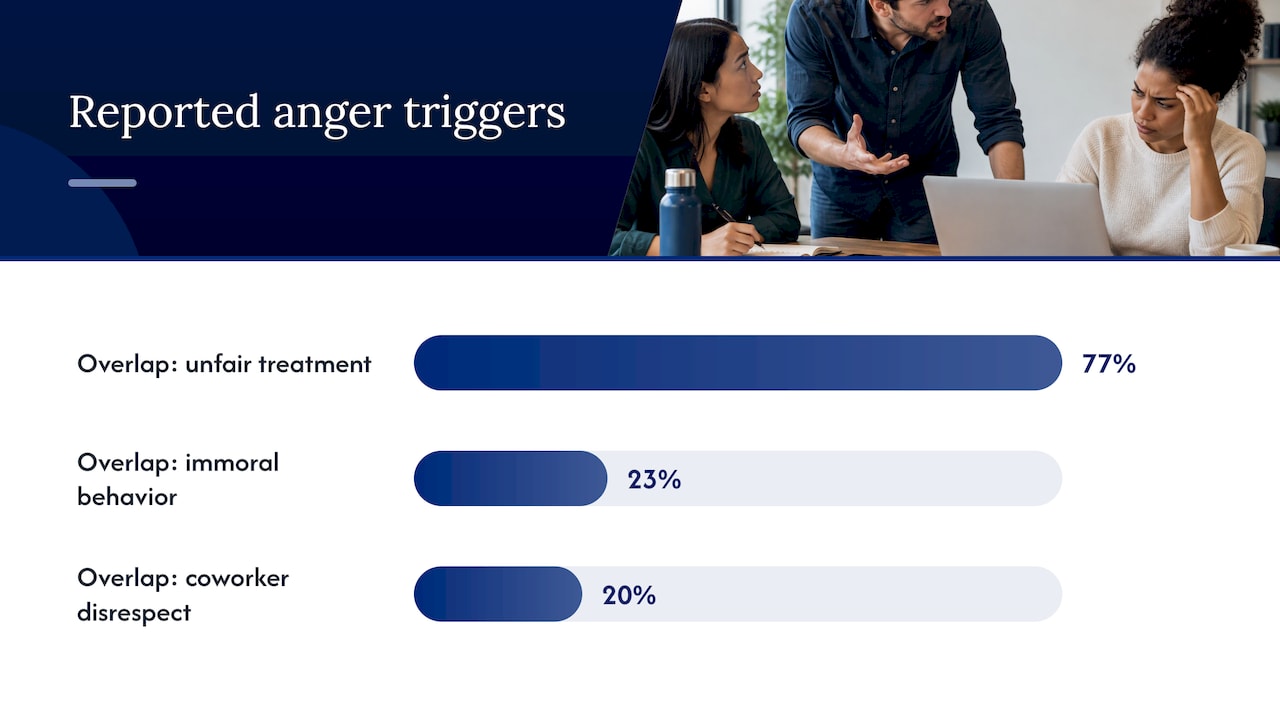
Knowing the cause is half the work. In an early Australian study cited by The Conversation, the most common trigger was being treated unfairly, reported by 77% of respondents. Another 23% cited immoral behavior like laziness or theft, and 20% cited disrespect by coworkers. Blocked goals, too little time or resources, and interpersonal conflict round out the list.
Stress-related causes overlap heavily. The Australian Psychological Society lists unrealistic deadlines, long hours, unclear roles, being passed over for promotion, poor supervisor support, bullying, micromanagement and office politics among the sources of workplace stress. Anger is often what stress looks like once it has nowhere to go.
We cover common triggers and employee anger patterns in more depth in our guide to anger management training for employees.
Warning signs in yourself and others
Cornell’s FSAP guide describes anger as three parts working together: physical reactions (faster heart rate, higher blood pressure, tight muscles, an adrenaline rush), the thought that something is wrong, unfair and undeserved, and behavior (raised voices, slammed doors, storming off).
Watch for these clusters:
- Body: a faster breathing rate, tense face and neck muscles, sweating, shaking hands, a flushed or pale face, according to a 2013 journal review on anger and the brain and body.
- Emotions: irritability, mood swings and defensiveness.
- Behavior: angry outbursts, changes in performance, absenteeism or showing up but checking out, withdrawal and impulsive or erratic actions. WorkSafe Victoria in Australia lists these among the warning signs of negative psychological responses.
A manager who sees these signs is better off starting with a private, calm conversation about what has changed than with a warning letter.
How to manage anger at work
The most consistent advice across sources fits into a short sequence.
- Acknowledge it. SHRM’s authors advise accepting that something real may have gone wrong and allowing yourself to feel angry, instead of pretending otherwise.
- Pause before acting. The University of York’s staff guidance suggests taking time out and saying you need a few minutes to think, deep breathing, or agreeing on a shared signal with colleagues.
- Skip the long vent. According to SHRM, psychologist Brad Bushman’s research found that doing nothing at all was more effective than punching a bag at defusing rage.
- Name the need underneath. Ask what triggered you, what feeling sits under the anger, and what step could help.
- Use an “I” statement. Once calm, try: “When you ___, I feel ___.” York’s guidance adds listening and reflecting back what you heard.
Calming the body first makes every other step easier. For a grounded take on this, see this guide to nervous system regulation, which covers how to notice and respond to your body’s alarm state rather than being run by it.
We lay out more step-by-step options in our posts on managing anger at work and anger reduction techniques.
For managers and HR
- Look at the system before the person. Unfair treatment, impossible workloads and unclear roles are common triggers, and fixing them lowers anger for everyone.
- Make it safe to say “I need ten minutes.”
- Offer skills training. Our overview of anger management for employees explains how it can build workplace harmony.
- Point people to professional support early, not after a crisis.
Our perspective
We see the same pattern in our work: people are rarely “angry people.” They are capable people whose anger has become the only tool they have for handling unfairness, pressure or hurt. The research above agrees that the feeling itself is not the enemy. What matters is the habit that follows it.
That is why we teach anger management as a skill set and not a character verdict. Our approach blends clinical rigor with practical tools you can use in the next meeting: spotting the early body signals, pausing, finding the need underneath, and saying it in a way that gets a result. We believe these skills are learnable at any age and in any job.
We also know that workplace anger is often tangled up with life outside work: strained marriages, family stress, burnout. Real change usually comes from addressing the whole picture, whether that is a class, individual counseling or coaching. If you recognize yourself in this article, taking a structured step is a strength, not an admission of failure.
Carlos
When to get professional help
MedlinePlus advises contacting your provider, a clergy member or a trusted friend if your anger feels out of control, affects your relationships or work, or you worry you might hurt yourself or others. If you ever fear you could harm someone, seek help right away and call 911 in an emergency.
Other good reasons to reach out: outbursts you regret, a pattern of conflict at several jobs, physical symptoms like pounding heart or headaches during arguments, or pressure from a supervisor or HR to address your behavior.
Anger management support from Mastering Conflict
We offer options for different needs and budgets. Our online anger management classes are available as a 1-hour class for $24.99, a 6-hour class for $79 and an 8-hour class for $85. Our group programs include a 4-hour program for $149 and an 8-hour program for $249.
If work stress is spilling into your relationship, we also offer couples sessions and packages, and individual counseling for men and women through our clinical services. Women facing burnout can explore our Women In Balance coaching program. Prefer to start at home? Our book Mastering Anger is a good first step.
FAQ
How do anger issues affect work performance?
Research links workplace anger and aggression to weaker task performance, less citizenship behavior and impaired judgment. A large meta-analysis found aggression harms performance across outcomes. Anger can also lead to withdrawal and absences, which pull performance down further.
What are the potential effects of workplace anger?
For individuals: stress, anxiety, burnout and strained relationships. For teams: tension, lower morale and less cooperation. For organizations: absences, turnover, accidents and lost productivity, as seen in a U.S. retail study of 21 stores.
Is there anger management for employees?
Yes. Skills-based classes teach people to spot triggers, pause, and communicate needs calmly. We offer self-paced online classes and group programs for adults, and you can read more on our page about anger management training for employees.
Can anger ever be useful at work?
Sometimes. A 2025 study found anger was linked to better goal achievement when people avoided ruminating on it. Anger that fuels a specific, calm request for fairness is more useful than anger that is vented or replayed.
Sources
- Anger at Work, American Psychological Association
- Workplace Aggression and Employee Performance: A Meta-Analytic Investigation
- How Anger Poisons Decision Making, Harvard Business Review
- The Emotional Aftermath of Incivility: Anger, Guilt, and Judgments about Harassment
- Anger in the Workplace, CPD Online
- Exploring Relationships Among Anger, Perceived Organizational Support, and Workplace Outcomes (CDC)
- FSAP: Anger at Work, Cornell University
- STRESS, International Labour Organization
- Stress and Cardiovascular Disease, Annual Review of Public Health
- Psychosocial factors and hypertension, PMC
- The daily relations between workplace anger, Frontiers in Psychology
- How to understand and harness your workplace rage, The Conversation
- The advantages and disadvantages of interpersonal anger, Acta Psychologica Sinica
- Viewpoint: How to Manage Your Anger at Work, SHRM
- Stress in the workplace, Australian Psychological Society
- Compliance code: Psychological health, WorkSafe Victoria
- The Effects of Anger on the Brain and Body, National Forum Journal
- Anger – Staff essentials, University of York
- Learn to manage your anger, MedlinePlus