
Confidence Skills: 6 Practical Ways to Build Them

Confidence skills are the learnable habits that let you trust your abilities enough to act: noticing your strengths, taking small steps toward things that scare you, talking to yourself fairly, speaking up clearly and recovering after a setback. You don’t have to wait until you feel confident to start. Confidence usually follows action, and the practices below show you where to begin.
TL;DR
- Confidence is a realistic belief in your abilities, not a personality trait you either have or lack, and it is separate from self-esteem.
- It grows from preparation, accomplishments, support and self-awareness, so you can build it deliberately.
- Six skills do most of the work: a strengths inventory, small steps, supportive self-talk, self-compassion, assertive communication and a feedback habit.
- Start with one skill for a week, then add the next. A 4-week plan is below.
- If anxiety, anger or a relationship problem keeps blocking you, working with a licensed clinician is a reasonable next step.
Table of Contents
- What confidence skills are
- Where confidence comes from
- Six confidence skills worth practicing
- Recognizing progress and recovering from setbacks
- A 4-week plan to start
- Our perspective
- When support makes sense
- Work on confidence with us
- FAQ
- Sources
What confidence skills are
The United Nations Office on Drugs and Crime describes confidence as a realistic inner sense of your capabilities and trust in your abilities. It links healthy confidence to decision-making, resilience, motivation, goal-setting and handling challenges. The word “realistic” matters. Confidence is not certainty that everything will go well. It is trust that you can handle what happens.
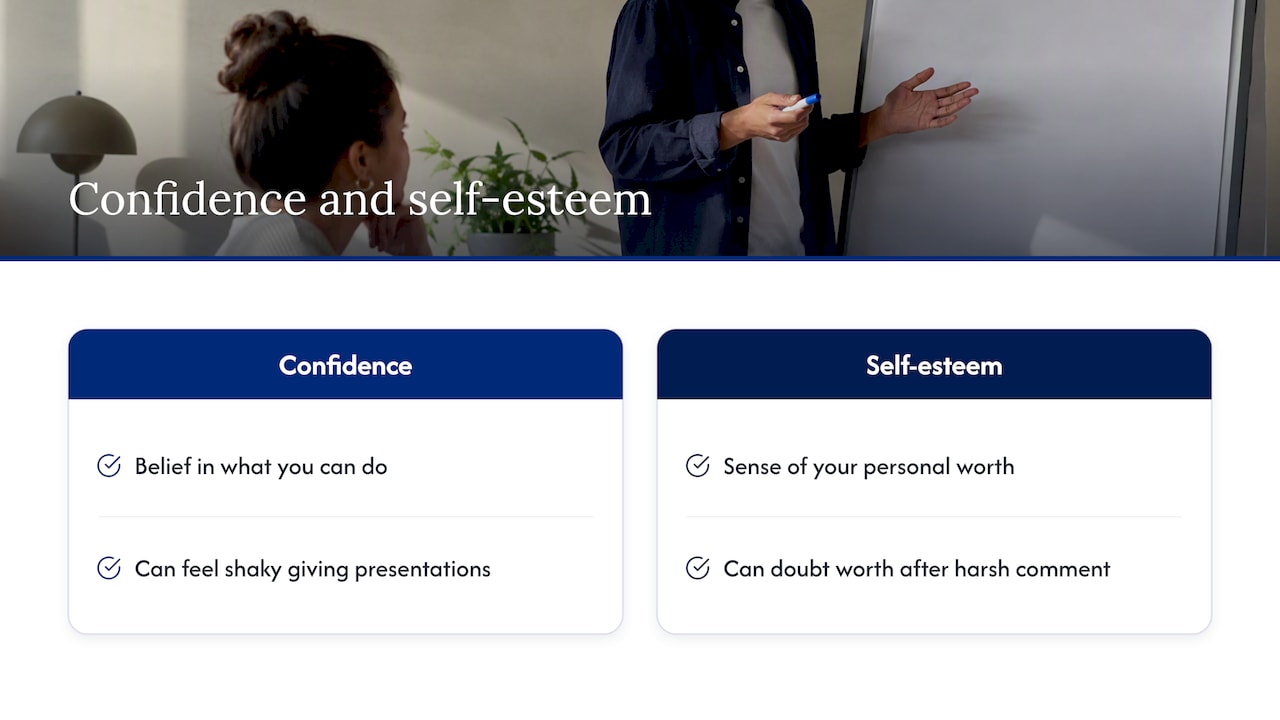
The Royal College of Nursing, in a 2026 guide on confidence as a skill, frames it as trusting your knowledge, abilities and judgment in a balanced way, while accepting both your strengths and your weaknesses. The same guide separates confidence from self-esteem. Confidence is about belief in what you can do. Self-esteem is about your sense of worth.
That distinction is useful in practice. You can feel confident as a driver and still doubt your worth after a harsh comment. You can also value yourself and still feel shaky about giving a presentation. Different problems call for different practice, and most of this article targets the first one: trust in your ability to act.
Why call it a skill
A skill improves with repetition and feedback. That is the best news in this topic. If confidence were a fixed trait, a bad week would be a verdict. As a skill, a bad week is data about what to practice next.
Where confidence comes from
Researchers who interviewed 14 successful world-class athletes identified nine sources of confidence: preparation, performance accomplishments, coaching, innate factors, social support, experience, competitive advantage, self-awareness and trust. The setting was elite sport, but several sources translate easily to work and relationships.
- Preparation: knowing your material or your plan before the moment arrives.
- Accomplishments: a record of things you have actually done.
- Social support: people who encourage you and tell you the truth.
- Self-awareness: knowing your strengths, your triggers and your patterns.
The sources do not matter equally to everyone. A 2021 study of 11 elite youth soccer players found that performance accomplishments, coaching, social support and preparation stood out for that age group and sport. So the useful question is not “what is the universal formula?” but “which source is thin for me right now?” If you rarely prepare, start there. If you have plenty of accomplishments but never register them, start with the inventory below.
A note on “the 5 C’s”
You may also see “the 5 C’s of confidence.” That phrase comes from youth development. Michigan State University Extension describes the five Cs as competence, confidence, connection, caring or compassion, and character, with contribution as a sixth. It is a framework for raising young people, not a checklist for adults, but it makes a fair point: confidence sits alongside competence and connection rather than replacing them.
Six confidence skills worth practicing
1. Take a strengths inventory
Most people with shaky confidence can list their flaws in seconds and struggle to list three strengths. The Royal College of Nursing recommends identifying your strengths, achievements, positive feedback and challenges you have already overcome, and also naming the areas you avoid or feel least sure about. The University of Southern California offers similar advice: list your skills, traits and accomplishments, and recall past successes.
Try this in 15 minutes:
- Write down five things you did in the past year that took effort, however small.
- Next to each, write the skill it required.
- Add any compliment or thank-you you remember receiving.
- Separately, list two or three situations you tend to avoid.
You now have evidence on one side and a practice map on the other. The NHS suggests keeping at least five positive items on a list like this and adding to it regularly, which is a good rule: keep the list somewhere you will see it.
2. Take small steps toward what scares you
The UNODC notes that completing activities builds confidence, so the practical route is to act, face a challenge and create chances to succeed even while you feel unsure. Waiting to feel ready reverses the order.
The trick is size. The Royal College of Nursing advises breaking a challenging goal into realistic small steps. For public speaking, its example is speaking up in team meetings before you lead one or give a presentation.
A ladder might look like this for someone nervous about speaking at work:
| Step | Action | Where it leads |
|---|---|---|
| 1 | Ask one question in a meeting | Hearing your own voice in the room |
| 2 | Offer a two-sentence update | Speaking without notes |
| 3 | Lead one agenda item | Holding attention briefly |
| 4 | Present for five minutes | The full goal |
Stay on each rung until it feels merely uncomfortable rather than frightening. Then move up. Preparation, one of the nine sources above, makes each rung easier.
3. Change how you talk to yourself
Self-talk is the running commentary that decides whether a mistake becomes a lesson or a verdict. Australia’s healthdirect suggests supportive phrases such as “I’ve handled challenges before,” “I can improve if I keep trying,” and “I can do this step by step.” It also recommends noticing automatic thoughts, pausing before you react, replacing fixed, harsh statements with neutral language and bringing your attention back to the present.
The NHS approach is more structured: write down a negative belief, then look for evidence against it. “I always embarrass myself” meets a list of times you didn’t.
There is research behind this. One study of distressed students with low self-esteem found that three sessions of either restructuring negative thoughts with thought records or rehearsing positive self-statements with daily flashcards produced clinically significant improvements that lasted at follow-up. That was a specific student sample, so treat it as encouraging rather than a guarantee.
Self-talk also works better when your body is calmer. Some strategies to reduce stress can lower the physical charge before you try to reason with a harsh inner voice.
4. Practice self-compassion, not self-criticism
Many people fear that being kind to themselves will make them lazy. The research points the other way. A 2019 meta-analysis of 27 randomized controlled trials found that self-compassion interventions improved 11 psychosocial outcomes compared with controls, with moderate effects on self-compassion, stress, depression, mindfulness, self-criticism and anxiety. The authors did note that the interventions varied and that publication bias was possible.
For younger people, a 2022 systematic review of 14 to 24 year olds linked higher self-compassion to lower anxiety and depression and pointed to reduced self-criticism as a likely reason. The evidence there is still emerging.
In plain terms: after a stumble, talk to yourself the way you would talk to a friend who made the same mistake. If you want a short daily routine, our guide to building self-compassion in 5 to 10 minutes a day walks through one. If the inner critic sounds like “everyone will find out I’m a fraud,” the 6-week plan for imposter syndrome addresses that pattern directly.
5. Speak up assertively
Confidence you only feel inside doesn’t help much if you can’t say what you need. Assertiveness is the outward skill. UNICEF recommends practicing assertiveness in small everyday situations, such as saying no politely and firmly, asking questions and weighing options rather than waiting for someone else to solve the problem. The NHS also lists practicing assertiveness among its ways to raise low self-esteem.
A simple structure for a hard conversation:
- Say what you observed, without judgment: “The deadline moved twice this week.”
- Say how it affects you: “I’m struggling to plan around it.”
- Make a clear request: “Can we agree on a fixed date by Friday?”
- Stay with the request if the first answer is deflection.
Pick low-stakes moments first: returning the wrong order, asking someone to repeat themselves, declining a small favor. For more scripts, see our guides on practicing assertiveness for confident communication and assertive communication in conflict.
6. Build a feedback habit
Other people are a source of confidence, and also a source of information. Ask one person you trust what they see as your strongest skill. Write the answer on your list. Specific feedback sticks better than general praise. UNICEF notes that specific, immediate positive feedback can build adolescents’ confidence and self-esteem, for instance praise for bravely sharing a difficult feeling. Adults respond to the same thing: “you explained that clearly” lands better than “good job.”
The habit runs both ways. When you give feedback, be specific and kind, and you make it easier for others to do the same. Our piece on giving constructive feedback covers how.
Recognizing progress and recovering from setbacks
Confidence rarely rises in a straight line. A strong week can be followed by a presentation that goes badly, and it is tempting to read that as proof you were fooling yourself. A few habits keep a setback in proportion:
- Keep a “done” list next to your to-do list. Progress is invisible when you only track what is left.
- Review the evidence, not the feeling. After a setback, ask what went well, what you would change and what you learned. Write one line for each.
- Repeat the step, smaller if needed. Dropping back one rung on your ladder is practice, not failure.
- Compare yourself with your past self. Comparison with others is a reliable way to feel worse, and USC’s guide advises avoiding it along with negative self-talk.
These are practical habits drawn from the approaches above rather than a clinical protocol. If a setback leaves you stuck for weeks, that is worth bringing to a professional.
A 4-week plan to start
Don’t try all six at once. One skill per week is enough.
| Week | Focus | Daily practice (5 to 10 minutes) |
|---|---|---|
| 1 | Strengths inventory | Add one item to your list of strengths and positive feedback |
| 2 | Small steps | Do one rung of your ladder, then note how it went |
| 3 | Self-talk and self-compassion | Catch one harsh thought, write a fairer version |
| 4 | Assertiveness and feedback | One small “no” or request, and ask one person for feedback |
At the end of week four, reread your list. That is your progress record.
Our perspective
In our work with individuals, couples and families, we rarely meet someone whose problem is a total absence of confidence. More often confidence is uneven. A person can be sure at work and silent at home, or direct with colleagues and unable to say a simple “no” to a parent. That is why we treat confidence and conflict as the same conversation. People who can’t voice a need tend to swallow it, and swallowed needs come out later as resentment, irritability or anger.
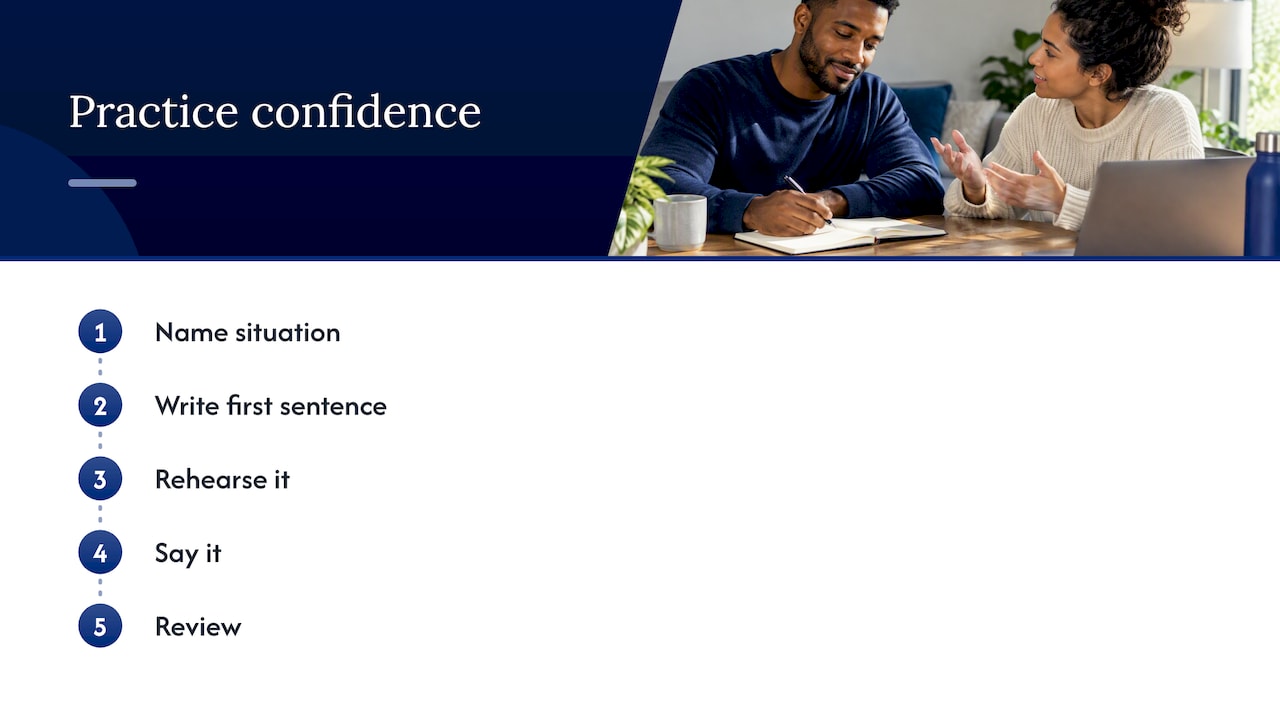
So we push clients toward the practical end of the spectrum: name a specific situation, write a first sentence, rehearse it, say it, then review. Small, repeated wins build trust in yourself faster than any amount of positive thinking. And we are cautious about advice that tells you to simply “fake it.” Acting before you feel ready is useful. Pretending you have no fear is not. The aim is to act with the fear present.
If you do this alone and keep hitting the same wall, that is information, not failure. Some patterns are easier to shift with a trained person across from you.
— Carlos
When support makes sense
Self-help works for ordinary dips in confidence. Consider seeing a licensed mental health professional if low confidence comes with persistent anxiety, low mood, panic, anger you struggle to control, or if it is damaging your relationship or your work. If you are in crisis or thinking about harming yourself, call or text 988, the Suicide and Crisis Lifeline in the US, or your local emergency number.
Work on confidence with us
We offer individual counseling for women, men and teens, couples counseling and online options through teletherapy. Many people come to us because a confidence problem shows up as conflict: they can’t speak up, or they speak up too late and too loudly. You can see everything we provide on our clinical services page, or explore teletherapy counseling if you prefer to meet from home. Women dealing with exhaustion and self-doubt at work may also want to look at our Women In Balance coaching program.

If you are not sure whether you need coaching or therapy, our page on coaching vs therapy explains the difference.
FAQ
What is the skill of confidence?
It is the ability to trust your own abilities in a realistic way, and to act on that trust. The UNODC describes it as a realistic inner sense of your capabilities. Like any skill, it improves with practice, feedback and repetition.
What are the 5 C’s of confidence?
The phrase comes from youth development. Michigan State University Extension lists competence, confidence, connection, caring or compassion, and character, with contribution as a sixth. It describes what helps young people thrive, and confidence is one part of it.
What are the 9 sources of confidence?
A study of 14 world-class athletes named preparation, performance accomplishments, coaching, innate factors, social support, experience, competitive advantage, self-awareness and trust. Which ones matter most varies by person, age and setting, so look for the one that is weakest for you.
Is confidence the same as self-esteem?
No. The Royal College of Nursing separates the two: confidence is belief in your abilities, while self-esteem is your sense of worth or value. They influence each other, but you can build one without the other, and the practices differ.
How long does it take to build confidence?
There is no fixed timeline, and we would distrust anyone who promised one. Many people notice small shifts within a few weeks of daily practice, such as speaking up once or catching a harsh thought. Larger changes build through repetition, and a clinician can help if progress stalls.
Sources
- Confidence, UNODC
- Confidence: the skill you can grow, Royal College of Nursing
- Building youth with the 5 C’s: Confidence, MSU Extension
- Sources and Types of Confidence Identified by World Class Athletes
- Elite Youth Soccer Players’ Sources and Types of Confidence
- Raising low self-esteem, NHS
- “Fake it until you make it”: Tips to boost your confidence, USC
- Self-talk, healthdirect
- Self-Statement Modification Techniques, APA PsycNet
- Self-Compassion Interventions and Psychosocial Outcomes: a meta-analysis
- A Review of Self-Compassion as an Active Ingredient, Springer
- How to help your teenage daughter succeed, UNICEF
- 11 tips for communicating with your teen, UNICEF
- How to Reduce Stress: 10 Effective Strategies