
Stop Relying on Willpower: Overcoming Procrastination With Emotion Work

Overcoming procrastination reliably requires two things at once: emotion-focused work like self-compassion and reframing, paired with instant behavior fixes like micro-steps and short focus intervals. Willpower alone rarely holds. Right now, set a timer for five minutes, write down the single next physical action for your most avoided task, and start that one step before your phone gets involved.
TL;DR:
- Address the emotional triggers behind procrastination by practicing self-compassion and reframing tasks to reduce shame and anxiety.
- Break vague tasks into specific, actionable steps that can be completed in under a minute to lower activation energy and ease starting.
- Schedule your most challenging tasks during your peak-energy hours to maximize focus and finish high-value work efficiently.
- Use environment strategies like templates, fixed communication times, and body doubling to minimize decision fatigue and sustain attention.
- Recognize when avoidance is rooted in mental health issues and seek professional support through therapy or counseling for persistent procrastination.
Table of Contents
- Why Do We Procrastinate? It’s Not Laziness
- How Do You Start a Task You Keep Avoiding?
- When Should You Schedule Your Hardest Tasks?
- Can Self-Compassion Actually Reduce Procrastination?
- What Environment Changes Make Focus Easier?
- What Do You Do When You Fall Back Into Old Habits?
- When Should Procrastination Become a Clinical Conversation?
- A Two-Week Plan Worth Actually Trying
- How Masteringconflict Supports Lasting Change
- Sources
Why Do We Procrastinate? It’s Not Laziness
Procrastination is not a character flaw. It’s what happens when a task triggers a feeling you’d rather avoid, and avoiding the feeling becomes more urgent than finishing the work. Research on the psychology of procrastination frames it as an emotion-regulation failure rather than a time-management flaw. That distinction changes everything about how you fix it. Telling yourself to “just start” ignores the anxiety, boredom, or self-doubt actually driving the delay, which is why pure discipline tactics burn out fast.
A useful way to locate the real block is the head, heart, hand framework, drawn from a neuroscientist’s diagnostic approach to chronic delay. Each category points to a different fix.
- Head problems are cognitive: the task is vague, you don’t know the first step, or you’re overwhelmed by scope. A grant proposal with no outline is a head problem.
- Heart problems are emotional: fear of failure, perfectionism, or dread of judgment. Avoiding a difficult conversation with a business partner is usually a heart problem.
- Hand problems are practical: you lack a skill, a tool, or the right environment. Putting off a spreadsheet you don’t know how to build is a hand problem.
Before you reach for any technique, ask yourself a few diagnostic questions:
- Do I not know what to do next, or do I know exactly what to do and still avoid it?
- Does think about this task trigger dread, boredom, or shame?
- Am I missing a skill, tool, or resource I need to actually complete this?
- Have I done something similar before, or does this feel genuinely unfamiliar?
Match the fix to the category. Clarity tools solve head problems. Self-compassion and reframing solve heart problems. Skills, support, or environment changes solve hand problems, according to the same emotion-regulation research. Using a head fix on a heart problem, like making a stricter to-do list when you’re actually afraid, just adds pressure to an already-avoided task.
How Do You Start a Task You Keep Avoiding?
Starting is the hardest part of any avoided task, and most people try to solve it by getting more motivated. That’s backwards. The fix is lowering the activation energy required to begin, not waiting to feel ready.
Turn vague tasks into a next action. “Work on the report” is not a task, it’s a category. Your brain can’t execute a category. Break it down until you reach something you could do in under a minute: open the document, write one sentence describing what the report needs to prove, or pull up last quarter’s version as a template. Academic productivity guides consistently point to this next-action habit as one of the most reliable starting tactics because it removes the decision-making that stalls people before they even begin.
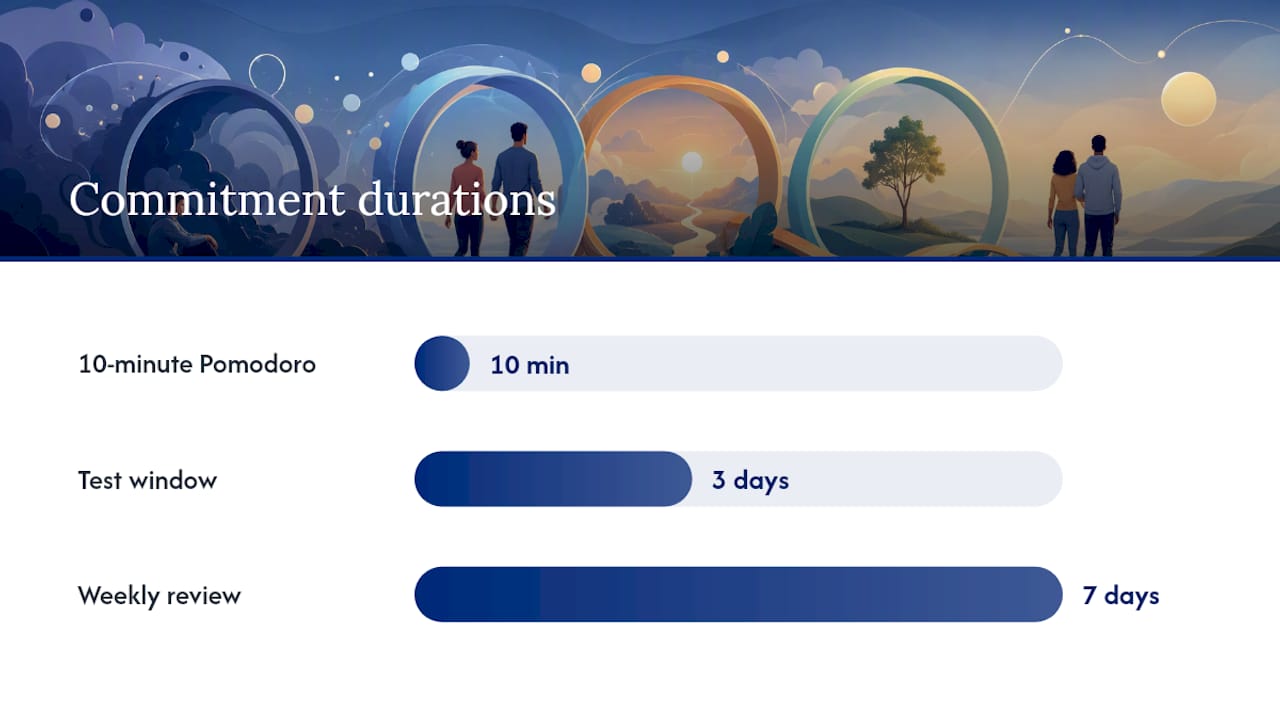
Use the Pomodoro Technique to protect momentum once you start. The standard version runs 25 minutes of focused work followed by a five-minute break, a rhythm Cleveland Clinic’s guidance on procrastination recommends because it keeps mental energy from draining over long, undivided stretches. If 25 minutes still feels intimidating, shrink it. A 10-minute Pomodoro is a legitimate variant for tasks you’ve been avoiding for weeks. If you’re in a flow state at the 25-minute mark, extend to 45 or 50 before you break. The interval is a floor, not a rule.
Here’s a quick-start plan you can run today and repeat tomorrow:
- Pick one avoided task and write its next physical action in one sentence.
- Set a timer for 25 minutes (or 10, if the task feels heavy) and work only on that next action.
- Take a five-minute break, then decide whether to do one more interval or stop for the day.
Pro Tip: Keep a running list of “next actions” for every stalled task, updated at the end of each work session. Starting tomorrow’s Pomodoro becomes automatic when the decision of where to begin is already made.
When Should You Schedule Your Hardest Tasks?
Timing matters as much as technique. Doing your hardest thinking during your lowest-energy hours is a losing bet no matter how good your task list looks. James Clear’s writing on productivity makes the case that managing energy, not just managing time, is what separates people who consistently finish demanding work from those who grind through it inconsistently.
Start by identifying your peak-energy window, the one to three hours a day when your focus is naturally sharpest. For most people it falls in the late morning, though some genuinely think best at night. Track it for a week if you’re not sure. Protect that window for your single most important task of the day, the one thing that actually moves a project forward, not the one that feels most urgent.
Energy valleys, usually right after lunch or late in the afternoon, are for lower-stakes work: email, filing, scheduling, anything that doesn’t require deep problem-solving.
A simple time-block template for one workday:
- Morning peak window: one deep-focus block on your highest-value task, broken into Pomodoro intervals.
- Midday valley: admin, email, quick calls.
- Afternoon block: a second priority task if energy allows, otherwise lighter follow-up work.
- End of day: five minutes to name tomorrow’s first next action.
The prioritization rule is simple: one high-value task per deep block, chosen before the day starts, not decided in the moment when your energy is already spent deciding.
Can Self-Compassion Actually Reduce Procrastination?
Yes, and the mechanism is specific. Harsh self-criticism after procrastinating creates a shame spiral that makes the next avoidance more likely, not less. Guidance on procrastination psychology links higher self-compassion to lower procrastination, because self-compassion interrupts that negative emotion loop before it drives you further into avoidance.
A short self-compassion script for the moment you notice you’ve been avoiding something: “This is hard right now. Plenty of people struggle with this exact kind of task. What’s one small thing I can do for myself before I try again?” Say it in your own words. The point is breaking the shame reflex, not reciting a script.
Reframing the task itself for meaning also matters. Ask three quick questions before you start: What does finishing this actually make possible? Who benefits if I do this well? What would future me thank present me for doing right now?
That last question connects to a specific exercise: future-self visualization, where you spend two minutes concretely imagining the relief or benefit your future self feels after the task is done. It sounds soft, but the underlying research on self-compassion and reappraisal treats meaning-finding as a genuine motivation lever, not a feel-good add-on.
- Name the emotion driving the avoidance before trying to push through it.
- Use the self-compassion script the moment shame shows up.
- Reframe with the three meaning questions before starting, not after.
- Visualize future-self relief for two minutes when motivation is lowest.
Self-compassion, in short, does something willpower can’t: it removes the emotional cost that made starting feel dangerous in the first place.
What Environment Changes Make Focus Easier?
Willpower is finite; environment design isn’t. The fewer decisions your environment forces on you, the more focus you have left for the actual task.
Reduce decision friction by building defaults. Keep a template for recurring documents so you’re never starting from a blank page. Set a “finish your day” ritual, five minutes spent writing tomorrow’s first next action, so you never open your laptop wondering where to begin.
Cluster communications instead of reacting to them all day. Check email and messages at two or three fixed times rather than continuously, and protect your peak-energy block from interruptions entirely. Meetings belong in your energy valleys whenever you have the scheduling power to put them there.
Body doubling is one of the more underused tools here. It means working alongside another person, in person or on a video call, without either of you helping with the other’s task. Reporting on enduring productivity strategies describes it as a gentle anchor for focus, particularly effective for people who struggle with sustained attention. You can implement it as simply as scheduling a 30-minute virtual co-working call with a colleague or friend, both of you muted, both working.
- Build templates for recurring tasks so you skip the blank-page decision.
- Set a five-minute end-of-day ritual to name tomorrow’s first action.
- Batch email and messages into two or three fixed check-in times.
- Try a 30-minute virtual co-working session as your first body-doubling experiment.
Caregivers juggling their own responsibilities alongside someone else’s often feel this friction hardest; recognizing the signs of caregiver burnout is worth doing before exhaustion turns into full avoidance.
What Do You Do When You Fall Back Into Old Habits?
Relapse is not failure, it’s data. The pattern usually looks the same: a stressful week, one skipped Pomodoro, then a slide back into the exact avoidance you’d been managing. Respond to it the way you’d coach a friend, not the way you’d punish yourself.
Treat each fix as a tiny experiment rather than a permanent verdict on your character:
- Form a hypothesis (“A 10-minute Pomodoro will get me started on this report”).
- Test it for three days.
- Measure honestly: did you start, did you finish the interval, how did it feel?
- Iterate: shorten, lengthen, or swap the tactic based on what you observed.
Habit stacking helps make the wins stick. Attach a new tactic to something you already do daily, like doing your first next-action review right after your morning coffee. A short weekly review checklist keeps the whole system honest:
Pro Tip: Every Friday, ask yourself which task you avoided most this week, which head/heart/hand category it falls into, and which single tactic you’ll test against it next week.
When Should Procrastination Become a Clinical Conversation?
Self-help tactics solve most procrastination, but chronic avoidance tied to anxiety, depression, or relationship conflict often needs more than a better system. Dr. Carlos Todd, a licensed clinical mental health counselor and psychologist and founder of Masteringconflict, works with individuals whose avoidance patterns have become entrenched enough to affect work, relationships, or daily functioning.
Clinicians commonly draw on cognitive behavioral therapy to challenge distorted thinking, behavioral activation to rebuild momentum through small scheduled actions, and motivational interviewing to work through ambivalence about change. A first appointment usually starts with an assessment of what’s actually driving the avoidance before any tactic gets assigned. If procrastination is paired with persistent low mood, panic around specific tasks, or conflict at home, that’s a signal worth bringing to a professional rather than managing alone.
A Two-Week Plan Worth Actually Trying
Pick one Pomodoro a day, one self-compassion script when shame shows up, three tasks broken into micro-steps, and one accountability check-in with a body-doubling partner. Run it for two weeks before judging whether it worked.
Progress here is never linear. Expect a skipped day, a bad week, a slide back into old avoidance. That’s the process working, not failing. What matters is returning to the experiment, not achieving a streak.
— Carlos
How Masteringconflict Supports Lasting Change
When procrastination is really avoidance in disguise, tactics alone eventually stall, and that’s where working with someone trained to address the underlying emotion pays off faster than another productivity app. Masteringconflict offers a direct path forward for readers whose avoidance patterns have become chronic rather than occasional.

An anger management assessment can clarify whether frustration or conflict avoidance is fueling the procrastination in the first place, particularly for tasks tied to difficult conversations. Couples counseling helps when procrastination shows up as avoided joint decisions, unfinished shared projects, or stalled conversations between partners. For readers who want flexible, remote support, teletherapy sessions bring the same clinical tools, cognitive behavioral techniques, behavioral activation, motivational interviewing, directly to a video call on your schedule. If stress at work is part of what’s driving the avoidance, this guide to stress management for professionals is a useful next read. Book a consultation with Masteringconflict to find the approach that actually fits what’s behind your avoidance.
Sources
- How to stop procrastinating — Cleveland Clinic
- Productivity — James Clear
- How to think differently about procrastination and make progress — Psyche Guides
- A neuroscientist’s 3-step strategy for overcoming procrastination — CNBC
- The real reasons you procrastinate — The Conversation