
How to Apologize Effectively: A Relationship-Repair Guide

A genuinely effective apology does six things: it acknowledges the harm, accepts responsibility, expresses remorse, offers repair, commits to change, and creates space for the other person to respond. Research confirms that simply saying “I’m sorry” without any of those elements rarely repairs trust. Here is what each one means in practice:
- Acknowledge the harm. Name what you did, specifically. “I missed your graduation” lands harder and truer than “I wasn’t there for you.”
- Accept responsibility. Own it without hedging. No “if you were hurt” or “I’m sorry you felt that way.”
- Express remorse. Show you understand the impact, not just the act.
- Offer repair. Ask what would help, or propose something concrete.
- Commit to change. Describe one specific thing you will do differently.
- Listen. Stop talking and let the other person respond on their own terms.
Your immediate action checklist: name the offense, say “I was wrong,” state the impact you caused, ask what repair looks like, name one behavioral change, then go quiet.
Pro Tip: Before you open your mouth, notice the urge to explain yourself first. That reflex is your defensive self-image protecting you. Recognize it, set it aside, and lead with acknowledgment instead. The explanation, if it’s needed at all, comes later.
Key Takeaways
A genuine apology requires six specific elements, and accepting responsibility is the single most critical one.
| Point | Details |
|---|---|
| Six elements are required | Acknowledge harm, accept responsibility, express remorse, offer repair, commit to change, and listen. |
| Responsibility is the core | Accepting responsibility is the single most important component; hedging or “but” statements destroy credibility. |
| Timing and setting matter | Prompt, private apologies restore trust faster than delayed or public ones in most personal contexts. |
| Words need follow-through | Amends and behavioral change, not just words, are what prevent the same harm from recurring. |
| Masteringconflict can help | Clinical services and courses at Masteringconflict support people who need structured help changing patterns that make sincere apologies difficult. |
Table of Contents
- How to deliver an effective apology step by step
- What does an effective apology actually sound like?
- When and where should you apologize?
- How to make amends and show real follow-through
- Tailoring apologies: competence mistakes, integrity mistakes, and public settings
- Common apology mistakes that sabotage reconciliation
- Psychologist-backed practice: roleplay prompts and a rehearsal checklist
- What are the psychological benefits of apologizing?
- How do cultural differences affect apology expectations?
- What real repair looks like in practice
- When coaching or therapy can help you apologize and change
- Sources
How to deliver an effective apology step by step
Knowing the six elements is one thing. Delivering them in a real conversation, when emotions are running high, is another. Here is a practical sequence you can follow.
Prepare before you speak. Write down what you did, why it was harmful, and what you want to say. This is not about scripting every word; it is about getting clear on the facts so you do not fumble into defensiveness mid-sentence.
Choose the right setting. Private, calm, and distraction-free. Not over text, not in a crowded restaurant, and definitely not right after a fight when both of you are still flooded.
Open with acknowledgment, not context. Your first sentence names the offense. “I want to apologize for canceling on you last minute without any explanation.” Not “I’ve been so stressed lately, and I know I’ve been dropping the ball.”
Take responsibility in plain language. Accepting responsibility is the single most critical component of an effective apology. Say “I was wrong” or “That was my fault.” Full stop.
Express remorse by naming the impact. “I imagine that felt dismissive, and that’s the last thing I wanted you to feel.” This shows you thought about their experience, not just your own discomfort.
Offer repair and commit to change. Ask: “What would help make this right?” Then add one concrete behavioral commitment. Not “I’ll try to do better,” but “I’m going to set a reminder so this doesn’t happen again.”

Invite their response and then listen. Allowing the injured person to speak and including multiple apology components significantly raises the chance of reconciliation. Ask “How are you feeling about all of this?” and resist the urge to fill the silence.
Phrases that help vs. phrases that hurt
Use these:
- “I was wrong to…”
- “I understand why that hurt you.”
- “What can I do to make this right?”
- “I’m committed to changing…”
Avoid these:
- “I’m sorry but…” (the “but” erases everything before it)
- “Mistakes were made.” (Passive voice reads as insincere)
- “I’m sorry you feel that way.” (shifts blame to the recipient)
- “Can you just forgive me?” (pressures rather than invites)
On timing: A prompt apology signals that you take the harm seriously. If you need a day to process before you can apologize without getting defensive, that is fine. Tell the other person: “I want to apologize properly. Can we talk tomorrow evening?” That buys time without abandoning the repair.
What does an effective apology actually sound like?
Small wording choices make a dramatic difference. Here are four common scenarios with side-by-side examples.
| Scenario | Ineffective wording | Effective wording | Why it works |
|---|---|---|---|
| Partner/romantic | “I’m sorry if I made you feel ignored.” | “I ignored your calls for two days. That was wrong, and I understand why you felt shut out. What would help right now?” | Names the act, owns it, expresses impact, offers repair |
| Close friend | “Sorry, I’ve just been really busy lately.” | “I forgot your birthday, and that matters. You deserved better from me. Can I take you to dinner this week?” | Drops the excuse, acknowledges what the friend deserved |
| Coworker/professional | “Mistakes were made on the report.” | “I submitted the report with errors that cost the team extra work. I should have proofread it. I’ll fix it today and build in a review step going forward.” | Active voice, specific corrective action, no passive deflection |
| Parent/child | “I’m sorry you got upset when I yelled.” | “I yelled at you, and that was wrong. You didn’t deserve that. I’m working on handling my frustration differently.” | Child hears ownership, not blame-shifting; models emotional accountability |
A few notes on customizing these scripts. Tone should match the relationship: a coworker apology is more formal and solution-focused; a partner apology can be warmer and more emotionally explicit. Length matters too. A brief professional apology that drags on starts to feel performative. For cross-cultural contexts, see the section below on cultural differences, because what counts as sufficient acknowledgment varies considerably across communities.
When and where should you apologize?
The core guideline: Apologize when you caused harm or created a reasonable perception of harm, even if that was not your intent. Intent does not cancel impact.
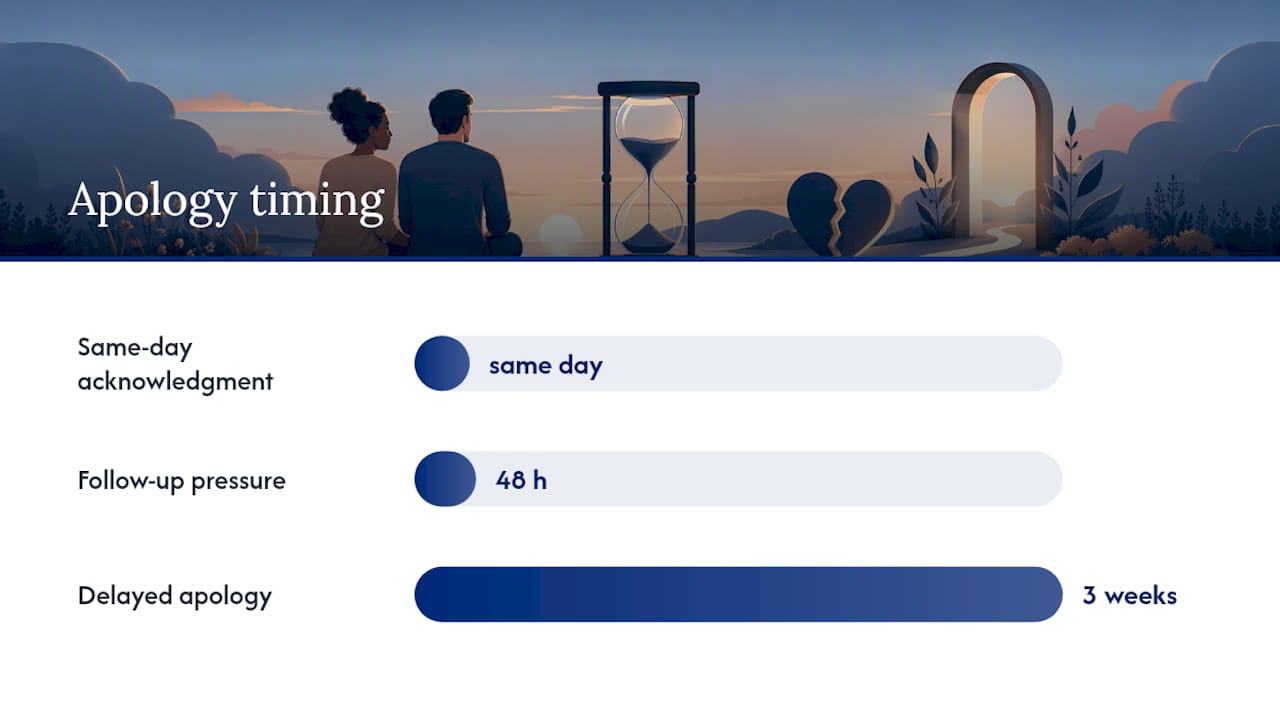
Timing matters more than most people realize. Speed, candor, and concrete corrective action restore trust faster than a delayed, polished apology. A quick, genuine acknowledgment the same day beats a carefully worded letter three weeks later.
Private vs. public apologies:
- Apologize privately when the offense was personal or relational.
- Apologize publicly when the harm was public (a social media post, a workplace announcement, a group meeting) and the affected person has consented to that format.
- In workplace settings, loop in HR or a manager only when the offense involved a policy violation or affected the broader team.
When to pause before apologizing:
- You are still too activated to speak without escalating.
- You need to gather facts first (apologizing for something you did not actually do erodes your credibility).
- The other person has asked for space.
When NOT to apologize:
- When you are being pressured to apologize to keep the peace rather than because you caused harm. Hollow apologies undermine trust rather than rebuild it.
- In situations involving abuse dynamics, where an apology cycle may reinforce harmful patterns.
- When legal liability is involved. Consult an attorney before making any admission of fault in writing or in a formal setting.
Pro Tip: If the other person says they need time, honor it. “I’ll be here when you’re ready” is more respectful than following up every 48 hours. Pressure converts your apology into a demand.
How to make amends and show real follow-through
Words are the start, not the finish. Costly reparations, whether time, money, or public corrective action, often matter more than words alone when the harm was significant. Here is how to move from saying sorry to actually repairing things.
Ask what repair looks like to them. Do not assume. “What would help you feel like this is actually being addressed?” gives the injured person agency and often surfaces something more specific than what you would have guessed.
Practical amends examples:
- Repairing or replacing damaged property.
- Financial restitution when money was lost or wasted.
- Publicly correcting a false statement you made about someone.
- Scheduling regular check-ins to demonstrate you are following through on a behavioral commitment.
- Entering therapy or an anger management program when a pattern of behavior is the issue.
Building accountability into behavior change:
- Name the specific behavior you are changing, not just the outcome you want.
- Set a measurable timeline (“I will not cancel plans without 48 hours’ notice for the next three months”).
- Tell a trusted third party about your commitment so there is external accountability.
- Check back with the person you harmed after two to four weeks to ask how things feel from their side.
- If the pattern is deeply ingrained, consider working with a coach or therapist who can track progress with you.
Follow-up behavior is what prevents repetition. An apology without changed behavior is a promise, and a broken promise compounds the original harm.
Tailoring apologies: competence mistakes, integrity mistakes, and public settings
Not all offenses are the same, and the apology approach should reflect that.
Competence vs. integrity mistakes. A competence mistake is a skill or judgment failure: you miscalculated a budget, forgot an important date, or gave bad advice. An integrity mistake is a values failure: you lied, betrayed a confidence, or acted selfishly at someone else’s expense. Research from Harvard’s Program on Negotiation shows that for competence errors, accepting sole responsibility and explaining what went wrong restores trust most effectively. For integrity errors, a brief truthful external explanation can sometimes help, but only if it genuinely contextualizes rather than excuses. The difference is thin, and most people can feel it.
When a brief explanation helps:
- It is factually relevant and short (one sentence).
- You preface it clearly: “This is not an excuse, but I want you to understand the context.”
- You return immediately to ownership after stating it.
Pro Tip: If you find yourself spending more than one sentence on context, you have crossed from explaining into justifying. Cut it back.
Public apologies require extra care. A public statement that is vague or performative often does more damage than a private one. If you are apologizing in a professional or organizational context, involve the affected parties in shaping the message before it goes out. A statement that surprises the person you harmed is not an apology; it is a PR move.
A brief legal note: In contexts where litigation is possible, such as a workplace incident, a car accident, or a business dispute, consult legal counsel before making any written or formal admission of fault. An apology can be sincere and still be strategically timed.
Common apology mistakes that sabotage reconciliation
Even well-intentioned apologies fail. Here are the most common ways they go wrong, and how to recover if yours already did.
- Hedging with “if.” “I’m sorry if I hurt you” implies you are not sure you did. Replace with “I’m sorry I hurt you.”
- The “but” reversal. Everything before “but” gets erased. “I’m sorry I was late, but traffic was terrible” is not an apology.
- Passive voice. “Mistakes were made” names no one and owns nothing. Use active voice and a first-person subject.
- Demanding forgiveness. Pressuring for forgiveness converts the apology into a self-serving transaction and often backfires. Forgiveness is the recipient’s to give on their own timeline.
- Minimizing. “It wasn’t that big a deal” tells the other person their pain is wrong.
- Over-apologizing when not at fault. Apologizing reflexively for things you did not do trains others to expect it and dilutes the weight of your genuine apologies.
If your first apology failed: A bad apology can worsen the relationship, but a follow-up that acknowledges the failure can recover more trust than silence. Say: “I’ve been thinking about how I apologized, and I don’t think I did it well. I got defensive, and that wasn’t fair to you. Can I try again?” That kind of meta-apology, an apology for the apology, signals genuine self-awareness and often lands better than the original attempt.
Psychologist-backed practice: roleplay prompts and a rehearsal checklist
Structured practice increases apology effectiveness. Rehearsing out loud, even alone, helps you hear where you slip into hedging or justification before you are in the actual conversation.
Reflection questions to answer before you apologize
- What exactly did I do, and when?
- What impact did it likely have on the other person emotionally?
- What would I want to hear if the situation were reversed?
- What specific change am I genuinely prepared to commit to?
Roleplay prompts
Ask a trusted friend to play the role of the person you harmed. Give them permission to push back. Run through your apology once, then ask: “Did I hedge anywhere? Did I get defensive? Did I actually listen, or did I just wait to talk?”
Watch for these in the feedback:
- Any sentence that started with “but” or “I was just…”
- Moments where you explained before you acknowledged.
- Whether you asked what repair would look like, or assumed.
One-page rehearsal checklist
- Name the specific offense out loud.
- Say “I was wrong” or “That was my fault.”
- Describe the impact on the other person.
- Offer one concrete repair action.
- State one specific behavioral change.
- Ask: “How are you feeling? What would help?”
- Listen without interrupting.
Simple, concrete steps like these are widely recommended by relationship and mental health organizations precisely because they prevent the most common derailments.
Pro Tip: Record yourself on a voice memo running through the checklist. You will immediately hear the hedges, the passive constructions, and the moments where your tone shifts defensive. One listen is usually enough to fix them.
What are the psychological benefits of apologizing?
Apologizing is not just good for the relationship. Peer-reviewed research links structured apology components to increased forgiveness and reduced retaliation in interpersonal contexts, though effects vary by situation and study design.
For the person apologizing, the act of owning a mistake tends to reduce guilt, restore a sense of integrity, and lower the psychological cost of carrying unresolved conflict. Chronic unresolved guilt is associated with rumination and stress. Naming what you did and committing to change interrupts that cycle.
For the recipient, receiving a genuine apology validates their experience. It signals that the harm was real, that the other person sees it, and that the relationship is worth protecting. That validation alone, separate from any concrete repair, can reduce anger and open the door to rebuilding trust. Forgiveness, when it comes, tends to follow acknowledgment, not demands.
How do cultural differences affect apology expectations?
What counts as a complete apology varies significantly across cultures, and misjudging that can make a sincere effort land as dismissive.
In many East Asian cultural contexts, apologies tend to emphasize social harmony and group face-saving. The expression of remorse and the restoration of relational balance often matter more than a detailed accounting of individual fault. In contrast, many Western, particularly American, cultural norms place high value on explicit individual accountability: naming the act, owning it personally, and describing corrective steps.
Within the United States, apology norms also vary by community, family system, and religious background. For some communities, forgiveness carries a spiritual dimension that shapes both what an apology should include and how forgiveness is understood. Acknowledging that dimension, rather than treating apology as a purely transactional exchange, can matter enormously.
A practical approach: when you are uncertain about what the other person needs, ask. “Is there anything specific you need to hear from me?” is not a sign of weakness. It is a sign that you are prioritizing their experience over your own comfort.
What real repair looks like in practice
Most people who struggle to apologize are not bad people. They are people whose self-image feels threatened by admitting fault. The defensive reflex, the urge to explain, minimize, or redirect, is almost universal. What separates a repairing apology from a failed one is usually not eloquence. It is the willingness to sit with discomfort long enough to let the other person feel heard.
In clinical work, the apologies that actually move relationships forward share one quality: the person apologizing is more focused on the other person’s experience than on managing their own. That shift in focus, from “how do I get out of this” to “what does this person need from me,” changes everything about how an apology sounds and lands.
Forgiveness is the recipient’s choice, made on their timeline. Your work is to make sincere repair, follow through on what you committed to, and give the other person room to process. If the checklist in this guide feels awkward the first time you use it, that is normal. Use it anyway.
When coaching or therapy can help you apologize and change
Some patterns are hard to break alone. If you find yourself apologizing for the same behavior repeatedly, struggling with anger management, or unable to admit fault without getting defensive, that is not a character flaw. It is a signal that the underlying pattern needs more than good intentions to shift.

Masteringconflict offers clinical services and coaching programs designed for exactly this situation: people who want to repair relationships and change the behaviors that keep damaging them. Whether you need structured conflict resolution courses, individual therapy, or couples counseling, the work is grounded in evidence-based approaches and delivered with confidentiality. If you are not sure whether coaching or therapy is the right fit, the coaching vs. therapy comparison on the site walks you through the difference clearly. Book an assessment and start with a real conversation about what change looks like for you.
Sources
These are the sources used throughout this guide, each worth reading in full if you want to go deeper.
- When an apology is most effective (PON, Harvard)
- The good apology (Wharton at Work)
- The art of a heartfelt apology (Harvard Health)
- Making an effective apology | Greater Good in Action
- How to Offer Apologies | Mount Holyoke College
- PubMed indexed studies on apology and forgiveness
This article is general information, not a substitute for advice from a qualified doctor. Consult a qualified healthcare professional about your own circumstances before acting on anything here.
Recommended
- How to Apologize to Your Partner: A Complete Step-by-Step Guide – Mastering Conflict
- How to Resolve Arguments Effectively and Rebuild Trust – Mastering Conflict
- How to Forgive in Relationships and Rebuild Trust – Mastering Conflict
- How to Argue Respectfully and Resolve Conflict Effectively – Mastering Conflict