
Anger Management Classes for Parents: Find the Right Fit

Parent-focused anger management classes genuinely help. Research consistently shows that structured, evidence-based programs improve parenting practices, communication, and emotion regulation, and roughly 75% of people who complete anger management therapy show measurable improvement. If you’re reading this because you’ve already recognized a pattern you want to change, that self-awareness is the first real step.
Here’s what to do right now:
- Try the count-to-10 pause. Stanford Children’s Health recommends this as an immediate way to stop anger from boiling over before you respond to your child.
- Check class availability. Look at Masteringconflict’s anger management groups for clinician-led, parent-focused cohorts available online and regionally across the U.S.
- Ask your primary care provider for a referral if you’re unsure where to start.
Classes work best when they’re led by a licensed clinician or certified anger management specialist and built around cognitive behavioral therapy (CBT), communication training, and emotion-regulation skills. The sections below explain exactly what to expect, how to choose a class, and what the research actually supports.
Key Takeaways
Parent-focused anger management classes grounded in CBT and led by licensed clinicians consistently improve parenting practices and communication, with many participants in anger management therapy showing measurable improvement.
| Point | Details |
|---|---|
| Classes typically help | Roughly 75% of people in anger management therapy improve; parenting practices and communication show the most consistent gains. |
| CBT is the core | Effective programs combine thought reframing, communication training, and emotion-regulation skills, not just breathing exercises. |
| Duration varies | Programs commonly run 6–12 weeks in group cohorts; individual therapy with anger modules may run 8–28 sessions. |
| Use skills now | The count-to-10 pause, paced breathing, and scripted de-escalation phrases work immediately, before you ever attend a class. |
| Masteringconflict option | Clinician-led anger management groups are available online and regionally; contact the team to confirm cohort dates and credentials. |
Table of Contents
- What anger management classes for parents actually teach
- What formats and durations look like in practice
- What outcomes to expect, and where the evidence has limits
- Five in-the-moment strategies you can use before class starts
- How to pick the right class for your family
- Where to find classes and how to enroll
- What clinicians actually see parents gain from structured programs
- Masteringconflict’s clinician-led classes for parents
- Sources
What anger management classes for parents actually teach
The curriculum in a well-designed parent-focused program covers more than breathing exercises. It targets the thought patterns, communication habits, and physical responses that drive reactive parenting.
Core components you’ll typically find:
- CBT-based thought reframing. You learn to catch the automatic thoughts that escalate a situation (“They’re doing this on purpose”) and replace them with more accurate ones (“They’re tired and overwhelmed, like I am”).
- Communication and parent-training techniques. Classes teach specific language for setting limits without threats, listening without defensiveness, and repairing after a conflict.
- Emotion-regulation skills. These include recognizing your personal escalation cues, pacing your breathing, and using a structured pause before responding.
- Relaxation techniques. Progressive muscle relaxation and guided breathing are common; both reduce the physiological arousal that makes reactive responses more likely.
- Problem-solving frameworks. You practice working through recurring conflicts with your child or partner using a structured sequence rather than improvising under pressure.
The evidence-based anger management strategies that show the strongest results combine in-the-moment behavioral tools with longer-term cognitive work. One without the other tends to produce short-lived change. A class that only teaches breathing is not the same as one that also addresses the beliefs and communication patterns underneath the behavior.
Statistic to know: Verywell Mind reports that anger management classes are typically CBT-based, include relaxation and communication training, and run weekly for 8–28 sessions depending on the program.
What formats and durations look like in practice
Understanding the logistics helps you find a class that fits your schedule, your privacy needs, and any court or insurance requirements.
Facilitators matter as much as format. Look for a licensed clinical mental health counselor (LCMHC), licensed clinical social worker (LCSW), licensed psychologist, or a certified anger management specialist (CAMS). These credentials signal that the facilitator can recognize co-occurring conditions like depression or anxiety that often sit underneath chronic parental anger.
Pro Tip: If accountability is your biggest obstacle, a live group format beats self-paced every time. The scheduled session and the presence of other parents create a structure that’s hard to replicate alone. If privacy is your primary concern, a clinician-led online group gives you both.
What outcomes to expect, and where the evidence has limits
The research on parenting anger management programs is encouraging but not uniform. That’s worth knowing before you enroll.
A 2024 quasi-experimental study testing a multi-session cognitive problem-solving workshop found that mothers showed improved parenting styles after the program, but the study did not find a significant reduction in direct aggression toward children. That’s a meaningful distinction. Parenting style and communication can shift before raw aggression counts do, and both matter for your children’s development.
The broader picture is more positive. Programs that strengthen parents’ emotion regulation are linked with better child outcomes across multiple studies and reviews. Healthline’s summary of the therapy literature puts the overall improvement rate at roughly 75%, which holds across a range of anger-focused interventions.
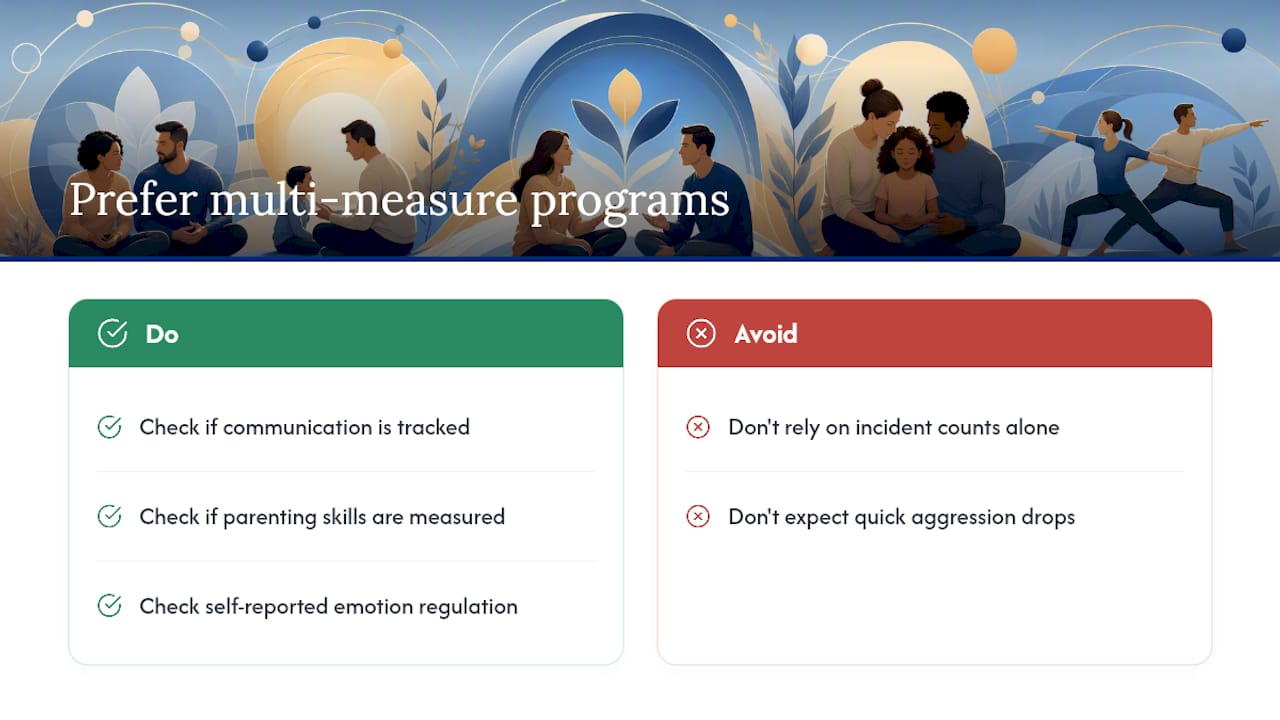
What this means practically: judge a program by more than one measure. Ask whether it tracks communication changes, parenting skill usage, and self-reported emotion regulation, not just whether participants report fewer outbursts. A program that only counts incidents is missing most of what actually changes. For a deeper look at what the anger management evidence-based practice literature actually supports, the Masteringconflict blog covers the research in detail.
Five in-the-moment strategies you can use before class starts
These are the same techniques taught in structured programs. You can start using them today.
- Recognize your escalation cues. Before you can interrupt a reaction, you need to know what it feels like in your body. Tight jaw, raised shoulders, a faster heartbeat. Raising Children Network recommends naming the feeling first: “I’m feeling really frustrated right now” keeps you in the observing position rather than the reacting one.
- Use paced breathing. Slow your exhale to be longer than your inhale. A simple pattern: breathe in for 4 counts, out for 6. The NHS recommends this alongside stepping away from the immediate situation when you feel overwhelmed.
- Take an adult time-out. Stepping away is not giving up. Say something like: “I need a few minutes. We’ll finish this conversation when I’m calmer.” This models regulation for your child and prevents escalation. Stanford Children’s Health specifically recommends stepping away if you feel your anger building past the point of productive conversation.
- Use a scripted phrase to de-escalate. Having a sentence ready before you need it removes the cognitive load in the moment. Options that work: “I hear you, and I want to understand” or “Let’s both take a breath and try again.” These phrases interrupt the defensive back-and-forth without conceding or dismissing.
- Run a simple problem-solving prompt. After you’ve calmed down, ask: “What do we both need here?” This shifts the frame from conflict to collaboration and is a direct skill taught in parenting anger management programs.
Safety note: If you feel you cannot safely stay in a situation with your child, remove yourself immediately. If anger has led to physical harm or you fear it might, contact a mental health crisis line or your child’s pediatrician the same day. These strategies are for managing escalating but non-dangerous situations.
How to pick the right class for your family
Not all programs are equal. Here’s what to look for and what to avoid.
Criteria that matter:
- Curriculum built on CBT and parent-training components, not just stress relief
- Facilitator with a clinical license or certified anger management specialist credential
- Clear attendance policy and a defined program length
- Outcome tracking beyond self-report (structured assessments, skill checklists)
- Confidentiality policy you can review before enrolling
Questions to ask any provider before you commit:
- What is your facilitator’s license or certification?
- Does the curriculum include communication training and parent-specific scenarios?
- How do you document completion for court or insurance purposes?
- Is there a sliding-scale fee or insurance billing option?
- What happens if I miss a session?
Red flags:
- Promises of results in one or two sessions
- No stated facilitator credentials
- Group formats that require public disclosure of personal details without consent
- No structured curriculum or written program outline available on request
Cost varies widely. A community mental health center group may run $20–$50 per session; private therapy with anger modules typically runs $100–$200 per session without insurance; online self-paced programs range from free to a few hundred dollars total. Always ask about insurance coverage and sliding-scale options before assuming a program is out of reach.
Where to find classes and how to enroll
Where to look:
- Your primary care physician or current therapist for a direct referral
- Community mental health centers (search SAMHSA’s treatment locator at findtreatment.gov)
- Hospital-based outpatient behavioral health departments
- Masteringconflict’s clinical services and anger management groups, available online and regionally
- Teletherapy directories for clinician-led online options
Enrollment steps:
- Identify two or three programs that match your format preference and schedule.
- Call or email each provider to confirm facilitator credentials and current cohort availability.
- Ask about intake paperwork, any required assessment, and whether a waitlist applies.
- Confirm cost, insurance billing, and sliding-scale options in writing before your first session.
- Schedule your first session or intake appointment before you hang up.
What to have ready:
- Insurance card and member ID (if using insurance)
- Any court order or referral letter specifying program requirements
- Your availability for the next 8–12 weeks so you can commit to a cohort
What clinicians actually see parents gain from structured programs
The changes that show up most reliably in clinician-led programs are not always the ones parents expect when they enroll. Most parents come in wanting to stop yelling. What they leave with is something more durable: a clearer read on their own triggers, a set of phrases that work in real arguments, and a noticeably different dynamic with their kids and partners.

The harder part of the work is attendance and homework. Parents are busy, and the weeks when life is most chaotic are exactly the weeks the class material is hardest to practice. Clinicians who run these groups know this, and good programs build in accountability structures, brief between-session check-ins, and realistic homework that takes five minutes rather than fifty.
Co-parent buy-in is the other common obstacle. One parent doing the work while the other continues reactive patterns creates friction. When both partners participate, even in separate tracks, the gains tend to hold longer. Masteringconflict’s couples packages address this directly for parents who want to work on communication together alongside individual anger management work.
The parents who benefit most are those who show up consistently, do the between-session practice, and stay in the program through the uncomfortable middle weeks when old habits push back hardest. That’s not a motivational statement. It’s what the attendance data in group programs consistently shows.
Masteringconflict’s clinician-led classes for parents
Masteringconflict offers parent-focused anger management groups led by licensed clinicians and certified anger management specialists, with both online and regional U.S. options across North Carolina, South Carolina, and Florida. Programs are built on CBT and parent-training frameworks, run in structured cohorts, and include documentation for court or insurance purposes when needed.
When you contact Masteringconflict for the first time, ask about current cohort start dates, the facilitator’s credentials, whether the program includes parent-specific communication modules, and sliding-scale availability. The teletherapy option means geographic distance is not a barrier. Book a consultation through the website to confirm the right fit before your first session.
Sources
- Anger Management: Strategies for Parents and Grandparents – Stanford Medicine Children’s Health
- Anger Management for Parents: Tips and Resources – Healthline
- Quasi-experimental study of a cognitive problem-solving workshop (2024) – DOI
- Anger management guide for parents | Raising Children Network
- What happens in anger management classes – Verywell Mind
- Helping your child with anger issues – NHS
This article is general information, not a substitute for advice from a qualified doctor. Consult a qualified healthcare professional about your own circumstances before acting on anything here.
Recommended
- Anger Management Classes Near Me: Find Local & Online Options 2025 – Mastering Conflict
- Anger management classes: Build emotional control that lasts – Mastering Conflict
- Best Anger Management Classes Near Me: 2026 Guide – Mastering Conflict
- 7 Ways Local Anger Management Classes Help Adults Grow – Mastering Conflict