
Open Communication Strategies for Stronger Relationships

TL;DR:
- Effective open communication strategies are structured methods that promote honesty, clarity, and trust in relationships. Using tools like active listening, clear messaging, and written follow-up reduces misunderstandings and conflicts. Consistently practicing these skills fosters psychological safety and strengthens connection over time.
Open communication strategies are deliberate, structured methods that create transparent, honest exchanges between people in personal and professional relationships. Non-verbal cues make up 55% of total communication, which means what you don’t say carries as much weight as your words. Whether you are working through conflict with a partner or trying to improve dialogue with a colleague, mastering these strategies is the difference between relationships that stagnate and ones that grow. At Masteringconflict, the clinical approach to communication is grounded in evidence, not guesswork.
What are effective open communication strategies?
Open communication, known in clinical settings as transparent interpersonal communication, rests on three pillars: clarity, consistency, and honesty. These are not personality traits. They are skills you build through deliberate practice.
The 5 C’s of communication give you a practical framework to apply immediately:
- Clear: One idea per message. No buried requests.
- Cohesive: Your tone, words, and body language align.
- Complete: Include all the context the other person needs.
- Concise: Say it in fewer words than you think you need.
- Concrete: Use specific examples, not vague generalizations.
Active listening is the engine behind all five. Most people listen to respond, not to understand. Real active listening means you reflect back what you heard, ask clarifying questions, and resist the urge to defend yourself before the other person finishes speaking. This single habit resolves more conflicts than any script or technique.
Layered communication methods that combine one-on-one coaching, group discussions, and written updates can increase productivity by up to 25%. That number applies equally to couples and teams. When you mix real-time conversation with written follow-up, you give both parties time to process and respond thoughtfully.

Pro Tip: After any significant conversation, send a brief written summary of what was agreed. This one habit eliminates the “that’s not what I said” argument almost entirely.
Which tools and techniques support open dialogue?
Choosing the right communication channel matters as much as choosing the right words. The three main channels each serve a different purpose.
| Channel | Best Use | Key Benefit |
|---|---|---|
| Synchronous (calls, in-person) | Emotional conversations, decisions | Immediate feedback, tone clarity |
| Asynchronous (email, chat) | Updates, non-urgent requests | Reduces “always-on” pressure |
| Documentation (notes, shared docs) | Agreements, processes, history | Persistent, scalable reference |
Setting clear response time norms, such as four hours for chat and 24 hours for email, can reduce unnecessary meetings by 30–50%. That reduction matters in relationships too. When both people know when to expect a reply, anxiety drops and trust builds.
Documentation is the most underrated channel in any relationship. Written records of shared decisions eliminate repetitive arguments and give both parties a neutral reference point. In couples therapy, this often looks like a shared agreement written after a difficult conversation.
Anonymous feedback tools and “equal voice” practices are powerful in group or professional settings. Institutionalizing equal voice moments where every person contributes regardless of seniority produces more candid input and breaks down hierarchy barriers. The same principle applies at home. When one partner consistently dominates conversations, the other stops sharing honestly.
Body language and facial expressions shape how your message lands. Learning to read non-verbal communication cues gives you a significant advantage in any conversation, especially during conflict.
Pro Tip: Before any difficult conversation, agree on a signal word both parties can use to pause the discussion if emotions escalate. This prevents shutdowns and keeps the dialog productive.
How to implement open communication step by step
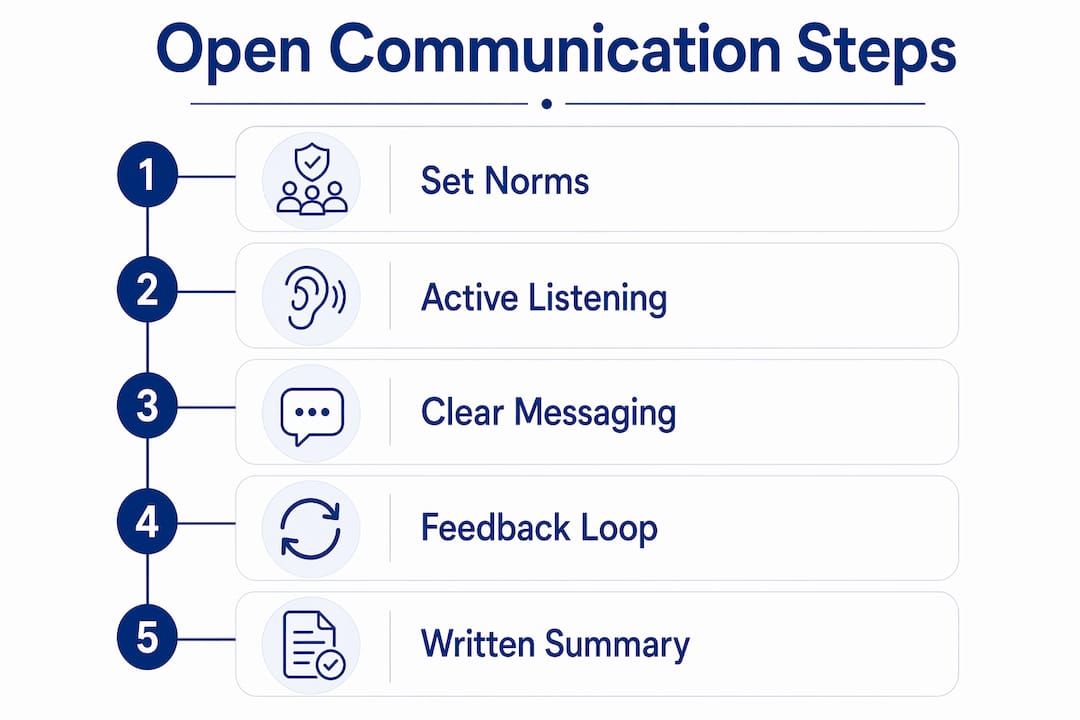
Knowing the theory is not enough. You need a repeatable process. Here is a step-by-step approach that works for couples, families, and professional teams.
- Establish shared communication norms. Decide together how and when you will communicate. Set response time expectations. Agree on which topics belong in text and which require a real conversation.
- Practice active listening daily. Start with low-stakes conversations. Reflect back what you heard before you respond. This builds the muscle before you need it in a high-stakes moment.
- Express yourself with “I” statements. “I felt dismissed when the meeting ran over” lands differently than “You always go over time.” The first invites dialog. The second triggers defense.
- Integrate written follow-up. After important conversations, document what was decided and who is responsible for what. Tools like Google Docs or a shared notes app work well for couples and teams alike.
- Build psychological safety. People only communicate openly when they trust they will not be punished for honesty. Acknowledge contributions, respond without contempt, and separate feedback from criticism.
- Manage information overload. High-performing teams default to asynchronous updates to protect focused time and reserve real-time meetings for decisions that require collaboration. Apply this logic at home by designating specific times for relationship check-ins rather than processing everything in real time.
- Repair quickly after breakdowns. Every relationship has communication failures. The couples and teams that thrive are not the ones who never break down. They are the ones who repair faster.
Healthy communication in relationships requires all seven of these steps working together. Skipping step five, psychological safety, makes every other step harder.
Pro Tip: Schedule a weekly 15-minute “communication check-in” with your partner or team. Use it to surface anything that felt unclear or unresolved that week. Consistency here prevents small frustrations from becoming large conflicts.
What causes open communication to break down?
Even people with strong intentions hit walls. Recognizing the specific breakdown pattern is the first step to fixing it.
Over-communication is as damaging as silence. Flooding someone with messages, updates, or emotional processing creates fatigue. The receiver starts tuning out, which looks like disengagement but is actually self-protection.
Polished information erodes trust. Sharing only finalized decisions after the fact signals that the other person’s input does not matter. Sharing uncertain, evolving information early builds far more trust than presenting a perfect conclusion. This is counterintuitive for people who want to appear confident, but it is consistently more effective.
Structural barriers block honesty. Open communication requires structural interventions, not just open-door policies. In professional settings, this means separating coaching conversations from performance evaluations so people feel safe being honest. In relationships, it means creating a space where vulnerability is not weaponized later.
Common breakdown patterns to watch for:
- One person talks, the other waits to respond without truly listening
- Tone shifts mid-conversation and neither party names it
- Written messages are misread because non-verbal context is missing
- Feedback is given during high-emotion moments instead of calm ones
- Hierarchy, whether professional or relational, silences the less powerful person
The fix for most of these is not a new technique. It is slowing down and naming what is happening. “I notice we are both getting defensive. Can we pause and reset?” That sentence alone changes the trajectory of most difficult conversations.
Understanding the difference between coaching and therapy also matters here. Coaching builds skills. Therapy addresses the deeper patterns that make those skills hard to use. Both have a role in developing lasting communication change.
Key takeaways
Open communication strategies work because they combine structural norms, active listening, and psychological safety into a repeatable system that reduces conflict and builds trust.
| Point | Details |
|---|---|
| Start with the 5 C’s | Clear, cohesive, complete, concise, and concrete messaging forms the foundation of every effective exchange. |
| Match channel to context | Use synchronous conversation for emotional topics and asynchronous tools for updates to reduce pressure. |
| Document agreements | Written follow-up after key conversations eliminates misunderstandings and provides a neutral reference point. |
| Build psychological safety | People communicate honestly only when they trust that honesty will not be used against them. |
| Repair fast after breakdowns | Consistent, quick repair after communication failures matters more than avoiding them entirely. |
What i have learned after years of conflict work
After more than a decade working with couples and individuals at Masteringconflict, the pattern I see most often is this: people believe they are communicating openly when they are actually performing openness. They say the right words. They nod at the right times. But the real message, the fear, the need, the unspoken expectation, stays buried.
The couples who make the most progress are not the ones who learn the most techniques. They are the ones who get honest about what they actually want from a conversation before they start it. Are you looking to be heard? To solve a problem? To reconnect? Those are three different conversations, and they require three different approaches.
I have also seen how much damage the “open-door policy” myth does. Telling someone your door is always open does not create safety. What creates safety is how you respond when someone actually walks through that door with something uncomfortable. If you react with defensiveness, dismissal, or punishment, the door closes permanently regardless of what you say.
The most underused tool I recommend is the written follow-up. Couples who send a short message after a hard conversation, something like “I heard you say X, and I want to make sure I understood correctly,” resolve conflicts faster and with less resentment than those who rely on memory alone. It sounds clinical. It works.
Sustaining open communication over time requires treating it like a practice, not a destination. You will have weeks where it flows and weeks where it breaks down. The goal is not perfection. The goal is a shorter distance between breakdown and repair.
— Carlos
Take the next step toward clearer communication
Real change in how you communicate rarely happens through reading alone. Sometimes you need a structured space to practice these skills with professional support.
Masteringconflict offers teletherapy counseling for individuals and couples who want personalized guidance on communication and conflict resolution from anywhere. If you prefer a structured learning format, the communication and conflict courses cover everything from anger management to relationship repair in a self-paced format. For men specifically navigating communication challenges in relationships or at work, men’s counseling services provide a focused, judgment-free environment to build these skills. The first step is simply deciding that the way things are is not the way they have to stay.
FAQ
What are open communication strategies?
Open communication strategies are structured methods that promote honest, transparent exchanges between people. They include active listening, clear messaging, psychological safety, and consistent follow-up practices.
How do i start improving communication in my relationship?
Start by establishing shared norms around when and how you communicate, then practice reflecting back what you hear before responding. Couples communication exercises are a practical starting point for building these habits together.
Why does open communication break down even with good intentions?
Structural barriers, emotional reactivity, and the habit of sharing only polished information are the most common causes. Separating coaching from evaluation in professional settings, and separating feedback from criticism in personal ones, removes the biggest blocks to honest dialog.
How does non-verbal communication affect open dialog?
Non-verbal cues account for 55% of total communication, meaning your tone, posture, and facial expressions often carry more weight than your words. Misalignment between verbal and non-verbal signals is a leading cause of misunderstandings.
Can asynchronous communication work in personal relationships?
Yes. Written follow-up after important conversations, shared notes on agreements, and designated check-in times all reduce real-time pressure and give both people space to respond thoughtfully rather than reactively.
Recommended
- Enhance Your Relationship: Couples Communication Exercises – Mastering Conflict
- Communication Skills for Couples: Guide to Connection and Conflict Resolution – Mastering Conflict
- How to Resolve Arguments Effectively and Rebuild Trust – Mastering Conflict
- 7 Effective Client Engagement Strategies for Better Outcomes – Mastering Conflict