
Helping Teens Express Feelings: A Parent’s Guide

TL;DR:
- Helping teens express their feelings through routine emotional check-ins and validation builds safety and trust. Using “I messages” with moderate emotion words and modeling emotional regulation teach teens healthy communication and self-management skills. Consistent parental patience, gentle listening, and creative outlets foster emotional expression, even when teens resist sharing.
Helping teens express feelings is the single most effective thing a parent can do to protect their child’s emotional health and keep communication open through the turbulent adolescent years. Emotional expression, the clinical term used by therapists and researchers, refers to a person’s ability to identify, name, and communicate their internal states to others. The Child Mind Institute, USU Extension, and the Raising Children Network all confirm that parents who use specific, repeatable strategies see measurable improvements in how their teens communicate. This guide gives you those strategies, grounded in current research and clinical practice.
How does helping teens express feelings start at home?
The most direct entry point is the routine emotional check-in. A check-in is a brief, scheduled moment where you ask your teen about their emotional state, listen without interrupting, and validate what they share before you offer any advice or solutions. According to emotional validation research from the Child Mind Institute, this sequence builds a safe emotional container that teens return to repeatedly. That safety is not automatic. It has to be built through consistency.
The structure matters more than the timing. A check-in at dinner works just as well as one during a car ride, as long as you follow the same pattern each time. Start with an open-ended question rather than a yes-or-no prompt. “What was the hardest part of your day?” gets more than “Did you have a good day?” ever will. Then listen completely before you respond.
Validation is the step most parents skip. Validation does not mean agreeing with your teen’s interpretation of events. It means acknowledging their experience as real and understandable. “That sounds genuinely frustrating” lands differently than “You’ll be fine.” The first response keeps the conversation open. The second closes it.
Here are the core elements of an effective emotional check-in:
- Ask one open-ended question about feelings, not events
- Make eye contact and put your phone face-down
- Reflect back what you hear before offering any opinion
- Validate the emotion before addressing the situation
- Resist the urge to fix, advise, or minimize
Pro Tip: Turn off all screens and close the laptop before a check-in. Teens read distraction as disinterest, and one glance at your phone can undo the trust you built in the previous five minutes.
What are “I messages” and why do they reduce teen defensiveness?
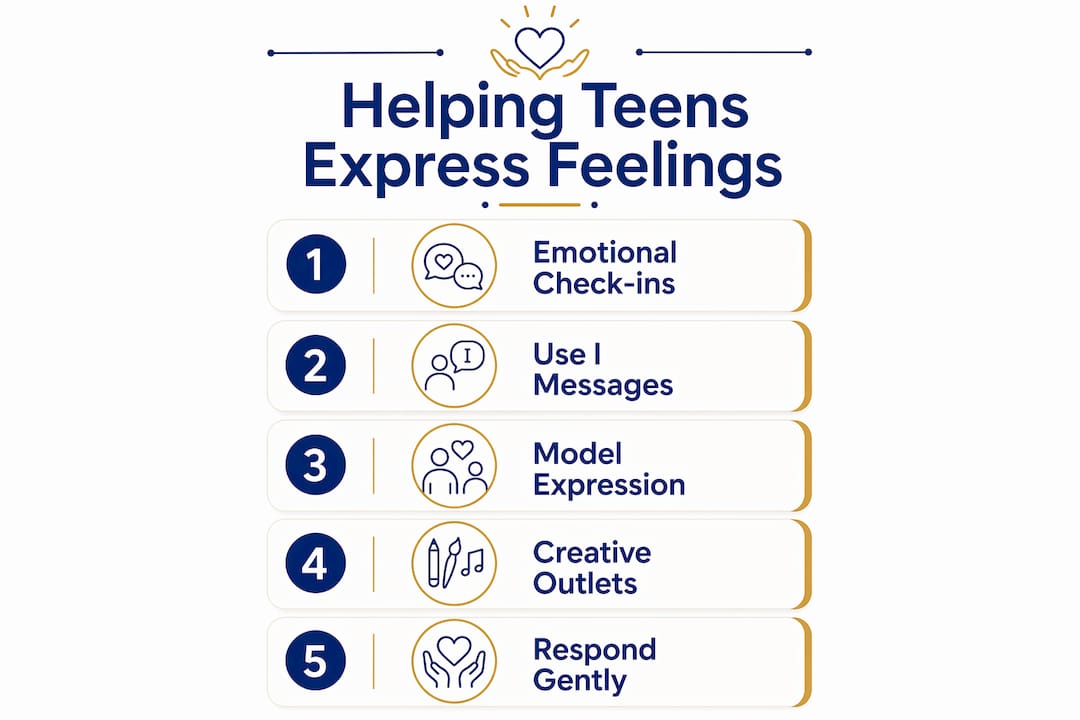
“I messages” are a structured communication format developed to express feelings and needs without placing blame on the listener. The formula, as outlined by USU Extension, follows three steps: “I think,” “I feel because,” and “I want.” This structure keeps the focus on the speaker’s internal experience rather than the other person’s behavior, which dramatically reduces the chance of a defensive reaction from your teen.
The word choice inside the formula matters as much as the structure itself. USU Extension specifically recommends using less intense emotional labels such as “concerned” or “upset” rather than “devastated” or “furious.” Intense language raises the emotional temperature of the conversation and can cause teens to shut down entirely. Moderate language keeps the door open.
Tone and body language carry equal weight. Nonverbal communication, including your posture, facial expression, and vocal tone, shapes how your teen receives the message before they process the words. A calm, level tone with an open posture signals safety. A tense jaw and crossed arms signal conflict, regardless of what you say.
Follow these steps to build the habit:
- Write out your I message before the conversation so you know exactly what you want to say
- Choose a moderate emotion word that accurately describes your state without amplifying it
- State the specific behavior that triggered the feeling, not a character judgment
- Name what you want going forward, keeping it concrete and achievable
- Deliver it in a neutral setting, not in the middle of an argument
Pro Tip: Practice I messages in low-stakes moments first. Tell your teen “I feel proud because you handled that situation calmly, and I want you to know I noticed.” Positive I messages build the format into your relationship before you need it for harder conversations.
How does modeling emotional expression shape your teen’s skills?

Parents are the primary emotional role models for their teens, and modeling appropriate expression of feelings is one of the most powerful tools available. When you name your own emotions out loud, you demonstrate that feelings are speakable and manageable. Saying “I’m feeling stressed about this deadline, so I’m going to take ten minutes before we talk” teaches your teen two things at once: that stress is normal, and that pausing is a legitimate response.
The Raising Children Network identifies emotional self-management as a skill teens learn primarily by watching adults navigate difficult moments. When you model a pause during a heated exchange, you show your teen that regulation is possible even when emotions are intense. That demonstration is more instructive than any lecture about staying calm.
Vulnerability is an underused tool in parenting. Sharing that you felt nervous before a work presentation, or that a conversation with a friend left you feeling hurt, normalizes the full range of human emotion. Teens who see their parents express sadness, disappointment, and uncertainty alongside joy and pride develop a broader emotional vocabulary and a more realistic picture of adult life.
Key behaviors to model consistently:
- Name your emotions aloud in everyday situations, not just difficult ones
- Pause conversations when your own emotional intensity rises and return to them later
- Apologize when you handle a moment poorly and explain what you would do differently
- Describe your coping strategies as you use them (“I’m going for a walk because I need to clear my head”)
- Reflect on your emotional state after events, not just during them
What creative outlets help teens process complex emotions?
When verbal communication feels impossible, creative and physical outlets give teens a way to externalize feelings safely. Art, journaling, music, and sports each offer a different channel for emotional processing, and UNICEF’s parenting guidance confirms that nonverbal expression relieves emotional intensity and supports healthy development. The key is offering access without pressure.
Writing feelings down before speaking is particularly effective for teens who struggle to find words in the moment. Externalizing a feeling onto paper reduces its intensity and often makes verbal communication easier afterward. A teen who journals about a conflict with a friend is more likely to talk about it clearly than one who has been sitting with the feeling unexpressed.
The following table compares common creative outlets and their primary emotional benefits:
| Outlet | Primary emotional benefit | Best for |
|---|---|---|
| Journaling | Clarifies thoughts and reduces verbal pressure | Teens who internalize feelings |
| Drawing or painting | Externalizes emotions without words | Teens who struggle with verbal expression |
| Music (listening or playing) | Regulates mood and provides emotional release | Teens with high emotional intensity |
| Physical activity | Discharges tension and improves mood | Teens who express through behavior |
| Creative writing or poetry | Builds emotional vocabulary and narrative distance | Teens who process analytically |
Support access to these outlets by keeping supplies available, attending performances or games, and asking about the work without demanding explanation. “What were you feeling when you wrote that?” is an invitation. “Tell me what this means” is an interrogation.
How do you respond when teens resist sharing feelings?
Teen resistance to emotional sharing is developmentally normal, not a sign of failure. Teen brains process emotions differently than adult brains, with the prefrontal cortex still developing through the mid-twenties. This means teens genuinely experience emotions more intensely and sometimes misread social cues, making vulnerability feel riskier than it does for adults. Understanding this removes the frustration from the equation and replaces it with patience.
Practicing emotional expression in small, low-stakes steps builds comfort over time. You do not need a breakthrough conversation to make progress. A teen who says “I’m annoyed” instead of slamming a door has made real progress in teen emotional expression, even if it does not feel dramatic.
Strategies that maintain connection without pushing:
- Accept silence without filling it with questions or advice
- Acknowledge nonverbal cues directly: “You seem tense. I’m here if you want to talk.”
- Respect privacy while keeping the door open: “You don’t have to share everything. I just want you to know I’m available.”
- Avoid judging or dismissing feelings, since invalidating responses shut down communication faster than almost anything else
- Use active listening by reflecting back what you hear before responding
Pro Tip: Watch for indirect expressions. A teen who suddenly wants to talk about a character in a TV show, or asks a hypothetical question about a friend’s situation, is often talking about themselves. Follow that thread gently.
Key takeaways
Consistent, empathetic parental engagement through check-ins, I messages, and emotional modeling is the most effective approach to supporting teen emotional expression.
| Point | Details |
|---|---|
| Routine check-ins build safety | Ask open-ended questions and validate feelings before offering any advice or solutions. |
| I messages reduce conflict | Use the “I think, I feel because, I want” formula with moderate emotion words to keep dialogue open. |
| Modeling teaches regulation | Name your own emotions aloud and pause difficult conversations to show teens that self-management is possible. |
| Creative outlets fill the gap | Journaling, art, music, and physical activity help teens process feelings when words are hard to find. |
| Resistance is developmental | Teen brains are still forming. Patience, gentle presence, and avoiding judgment keep the connection intact. |
What I’ve learned after years of working with teens and families
After working with hundreds of families as a licensed clinical mental health counselor, the pattern I see most often is this: parents come in frustrated because their teen “won’t talk,” and teens come in feeling like no one actually listens. Both are right, and both are wrong at the same time.
The parents who make the most progress are not the ones who find the perfect thing to say. They are the ones who get comfortable with silence, who stop treating every emotional moment as a problem to solve, and who start treating it as an opportunity to be present. That shift is harder than it sounds, especially for high-achieving parents who are wired to fix things.
I also want to push back on the idea that teens need to be “opened up” like a locked box. Most teens are not closed. They are testing. They are watching to see whether you can handle what they share without panicking, lecturing, or making it about you. When you pass that test consistently, they talk. The conflict resolution skills that help in adult relationships apply here too. Listening first, speaking second, and staying regulated throughout.
The families I see make the most lasting progress are those where at least one parent commits to working on their own emotional expression first. You cannot teach what you do not practice. If you want your teen to name their feelings, start naming yours. It is that direct.
— Carlos
Build stronger communication with Masteringconflict
If you are ready to move beyond reading and into practice, Masteringconflict offers structured programs designed specifically for parents navigating teen emotional challenges. Dr. Carlos Todd and the Masteringconflict team provide family counseling that addresses the real dynamics behind communication breakdowns between parents and teens.

For parents who prefer to work at their own pace, the courses on emotional regulation cover I messages, active listening, conflict resolution, and emotional modeling in depth. Teletherapy options are also available for families across North Carolina, South Carolina, Florida, and beyond. The tools in this article are a starting point. Masteringconflict helps you build them into lasting habits.
FAQ
How often should I do emotional check-ins with my teen?
Daily brief check-ins are more effective than weekly long conversations. A two-minute exchange during a car ride or at dinner builds the habit and keeps communication lines open consistently.
What if my teen refuses to use I messages?
You do not need your teen to use I messages. Use them yourself. When teens consistently hear the format modeled without pressure, many adopt it naturally over time.
Can journaling really replace talking for teens?
Journaling is not a replacement for verbal communication, but writing feelings down before a conversation reduces pressure and helps teens find the words they need. Use it as a bridge, not a substitute.
How do I know if my teen’s emotional withdrawal is normal or a warning sign?
Temporary withdrawal during stress is developmentally normal. Persistent withdrawal combined with changes in sleep, appetite, or social behavior warrants professional attention. Masteringconflict’s teen counseling services can help you assess the difference.
What is the biggest mistake parents make when teens share feelings?
Jumping to solutions before validating the emotion. When a teen shares a feeling and the first response is advice, they learn that sharing leads to being managed, not understood. Validate first, always.
Recommended
- Managing teen anger: A parent’s step-by-step guide – Mastering Conflict
- Learning Emotional Regulation: Tools for Parenting Teens – Mastering Conflict
- Online therapy for teens: parent’s guide to support 2026 – Mastering Conflict
- Signs of Teen Depression: What Every Parent Should Know – Mastering Conflict