
How to Communicate Needs in Relationships Clearly

TL;DR:
- Effective communication of needs involves expressing clear, specific, and respectful requests that foster understanding. Naming feelings before needs reduces defensiveness, and using “I” statements prevents blame, encouraging collaboration and emotional safety. When communication breaks down, recognizing signs and seeking professional support can help rebuild trust and connection.
Communicating your needs effectively is defined as stating what you require from others in clear, specific, and respectful language that invites understanding rather than resistance. Most relationship conflict does not stem from incompatible people. It stems from unexpressed or poorly expressed needs. Whether you are a partner, parent, or individual working through personal growth, learning how to communicate needs changes the quality of every relationship you have. Masteringconflict works with clients daily who discover that the problem was never the relationship itself. It was the missing language to say what they actually needed.
How to communicate needs: the foundational principles
Effective needs communication rests on the 7 Cs of Communication: clear, concise, concrete, correct, coherent, complete, and courteous. Each principle serves a specific function. “Clear” removes ambiguity. “Concrete” replaces vague complaints with specific requests. “Courteous” keeps the conversation collaborative rather than combative. Together, they turn “you never support me” into something a listener can actually respond to.
The most common mistake people make is skipping the feeling before the need. Naming your feeling first reduces defensiveness and signals that you are sharing an experience, not launching an attack. “I feel disconnected” lands differently than “you never make time for me.” The first opens a door. The second closes one.
“I” statements are the structural backbone of assertive needs expression. They shift ownership of the experience to the speaker, which prevents the listener from feeling blamed. Pair an “I” statement with a specific, concrete request and you have the core formula for expressing personal needs without triggering a fight.
Invitations work better than demands. Ending a needs statement with “would that work for you?” or “what do you think?” signals that you value the other person’s input. That small shift moves the conversation from confrontation to collaboration.
Pro Tip: Before any difficult conversation, write out your need in one sentence using this format: “I feel [emotion] when [situation]. I need [specific request].” Read it aloud twice before you speak it to someone else.
How do you identify your needs before you can express them?
You cannot communicate what you have not yet named. The first step in expressing personal needs is recognizing which category of need is unmet. Common categories include connection, autonomy, security, appreciation, support, respect, and play. Most relationship conflicts trace back to one or more of these.
Journaling is the most direct tool for identifying unmet needs. Write about a recent conflict or frustration without editing yourself. Then ask: what was I actually wanting in that moment? The answer is usually a need, not a complaint. This process bypasses the reactive mind and gets to the real issue.
Conditioned trauma responses often interfere with this process. Many people were taught, explicitly or through experience, that expressing needs is selfish, weak, or unsafe. Those lessons do not disappear in adulthood. They show up as silence, vague hinting, or explosive outbursts when needs go unmet too long.
Emotional naming is a skill, not a personality trait. Practice labeling your internal state with precision. “Frustrated” is a start. “Lonely and overlooked” is more useful. The more specific the feeling, the more clearly the underlying need emerges.
Once you have identified your need, prepare a short script before the conversation. Research confirms that rehearsing clear needs statements reduces anxiety and improves delivery. Three sentences is enough: the feeling, the need, and the request.
- Write the feeling down without judgment.
- Identify the category of need it points to.
- Draft a one-sentence request that is specific and realistic.
- Read the script aloud to yourself before the conversation.
- Adjust the language until it sounds like you, not a therapy worksheet.
What are the steps to expressing needs clearly and empathetically?
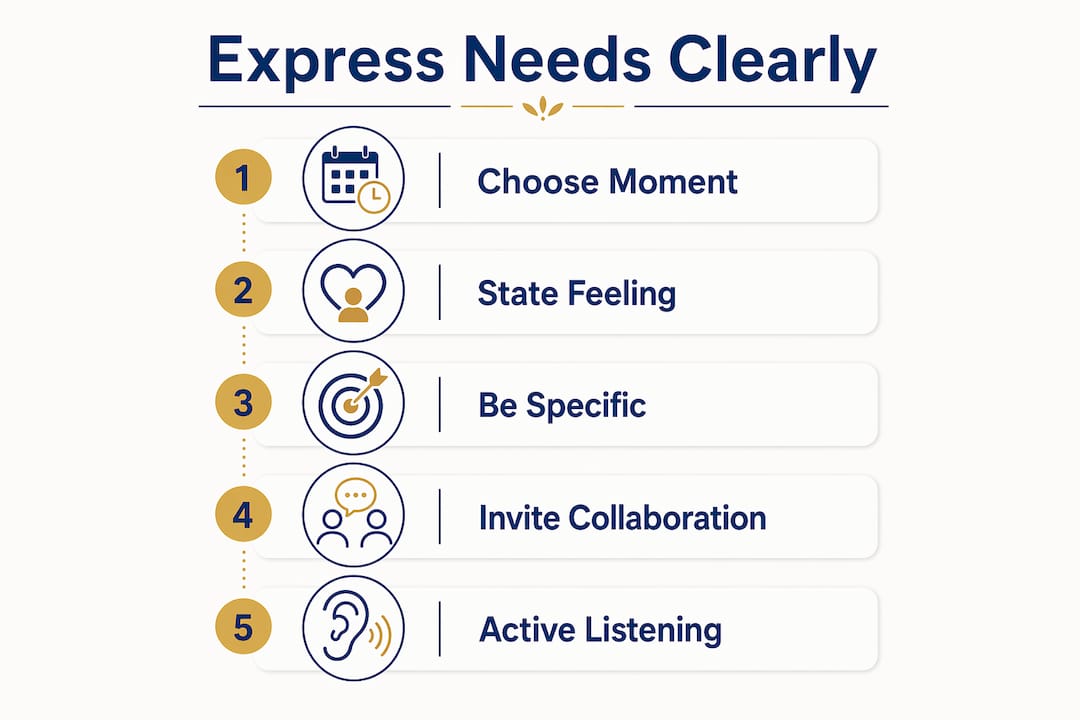
Structure matters when emotions are high. Following a consistent process keeps the conversation on track even when one or both people feel vulnerable.
Choose the right moment
Timing is not a minor detail. Raising a significant need when your partner is walking in the door, mid-task, or already stressed sets the conversation up to fail. Ask for a specific time: “Can we talk tonight after dinner? There’s something I want to share.” That request alone signals respect and reduces defensiveness before the conversation begins.

State the feeling, then the need
Naming feelings before expressing needs helps the listener understand the emotional weight behind the request. “I feel overwhelmed, I need some support” communicates both the internal experience and the ask. Skipping the feeling and going straight to the request, such as “I need you home by 6 PM,” often reads as a demand. The listener hears the rule without understanding the relationship behind it.
Be specific and concrete
Vague requests produce vague responses. “I need more help” gives the other person nowhere to go. “I need you to handle dinner on Tuesday and Thursday evenings” is actionable. Specificity is not rigidity. It is clarity, and clarity is a gift to the person you are asking.
Invite collaboration
After stating your need, pause. Ask the other person what they think or whether the request is workable. Open communication about needs nurtures emotional safety and connection. That safety only exists when both people feel heard, not just one.
Pro Tip: Use active listening after you state your need. Nod, maintain eye contact, and reflect back what you hear: “So what I’m hearing is…” This signals that the conversation is a two-way exchange, not a presentation.
The table below shows how to reframe common vague or accusatory statements into clear needs expressions.
| Vague or Accusatory Statement | Clear Needs Expression |
|---|---|
| “You never listen to me.” | “I feel unheard. I need us to put phones away during dinner.” |
| “You’re always working.” | “I feel disconnected. I’d love to plan one evening together each week.” |
| “You don’t help enough.” | “I feel overwhelmed. Can you take over bedtime on Wednesdays?” |
| “You don’t care about my feelings.” | “I feel dismissed. I need you to acknowledge what I’m going through before offering solutions.” |
What happens when needs communication breaks down?
Communication breakdowns are not failures. They are signals that the current approach is not working and something needs to shift. Recognizing the signs early prevents small misunderstandings from becoming entrenched patterns.
Common signs of breakdown include:
- One person goes silent or shuts down (stonewalling).
- The conversation shifts from the need to a list of past grievances.
- Deflection replaces engagement: “You’re too sensitive” or “I was just joking.”
- Minimization dismisses the need: “It’s not a big deal.”
- The same argument repeats without resolution.
When these patterns appear, the goal is not to win the moment. The goal is to stay in the conversation without escalating. Lower your voice, slow your pace, and return to the feeling statement. “I’m not trying to attack you. I’m trying to tell you what I need.”
Avoiding “solution-jumping,” meaning immediately requesting a fix without sharing the underlying emotional need, prevents triggering resistance and misunderstanding. Share the feeling first. The request lands better when the listener understands why it matters.
Reframing works when direct repetition fails. If “I need more support” is not landing, try a different angle: “When I’m handling everything alone, I start to feel like I’m doing this by myself. That’s not the partnership I want.” Same need, different entry point.
Patterns of conflict, stonewalling, or dismissal indicate structural problems that go beyond individual conversation skills. When those patterns persist despite genuine effort, couples therapy or counseling is the appropriate next step. Seeking help is not an admission of failure. It is a decision to take the relationship seriously.
Self-care matters during these periods. Chronic needs suppression is exhausting. Protect your own emotional reserves through sleep, physical activity, and time with people who do hear you.
How do parents and families communicate needs effectively?
Family communication carries unique pressures. Parents must model the very skills they want their children to develop, often while managing their own unmet needs at the same time.
Effective family needs communication includes:
- Modeling vulnerability. Children learn that needs are normal when they see adults name and express them without shame.
- Using age-appropriate language. A five-year-old needs “I feel sad when toys are left out. I need your help picking them up.” A teenager needs more context and less instruction.
- Creating regular check-ins. A weekly family meeting, even ten minutes long, gives every member a structured space to share what they need that week.
- Validating before problem-solving. When a child or co-parent expresses a need, acknowledge it before responding with a solution. “That makes sense” goes further than most people realize.
- Separating co-parenting needs from relationship conflict. Two people can disagree as partners and still communicate clearly as parents. Keeping those conversations in separate lanes reduces confusion for everyone.
Healthy communication in family systems is not about perfect conversations. It is about consistent effort and repair when things go wrong. Families that practice repair, meaning they return to a conversation after a rupture and try again, build more trust than families that avoid conflict entirely.
What I have learned about needs communication after years of clinical work
The most common misconception I encounter is that expressing needs is selfish. Clients arrive believing that asking for what they need puts a burden on the people they love. The opposite is true. Unexpressed needs do not disappear. They accumulate and eventually come out as resentment, withdrawal, or explosion.
Vulnerability and assertiveness are not opposites. The most effective communicators I have worked with are both honest about their feelings and clear about their requests. They do not apologize for having needs. They present them as facts about their experience, not demands on another person’s behavior.
Communicating needs is less about perfection and more about willingness and practice. Relationships evolve when both people keep showing up to the conversation, even imperfectly. At Masteringconflict, the work we do with individuals, couples, and families is built on that principle. You do not need to get it right every time. You need to keep trying.
The clients who make the most progress are the ones who stop waiting for the perfect moment and start practicing with low-stakes conversations first. Ask for what you need at dinner before you tackle the harder conversations. Build the muscle before the heavy lift.
— Carlos
Support for building real communication skills
Knowing the principles is one thing. Applying them under emotional pressure is another. Masteringconflict offers counseling and teletherapy services designed to help individuals and couples move from knowing what to say to actually saying it, even when it feels hard.
Whether you are working through communication patterns in a relationship, processing what makes it difficult to ask for support, or rebuilding trust after repeated breakdowns, professional support accelerates the process. Masteringconflict’s men’s counseling services address the specific barriers men face in expressing needs, and teletherapy options make that support accessible from anywhere. Booking an appointment takes minutes. The work it starts can change how you relate to everyone around you.
FAQ
What does it mean to communicate your needs effectively?
Communicating needs effectively means stating what you require in specific, feeling-grounded language that the other person can understand and respond to. The 7 Cs of Communication provide a practical checklist: clear, concise, concrete, correct, coherent, complete, and courteous.
Why do people struggle to express their personal needs?
Many people were conditioned to believe that expressing needs is selfish or unsafe. Conditioned responses from past experiences can shut down honest expression before it starts, making self-awareness and preparation critical first steps.
How do “I” statements help when sharing feelings?
“I” statements shift ownership of the experience to the speaker, which reduces the listener’s defensiveness. Saying “I feel disconnected” instead of “you never make time for me” opens dialogue rather than triggering a defensive response.
When should couples seek professional help for communication issues?
Couples should seek professional help when the same conflicts repeat without resolution, or when stonewalling, dismissal, or withdrawal become the default pattern. These signs indicate structural relational issues that conversation skills alone cannot fix.
How can parents model healthy needs communication for children?
Parents model healthy communication by naming their own feelings and needs out loud in age-appropriate ways. Consistent repair after conflict, regular family check-ins, and validating children’s needs before problem-solving build the foundation for lifelong communication skills.
Key takeaways
Effective needs communication requires naming feelings before making requests, using specific language, and inviting collaboration rather than demanding compliance.
| Point | Details |
|---|---|
| Name feelings first | State the emotion before the request to reduce defensiveness and signal vulnerability. |
| Be specific and concrete | Replace vague complaints with clear, actionable requests the other person can actually fulfill. |
| Use “I” statements | Own your experience in language to prevent the listener from feeling blamed or attacked. |
| Prepare before hard talks | Write and rehearse a short script to reduce anxiety and improve clarity during the conversation. |
| Seek help when stuck | Repeated breakdowns, stonewalling, or dismissal call for professional counseling, not just better phrasing. |
Recommended
- Healthy Communication in Relationships Explained – Mastering Conflict
- Communication Skills for Couples: Guide to Connection and Conflict Resolution – Mastering Conflict
- Improve communication for conflict resolution in 2026 – Mastering Conflict
- Master Assertive Communication Skills for Conflict Resolution – Mastering Conflict