Conflict Resolution Education for Families and Couples

TL;DR:
- Conflict resolution education teaches skills like active listening, empathy, and negotiation to foster constructive dispute handling. It aims to eliminate conflicts through mutual agreement while also managing ongoing issues effectively. Practicing these skills daily, with professional support if needed, leads to healthier relationships and social cohesion.
Conflict resolution education is the process of teaching skills and strategies that empower people to handle disputes constructively, improving personal and family relationships at every stage of life. This field, formally known as conflict resolution and management education (CRME), goes well beyond simply stopping arguments. CRME promotes sustainable peace and social justice by building communication, negotiation, empathy, and problem-solving skills that reshape how people relate to one another. Programs range from peer mediation in schools to structured workshops offered by organizations like the Stitt Feld Handy Group, and global frameworks like the UNESCO 2023 recommendation now urge 194 member states to embed these skills into everyday education. For couples, parents, and individuals, learning how to resolve conflicts is one of the highest-return investments you can make in your relationships.
What are the fundamental skills in conflict resolution education?
Conflict resolution education builds a specific set of interpersonal and emotional skills. These are not soft skills in the dismissive sense. They are learnable, measurable, and directly tied to relationship outcomes.
The core skills taught across most programs include:
- Active listening. This means hearing what the other person says without preparing your rebuttal while they speak. Reflective listening techniques, where you paraphrase what you heard before responding, reduce misunderstandings by giving the speaker confirmation that they were understood.
- Clear, non-blaming expression. Effective communication strategies teach people to use “I” statements rather than “you always” accusations. “I feel dismissed when decisions are made without me” lands very differently than “You never include me.”
- Negotiation techniques. Principled negotiation moves beyond stated positions to identify the underlying interests driving each person’s demands. A couple arguing over finances is rarely arguing about money. They are arguing about security, control, or respect.
- Emotional regulation. De-escalation is a teachable skill. Recognizing your own physiological arousal, the racing heart, the tightening jaw, and pausing before responding is a practice that prevents most conflicts from escalating.
- Empathy development. Understanding a dispute from the other person’s perspective does not mean agreeing with them. It means accurately representing their experience before advocating for your own.
One distinction worth understanding early: conflict resolution and conflict management are not the same thing. Resolution aims to eliminate the dispute entirely through mutual agreement. Management controls the impact of ongoing conflict without necessarily resolving its root cause. Both skill sets belong in a complete education, but knowing which one you need in a given situation changes your approach entirely.
Pro Tip: Pay attention to non-verbal cues during disagreements. Body language, personal space, and tone of voice often communicate more than the words themselves. If your partner’s arms are crossed and their voice is clipped, the content of what they say is only part of the message.
How do conflict resolution education programs differ?
Not all programs are built the same, and choosing the wrong format for your situation wastes time. Here is how the major models compare.
| Program type | Target audience | Core method | Primary outcome |
|---|---|---|---|
| Peer mediation (e.g., Peacekeepers) | Students, youth | Restorative conferences, peer facilitation | Reduced suspensions, self-directed resolution |
| School-based restorative justice | Teachers, school staff | Structured handbooks, group dialogue | Positive learning climate, fewer disciplinary actions |
| Professional workshops (e.g., Stitt Feld Handy Group) | Adults, educators, professionals | 4-day immersive training with role-plays | Dispute management in workplace and institutional settings |
| Family and couples coaching | Individuals, couples, parents | Guided sessions, skill practice, teletherapy | Improved communication and relationship repair |
| Community peace education programs | Broad community members | Facilitated dialogue, cultural frameworks | Reduced community-level conflict, social cohesion |
The Peacekeepers program in Wichita trains middle school students as peer mediators using restorative justice principles. Students facilitate conferences focused on understanding and mutual agreement rather than assigning blame. This model matters for parents because it shows that children as young as 11 can learn and apply these skills when given structured guidance.
For adults seeking formal training, 4-day immersive workshops like those offered by the Stitt Feld Handy Group combine practical exercises, live coaching, and expert feedback to build dispute management skills in education and professional settings. The immersive format accelerates skill retention compared to a single seminar because participants practice under realistic pressure.
Restorative practices implemented in schools, including those piloted in Seychelles through the University of Seychelles (Unisey), have reduced disciplinary actions and created measurably more positive learning climates. That same restorative logic transfers directly to family dynamics: addressing the harm caused and rebuilding trust produces better long-term outcomes than punishment alone.
Pro Tip: Before selecting a program, identify whether your goal is resolution or management. If you and your partner keep revisiting the same argument, you need resolution skills. If you are managing a high-conflict co-parenting situation, management strategies may be more realistic in the short term.
How can individuals, couples, and parents apply these skills daily?
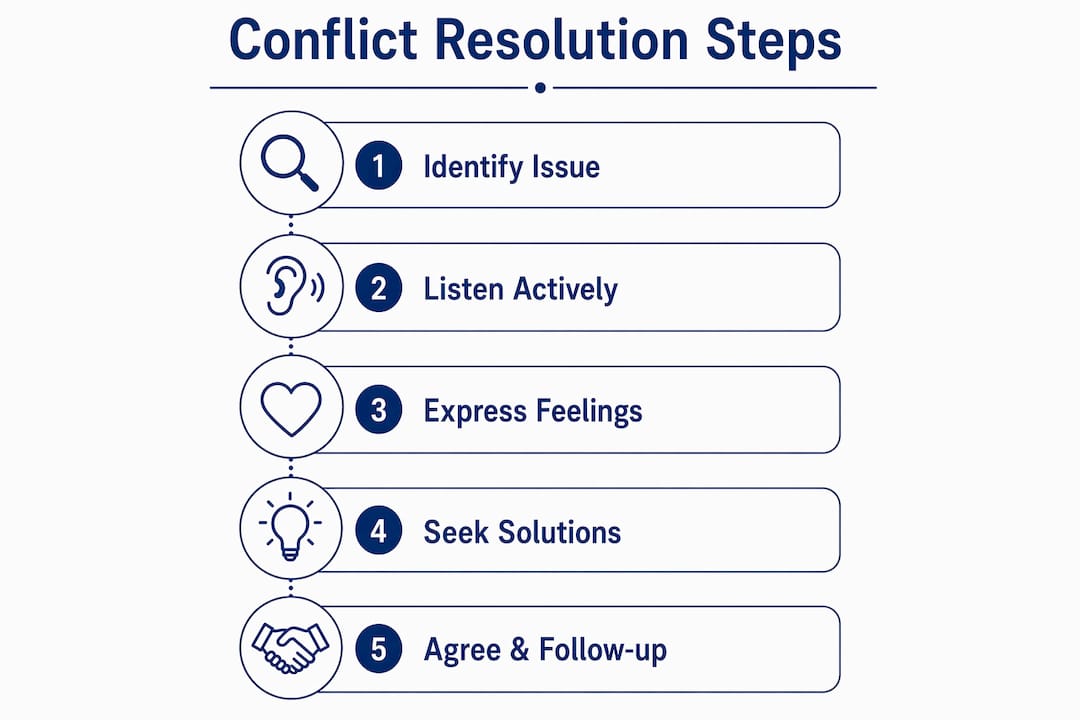
Knowing the theory is one thing. Applying dispute resolution skills in the middle of a heated argument with your spouse or a defiant teenager is another. Here is a practical sequence that works in real family and relationship contexts.
- Pause before responding. When you feel your emotional temperature rising, name it internally. “I am angry right now.” That moment of labeling activates the prefrontal cortex and creates a brief window before reactive behavior takes over.
- State your observation without judgment. Describe what happened factually before interpreting it. “You came home two hours late” is an observation. “You clearly don’t care about this family” is an interpretation that will immediately put the other person on the defensive.
- Express your underlying need. Most surface-level conflicts are about unmet needs: safety, respect, connection, or autonomy. Naming your need directly, “I need to feel like a priority,” gives the other person something concrete to respond to.
- Listen to understand, not to win. Ask one clarifying question before making your case. “What was going on for you tonight?” opens the conversation rather than closing it.
- Negotiate a specific agreement. Vague resolutions like “we’ll do better” fail within days. Specific agreements, “I’ll text by 6 p.m. if I’m running late,” create accountability.
For parents, the goal is not just resolving today’s conflict. It is modeling the process so children internalize it. Conflict resolution for adolescents requires age-appropriate framing, but the underlying steps are identical. When a teenager watches a parent listen without interrupting, they learn that skill by observation long before any formal instruction.
Couples benefit from scheduling low-stakes practice. Bring up a minor disagreement, something with no emotional charge, and walk through the five steps above deliberately. The goal is to build the neural pathway so the process becomes automatic when the stakes are higher. For families navigating more persistent conflict patterns, family tools and teletherapy resources can provide structured support alongside self-directed practice.
What challenges make conflict resolution education hard to practice?
Learning these skills in a workshop or article is straightforward. Sustaining them under real emotional pressure is where most people struggle. Understanding the common obstacles helps you prepare for them rather than being derailed by them.
- The avoidance trap. Many people confuse peace with the absence of conflict. They avoid difficult conversations entirely, which allows resentment to accumulate until a minor incident triggers a disproportionate reaction. Proactive conflict resolution addresses root emotional triggers rather than silencing disputes. Avoidance is not resolution.
- Defensiveness as a default. When people feel criticized, the brain’s threat response activates before the rational mind can engage. Recognizing defensiveness as a physiological response, not a character flaw, makes it easier to pause and choose a different behavior.
- Cultural resistance. In many families and communities, open conflict dialogue is considered disrespectful or shameful. This creates a double barrier: the conflict itself, and the belief that addressing it directly is wrong. Restorative practices work across cultural contexts precisely because they center relationships and dignity rather than confrontation.
- Expecting immediate results. Conflict resolution skills take months of consistent practice to become automatic. Most people give up after one or two attempts that did not go perfectly. The empowerment mindset central to effective conflict education measures success by participants’ growing ability to resolve their own conflicts, not by achieving perfect outcomes from day one.
- Confusing the method with the goal. Active listening is a tool, not the destination. Some people become so focused on performing the technique correctly that they lose genuine connection with the person in front of them. The goal is understanding, not a flawless execution of steps.
Viewing conflict through a systemic and relational lens shifts the focus from winning arguments to repairing and strengthening relationships. That shift in perspective is often the single biggest breakthrough people experience when they commit to this education seriously.
Key takeaways
Conflict resolution education works because it replaces reactive, blame-driven patterns with learnable skills in communication, emotional regulation, and negotiation that improve relationships at every level.
| Point | Details |
|---|---|
| Resolution vs. management | Resolution eliminates disputes; management controls impact. Know which goal fits your situation. |
| Core skills are teachable | Active listening, empathy, and negotiation are learned behaviors, not fixed personality traits. |
| Program format matters | Choose peer mediation, immersive workshops, or coaching based on your context and relationship goals. |
| Daily practice builds the habit | Apply the five-step sequence in low-stakes situations to build the skill before high-conflict moments arise. |
| Avoidance is the enemy | Suppressing conflict allows resentment to build. Proactive engagement with root causes produces lasting change. |
Why I believe conflict resolution education changes everything
I have worked with hundreds of couples, families, and individuals over the years, and the pattern I see most consistently is this: people do not lack love or goodwill. They lack a shared language for conflict. They walk into arguments with completely different assumptions about what a fair fight looks like, what counts as listening, and what resolution is supposed to feel like when it arrives.
What formal conflict resolution education does, at its best, is give people that shared language. When both partners understand what active listening actually requires, they stop arguing about whether they were heard and start actually hearing each other. That shift sounds small. In practice, it changes the entire texture of a relationship.
The piece most people underestimate is the emotional regulation component. You can know every technique in the book and still blow up a conversation the moment your nervous system decides you are under threat. The work of learning to master conflict resolution skills is as much about understanding your own triggers as it is about learning communication frameworks.
I also want to push back on the idea that conflict resolution education is only for people in crisis. The couples and families who benefit most are often the ones who come in before things are broken. They are investing in their relationship the same way they would invest in their physical health: proactively, not just when something goes wrong. That mindset is what I try to bring to every client I work with at Masteringconflict.
— Carlos
Take the next step with professional support
Reading about conflict resolution education builds awareness. Practicing it with professional guidance builds lasting change.
At Masteringconflict, Dr. Carlos Todd and his clinical team offer teletherapy counseling and clinical services designed specifically for individuals, couples, and families who want to move from conflict patterns to genuine connection. Whether you are navigating a recurring argument with your partner, struggling to communicate with a teenager, or simply ready to build stronger relationship skills, personalized support accelerates what self-study alone cannot. Not sure whether therapy or coaching fits your situation? Explore the difference between coaching and therapy to find the right starting point for you.
FAQ
What is conflict resolution education?
Conflict resolution education is a structured process of teaching communication, negotiation, empathy, and problem-solving skills that help people handle disputes constructively. It applies to personal relationships, family dynamics, schools, and professional settings.
How does conflict resolution differ from conflict management?
Conflict resolution aims to eliminate a dispute entirely through mutual agreement, while conflict management controls the impact of ongoing conflict without necessarily resolving its root cause. Both skill sets are useful depending on the situation.
Can children and teenagers learn conflict resolution skills?
Yes. Programs like the Peacekeepers initiative in Wichita train middle school students as peer mediators using restorative justice principles, demonstrating that youth can learn and apply these skills effectively with structured guidance.
How long does it take to develop conflict resolution skills?
Skill development varies by individual, but most structured programs recommend consistent practice over several months before the techniques become automatic under emotional pressure. Immersive formats like 4-day workshops accelerate initial learning significantly.
What is the biggest mistake people make when learning these skills?
The most common mistake is avoiding conflict entirely rather than engaging with it constructively. Avoidance allows resentment to accumulate, which makes eventual conflicts more intense and harder to resolve.
Recommended
- Conflict Resolution for Couples: Practical Strategies for 2025 – Mastering Conflict
- Conflict Resolution for Families: Tools, Tips, and Teletherapy 2025 – Mastering Conflict
- Effective Conflict Resolution Steps for Couples, Families, and Professionals 2025 – Mastering Conflict
- Family Conflict Resolution Services: Transforming Relationships – Mastering Conflict