
Parenting Through Conflict: Strategies That Actually Work

TL;DR:
- Parenting through conflict involves deliberate, research-based strategies to maintain family relationships and ensure child wellbeing during disagreements.
- Effective communication focuses on connection before correction, reducing conflict through active listening, emotional validation, and child involvement.
- Building emotion regulation skills like reappraisal and modeling repair fosters healthier parent-child dynamics and resilient conflict management.
Parenting through conflict is the practice of using deliberate, research-informed strategies to maintain family relationships and protect child wellbeing during disagreements and difficult dynamics. Most parents experience conflict as something to survive rather than something to learn from. That shift in perspective changes everything. Tools like SES NXT, frameworks from John and Julie Gottman, and emotion regulation research from longitudinal studies of over 1,000 U.S. families now give parents a concrete roadmap. The goal is not a conflict-free home. The goal is a conflict-resilient one.
What communication strategies improve parenting through conflict?
Conflict resolution in parenting starts with how you speak before the argument escalates. The most effective communication approaches share one feature: they prioritize the relationship over winning the moment.
Research by John and Julie Gottman, along with developmental psychologist Grazyna Kochanska, shows that mutually positive relationships produce committed compliance in children. This means children who feel genuinely connected to their parents are far more likely to follow guidance without coercion. Connection before correction is not a soft parenting philosophy. It is a behavioral outcome strategy.
Practical communication techniques that reduce conflict intensity include:
- Active listening with reflection: Repeat back what your child said before responding. “You’re saying you feel left out when I focus on your sibling” signals that you heard them, which lowers defensiveness immediately.
- Naming emotions before giving direction: Saying “I can see you’re frustrated” before addressing behavior reduces the child’s need to escalate to feel understood.
- Problem-solving conversations: Replace directives with questions. “What do you think would help here?” gives children agency and reduces power struggles.
- Polite, specific requests: “Please put your shoes by the door” outperforms “Stop leaving your stuff everywhere” every time. Specificity removes ambiguity and reduces the emotional charge.
These techniques apply equally to co-parenting disagreements. When two parents are in conflict with each other, the same principles hold. Validate before you counter. Ask before you assume. Tools like OurFamilyWizard, a co-parenting communication platform, help separated parents maintain structured, documented dialogue that removes emotional reactivity from routine decisions.
Pro Tip: Before addressing a behavior problem with your child, spend two minutes in a neutral, connecting activity first. A short game, a shared snack, or even a brief check-in about their day shifts the relational climate before the harder conversation begins.
How does parental emotion regulation impact conflict and child wellbeing?
Your emotion regulation style matters more than the specific words you choose during a conflict. A preregistered three-wave study of 1,046 U.S. parents of 6th through 9th graders found that reappraisal-focused parents showed lower exhaustion, fewer child internalizing problems, and closer parent-child relationships compared to self-ruminators. These profiles remained stable across four months, which means your default way of processing emotion is not just a mood. It is a pattern with measurable consequences for your children.

Self-rumination, the habit of replaying conflict in your mind without resolution, is particularly damaging. It keeps the nervous system activated long after the argument ends, which means your next interaction with your child starts from a place of residual stress. Reappraisal, by contrast, involves consciously reframing a situation to reduce its emotional intensity. “My teenager is not attacking me. They are struggling and don’t have the words yet” is a reappraisal. It changes your physiological response and your behavior.
Building reappraisal skills takes deliberate practice. Strategies that work include:
- Cognitive labeling: Name the emotion you feel before reacting. Neuroscience research consistently shows that labeling an emotion reduces its intensity in the brain.
- Perspective-taking prompts: Ask yourself what the situation looks like from your child’s developmental stage. A 13-year-old’s defiance reads differently when you remember that identity formation requires some separation from parents.
- Scheduled reflection: Set aside a specific time to process conflict rather than ruminating throughout the day. This interrupts the rumination loop by giving it a container.
- Physical regulation first: Slow breathing, a brief walk, or even cold water on the face resets the autonomic nervous system before you attempt cognitive reappraisal.
For parents managing emotional regulation during teen years, the stakes are especially high. Adolescents are acutely sensitive to parental emotional states and will mirror dysregulation back at you.
What are child-centered approaches to managing high-conflict parenting situations?
Child-centered conflict management places the child’s psychological safety and voice at the center of every intervention decision. A study of 46 Finnish social workers using vignette interviews identified three dimensions of child-centredness: direct child involvement, parent-mediated communication, and coordinated professional collaboration. No single dimension is sufficient on its own. All three must work together.
The digital intervention SES NXT demonstrates what this looks like in practice. In a randomized controlled trial of 294 youths ages 11 to 17 and 467 parent-family units, SES NXT significantly reduced perceived postdivorce parental conflict with medium-to-large effect sizes after 12 weeks. The key mechanism was not simply reducing adult arguments. It was changing how children perceived the conflict around them, which directly improved their emotional adjustment.
The table below compares standard conflict management approaches with child-centered approaches across key dimensions:
| Dimension | Standard approach | Child-centered approach |
|---|---|---|
| Focus | Adult behavior and agreements | Child’s perception of safety and voice |
| Child involvement | Minimal or indirect | Direct participation in age-appropriate ways |
| Professional role | Mediator between adults | Collaborator supporting child and parents |
| Success metric | Fewer arguments | Improved child adjustment and reduced perceived conflict |
| Communication channel | Parent-to-parent | Parent-to-child and child-to-professional |
Implementing child-centered approaches in complex family dynamics requires realistic expectations. Child-centredness is a nuanced, evolving process that requires multi-professional collaboration and active parental agency. It is not a checklist. It is a sustained commitment to asking “what does my child need to feel safe here?” rather than “how do I win this dispute?”
For parents seeking structured guidance on family conflict resolution strategies, the research is clear: the child’s experience of conflict matters as much as the conflict’s resolution.
What practical steps can parents take to repair relationships after conflicts?
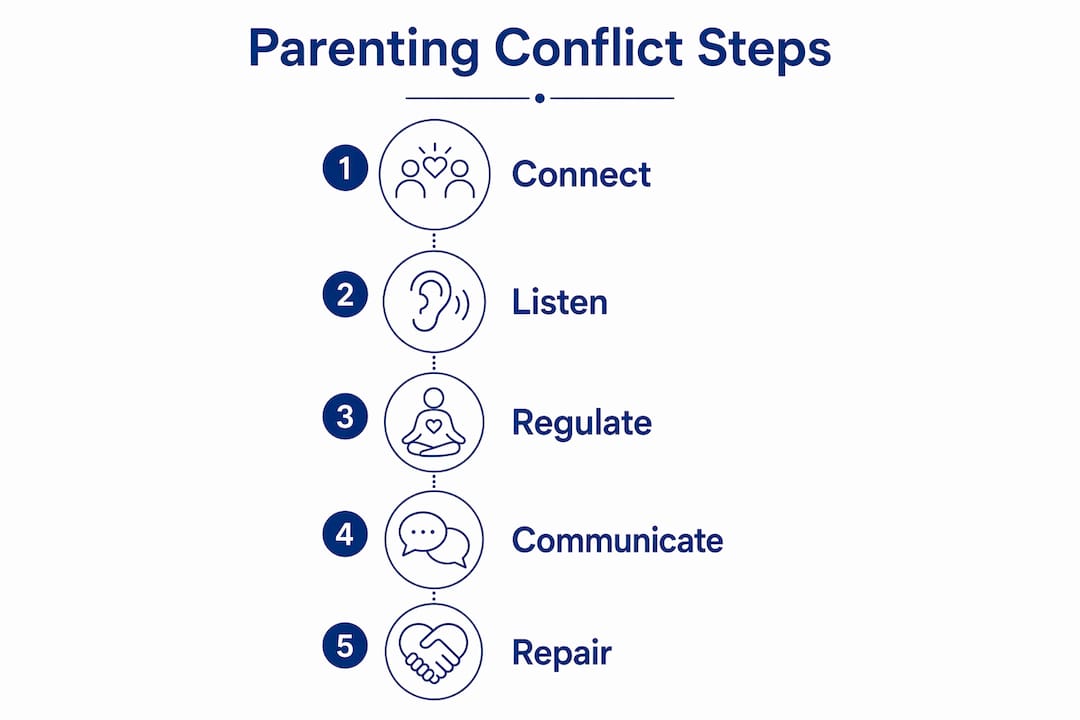
Relationship repair after conflict is a teachable skill, not an instinct. The absence of repair is what turns isolated arguments into chronic disconnection. Here is a structured process for reconnecting after a difficult moment:
- Recognize the signal. Notice when the emotional temperature in your home has dropped. Withdrawal, short answers, or avoidance from your child are signals that repair is needed, not more correction.
- Create a calm opening. Do not attempt repair in the heat of the moment. Wait until both you and your child are regulated. A simple “Can we talk about what happened earlier?” said calmly is enough.
- Validate feelings before explaining your position. Start with “I understand you felt…” before offering your perspective. Validation does not mean agreement. It means acknowledgment.
- Take responsibility for your part. Children learn repair by watching parents model it. Saying “I raised my voice and that wasn’t fair to you” is not weakness. It is the most powerful teaching moment available to you.
- Co-create a solution. Ask your child what would help them feel better and what they think should happen differently next time. This builds problem-solving skills and restores their sense of agency.
- Follow through consistently. Repair only builds trust when it is consistent. One repair conversation followed by the same behavior next week teaches children that apologies are performances, not commitments.
On the question of consequences versus punishment: logical consequences tied to behavior support learning without damaging the relationship. If your child leaves their bike in the driveway after being asked not to, removing bike privileges for a day is a logical consequence. Taking away their video game is a punishment. The first teaches cause and effect. The second teaches fear and resentment.
Pro Tip: Repair conversations work best when initiated by the parent, not waited for from the child. Children should not carry the burden of restarting connection after a conflict. When you go first, you model exactly the behavior you want them to develop.
Consistent repair practice also reduces the intensity of future conflicts. When children trust that ruptures will be followed by reconnection, they feel safer expressing disagreement without fear of permanent relational damage. This is the foundation of raising emotionally intelligent kids who can manage their own conflicts as they grow.
Key takeaways
Effective parenting through conflict requires combining emotion regulation, child-centered communication, and consistent repair practices to protect both family relationships and child psychological health.
| Point | Details |
|---|---|
| Emotion regulation style matters most | Reappraisal-focused parents show lower exhaustion and fewer child internalizing problems than self-ruminators. |
| Connection before correction works | Positive relational connection produces committed compliance in children, reducing the need for punishment. |
| Child-centered approaches change perception | Interventions like SES NXT reduce how children perceive conflict, which directly improves their adjustment. |
| Repair is a teachable skill | Consistent repair conversations after conflict build trust and reduce the intensity of future disagreements. |
| Logical consequences preserve relationships | Consequences tied directly to behavior support learning without the resentment that unrelated punishments create. |
What I’ve learned about conflict and parenting after years in clinical practice
Most parents who come to me are not failing at parenting. They are failing at regulating themselves under pressure, and then blaming the parenting. That distinction matters enormously. When I work with families at Masteringconflict, the first thing I assess is not what the parent says during conflict. It is what they do in the 30 seconds before they say anything.
The research on longitudinal emotion regulation profiles confirms what I see clinically every week. Self-rumination is the silent saboteur of family relationships. Parents who replay arguments in their heads for hours are not processing. They are re-activating. And their children feel it, even when nothing is said.
What I tell parents consistently is this: your child does not need you to be perfect. They need you to be repairable. The families that recover from conflict most effectively are not the ones with the fewest arguments. They are the ones where repair is fast, genuine, and expected. Children who grow up in homes where adults take responsibility and reconnect after conflict develop a fundamentally different relationship with disagreement. They learn that conflict is survivable. That is the most protective thing you can give them.
I also want to name something that rarely gets said directly: parenting through difficult times is exhausting in ways that are not always visible. The emotional labor of staying regulated, staying connected, and staying consistent depletes parents. Self-care is not a luxury in this context. It is a clinical requirement. You cannot pour from an empty vessel, and no communication strategy works when you are running on fumes.
— Carlos
How Masteringconflict supports parents through family conflict

Parenting through conflict is hard enough without trying to figure it out alone. Masteringconflict offers clinical services specifically designed for parents managing family conflict, including family counseling, individual therapy, and anger management programs. For couples whose co-parenting relationship is under strain, the couples packages provide structured, evidence-based support to rebuild communication and reduce conflict at its source. Every service is grounded in the same principle that runs through this article: relationships are repairable, and the right support makes that process faster and more sustainable. Book a session today and take the first concrete step toward a calmer, more connected family dynamic.
FAQ
What does parenting through conflict actually mean?
Parenting through conflict means using deliberate strategies to maintain healthy family relationships and protect child wellbeing during disagreements, rather than simply reacting to them. It covers both parent-child conflict and co-parenting disputes between adults.
How does a parent’s emotion regulation affect their children?
Research on 1,046 U.S. parents found that reappraisal-focused parents had fewer child internalizing problems and closer relationships with their children compared to self-ruminators. Your emotional processing style directly shapes your child’s psychological outcomes.
What is the “connection before correction” approach?
Connection before correction means building relational warmth with your child before addressing a behavioral problem. Studies by John and Julie Gottman and Grazyna Kochanska show this produces committed compliance rather than fear-based obedience.
How effective are digital tools for reducing parenting conflict?
The SES NXT digital intervention reduced perceived postdivorce conflict for both youth and parents with medium-to-large effect sizes after 12 weeks in a randomized controlled trial. Digital tools work best when they are child-oriented rather than focused solely on adult behavior.
When is professional help the right step for family conflict?
Professional support is appropriate when conflict is frequent, when children show signs of anxiety or withdrawal, or when repair attempts consistently fail. Masteringconflict provides family counseling and conflict resolution services for exactly these situations.