
Managing Anxiety, Depression and Stress: Your 2026 Guide

TL;DR:
- Anxiety, depression, and stress are interconnected conditions requiring distinct and tailored treatment strategies. Lifestyle changes, therapy, and resilience training effectively improve symptoms and promote long-term mental health. Differentiating these conditions enhances self-awareness and guides appropriate intervention, fostering recovery and personal growth.
Anxiety, depression, and stress are three distinct but deeply interconnected mental health conditions that affect your emotional state, physical health, and daily functioning. Anxiety is a persistent state of excessive fear or unease, often without a clear external cause. Depression is a mood disorder characterized by prolonged sadness, loss of interest, and disrupted physical functioning. Stress is a natural physiological response to demanding situations that becomes harmful when it turns chronic. According to the WHO and CDC, these conditions collectively affect hundreds of millions of people worldwide, and they frequently occur together, making accurate identification and tailored management strategies critical for recovery.
What are the symptoms and causes of anxiety, depression, and stress?
Anxiety, depression, and stress share overlapping symptoms but have distinct clinical profiles that determine how you treat them. Understanding the differences helps you seek the right kind of depression and anxiety help rather than applying a one-size-fits-all approach.
Anxiety disorders involve persistent excessive fear and behavioral changes, such as avoidance of situations that trigger distress. Physically, anxiety produces rapid heartbeat, sweating, muscle tension, and shortness of breath. Emotionally, it shows up as constant worry, irritability, and a sense of impending doom. Comorbidities with depression are common, and treatment typically includes psychotherapy and medication.
Depression presents differently. Its hallmark symptoms include persistent low mood, loss of pleasure in activities you once enjoyed, fatigue, changes in appetite or sleep, and in severe cases, thoughts of self-harm. Unlike anxiety, which is often future-focused, depression tends to anchor you in the past with feelings of worthlessness and hopelessness.
Chronic stress is linked to worse health outcomes and increased use of substances, and it frequently acts as the trigger that pushes someone from manageable worry into a full anxiety disorder or depressive episode. Stress is situational by nature, but when the pressure never lets up, the body’s cortisol response stays elevated, damaging sleep, immunity, and mood regulation over time.
Pro Tip: Keep a symptom diary that captures exact triggers, sensations, and behaviors each day. Detailed symptom records improve clinical assessment accuracy far more than vague retrospective reports, and they give your therapist a precise map of your experience.
The table below summarizes the key differences at a glance:
| Condition | Core symptoms | Common causes |
|---|---|---|
| Anxiety | Excessive fear, avoidance, physical tension | Genetics, trauma, chronic stress, brain chemistry |
| Depression | Persistent low mood, fatigue, loss of interest | Life events, hormonal changes, chronic illness, isolation |
| Stress | Overwhelm, irritability, physical tension | Work pressure, relationship conflict, financial strain |
How do lifestyle factors influence mental health levels?
Diet, exercise, sleep, and social connection are not soft suggestions. They are evidence-based levers that directly shift the severity of anxiety, depression, and stress symptoms.

A meta-analysis of 633,317 individuals across 23 countries found that people adhering to healthy diets reported significantly lower symptoms of depression, anxiety, and stress. The effect sizes were modest but consistent across cultures, which means improving your diet is one of the few interventions that works regardless of where you live or what your background is. Prioritizing whole foods, reducing ultra-processed food intake, and maintaining stable blood sugar throughout the day all contribute to a more regulated mood.
Physical activity is equally powerful. The CDC recommends 150 minutes of moderate physical activity per week for adults, which breaks down to roughly 20 to 30 minutes daily. Exercise reduces cortisol, increases endorphins, and improves sleep quality. All three of those effects directly counter the core mechanisms of anxiety and depression.
Sleep hygiene deserves its own attention. Poor sleep amplifies the effects of anxiety on health, reduces emotional regulation, and makes stress feel unmanageable. A consistent sleep schedule, limiting screen exposure before bed, and keeping your bedroom cool and dark are simple changes with measurable impact on mood.
Here are the lifestyle habits that consistently show the strongest mental health benefits:
- Eat a diet rich in vegetables, legumes, whole grains, and lean proteins
- Exercise for at least 20 minutes daily, even if it is just a brisk walk
- Maintain a consistent sleep and wake schedule, including weekends
- Limit alcohol and caffeine, both of which worsen anxiety symptoms
- Build and protect social connections, since isolation amplifies depression
Social support is one of the most underrated stress management techniques available. Regular contact with people you trust lowers cortisol levels and provides the emotional regulation that chronic stress depletes. You do not need a large social network. Two or three reliable relationships are enough to make a measurable difference.
What coping strategies effectively manage anxiety, depression, and stress?
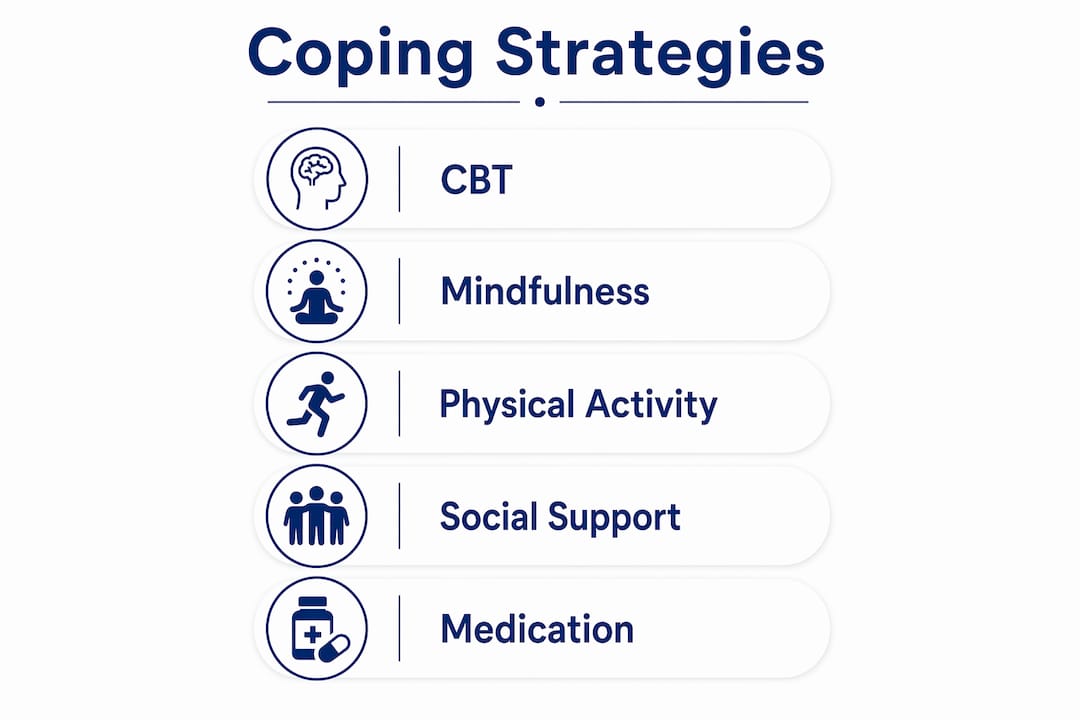
Cognitive-behavioral therapy (CBT) is the most evidence-supported psychotherapy for all three conditions. CBT works by identifying distorted thought patterns and replacing them with more accurate, balanced ones. For anxiety, this means challenging catastrophic thinking. For depression, it means addressing negative self-beliefs. For stress, it means reframing situations as manageable rather than overwhelming.
Mindfulness-based practices, including Mindfulness-Based Stress Reduction (MBSR) developed by Jon Kabat-Zinn, teach you to observe thoughts and sensations without reacting to them. This is particularly effective for coping with stress because it interrupts the automatic escalation from stressor to panic. Even ten minutes of daily mindfulness practice produces measurable changes in the brain’s stress response over time.
Medication plays a role for moderate to severe cases. Selective serotonin reuptake inhibitors (SSRIs) such as sertraline and escitalopram are first-line treatments for both anxiety and depression. They are not a substitute for therapy but work best in combination with it. If you are unsure whether medication is right for you, a licensed clinical mental health counselor or psychiatrist can help you weigh the options.
Pro Tip: If formal therapy feels out of reach right now, start with natural anxiety management techniques like diaphragmatic breathing, progressive muscle relaxation, and scheduled worry time. These are clinician-endorsed tools you can use today.
The following strategies are practical starting points for reducing anxiety and stress on your own:
- Practice slow, diaphragmatic breathing for five minutes when anxiety spikes
- Use progressive muscle relaxation before bed to release physical tension
- Schedule a dedicated “worry window” of 15 minutes daily to contain anxious thinking
- Write three specific things you are grateful for each morning to shift depressive thought patterns
- Limit news and social media consumption to defined time blocks
Interpersonal therapy (IPT) is another clinically validated option, particularly for depression linked to relationship difficulties or major life transitions. Behavioral activation, a component of CBT, is especially useful for depression because it breaks the cycle of withdrawal and low mood by scheduling small, rewarding activities even when motivation is absent.
How can you build resilience against long-term mental health challenges?
Resilience is not a personality trait you either have or lack. Resilience is a learnable skill set comprising calm innovative thinking, optimism, decisiveness, and social connection, all of which can be cultivated deliberately. This distinction matters because many people assume they are simply not built to handle stress, when in fact they have never been taught the specific skills that make stress manageable.
High-stress professionals, including Navy SEALs and emergency physicians, demonstrate that resilience-building exercises involving rapid mental focus shifts, calm problem-solving, and emotional regulation can be trained systematically. You do not need to be in a high-stakes profession to apply these principles. The same techniques translate directly to managing workplace pressure, relationship conflict, and health anxiety.
An antifragility mindset takes resilience one step further by treating stress-induced volatility as raw material for personal growth rather than something to merely survive. This framework, drawn from risk management and psychology, encourages you to ask what a difficult experience is teaching you rather than simply how to get through it.
Here is a practical daily routine for building resilience over time:
- Start each morning with five minutes of intentional breathing or meditation before checking your phone
- Write one sentence in a journal about what you are grateful for and one sentence about what you are working toward
- Identify one small, manageable task each day that you complete fully, building a track record of follow-through
- Schedule at least one meaningful social interaction daily, even a brief phone call counts
- End each evening with a brief review of what went well, not what went wrong
Honesty with yourself is a non-negotiable part of this process. Resilience does not mean pretending you are fine. It means accurately assessing your situation, accepting what you cannot control, and directing your energy toward what you can. For managing stress naturally over the long term, this combination of self-awareness and deliberate habit-building is more effective than any single technique applied in isolation.
Key takeaways
Anxiety, depression, and stress require distinct but overlapping strategies, and addressing all three together through lifestyle, therapy, and resilience-building produces the most durable mental health outcomes.
| Point | Details |
|---|---|
| Distinguish the conditions | Anxiety centers on fear, depression on mood, and stress on situational overwhelm. Each needs a tailored response. |
| Diet and exercise matter | A healthy diet and 150 minutes of weekly exercise measurably reduce symptoms across all three conditions. |
| CBT is the gold standard | Cognitive-behavioral therapy addresses distorted thinking patterns at the root of anxiety and depression. |
| Resilience is a skill | Calm thinking, optimism, and social connection can be deliberately trained, not just inherited. |
| Track your symptoms | A daily symptom diary improves clinical accuracy and helps you identify patterns faster than memory alone. |
What I’ve learned from working with people carrying all three at once
After years of working with individuals navigating anxiety, depression, and stress simultaneously, the pattern I see most often is not a lack of willpower or insight. It is a lack of differentiation. People come in treating all three conditions as one undifferentiated cloud of suffering, which means their coping strategies are scattered and their progress stalls.
The most effective shift I have seen is when someone starts separating the three. They ask: “Is this fear about something specific, or is it a persistent low mood, or is it a response to a real external pressure?” That single question changes everything. It moves the person from passive suffering to active problem-solving, and that shift in agency is often the first real sign of recovery.
I also want to push back on the idea that professional help is a last resort. Many people I work with waited years before seeking support, convinced they should be able to handle it on their own. The stress management strategies that work best are almost always a combination of self-directed practice and professional guidance, not one or the other. You would not manage a broken leg with breathing exercises alone. The same logic applies here.
What gives me genuine optimism is the quality of tools available in 2026. CBT, MBSR, medication when appropriate, and structured resilience training are all accessible, evidence-based, and effective. The gap is not in the tools. It is in knowing which one to reach for and when.
— Carlos
Ready to get personalized support for anxiety, depression, and stress?
Reading about these conditions is a meaningful first step. Acting on what you have learned is where real change begins.
At Masteringconflict, Dr. Carlos Todd and his clinical team offer evidence-based clinical services for individuals managing anxiety, depression, and stress. Services include individual therapy, clinical assessments, and coaching programs designed around your specific situation, not a generic protocol. Whether you are in North Carolina, South Carolina, Florida, or accessing care online, Masteringconflict provides structured, professional support that moves you from surviving to functioning well. Book a consultation today and get a clear plan built around your needs.
FAQ
What is the difference between anxiety, depression, and stress?
Anxiety involves persistent excessive fear and avoidance behaviors, depression is a mood disorder marked by prolonged sadness and loss of interest, and stress is a situational response to external pressure that becomes harmful when chronic. All three can occur together and often reinforce each other.
What are the most effective stress management techniques?
CBT, mindfulness-based stress reduction, regular physical activity, and consistent sleep schedules are the most evidence-supported stress management techniques. The CDC recommends at least 150 minutes of moderate exercise weekly as a baseline for mental well-being.
How does diet affect anxiety and depression symptoms?
A healthy diet is associated with significantly lower symptoms of depression, anxiety, and stress, based on a meta-analysis of over 633,000 individuals across 23 countries. Whole foods, stable blood sugar, and reduced ultra-processed food intake all support more regulated mood.
When should I seek professional help for anxiety or depression?
Seek professional support when symptoms persist for more than two weeks, interfere with work or relationships, or include thoughts of self-harm. A licensed clinical mental health counselor can assess whether therapy, medication, or a combination is the right approach for your situation.
Can resilience be learned, or is it something you are born with?
Resilience is a learnable skill set, not a fixed trait. Harvard Health research confirms that calm thinking, optimism, decisiveness, and social connection can all be deliberately cultivated through consistent practice and, when needed, professional guidance.
Recommended
- 7 Early Signs of Stress and How to Manage Them Effectively – Mastering Conflict
- Balancing work and relationship: a 2026 guide for couples – Mastering Conflict
- Stress Management for Men: Master Your Emotions Today – Mastering Conflict
- 7 Practical Tips for Managing Anxiety Naturally – Mastering Conflict