
How to Forgive in Relationships and Rebuild Trust

TL;DR:
- Forgiveness is a personal decision to release resentment, not an immediate emotional feeling or forgotten event.
- Rebuilding trust requires genuine accountability, patience, and consistent behavior over time, often taking 12 to 24 months.
Forgiveness is one of the hardest things you will ever ask of yourself in a romantic relationship. When someone you love hurts you, the emotional wound does not heal on a schedule. Learning how to forgive in relationships is not about pretending the pain did not happen or accepting that it was okay. It is about choosing your own peace and making a deliberate decision about your future. This guide walks you through the evidence-based steps that actually work, the mindset shifts that prepare you for the work ahead, and the common mistakes that quietly derail even the most committed couples.
Table of Contents
- Key Takeaways
- How to forgive in relationships: what it actually means
- Getting emotionally ready to forgive
- Steps to forgive your partner and rebuild trust
- Pitfalls that silently derail forgiveness
- My honest take on forgiveness after years of this work
- Ready to move forward? Mastering Conflict can help
- FAQ
Key Takeaways
| Point | Details |
|---|---|
| Forgiveness is a choice, not a feeling | You decide to forgive before the emotional relief arrives, not after. |
| Reconciliation requires accountability | Your partner’s genuine remorse and behavioral change are non-negotiable for repair. |
| Trust recovery takes real time | Major betrayals take 12-24 months to reach a new emotional baseline. |
| Anger rumination blocks healing | Reducing how often you replay the hurt is a measurable path to better flourishing. |
| Professional support accelerates progress | Therapy provides scaffolding that prevents blame spirals and shortens recovery time. |
How to forgive in relationships: what it actually means
Most people misunderstand forgiveness before they even attempt it. They think forgiving means forgetting, approving, or giving their partner a free pass. None of those are true.
Forgiveness is the internal decision to release your claim to ongoing resentment. It does not require you to restore the relationship, trust your partner immediately, or pretend the betrayal was minor. Research confirms that forgiveness protects against deep anger and anxiety while still allowing you to pursue accountability. You can forgive someone and still set firm boundaries. You can forgive and still decide the relationship is over.
Here is what forgiveness in relationships is not:
- A one-time event you perform and move on from
- A sign that what happened was acceptable
- The same as reconciliation or restored trust
- Something you owe your partner unconditionally
The distinction between forgiveness and reconciliation matters enormously. Forgiveness is personal work you do for yourself. Reconciliation is a mutual process that requires your partner’s genuine participation. Confusing the two leads to heartbreak when people forgive prematurely, return to the relationship, and find the same patterns repeating.
Pro Tip: Write down what you are actually forgiving. Making a concrete list of the specific hurts you are releasing helps your brain process them as finite events rather than an endless loop.
Getting emotionally ready to forgive
Before you take a single step toward forgiving your partner, you need to give your own pain honest attention. Skipping this stage is the most common reason forgiveness falls apart later.
Start by acknowledging exactly what you feel. Anger, grief, humiliation, and confusion are all legitimate responses to betrayal. Suppressing those emotions does not make them disappear. It buries them where they grow stronger. Reducing anger rumination is one of the most measurable ways to support your psychological wellbeing during this process. That means actively limiting how often you replay the betrayal in your mind, not through denial but through deliberate redirection.

Support systems matter more than most people realize. Research shows that social support buffers the negative effects of anger rumination and strengthens the path toward flourishing. Reaching out to trusted friends, a counselor, or a structured support group is not weakness. It is strategy.
The emotional readiness checklist before attempting forgiveness:
- You can name the specific harm done without spiraling into rage
- You have stopped expecting your partner to spontaneously “get it” without a real conversation
- You have support outside the relationship to process your emotions
- You understand that forgiving is a gift to yourself first
“Forgiveness is not about forgetting or excusing. It is about integrating the pain into a new relational narrative where it no longer controls your present.”
Trust recovery also follows a predictable shape. Recognizing the timeline helps you stay patient rather than assume the process is broken. Research outlines four stages: Recognition (1-2 weeks), Remorse (2-4 weeks), Repair (2-12 months), and Restoration (6-18 months). Knowing you are in the Repair stage in month four does not mean you are failing. It means you are exactly where you are supposed to be.
You can also explore anger reduction techniques to manage the emotional intensity that tends to hijack the early stages of this work.
Steps to forgive your partner and rebuild trust
This is where the real work happens. These are not abstract ideas. They are specific moves, in sequence, that give forgiveness the best conditions to take root.
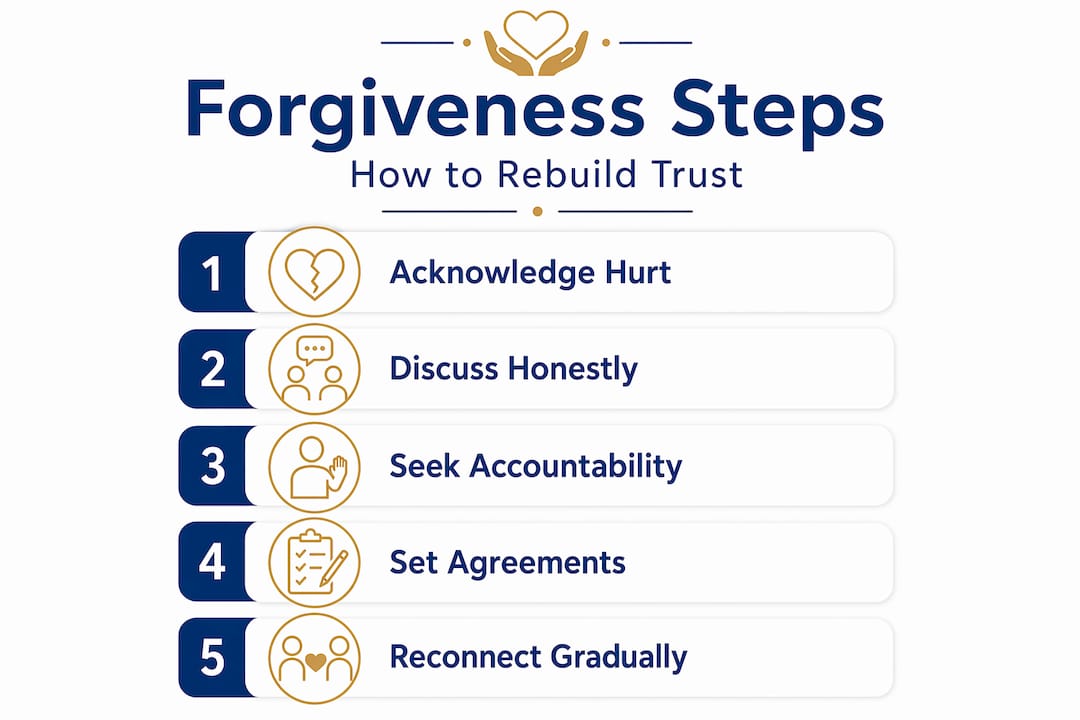
Have the hard conversation
You cannot rebuild what you have not discussed honestly. This conversation is not a fight or a confession session. It is a structured exchange where both partners get to speak and be heard without interruption. Successful relational repair requires perspective-taking and accountability without defensiveness. If every attempt at this conversation turns into a blame spiral, a therapist can provide the scaffolding that keeps both of you on track.
Require genuine accountability, not just an apology
An apology without accountability is just noise. True accountability looks like your partner:
- Naming specifically what they did wrong
- Acknowledging how it affected you without minimizing or qualifying
- Expressing genuine remorse, not embarrassment at being caught
- Committing to specific behavioral change going forward
The difference between an apology and genuine repair is that accountability means accepting impact and committing to change. If your partner cannot get through those four steps without deflecting, the relationship is not ready for reconciliation yet.
Establish new agreements and boundaries
After betrayal, the old rules of the relationship no longer apply. New agreements replace them. These are not punishments. They are the operating conditions under which trust can grow again.
Be specific. Vague promises like “I will do better” have no real structure. Specific agreements like “I will share my location when I am traveling” or “We will check in every evening” give trust something concrete to grow around.
Measure change over time, not intent
| What to measure | What to ignore |
|---|---|
| Consistent behavior over 30, 60, 90 days | Promises without corresponding action |
| Transparency offered without being asked | Emotional declarations that are not backed up |
| Respect for boundaries during conflict | Grand gestures that substitute for daily accountability |
| Willingness to continue hard conversations | Defensiveness when past events come up |
Emotional safety rebuilds trust more reliably than intellectual forgiveness. What your partner does on an ordinary Tuesday matters more than what they say during a crisis.
Reconnect emotionally in small doses
Do not rush the intimacy restoration. Gradual emotional reconnection through low-stakes positive experiences builds a new foundation. About 50% of couples who have experienced conflict do successfully reconcile, and the ones with the best outcomes used structured, evidence-based repair approaches rather than relying on emotional momentum alone.
Celebrating small wins matters. A conversation that did not turn into a fight is progress. A shared laugh is progress. A moment of genuine warmth is progress. Acknowledge them.
Pro Tip: Keep a short weekly record of moments when your partner honored a commitment. Over three months, this log becomes concrete evidence that change is real, which makes it easier for your brain to update its threat assessment of the relationship.
For a detailed phase-by-phase approach, the Mastering Conflict guide on rebuilding trust after betrayal offers additional structure you can apply alongside these steps.
Pitfalls that silently derail forgiveness
Even couples who are genuinely committed to repair fall into these traps. Recognizing them is half the battle.
The most destructive pattern is rushing. Couples who fast-forward forgiveness end up in cycles of breakup and reconciliation rather than actual healing. There is no shortcut through the emotional work. Attempting one simply delays and amplifies the pain.
The other major pitfalls:
- Treating an apology as full repair. “I said sorry” closes nothing if the behavior has not changed.
- Avoiding the pain entirely. Staying busy, minimizing what happened, or agreeing to “never bring it up again” is not healing. It is postponement.
- Trying to reconcile without acknowledgment. If your partner has not genuinely owned what they did, returning to the relationship does not restart it. It resumes the original dysfunction.
- Ignoring external pressure. Family, friends, and social expectations can push you toward forgiveness faster than your emotional state supports. Reconciliation takes 18-24 months for major betrayals. Anyone pressuring you to be “over it” by month two does not understand the process.
“Skipping the emotional work does not make you stronger or more forgiving. It makes you a person who learned to suppress rather than heal.”
The internal transformations in affect and cognition required for genuine trust restoration must happen in both partners. One person carrying all the emotional labor while the other coasts is not reconciliation. It is a new imbalance waiting to collapse.
My honest take on forgiveness after years of this work
I have sat with hundreds of couples over the course of my career, and the thing that surprises most of them is this: forgiveness is not linear. You will feel like you have forgiven your partner on a Tuesday, and then a specific song or smell will send you back to the worst moment in an instant. That does not mean you have failed. It means you are human.
What I have learned from working inside these painful moments is that people who forgive successfully are not people who feel less. They are people who keep choosing the process even when the feelings are not cooperating. The decision to forgive has to precede the emotion of forgiveness by weeks or months.
I have also seen the damage that “forced fast forgiveness” does. People who return to the relationship before genuine accountability has been offered almost always end up back in my office, this time carrying a second wound on top of the first. My strong position: do not move toward reconciliation until your partner can demonstrate remorse through behavior, not just words.
The importance of self-compassion in this process is something I cannot emphasize enough. You did not cause the betrayal by being imperfect. Forgiving your partner is work. Forgiving yourself for staying, for trusting, for not seeing it coming, that is often the harder work. Give yourself the same grace you are trying to extend to someone else.
— Carlos
Ready to move forward? Mastering Conflict can help

Knowing the steps is different from being able to execute them when you are in emotional pain. At Masteringconflict, Dr. Carlos Todd and the clinical team work specifically with couples and individuals navigating betrayal, resentment, and the long work of trust repair. Whether you need structured couples therapy for infidelity or want to understand the difference between coaching and therapy before committing, the resources are here.
You can explore the coaching vs therapy options to find what fits your situation, or browse the available courses for self-guided programs on communication, conflict resolution, and emotional rebuilding. Teletherapy sessions are available online, making it straightforward to get expert support regardless of where you are located. The work is hard. You do not have to do it alone.
FAQ
What does real forgiveness look like in a relationship?
Real forgiveness is the internal decision to release resentment toward your partner, separate from whether the relationship continues. It does not require you to forget what happened or restore trust immediately.
How long does it take to rebuild trust after betrayal?
Trust recovery follows four stages spanning Recognition, Remorse, Repair, and Restoration, with major betrayals typically requiring 12 to 24 months to reach a new emotional baseline.
Can you forgive someone and still end the relationship?
Yes. Forgiveness is personal work you do for your own wellbeing, and it is entirely separate from the decision to reconcile. You can release resentment and still choose not to continue the relationship.
What is the biggest mistake people make when trying to forgive?
Rushing the process is the most damaging error. Couples who fast-forward forgiveness before genuine accountability is established tend to cycle through repeated breakups and reconciliations rather than achieving real healing.
When should you seek professional help for forgiveness?
Seek professional support when conversations consistently turn into blame spirals, when one partner refuses accountability, or when the emotional weight of the betrayal begins affecting your daily functioning and mental health.
Recommended
- Rebuilding Trust After Betrayal: A Step-by-Step Process – Mastering Conflict
- Repairing After Infidelity: Steps to Rebuild Trust – Mastering Conflict
- Rebuilding trust in relationships: a complete guide 2026 – Mastering Conflict
- How to Resolve Arguments Effectively and Rebuild Trust – Mastering Conflict