
Couples Therapy for Infidelity: Rebuilding Trust and Connection

Trust can feel shattered after infidelity, leaving couples in North Carolina and South Carolina questioning the future of their relationship. Facing betrayal brings emotional pain, confusion, and often silence between partners. Seeking professional therapy offers a compassionate space to address these wounds and restore honest conversation. This guide highlights how couples therapy for infidelity uses structured support and communication strategies to help partners navigate the challenges of rebuilding trust, understand their unique needs, and begin true healing together.
Table of Contents
- What Is Couples Therapy for Infidelity?
- Understanding Types and Effects of Infidelity
- How Therapy Addresses Betrayal and Healing
- Rebuilding Trust and Improving Communication
- Common Challenges and Therapy Mistakes
- Deciding to Stay Together or Move Forward
Key Takeaways
| Point | Details |
|---|---|
| Couples Therapy Focus | Couples therapy for infidelity helps partners navigate emotional turmoil and rebuild trust after betrayal. |
| Types of Infidelity | Infidelity encompasses various forms, including physical, emotional, and financial affairs, each with its unique psychological impacts. |
| Therapeutic Process | The recovery process involves distinct phases: managing immediate emotions, exploring dynamics, and reconstructing trust or separation. |
| Decision to Stay or Leave | Couples must evaluate their commitment to healing, quality of communication, and emotional readiness when deciding their future together. |
What Is Couples Therapy for Infidelity?
Couples therapy for infidelity represents a specialized therapeutic approach designed to help partners navigate the profound emotional aftermath of betrayal and rebuild trust in their relationship. Unlike standard couples counseling, this type of intervention directly addresses the complex psychological wounds caused by an extramarital affair or significant breach of relationship boundaries.
In professional therapeutic settings, infidelity counseling is recognized as one of the most challenging forms of couples work. Therapists navigate complex emotional terrain when helping couples process betrayal, understand underlying relationship dynamics, and determine whether reconciliation is possible. The process involves multiple critical components:
- Establishing a safe, non-judgmental therapeutic environment
- Exploring the root causes of the infidelity
- Processing individual and collective emotional responses
- Developing communication and rebuilding trust strategies
- Deciding whether to repair or respectfully end the relationship
The therapeutic approach recognizes that infidelity isn’t just about a single act of betrayal, but represents a complex intersection of personal histories, relationship patterns, and individual psychological needs. Some couples discover that the affair reveals deeper systemic issues within their relationship that require comprehensive exploration and healing.
Successful couples therapy for infidelity demands extraordinary skill from therapists, who must simultaneously provide compassionate support, facilitate honest communication, and help partners make informed decisions about their shared future. The goal isn’t necessarily to preserve the relationship at all costs, but to support both individuals in achieving emotional healing and making choices aligned with their authentic needs.
Pro tip: Before starting couples therapy, both partners should independently reflect on their genuine motivations and commitment to the healing process.
Understanding Types and Effects of Infidelity
Infidelity is a complex relational phenomenon that extends far beyond a simple act of physical betrayal. Different types of affair dynamics reveal nuanced psychological and emotional complexities that profoundly impact relationship integrity and individual well-being.
Researchers have identified multiple categories of infidelity, each with distinct characteristics and potential consequences:
- Physical Affairs: Direct sexual encounters outside the primary relationship
- Emotional Affairs: Intimate non-sexual connections involving deep emotional attachment
- Cyber Affairs: Digital interactions involving romantic or sexual communication
- Financial Infidelity: Secret financial behaviors that breach relationship trust
- Psychological Affairs: Intimate connections that violate emotional boundaries
Psychological impacts of infidelity can be devastating. Emotional intimacy breaches often trigger profound trauma responses, including anxiety, depression, and significant trust erosion. The betrayed partner frequently experiences symptoms similar to post-traumatic stress, such as hypervigilance, intrusive thoughts, and intense emotional reactivity.

Understanding infidelity requires recognizing that motivations are rarely simplistic. Underlying factors might include unmet emotional needs, personal insecurities, communication breakdowns, or individual psychological challenges. Some individuals engage in affairs as a maladaptive coping mechanism, while others might be responding to systemic relationship problems.
Here’s a summary of common types of infidelity and their distinct features:
| Infidelity Type | Main Focus | Common Motivation |
|---|---|---|
| Physical | Sexual contact | Desire for novelty |
| Emotional | Deep personal connection | Seeking emotional closeness |
| Cyber | Online interactions | Anonymity, curiosity |
| Financial | Secret spending/saving | Control, power dynamics |
| Psychological | Intimate boundaries | Unmet emotional needs |
Pro tip: Approach understanding infidelity with compassion, recognizing that healing requires nuanced insight rather than simplistic blame.
How Therapy Addresses Betrayal and Healing
Couples therapy for infidelity employs a structured, compassionate approach to healing the profound emotional wounds caused by betrayal. Therapeutic intervention strategies are carefully designed to navigate the complex emotional landscape that emerges after an affair, recognizing that healing is not a linear process but a nuanced journey of understanding and rebuilding.
The therapeutic process typically encompasses three critical stages:
- Initial Impact Phase: Managing immediate emotional turbulence
- Meaning-Making Phase: Exploring underlying relationship dynamics
- Reconstruction Phase: Developing strategies for potential reconciliation or healthy separation
During these stages, therapists utilize multiple therapeutic techniques to address the intricate psychological challenges. Integrative therapeutic approaches combine cognitive-behavioral interventions, trauma-informed care, and insight-oriented strategies to help couples process their experiences. This might involve individual and joint sessions that focus on:
- Identifying communication breakdowns
- Understanding personal and relational triggers
- Developing emotional regulation skills
- Rebuilding trust through transparent interactions
- Processing individual and collective trauma responses
The ultimate goal of couples therapy in infidelity cases is not necessarily to preserve the relationship at all costs, but to support both partners in making informed, emotionally healthy decisions. This requires creating a safe therapeutic environment where both individuals can express their pain, fear, anger, and vulnerability without judgment.
Below are key phases of infidelity recovery therapy and their primary goals:
| Therapy Phase | Main Objective | Therapist’s Role |
|---|---|---|
| Initial Impact | Stabilize emotions | Provide safety |
| Meaning-Making | Explore relationship dynamics | Facilitate insight |
| Reconstruction | Restore trust or guide separation | Support healthy choices |
Pro tip: Approach healing as a collaborative journey, recognizing that recovery requires individual commitment and mutual understanding.
Rebuilding Trust and Improving Communication
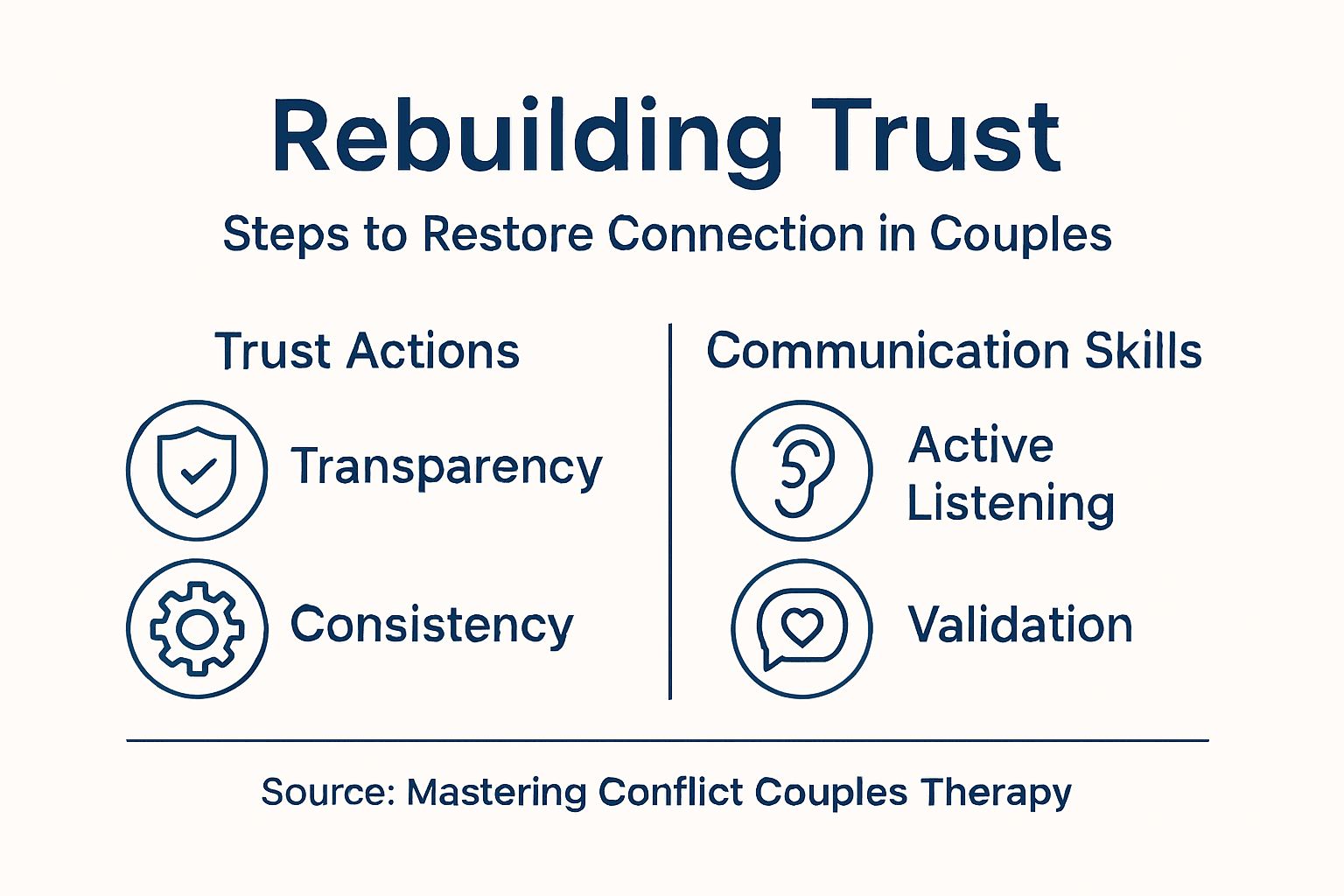
Therapeutic communication strategies are fundamental to healing relationships fractured by infidelity. The process of rebuilding trust requires more than simple apologies or promises—it demands a profound commitment to transparent, vulnerable, and intentional communication that addresses the root causes of relationship breakdown.
Successful communication and trust restoration involve several critical components:
- Emotional Transparency: Sharing genuine feelings without defensiveness
- Active Listening: Hearing and validating partner’s emotional experiences
- Accountability: Taking responsibility without making excuses
- Consistent Behavior: Matching words with demonstrable actions
- Establishing Boundaries: Creating clear relationship expectations
Couples must develop specific communication skills that go beyond surface-level interactions. Therapeutic approaches emphasize deep emotional connection techniques like expressing vulnerabilities, understanding underlying relationship needs, and creating safe spaces for honest dialogue. This might involve learning to:
- Recognize personal emotional triggers
- Practice non-defensive communication
- Express needs without blame or criticism
- Develop empathy and emotional attunement
- Navigate difficult conversations constructively
Effective communication also requires both partners to understand that rebuilding trust is a gradual, nonlinear process. It demands patience, consistent effort, and a mutual commitment to personal and relational growth. Therapists often guide couples in developing practical communication tools that transform destructive interaction patterns into opportunities for deeper understanding and connection.
Pro tip: Practice radical honesty and compassionate listening, recognizing that vulnerability is strength, not weakness.
Common Challenges and Therapy Mistakes
Couples therapy for infidelity requires extraordinary therapeutic skill and nuance, as managing complex therapeutic challenges demands exceptional professional sensitivity. The process is fraught with potential pitfalls that can derail healing and potentially cause additional relationship damage.
Common challenges in couples therapy after infidelity include:
- Intense emotional volatility from both partners
- Unresolved trauma and deep-seated resentment
- Power imbalances created by the betrayal
- Difficulty maintaining therapeutic neutrality
- Managing individual psychological needs simultaneously
Therapy mistakes often emerge from well-intentioned but misguided approaches. Therapists might inadvertently create additional relationship strain by:
- Rushing the reconciliation process
- Showing bias toward one partner
- Minimizing the emotional impact of betrayal
- Avoiding direct, uncomfortable conversations
- Failing to address individual psychological wounds
Successful therapeutic intervention requires a delicate balance between compassionate understanding and structured, evidence-based intervention. Therapists must create a safe environment that allows both partners to express vulnerabilities while maintaining professional boundaries and promoting constructive dialogue. This involves careful navigation of complex emotional terrain, recognizing that healing is a nonlinear process with unique challenges for each couple.
Pro tip: Approach couples therapy with patience and recognize that healing takes time, requiring consistent commitment from both partners.
Deciding to Stay Together or Move Forward
Relationship recovery pathways after infidelity are complex and deeply personal, with no universal solution that applies to every couple. Some partnerships emerge stronger after betrayal, while others recognize that separation represents the healthiest path forward.
Couples must carefully evaluate several critical factors when deciding their relationship’s future:
- Level of mutual commitment to healing
- Capacity for genuine forgiveness
- Quality of communication before and after the betrayal
- Willingness to address underlying relationship issues
- Individual and collective emotional readiness
- Presence of sustainable trust-rebuilding potential
Therapy aids decision-making processes by creating a structured environment where both partners can explore their authentic feelings and potential future scenarios. This involves honest conversations about compatibility, emotional safety, and realistic expectations for relationship reconstruction.
Ultimately, the decision to stay together or separate is not about assigning blame, but about understanding each partner’s authentic needs, emotional capacity, and long-term relational vision. Some couples discover that working through infidelity creates deeper intimacy and understanding, while others recognize that moving forward separately represents personal growth and emotional health.
Pro tip: Make relationship decisions from a place of self-respect and emotional clarity, not fear or desperation.
Take the First Step Toward Healing Your Relationship Today
Infidelity can shatter trust and leave deep emotional wounds that feel impossible to overcome. If your relationship is facing the pain of betrayal, you are not alone. Understanding the complex feelings of loss, anger, and confusion is critical to rebuilding connection and deciding your path forward. Our specialized couples therapy focuses on addressing these challenges with compassion and proven clinical methods that prioritize emotional safety, transparent communication, and restored trust.
Reclaim hope by engaging with expert support from Mastering Conflict. Whether you are seeking to rebuild your relationship or find clarity about the future our tailored couples therapy services provide a structured healing process informed by the latest in mental health research. Don’t wait until unresolved pain grows deeper – begin your journey toward understanding and connection now with professional guidance at Mastering Conflict. Discover how focused therapy can help you communicate honestly, process emotional trauma, and make empowered decisions about your relationship by visiting Mastering Conflict today.
Frequently Asked Questions
What is couples therapy for infidelity?
Couples therapy for infidelity is a specialized therapeutic approach that helps partners navigate the emotional aftermath of betrayal and work towards rebuilding trust within their relationship.
How does therapy address the emotional impacts of infidelity?
Therapy addresses emotional impacts by providing a structured process involving three critical phases: managing immediate emotions, exploring relationship dynamics, and developing strategies for rebuilding trust or healthy separation.
What techniques are used to rebuild trust during therapy?
Techniques to rebuild trust include emotional transparency, active listening, accountability, consistent behavior, and establishing clear boundaries in communication.
What factors should couples evaluate when deciding whether to stay together after infidelity?
Couples should consider their mutual commitment to healing, the capacity for genuine forgiveness, quality of communication, willingness to address underlying issues, and individual emotional readiness.