Six Group Activities That Cut Stress Fast, and Why They Work

Six activities you can run in the next ten minutes: paced breathing, 5-4-3-2-1 grounding, a 60-second progressive muscle relaxation pass, a three-minute guided imagery script, a shake-it-out movement break, and a two-minute peer check-in. Run any of these with a group of coworkers, a support circle, or a therapy cohort and you’ll see calmer faces before the timer runs out. Stress management group activities for adults work faster than solo apps or journaling for one simple reason: groups make regulation skills visible, so people copy what they see working in the person next to them.
That copying effect has a name. Peer modeling and accountability speed up skill adoption compared to people practicing alone, because a group normalizes the fact that everyone’s nervous system is misfiring a little, not just yours. You also get built-in accountability. Nobody skips the homework when six other people are checking in next week.
- Paced breathing (4 seconds in, 6 seconds out), one minute
- 5-4-3-2-1 sensory grounding in pairs
- 60-second progressive muscle relaxation sweep
- Three-minute guided imagery with a partner debrief
- A movement or laughter break to physically discharge tension
- A 90-second peer check-in on “one thing weighing on you”
One safety note before you run any of this: these activities work well for everyday stress and skill-building groups, but they are not a substitute for clinician-led care. If someone in the room is in acute crisis, dissociating, or disclosing trauma mid-exercise, that’s a hand-off moment, not a facilitation challenge.
Key Takeaways
Group-based stress management works because peer modeling speeds skill adoption, structured multi-week formats like SH+ build lasting habits, and proper screening keeps participants safe.
| Point | Details |
|---|---|
| Start with quick wins | Paced breathing, grounding, and movement breaks take under 10 minutes and need no equipment. |
| Structure beats improvisation | A five-week SH+ format or six-week resilience curriculum outperforms ad hoc sessions. |
| Screen before you scale | Ask about crisis risk and trauma history before enrolling anyone in group practice. |
| Homework locks in gains | Pair sessions with adequate sleep and regular physical activity weekly for lasting change. |
| Clinician-led groups fill the gaps | Mastering Conflict’s anger management groups and burnout coaching add trained screening and crisis response beyond what self-run groups can offer. |
Table of Contents
- Five- to Ten-Minute Stress Management Activities For Groups
- Structured 20 to 40 Minute Group Wellness Exercises
- Building a Multi-Week Stress Reduction Program
- How To Facilitate a Group Without Losing Control of It
- Mastering Conflict: Clinician-Led Groups and Coaching
- Sources
Five- to Ten-Minute Stress Management Activities For Groups
You don’t need a 90-minute workshop to shift a room’s stress level. Most of the tools below take less time than a coffee break and need zero equipment, which makes them the easiest entry point into stress management group activities for adults, whether you’re opening a staff meeting or closing a therapy session.
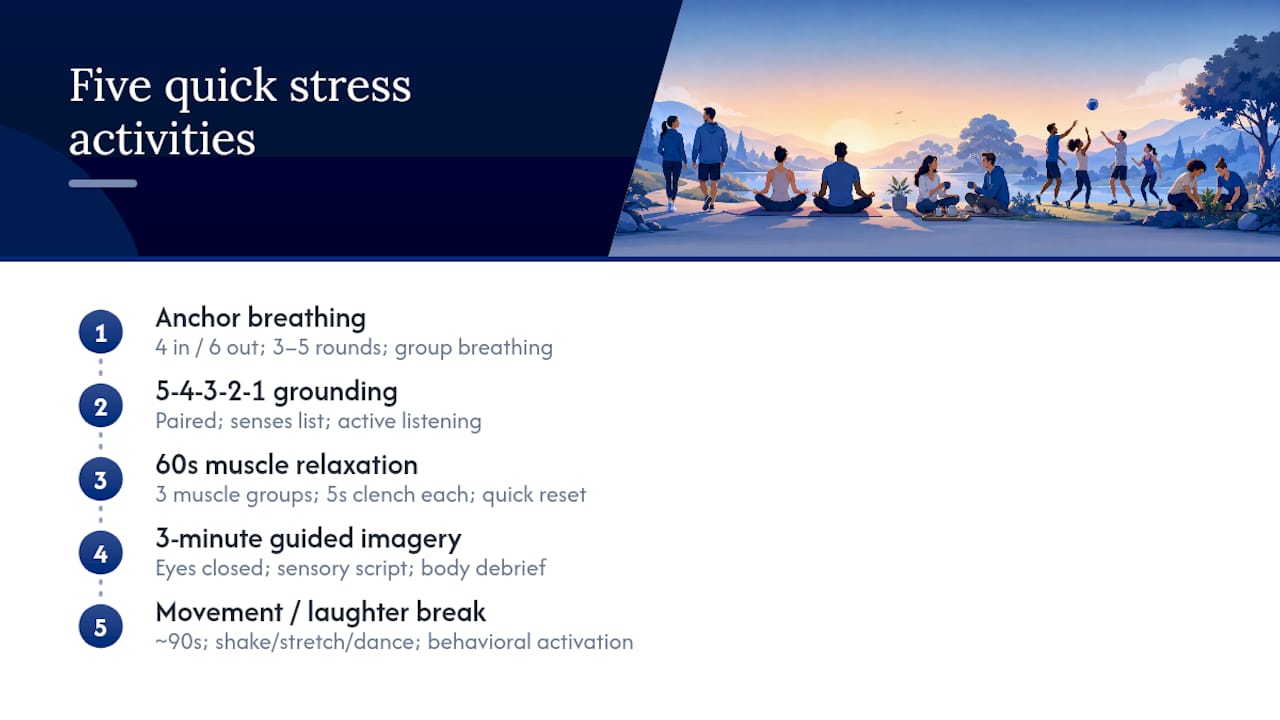
1. Anchor breathing with a paced exhale. Have the group inhale for four counts and exhale for six. The longer exhale activates the parasympathetic nervous system more reliably than even breathing does. Run three to five rounds out loud, counting together, then ask one question: “What’s different in your shoulders right now?” That’s it. No script needed beyond the count.
2. Five-four-three-two-one grounding, done in pairs. One person names five things they see, four they can touch, three they hear, two they can smell, and one they can taste (or would like to). Pairing people up instead of doing this solo forces active listening, and it turns an internal exercise into a small social one, which matters more than it sounds like it should.

3. Sixty-second progressive muscle relaxation. Skip the 20-minute version. Cue the group to clench fists for five seconds, release, then shoulders, then jaw. Three muscle groups, five seconds each, then a slow release. This works especially well right before a high-stakes conversation or presentation, when full relaxation isn’t practical but a fast reset is.
4. A three-minute guided imagery “safe place” script. Ask participants to close their eyes (or soften their gaze) and picture a place where they feel calm, then walk them through the sensory details: what they see, hear, smell. After three minutes, debrief with a single prompt: “What did you notice in your body when you pictured that place?” Guided imagery is one of the more underused tools in group settings because facilitators assume it needs more time than it actually does.
5. A movement or laughter break. Ninety seconds of shaking out arms and legs, a quick stretch sequence, or even a deliberately silly dance move resets a room faster than another round of talking. Behavioral activation, meaning physical movement paired with a mood shift, shows up consistently in stress-relief technique lists for a reason: the body often calms down before the mind catches up.
Pro Tip: Rotate which of these five you open a session with. Groups get bored of the same warm-up fast, and variety itself lowers resistance to trying the next new skill you introduce.
None of these five require special training to lead, but they do require a facilitator willing to model the behavior first. If you look uncomfortable doing the shoulder shake, the group will feel permission to skip it too.
Structured 20 to 40 Minute Group Wellness Exercises
Once a group has warmed up with quick resets, you can run something with more depth in a standard 45 to 90 minute session. These structured blocks work well for stress reduction workshops for adults, HR-led wellness sessions, or therapeutic group meetings, and each one follows a similar shape: brief teaching, guided practice, and a debrief.
- Mindful movement block (15 to 20 minutes). Open with a two-minute stretch warm-up, move into a slow sequence (walking meditation, chair yoga, or simple stretching held for 30 seconds each), then close with a reflective round: “What thought kept pulling your attention away?” This works particularly well for groups that resist sitting still for straight talk therapy.
- Cognitive reframe workshop (25 to 30 minutes). Participants write down one automatic negative thought from the past week. In pairs, they trade thoughts and practice reframing each other’s, out loud, using a simple script: “Another way to see this might be…” Peer reframing lands differently than self-reframing because hearing your own thought spoken back by someone else exposes distortions you’d otherwise miss.
- Support-map exercise (20 minutes). Each person draws three concentric circles and places names of people they could reach out to in each ring, from closest to most distant. Then everyone practices a single low-stakes reach-out script, texting or role-playing asking for support without immediately offering advice back. This trains people to receive help, which tends to matter more for burnout than another round of psychoeducation.
- Boundary-setting role-play (25 to 30 minutes). Pairs alternate practicing a boundary statement (“I can’t take that on right now”) with a partner who pushes back mildly, then swap. Guided feedback focuses on tone and body language, not just wording.
- Creative expression block (20 to 25 minutes). Journaling prompts or a collaborative collage where each person adds one image or word representing their current stress, followed by group reflection. This activity tends to surface things verbal check-ins miss entirely.
| Point | Details |
|---|---|
| Time structure | Budget five minutes for setup, the bulk of the block for practice, and five to ten minutes for debrief. |
| Peer format beats solo | Reframing and support-mapping work better in pairs than as individual worksheets. |
| Debrief is not optional | Skipping the reflective question cuts retention of the skill by a wide margin. |
Building a Multi-Week Stress Reduction Program
A single session helps, but lasting change tends to come from repetition across weeks. Two templates cover most needs: a short, scalable course and a longer skill-building curriculum.
The World Health Organization’s Self-Help Plus (SH+) program runs five weekly sessions of roughly 90 to 100 minutes, scaled for groups up to about 30 people. Each session pairs pre-recorded audio guidance with 30 to 40 minutes of interactive practice, which means a trained facilitator doesn’t need to be a licensed clinician to deliver it effectively. That’s a deliberate design choice: WHO built SH+ to be scalable in settings where specialist mental health staff are scarce.
For a deeper option, a six to eight week resilience curriculum works better. Resilience group curricula typically run 75 to 90 minute weekly sessions with six core sessions covering distinct skills (values clarification, cognitive flexibility, stress physiology, social support, and relapse planning), plus optional booster sessions.
| Format | Session length | Group size | Session count |
|---|---|---|---|
| SH+ (WHO) | 90 to 100 minutes | Up to ~30 | 5 weekly sessions |
| Resilience curriculum | 75 to 90 minutes | 6 to 10 | 6 core sessions + boosters |
Homework matters as much as the session itself. Public health guidance ties in-session physiological practice to concrete between-session targets: adequate sleep and regular physical activity weekly, alongside daily two-minute breathing check-ins.
- Track attendance and a simple pre/post self-report scale (0 to 10 stress rating) each week
- Use quick SUDS (subjective units of distress) snapshots before and after each activity block
- Closed groups (same members throughout) build trust faster for therapy-style work; open groups suit large SH+ style courses better
How To Facilitate a Group Without Losing Control of It
Good facilitation is mostly prevention. A short screening conversation before the first session catches most problems before they show up mid-exercise. Ask about current mental health treatment, any history of trauma that might surface during grounding work, and whether someone is in active crisis. Red flags, meaning suicidal ideation, recent psychiatric hospitalization, or active substance withdrawal, mean referral to individual or clinician-led care before group enrollment, not after.
Set norms in session one and repeat them briefly every session after: confidentiality (what’s shared stays in the room), time boundaries (nobody dominates the floor), and a clear speaking order or “pass” option so quieter members aren’t put on the spot.
- Screen for crisis risk, active trauma symptoms, and current treatment status before enrollment
- Confidentiality, time limits, and a “pass” option are the three non-negotiable norms
- If someone becomes flooded mid-exercise, switch immediately to grounding (naming objects in the room) rather than pushing through the planned activity
- Keep a local crisis line and referral list printed and ready every session, not just filed away
Leader guides consistently stress one underrated point: decide in advance which activities you’ll actually practice together versus which you’ll just describe. Trying to teach and fully practice every technique in one session is the single most common way facilitators run out of time and rush the debrief, which is usually the most valuable part.
Pro Tip: Structure skill-building sessions as “skill labs,” not processing groups. A skill lab practices tools; a processing group explores trauma. Mixing the two without warning is how well-meaning facilitators accidentally open a door they can’t safely close in 45 minutes.
Adapting Activities for Different Adult Groups
The same core exercises work across very different rooms, but small adjustments make a real difference.
- Workplace and professional groups: shorten scripts, cut therapeutic language (“trauma,” “healing”) in favor of performance framing (“focus,” “recovery time”), and cap activities at 10 minutes to fit meeting culture.
- Older adults or limited mobility: swap standing movement for seated stretches and chair-based progressive muscle relaxation; slow the pacing of guided imagery scripts.
- Veterans or trauma-exposed groups: give more notice before grounding exercises that involve closed eyes, and never require disclosure as a condition of participation.
- Virtual delivery: ask cameras on for connection but make it optional, use breakout rooms of two to three for paired exercises, and email a one-page handout of the session’s activities beforehand so tech hiccups don’t derail practice.
Why Trust This Guide on Group Stress Work
Mastering Conflict is led by Dr. Carlos Todd, a licensed clinical mental health counselor and psychologist whose practice includes anger management groups, burnout recovery coaching, and clinical supervision for other practitioners running group work. The activities above draw on established, publicly documented frameworks rather than invented techniques.
Group formats work because they turn private struggle into shared, practiced skill. WHO’s SH+ model proves that even non-specialist facilitators can deliver measurable relief when the curriculum is structured and evidence-based.
- WHO’s SH+ course and CDC lifestyle guidance anchor the activity recommendations above
- Mastering Conflict runs clinician-led anger management groups and burnout recovery coaching that use similar structured formats
- Clinical supervision services support practitioners who want to run these groups competently and safely
Mastering Conflict: Clinician-Led Groups and Coaching
Running these activities yourself works well for many teams and community groups. But some situations call for a facilitator with clinical training instead of a well-meaning volunteer, especially when the group includes people managing anger, chronic burnout, or relationship strain alongside general stress.
Mastering Conflict runs clinician-led anger management groups that use the same structured, session-by-session format described above, but with a licensed facilitator screening participants and adjusting pacing for people carrying more than everyday stress. For burnout specifically, the burnout recovery coaching program applies a similar multi-week structure with individualized attention. If you’re unsure whether coaching or clinical therapy fits your situation better, the breakdown on coaching versus therapy walks through the practical differences. The self-run activities in this guide are a strong starting point, but a clinician-led group adds screening, liability coverage, and trained crisis response that a workplace volunteer facilitator can’t replicate. Reach out through Mastering Conflict’s clinical services to schedule an assessment or ask about starting a tailored group for your team or community.
A Realistic Note on What These Groups Actually Deliver
Small, repeated practices build resilience more reliably than one big breakthrough session, and that’s the pattern I’ve seen hold across group formats again and again. People who show up for five or six consecutive weeks of a structured program tend to report steadier sleep, fewer reactive outbursts, and better recovery time after a stressful event, not the elimination of stress itself. That distinction matters for setting expectations. If you’re leading a group or considering joining one, start smaller than feels ambitious. A five-week SH+ style course beats an unstructured eight-week commitment nobody finishes. If your group needs clinical oversight rather than peer facilitation, Mastering Conflict is glad to talk through what a tailored program could look like.
— Carlos
Sources
- SELF-HELP PLUS (SH+) — A GROUP-BASED STRESS MANAGEMENT COURSE FOR ADULTS
- Mental health: Living with mental health conditions — CDC
- Managing the Strain of Stress: Leader’s guide — K-State Research & Extension