
Clinical Conflict Mediation: Project Management Methods for Clinicians

Clinical mediation is conflict resolution led by a licensed mental health clinician who helps couples, co-parents, or family members reach workable agreements while directly addressing the emotional patterns driving the conflict. It fits separating couples, disputing co-parents, and families where a child’s well-being is at stake. It is not appropriate where intimate partner violence is present or safety cannot be assured, and referral to individual therapy or safety planning should happen first.
TL;DR:
- Clinical mediation is most effective when both parties are motivated to negotiate, feel safe, and prioritize children, but it should be avoided in cases of recent violence or substance misuse.
- The process involves safety screening, conflict mapping, and structured communication, with most cases resolving in four to ten sessions focused on emotional containment and relationship repair.
- Techniques like emotion regulation, reframing, and pattern-focused listening distinguish clinical mediators from basic negotiators, improving long-term cooperation and reducing repeat disputes.
- Success depends on thorough training, safety protocols, and ongoing supervision, as well as recognizing underlying trust issues or emotional triggers beyond logistical conflicts.
- Clinical mediation systematically addresses ongoing family projects, preventing conflict from escalating into entrenched grievances, especially benefiting children by reducing parental discord.
Table of Contents
- What Is Clinical Mediation in Project Management (and Family) Contexts?
- Who Should Consider Clinical Mediation, and Who Shouldn’t
- What Happens in a Clinical Mediation Session?
- The Techniques That Make Clinical Mediation Work
- Does Clinical Mediation Actually Improve Outcomes for Families?
- Training Clinicians for Clinical Mediation Work
- Why “Conflict Mediation in Project Management” Matters for Family Life
- Types of Conflicts That Show Up in Family and Co-Parenting Disputes
- What a Clinical Mediator Actually Does in the Room
- A Step-by-Step Mediation Process Families Can Expect
- Structured Communication Tools and Interest-Based Negotiation
- Benefits: What Actually Improves When Mediation Works
- What Clinicians and Families Often Get Wrong About This Work
- Getting Started With Clinical Mediation and Clinician Training
- Sources
What Is Clinical Mediation in Project Management (and Family) Contexts?
Before going further, a clarification matters: this article uses “conflict mediation in project management” the way clinicians and families actually search it, meaning the management of conflict within a family or couple’s shared life project, not workplace or corporate project management. Every technique below applies to relational disputes, not office disputes.
Clinical, or therapeutic, mediation differs from structural or legal mediation in one fundamental way: it treats emotion as data, not noise. A structural mediator drafts terms and moves toward signature. A clinical mediator does that too, but only after helping both people regulate enough to negotiate honestly. The clinical mediator role described in counseling literature rests on three clinician skills: containment (keeping the room emotionally safe), differentiation (helping each person separate their feelings from the other’s), and strategic alignment (steering both parties toward shared goals like co-parenting stability).
In practice, that looks like:
- A divorcing couple negotiating holiday custody, where the clinician first defuses blame language before terms get discussed.
- Parents in conflict over a teen’s curfew, where the session separates the rule dispute from an older resentment neither has named.
- A separating couple drafting communication rules for co-parenting texts, so future disagreements don’t reopen old wounds.
Who Should Consider Clinical Mediation, and Who Shouldn’t
Clinical mediation works best when both people, even if they dislike each other, still want a workable outcome and can sit in a room without escalating. Readiness usually shows up as three things: both parties are motivated to negotiate rather than win, physical and emotional safety is reasonably assured, and any children involved are treated as the priority, not leverage.
It is not the right tool in every case. Contraindications include:
- Active or recent intimate partner violence, where mediation can pressure the victim into unsafe compromises.
- Severe untreated substance misuse that prevents honest engagement.
- One party using the process purely to stall or extract information for a legal case.
In any of these situations, individual therapy, safety planning, or a legal advocate is the safer next step, not joint mediation.
Pro Tip: Before booking, ask the clinician directly how they screen for safety in the first session. A provider who cannot answer that clearly is not ready to mediate your case.
What Happens in a Clinical Mediation Session?
Intake starts before anyone negotiates anything. A clinician typically screens each party separately for safety, coercion, and motivation, since early screening for safety and readiness is treated as essential before joint work begins. That mirrors how first couples-therapy sessions prioritize building a working alliance over deep conflict work.
From there, sessions generally move through a predictable arc:
- Safety and readiness screening. Individual conversations establish whether joint sessions are appropriate at all.
- Joint alliance-building. The first joint session sets ground rules for respectful dialogue rather than tackling the hardest issue immediately.
- Issue mapping. The clinician helps both parties name the actual points of conflict, separating logistics (schedules, finances) from emotional grievances.
- Negotiation with containment. Terms get discussed with the clinician actively managing tone, interrupting escalation, and reframing accusatory language.
- Drafting deliverables. Sessions typically produce a parenting plan, a communication protocol, or written agreements on specific disputes.
- Follow-up and coaching. A check-in session, often weeks later, tests whether the agreement is holding under real-life pressure.
Timelines vary, but most cases run somewhere between four and ten sessions depending on complexity. Couples with straightforward logistics might wrap in three sessions; families with entrenched conflict or multiple children often need ongoing coaching well past the initial agreement.
The Techniques That Make Clinical Mediation Work
What separates a clinical mediator from a general one is technique, not just credentials. Counselors bring emotion regulation, trauma-informed approaches, and differentiation into the room, which lets them contain outbursts and reframe accusations into workable statements without shutting the conversation down.
Core techniques include:
- Emotion containment. Naming escalation in real time (“I’m going to pause us here”) before it derails the session.
- Reframing. Turning “You never think about the kids” into “You’re both worried about how this affects the kids, just from different angles.”
- Pattern-focused listening. Attachment- and trauma-informed listening that tracks recurring dynamics rather than relitigating every incident.
- Structured communication tools. I-messages, strict turn-taking, and homework for practicing new communication outside session.
Pro Tip: If a session keeps circling the same argument, ask the clinician to name the pattern out loud. Patterns are usually easier to negotiate than specific incidents.
Explore related conflict management skills that improve therapy outcomes for a deeper look at how these tools translate into session practice.
Does Clinical Mediation Actually Improve Outcomes for Families?
The evidence points in a consistent direction. Ongoing conflict between parents is one of the strongest predictors of poor child adjustment after separation, and interventions that reduce interparental conflict improve outcomes for children. That is the entire rationale for clinical mediation over letting disputes play out in court or in silence.
Roughly 10 to 15 percent of families remain in high conflict long after a divorce or separation, according to estimates cited in family mediation research, and early intervention targeting that conflict matters most for protecting children over time.
Therapeutic mediation tends to outperform structural-only approaches on one specific measure: cooperation that outlasts the signed agreement. Reviews of mediation outcomes suggest therapeutic approaches improve the odds of sustained co-parenting cooperation compared with litigation-only paths, likely because the relational work, not just the paperwork, gets addressed.
Caveats apply. Clinician training varies widely, and mediation outcome studies differ in design and follow-up length, so results should be read as a coherent but limited signal rather than a guarantee for any individual case.
Training Clinicians for Clinical Mediation Work
Adding mediation to a clinical practice is not a weekend certificate. A serious curriculum covers systems theory (how families function as interconnected units), rigorous safety assessment protocols, and mediation-specific skills like neutral facilitation and structured negotiation.
Beyond coursework, clinicians need:
- Supervised practice hours before mediating unsupervised cases.
- Clear ethical boundaries around when mediation must stop and individual treatment or legal referral must begin.
- Ongoing consultation for complex or high-conflict cases.
Counselor training literature explicitly argues for adding mediation tracks and mentoring to standard clinical education, since the skill set does not develop automatically from general therapy training. Masteringconflict supports this through structured conflict management training courses and mentoring pathways designed for clinicians building this competency into practice.
Why “Conflict Mediation in Project Management” Matters for Family Life
Every family runs a kind of shared project: raising kids, managing a household, coordinating finances and schedules across two adults who don’t always agree. Conflict mediation in this context means applying structured, neutral facilitation to the recurring disputes that arise while running that shared project, whether it’s a divorcing couple dividing responsibilities or co-parents managing a custody schedule.
The relevance is practical, not theoretical. Unmanaged conflict in a shared family project doesn’t stay contained to one disagreement. It compounds. A disagreement about weekend custody bleeds into resentment about finances, which bleeds into how holidays get split. Clinical mediation interrupts that compounding effect early, before positions harden into permanent grievances.
This differs from generic conflict advice in one key way: it treats the family or couple’s ongoing coordination as an actual system with roles, deliverables, and timelines, similar to how any complex undertaking needs a facilitator when stakeholholders disagree on approach. The mediator’s job is to keep that system functioning even when the people running it are in active conflict.
Read more on approaches to conflict resolution for a broader clinician’s view of how mediation fits alongside other resolution methods.
Types of Conflicts That Show Up in Family and Co-Parenting Disputes
Most conflicts clinical mediators see fall into a few recurring categories, even though every family’s specifics look different.
Logistical conflicts cover scheduling, finances, and division of responsibilities. These sound simple but often carry unspoken resentment about fairness or effort.
Values-based conflicts involve disagreements over parenting philosophy, discipline, religion, or education. These run deeper than logistics because they touch identity, not just calendars.
Communication-pattern conflicts are the disputes that repeat regardless of topic. One partner shuts down, the other escalates, and the actual subject matter almost stops mattering.
Boundary conflicts show up around extended family involvement, new partners after separation, or how much autonomy each co-parent has in decision-making.
Trust-based conflicts stem from past betrayals, broken agreements, or unresolved grievances that resurface whenever a new decision needs to be made.
A skilled clinical mediator identifies which category (or combination) is actually driving a dispute, because the intervention differs. Logistical conflicts often resolve with structured negotiation alone. Trust-based conflicts require the relational repair work therapeutic mediation is built for. Treating a trust-based conflict as if it were purely logistical is one of the most common reasons mediation stalls.
What a Clinical Mediator Actually Does in the Room
A clinical mediator’s role splits into two functions that a purely legal mediator does not perform: facilitator of agreements and regulator of the emotional temperature that makes agreement possible.
On the facilitation side, the mediator keeps sessions on track, ensures both parties get equal airtime, and drives the conversation toward concrete deliverables like parenting plans or communication protocols. This part resembles any structured negotiation process.
The second function is where clinical training earns its place. The mediator watches for escalation cues, intervenes before a session turns into a shouting match, and reframes accusatory statements into workable positions without taking sides. That neutrality is deliberate and constant. A clinical mediator does not advocate for either party’s position, even when one seems more reasonable, because the moment neutrality breaks, trust in the process breaks with it.
Responsibilities also include safety monitoring throughout, not just at intake. If new information about coercion or risk surfaces mid-process, an ethical clinical mediator pauses joint work and reassesses, even if that disrupts progress toward an agreement. This responsibility for ongoing risk management, more than any single technique, is what separates a licensed clinician from someone simply trained in negotiation tactics.
A Step-by-Step Mediation Process Families Can Expect
While the earlier session-structure section covered timeline and phases, the actual step-by-step mechanics of how a dispute moves from conflict to agreement look like this in practice.
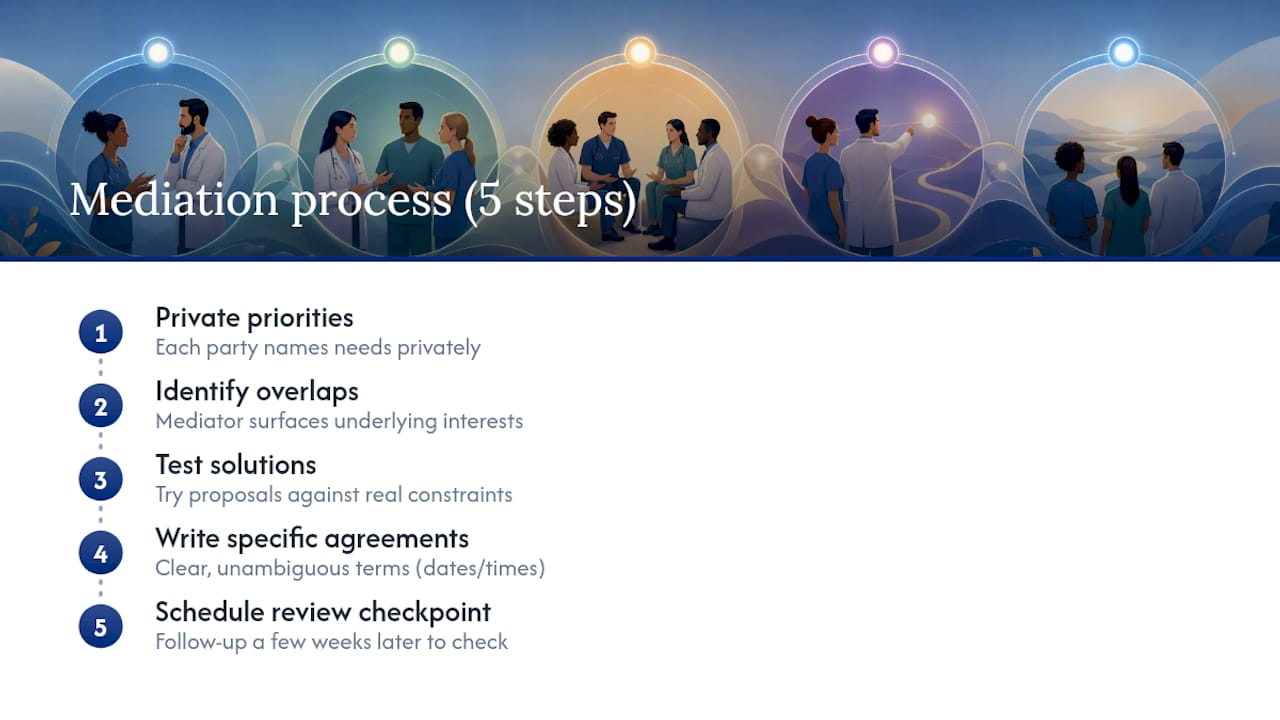
First, each party names their own priorities privately, without the other person in the room, so the mediator understands what each side actually needs rather than what they say in front of the other.
Second, the mediator identifies overlapping interests. This is the interest-based negotiation core of the process: instead of arguing over fixed positions (“I want the kids every other weekend”), the mediator surfaces the underlying interest (“I want consistent time to maintain my relationship with them”) and looks for solutions that satisfy the interest even if the position shifts.
Third, both parties test proposed solutions against real-world constraints, work schedules, school calendars, financial limits, before anything gets finalized.
Fourth, agreements get written down in specific, unambiguous language. Vague terms like “reasonable visitation” tend to reignite conflict later; specific terms like “alternating weekends starting Friday at 6pm” hold up better.
Fifth, a review checkpoint gets scheduled, usually a few weeks out, to confirm the agreement is working under actual conditions rather than just in theory. Follow more detail on this in the step-by-step mediation process for couples and families.
Structured Communication Tools and Interest-Based Negotiation
Two techniques do most of the heavy lifting in project-style family mediation: structured communication protocols and interest-based negotiation.
Structured communication protocols replace free-flowing argument with rules. Turn-taking, time limits per person, and required use of I-statements (“I feel concerned when…” instead of “You always…”) keep sessions from devolving into old fighting patterns. Many mediators also assign structured communication homework between sessions, such as a shared co-parenting app or a written weekly check-in, so the skill transfers outside the room.

Interest-based negotiation, borrowed from broader dispute-resolution theory, asks “why do you want that” before asking “what do you want.” A parent insisting on a specific pickup time might really be protecting a work commitment, not the time itself. Once the underlying interest is visible, alternative solutions open up that a positional argument would never reach.
Other tools worth naming: written agendas for each session to prevent scope creep into unrelated grievances, and a shared document both parties can reference so agreements don’t rely on memory alone. None of these require special software. They require discipline and a facilitator willing to enforce the structure when emotion tries to override it.
Benefits: What Actually Improves When Mediation Works
The clearest benefit is fewer relitigated disputes. Families who mediate well tend to spend less time re-arguing settled issues because the agreement addressed the underlying interest, not just the surface complaint.
Team dynamics, in the sense of how co-parents or family members function together going forward, tend to improve because the process models a communication style both parties can reuse without a mediator present. That skill transfer is arguably more valuable long-term than any single agreement reached in session.
Children benefit indirectly but significantly. Since ongoing parental conflict is a strong predictor of child maladjustment, reducing that conflict through mediation has downstream effects on kids even though they are rarely in the room. Faster resolution also matters: unresolved disputes tend to expand, pulling in extended family, finances, and old grievances the longer they sit unaddressed.
What Clinicians and Families Often Get Wrong About This Work
Most people assume clinical mediation is either therapy in disguise or negotiation with extra feelings talk. Neither is accurate, and that confusion causes real harm. I’ve seen the framing shift outcomes: families who expect a neutral arbiter to hand down a verdict get frustrated when the clinician instead asks them to sit with discomfort long enough to actually hear each other. That discomfort is the work.
One pattern shows up constantly: a couple insists their only conflict is logistical, custody schedules, holiday splits, when the real driver is an unresolved trust breach neither has named. A skilled clinical mediator notices the mismatch and slows the process down rather than rushing toward a signed agreement that won’t hold. If you’re unsure whether your situation needs this kind of mediation or a different kind of support entirely, an assessment conversation with a licensed clinician is the fastest way to find out.
— Carlos
Getting Started With Clinical Mediation and Clinician Training
If you’re navigating a co-parenting dispute, a separation, or family conflict that’s affecting your kids, Masteringconflict’s clinical services offer clinician-led mediation built around safety screening, emotional containment, and structured negotiation, not just paperwork. Unlike a general mediator, you’re working with a licensed clinician trained to spot the difference between a logistics dispute and a deeper trust issue driving it.
For families dealing specifically with anger as a driver of conflict, an anger management assessment can clarify whether individual work needs to happen before joint mediation makes sense. And if the conflict is centered on family dynamics rather than a couple’s separation, family counseling services address that directly.
Clinicians looking to add this competency to their own practice can start with a mentoring conversation about supervision and credentialing pathways. Booking a discovery assessment, whether for your own family or your professional development, is the fastest way to find out if clinical mediation is the right fit.
Sources
Key sources include the Kutztown research on clinical mediator roles, the AAML paper on therapeutic mediation, and Springer’s family therapy mediation research. Explore conflict management techniques in project management for related clinician training content.
This article is general information, not a substitute for advice from a qualified doctor. Consult a qualified healthcare professional about your own circumstances before acting on anything here.
- PMC article on family systems and conflict
- Clinical mediation and counselor role (Kutztown research)
- Mediation in Couple and Family Therapy | Springer Nature Link