Five Week Ready to Use Stress Management Lesson Plans for Clinicians

A clinically effective stress management program for adult groups typically runs five sessions around an hour and a half, with some CBT-based formats running for several weeks. Core modules cover grounding and relaxation, structured problem solving, cognitive skills, and values-based behavioral activation, closing with relapse prevention. A trained clinician or a supervised facilitator typically leads each session.
TL;DR:
- Large-group psychoeducational programs like SH+ and Stress Control reach up to 30 participants in roughly 90-minute sessions, prioritizing access over individual depth.
- Small CBT-style groups involving 5 to 9 members offer more personalized support, with satisfaction and symptom outcomes comparable to digital coaching in feasibility studies.
- Facilitator training should include supervision and structured practice, especially for clinical cases with higher acuity, to ensure participant safety and program fidelity.
- Attendance greatly influences outcomes, with higher recovery rates associated with consistent participation, making retention efforts crucial.
- Symptom improvement is measurable with simple tools like the Perceived Stress Scale, but effect sizes remain small to moderate, emphasizing the programs’ role as part of stepped care.
Table of Contents
- Choosing between short scalable courses and small-group CBT programs
- A turnkey five-week lesson plan for clinical groups
- Scripts and exercises facilitators can use word for word
- Who should facilitate, and how to keep participants safe
- What to measure and what results to expect
- Why manual fidelity matters less than people think
- Get hands-on support running your program
- Sources
Choosing between short scalable courses and small-group CBT programs
The format you pick depends on who is in the room and how much depth they need. A large psychoeducational course reaches more people with less staff time; a small CBT-style group goes deeper but costs more in facilitator hours and screening.
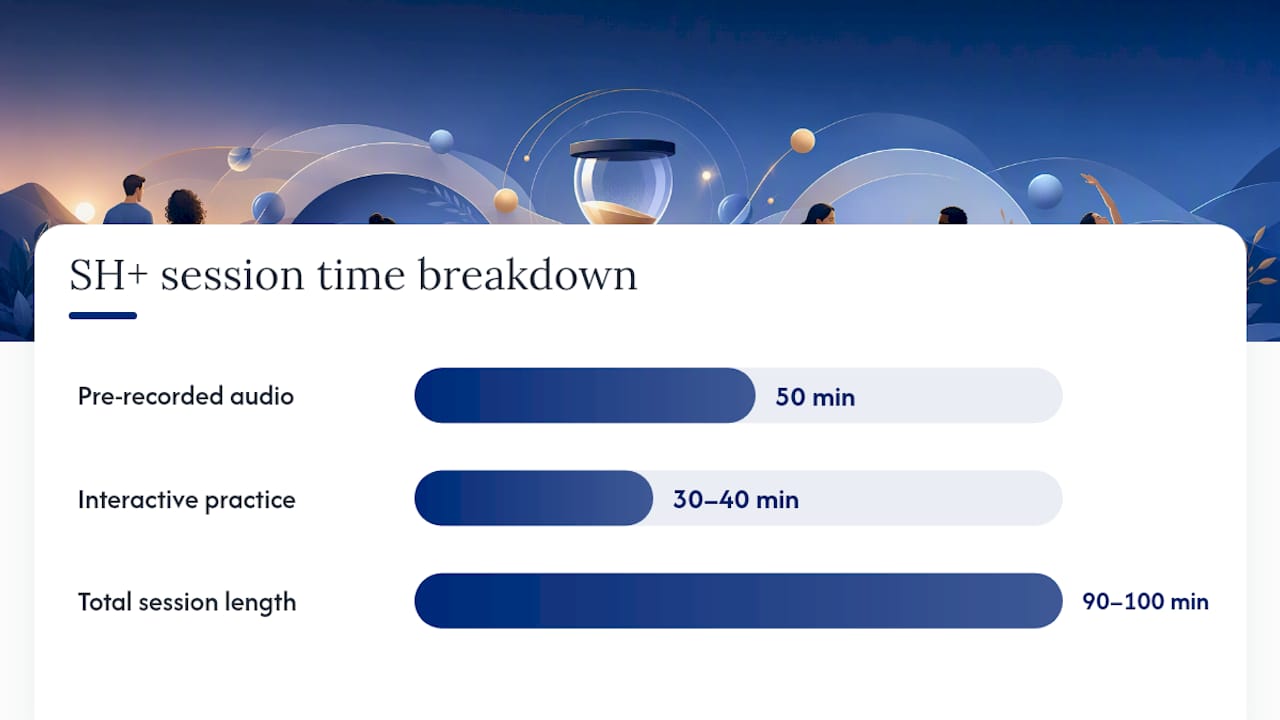
WHO’s SH+ manual lays out a five-week, group-based course built around roughly 90 to 100 minute sessions, mixing about 50 minutes of pre-recorded audio with 30 to 40 minutes of interactive practice. It scales to groups of up to 30 participants, which makes it a strong fit for community outreach or stepped-care programs where reach matters more than individualized attention. Stress Control follows a similar large-group logic, functioning as low-intensity psychoeducation rather than intensive therapy.
Small-group formats trade scale for depth. A feasibility study on group stress management training tested weekly online sessions lasting about an hour and a half, with small groups consisting of several participants, led by a qualified trainer, and found it produced satisfaction and symptom outcomes comparable to individual digital coaching.
Use each format where it fits naturally:
- Large-group psychoeducation (SH+, Stress Control): community mental health outreach, employer wellness workshops, stepped-care entry points
- Small CBT-style groups (5 to 9 members): clinical group therapy, populations needing more personalized coaching, cases with higher comorbidity
Session length generally ranges from about one to two hours, and group sizes vary depending on the format, from small groups to larger ones with many participants, according to baseline data on SH+ program structure. Neither model is inherently superior. The large-group course wins on access; the small group wins on retention and individualized attention.
A turnkey five-week lesson plan for clinical groups
Here is a session-by-session structure built for a 90-minute weekly meeting, adaptable to your group’s size and clinical needs.
- Session 1, orientation and grounding. Objective: build group safety and teach a basic grounding skill. Spend 20 minutes on introductions and group agreements, 30 minutes explaining the stress response in plain language, 25 minutes on a first breathing exercise, and 15 minutes assigning home practice: two daily grounding reps logged on a tracking sheet.
- Session 2, progressive muscle relaxation and problem identification. Objective: teach full-body relaxation and start distinguishing solvable from unsolvable stressors. Fifteen minutes reviewing home practice, 30 minutes on guided PMR, 30 minutes introducing the problem-solving framework, 15 minutes assigning a worksheet: list three current stressors and sort them into “can act on” versus “must accept.”
- Session 3, structured problem solving. Objective: apply a stepwise problem-solving method to a real stressor. Fifteen minutes check-in, 45 minutes of paired practice generating and evaluating options, 20 minutes group debrief, 10 minutes assigning one action step to try before next week.
- Session 4, cognitive restructuring. Objective: identify and challenge unhelpful thought patterns. Fifteen minutes reviewing the action step, 35 minutes teaching thought records, 30 minutes paired practice reframing a real recent thought, 10 minutes homework: complete one thought record daily.
- Session 5, values-based activation and relapse prevention. Objective: connect daily behavior to personal values and build a maintenance plan. Fifteen minutes review, 30 minutes values clarification exercise, 25 minutes drafting an individualized relapse-prevention plan, 20 minutes closing ritual and referral to ongoing resources if needed.
Materials to have ready before Session 1:
- Printed or digital participant workbook with space for each week’s worksheet
- Audio file or script for grounding and PMR exercises
- Thought-record template and values clarification handout
- Attendance log and simple pre/post assessment sheet
For ready-made activity descriptions that map directly onto these sessions, therapy-ready group activities for adults offer facilitator prompts you can slot straight into Session 2 or 3.
Scripts and exercises facilitators can use word for word
Reading a script verbatim in your first few sessions is not a weakness. It keeps timing tight and prevents you from rushing the pauses that make relaxation work.
Grounding script (3 to 5 minutes): “Find a comfortable position. Notice five things you can see. Now four things you can hear. Now three things you can feel against your skin. Take a slow breath in for four counts, hold for four, release for six. Repeat that breath three times.” This short sequence works as a session opener or a homework anchor participants can use anywhere.
Progressive muscle relaxation (10 to 12 minutes): Walk the group through tensing and releasing each muscle group for five seconds, starting at the feet and moving upward. Cue each release with, “Notice the difference between tension and release.” Full guided relaxation scripts give you longer versions if your group responds well to slower pacing.
Paired problem solving: Pair participants, give each person four minutes to describe one stressor, then five minutes for the partner to ask clarifying questions only, no advice. Debrief as a full group: “What did you notice about a stressor when someone just listened first?”
Values-guided activation prompt: Hand out a worksheet with one line: “Name one value this stress has been getting in the way of. Write one small action this week that honors it.” Keep it to a single sheet.
For online delivery, assign a technical support person separate from the clinical facilitator, use breakout rooms for the paired exercises, and build in 15 minutes of informal peer time after the formal close, a step the Group iSMT feasibility trial found meaningfully improved engagement in small online groups.
Pro Tip: Send the grounding script as a one-page PDF after Session 1. Participants forget guided exercises fast, but they will reread a script on a hard day if it is sitting in their inbox.
Who should facilitate, and how to keep participants safe
Facilitator training is not optional paperwork. The Group PM+ manual recommends structured classroom training combined with supervised in-field practice before anyone runs a group independently, and that standard holds whether your facilitator is a licensed clinician or a trained non-specialist.
Before the first session, screen every participant with a brief intake that includes a single-item check for suicidal ideation. Build a clear triage path: immediate referral for acute risk, clinician follow-up for moderate concerns, and monitored participation with extra check-ins for everyone else.
- Non-specialist facilitators can run large psychoeducational formats like SH+ safely, provided a licensed clinician is available for consultation
- Small CBT-style groups with higher clinical acuity need direct clinician co-facilitation, not just supervision on call
- Retention improves with reminders, workbooks, and brief check-in calls before certain sessions
Attendance is the strongest predictor of outcome in this literature. Practice-based data on Stress Control found A substantial portion of participants attended most sessions, and attending all sessions is associated with notably higher recovery rates compared to average outcomes. That gap alone justifies spending real effort on retention tactics rather than treating them as an afterthought.
What to measure and what results to expect
Keep measurement simple enough that participants actually complete it. A short version of the Perceived Stress Scale, paired with attendance counts and a home-practice log, tells you most of what you need.
- Administer PSS or a brief wellbeing item at intake and again at Session 5
- Track attendance every week; a dip after Session 2 usually signals a scheduling or engagement problem worth addressing immediately
- Log home-practice completion as a rough proxy for skill uptake
Evidence on both SH+ and small online group formats shows these programs are feasible to run and produce measurable symptom improvement, though systematic review evidence on Stress Control notes effect sizes are small to moderate and the quality of evidence varies. Treat these programs as one strong piece of stepped care, not a stand-alone cure for severe cases. A one-page report per cohort, attendance rate, average PSS change, and completion rate, is enough to track whether your program is working.
Why manual fidelity matters less than people think
Clinicians new to group work often treat a manual like scripture, terrified that skipping a line will invalidate the whole session. That fear is backwards. The Coping Effectiveness Training facilitator manual makes the point directly: structure protects the group, but flexibility inside that structure is what makes the content land for the actual humans sitting there.
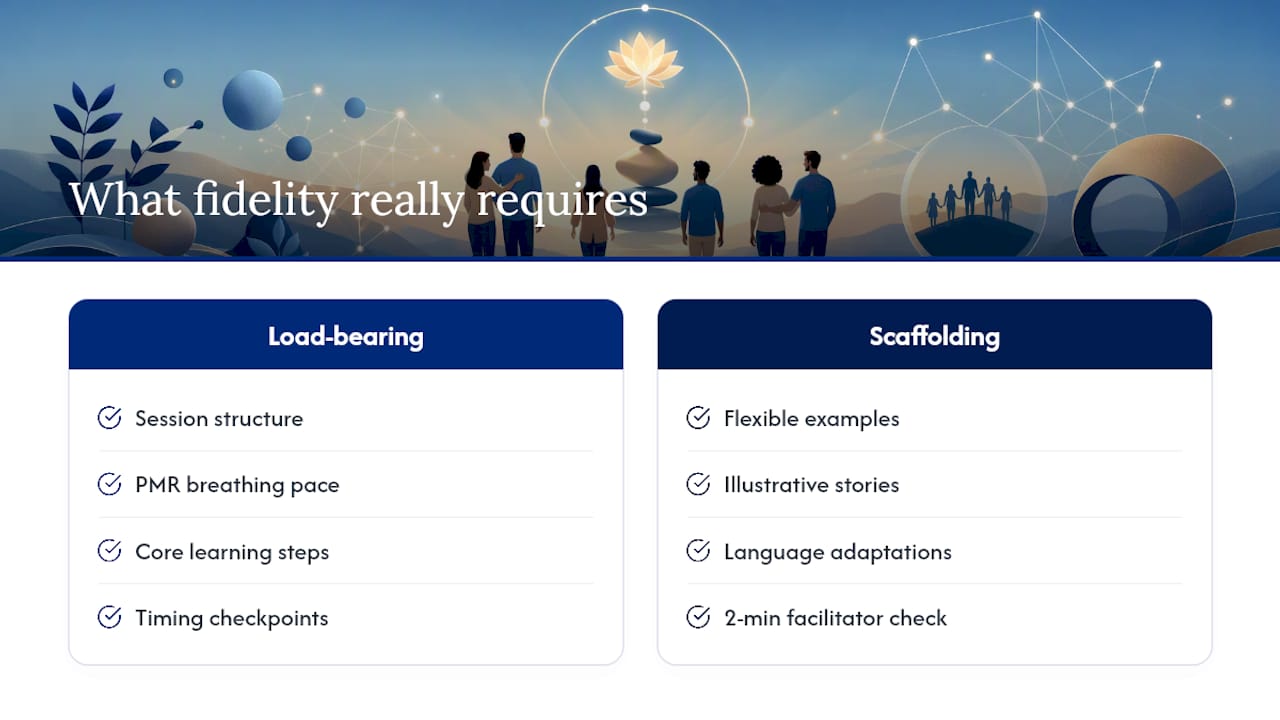
The real skill is knowing which parts of a session are load-bearing and which are just scaffolding. The breathing pace in a PMR script matters. The specific example you use to illustrate cognitive restructuring does not, and swapping it for something closer to your group’s lived experience almost always helps.
One adaptation worth naming: when we moved a five-session format to teletherapy, the paired problem-solving exercise nearly fell apart in breakout rooms until we added a facilitator “knock in” at the two-minute mark, a quick check that both people were still on track. Small fix, and it saved the exercise.
— Carlos
Get hands-on support running your program
Reading a manual and running a live group are two different skills, and the gap between them is where most first-time facilitators get stuck. Training and supervised practice is recommended for clinicians and organizations building these programs, rather than just handing over a workbook.
Our clinical supervision track pairs you with a licensed clinician while you run your first cohorts, covering the same screening, triage, and facilitator preparation standards outlined above. If you are building out a broader program, our clinical services page details group formats we already run, including our anger management groups, which follow a similar structured, session-by-session model. Mentoring is also available through our clinical mentoring program if you are earlier in your training path. It is often advisable to schedule a consultation and receive a facilitator readiness assessment before the first session.
This article is general information, not a substitute for advice from a qualified doctor. Consult a qualified healthcare professional about your own circumstances before acting on anything here.
Sources
- SELF-HELP PLUS (SH+) — WHO manual
- Feasibility study of online group stress management training (Group-iSMT) — PMC article
- Stress Control as a large-group psychoeducational intervention — Cambridge / Behavioural and Cognitive Psychotherapy
- Effectiveness of Stress Control large-group psychoeducation: systematic review and meta-analysis
One Response