
Feel Better by Friday: 10 Clinician Backed Stress Moves for Students

The most effective way for college students to manage stress is a combined approach: immediate coping skills, consistent daily habits, and real use of support resources. Time management, protected sleep, short movement breaks, and quick breathing or grounding techniques form the core toolkit. None of these works well alone. Stacked together, they reduce both the spike of acute stress and the slow burn of chronic overload. The rest of this guide breaks down exactly how to build that stack, starting today.
TL;DR:
- Short breaks, grounding exercises, and outdoor movement significantly reduce both immediate anxiety spikes and long-term stress overload.
- Breaking large tasks into actionable steps and scheduling them consistently helps prevent overwhelming feelings and reduces study-related anxiety.
- In-the-moment techniques like breathing exercises and muscle relaxation are effective, but require prior regular practice to work reliably under pressure.
- Maintaining healthy sleep, nutrition, and movement habits before stress peaks lowers baseline stress levels and improves overall resilience.
- Building support networks early and seeking professional help when warning signs of serious stress or mental health issues appear are crucial for effective management.
Table of Contents
- Stress Management Techniques for Students: A 10-Step Checklist to Try This Week
- Time Management for Student Stress: Building a Routine That Prevents Overload
- In-the-Moment Stress Relief Tips for Students: Grounding, Breathing, and Fast Resets
- Sleep, Movement, and Nutrition: The Lifestyle Habits Behind Effective Stress Reduction Strategies
- Building a Support Network and Using Campus Resources
- Coping With Academic Stress: Warning Signs It’s Becoming Something More Serious
- The Research Behind These Stress Management Strategies for Students
- How to Start Building Real Stress Relief Habits (And Where to Go From Here)
- Sources
Stress Management Techniques for Students: A 10-Step Checklist to Try This Week
You don’t need a semester-long plan to feel better by Friday. You need a handful of moves you can make in the next 24 to 72 hours, each backed by a reason that isn’t just “trust me.” Here’s a working list, roughly ordered from fastest to most involved.
Take a five-minute microbreak every hour during study sessions. Set a timer. Step away from the screen, stretch, or just stare out a window. Practitioners note that short recovery breaks restore attention better than pushing through fatigue, which is the same logic behind why sleep and microbreaks often double efficiency compared with grinding through exhaustion.
Run the 5-4-3-2-1 grounding drill when anxiety spikes. Name five things you see, four you can touch, three you hear, two you smell, one you taste. Use it right before a test starts or when a racing mind won’t let you focus on the page in front of you. Grounding exercises like this one offer rapid relief for acute stress, and they work precisely because they force your brain out of anticipation mode and into the present moment.
Practice box breathing for two minutes. Inhale for four counts, hold for four, exhale for four, hold for four. Repeat six to eight cycles. This is the tool to reach for in a waiting room outside an exam hall, not mid-lecture.
Take a 10 to 20 minute walk outside, no phone. Movement outdoors lowers physical tension fast. Use it after a rough class or before you sit down to write a paper you’ve been avoiding.
Pick one small task from your to-do list and finish it today. Not the biggest one. The smallest one that’s been nagging you. Momentum from a completed task quiets the mental noise better than staring at an overwhelming list.
Set a consistent wind-down routine 30 minutes before bed. Dim the lights, put the phone in another room, and do something boring on purpose. Sleep disruption is one of the clearest markers that chronic stress is taking hold, so protecting the hour before sleep protects everything else.
Cut caffeine after 2 p.m. if you’re drinking coffee, energy drinks, or even a lot of tea past that point, your sleep tonight pays for it. This is one of the cheapest wins on this list and one of the most skipped.
Text or call a friend today, not to vent, but to check in. Reaching out during ordinary weeks, not just crisis weeks, keeps that support available when you need it most. That’s the pattern behind advice to build reliable supports before things get hard, not after.
Book one appointment with campus counseling or advising this week, even if nothing feels urgent yet. Getting on the calendar now means you’re not waiting two weeks when you actually need the slot.
Eat something with protein and fiber instead of skipping meals or living on vending machine snacks. Blood sugar crashes mimic anxiety. A handful of nuts and a piece of fruit beats a candy bar for steadying your mood through a long afternoon.
Pro Tip: The techniques on this list work best when you’ve already practiced them before you’re desperate. Run box breathing or the grounding drill for two minutes a day during a calm week, so your body already knows the pattern when a real deadline or exam hits. This kind of repeated, low-stakes rehearsal, sometimes called “dosing” a coping skill, is what makes a technique reliable under pressure instead of one more thing you fumble through while panicking.
Time Management for Student Stress: Building a Routine That Prevents Overload
Most student stress isn’t caused by having too much to do. It’s caused by not knowing when you’re going to do it. That gap between “I have a paper due” and “I’m writing paragraph two at 9 a.m. on Tuesday” is where anxiety lives.
Start by breaking every big assignment into its next physical action. “Write research paper” isn’t a task, it’s a category. “Find three sources on Tuesday” is a task. “Outline section one on Wednesday” is a task. Once you have next actions, put each one on a specific day in a week view calendar, whether that’s Google Calendar, a paper planner, or an app. Block time the same way you’d block a class: same slot, same day, every week, if possible.
A realistic heavy week during midterms or finals might look like this:
- Monday through Friday: two 90-minute study blocks, morning and afternoon, with a hard stop by 9 p.m.
- One full rest evening midweek where you do zero schoolwork, on purpose, not by accident.
- Saturday: one longer three-hour block for the assignment you’ve been dreading, followed by something social or physical.
- Sunday: a 30-minute planning session to set next week’s next actions before Monday arrives.
When the week gets too heavy, something has to come off the calendar. Trim in this order: optional social commitments first, then lower-stakes assignments where a slightly lower grade is genuinely fine, then sleep is the last thing you touch, not the first. Students consistently cut sleep to make room for everything else, and it’s the worst trade on the list.
Use Pomodoro-style sprints, 25 minutes of focused work followed by a five-minute break, for dense reading or writing tasks. Spaced practice, reviewing material in short sessions across several days instead of one long cram, holds information better than a single marathon session the night before an exam.
If your workload includes a genuine crunch, whether that’s a major exam or a professional admissions test, the pressure tends to spike weeks in advance rather than the night before. Some practical strategies for high-stakes testing translate directly to college finals: start review earlier than feels necessary, and treat the week before as tapering, not cramming.
If a course load genuinely exceeds what’s manageable, most schools have a formal process for accommodations or deadline extensions. Before you email a professor or advising office, gather these:
- The specific assignment or exam and its current due date.
- A brief, honest reason (illness, family emergency, documented disability, mental health crisis).
- Any supporting documentation you already have, even informal.
- A proposed new deadline, so you’re offering a solution, not just a problem.
In-the-Moment Stress Relief Tips for Students: Grounding, Breathing, and Fast Resets
Some stress needs a routine to fix. Some stress needs to stop right now, five minutes before you walk into an exam room or step up to present. These four tools are built for that second category.
- 5-4-3-2-1 grounding: Silently or quietly name five things you can see, four you can touch, three you can hear, two you can smell, one you can taste. Takes 90 seconds. Best used the moment you notice your thoughts spiraling into “what if I fail.”
- Box breathing: Inhale four counts, hold four, exhale four, hold four. Six rounds. Best right before something starts, walking into a testing room, sitting down for an interview, stepping on stage.
- Waterfall breathing: Inhale slowly through the nose picturing breath flowing down like water, exhale slowly through the mouth. Slower and gentler than box breathing. Good for late-night anxiety when you’re lying awake and box breathing feels too rigid.
- Quick progressive muscle relaxation: Starting with your feet, tense each muscle group for five seconds, then release. Work up through legs, stomach, hands, shoulders, face. A two-minute version hits the major muscle groups without needing the full 20-minute version.
Pick based on context, not preference. Grounding works when your mind is racing but your body feels okay. Progressive muscle relaxation works when your body is physically tense, jaw clenched, shoulders up near your ears, even if your thoughts feel manageable. Breathing techniques work for both, which is why they’re the most versatile entry point.
Here’s what almost nobody tells you: sometimes these techniques make you feel worse for the first thirty seconds. Slowing down and paying attention to your body can briefly amplify anxiety before it settles, especially the first few times you try a technique. That’s normal. Stick with it for the full cycle before deciding it doesn’t work.
Pro Tip: Practice these on a boring Tuesday afternoon, not for the first time during a panic spike on exam morning. A muscle you’ve never trained won’t perform under load, and a coping skill is no different. One structured way to build that muscle is through short, repeated practice sessions, sometimes just two to five minutes a day, which is closer to how these skills actually become automatic.

Sleep, Movement, and Nutrition: The Lifestyle Habits Behind Effective Stress Reduction Strategies
Skills you use in the moment matter, but they’re working against a losing hand if your sleep, movement, and eating patterns are wrecked underneath them. This is the layer that determines your baseline stress level before anything stressful even happens.
Sleep hygiene that actually holds up during exam weeks:
- Keep a consistent bedtime and wake time within about an hour, even on weekends.
- Stop caffeine after early afternoon; it has a longer half-life than most people assume.
- Get bright light exposure, ideally outdoors, within an hour of waking to anchor your body clock.
- Treat the hour before bed as a wind-down, not a scroll-down. Phones out of the bedroom if you can manage it.
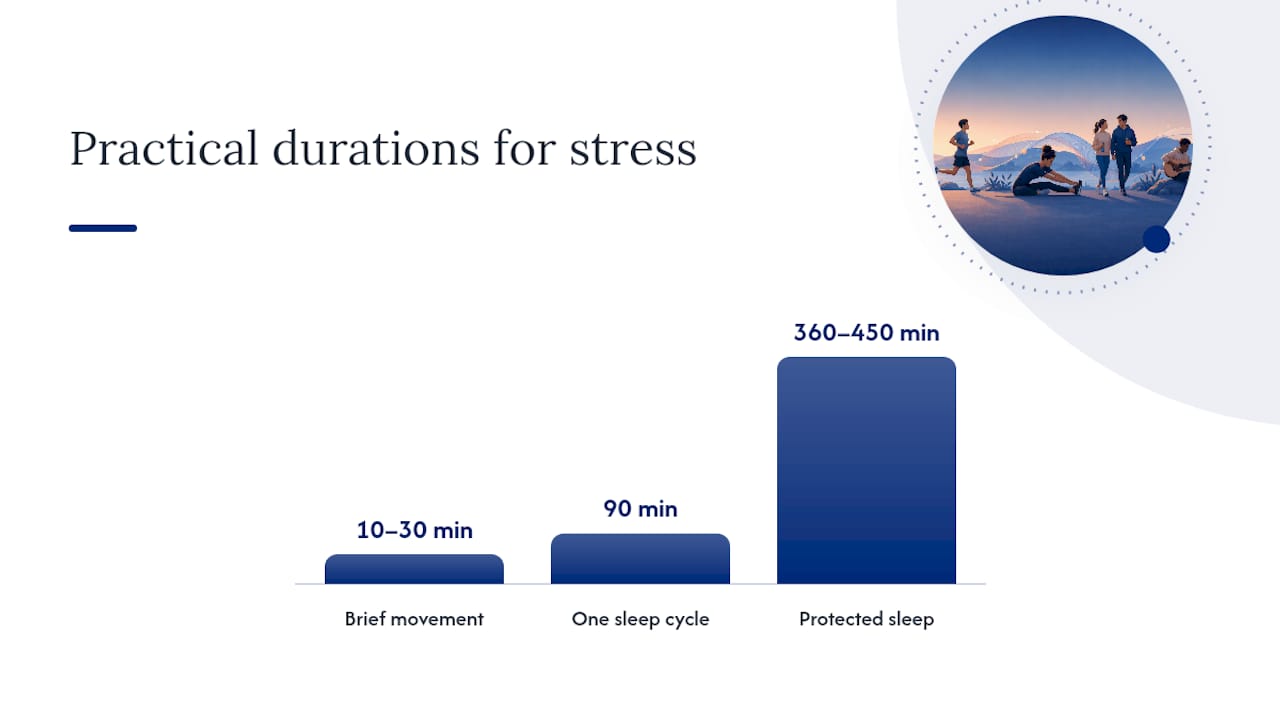
- During finals week specifically, protect at least one full sleep cycle (roughly 90 minutes of uninterrupted rest, repeated four to five times) rather than sacrificing sleep entirely to cram.
Practitioners who work with students consistently see the same pattern: switching from all-nighters to consistent sleep improves exam performance, according to clinical observations, often dramatically. The trade students think they’re making, more study time for less sleep, usually costs more than it buys.
Movement doesn’t need a gym membership or an hour block. Ten to thirty minutes of brisk walking, a short bike ride, or even dancing around your dorm room raises heart rate enough to trigger a real endorphin response and improves sleep quality that night. The point isn’t building fitness. It’s using your body to burn off cortisol that’s otherwise circulating with nowhere to go.
Nutrition for steady energy, not crash-and-jitter cycles:
- Eat protein at breakfast; it slows the blood sugar spike that skipped-meal mornings tend to produce.
- Keep caffeine intake moderate and spread out rather than one large dose followed by a crash.
- Add fiber (fruit, vegetables, whole grains) to meals to avoid the energy dip that drives afternoon irritability.
- Hydrate before you assume you need more caffeine; dehydration mimics fatigue almost exactly.
The connection between these habits and academic outcomes is documented, not anecdotal. A systematic review of stress-management skills training found it significantly improved both academic vitality and psychological well-being among college students, and the interventions studied leaned heavily on exactly these lifestyle fundamentals: sleep, movement, and structured coping practice, not willpower alone.
Combining these three levers, sleep, movement, nutrition, alongside natural, routine-based approaches to stress reduction tends to outperform any single fix attempted in isolation.
Building a Support Network and Using Campus Resources
Stress management gets a lot easier when you’re not doing it alone, and most students underuse the support that’s already available and often already paid for through tuition and fees.
Reaching out doesn’t require a perfect script, but having language ready helps when you’re anxious. To a friend: “Hey, I’ve been stretched thin lately, can we grab coffee this week? I could use the company.” To a professor: “I’m struggling to keep up with the reading load this semester and wanted to ask about your office hours to talk through a plan.” To an academic advisor: “I want to talk through whether my course load this semester is realistic given everything else on my plate.”
Campus counseling centers typically offer a intake session first, a conversation to understand what’s going on and match you with the right level of care, followed by either short-term individual sessions, group sessions, or a referral to community providers if your needs exceed what the campus can offer. Walking in with a rough idea of what’s been happening (sleep changes, mood shifts, specific stressors) speeds up that first appointment considerably.
When campus resources aren’t enough or aren’t accessible, alternatives exist:
- Teletherapy for students who prefer remote sessions or live off campus, offering the same clinical support without needing to be on-site.
- National helplines and directories, including resources through NIMH’s guidance on recognizing when stress has become too much, which lists warning signs and where to find care.
- Peer support groups, which work well for students who find one-on-one settings intimidating but benefit from structured group formats.
Building this network before a crisis, not during one, is the difference between having somewhere to turn and scrambling to find help while already overwhelmed.
Coping With Academic Stress: Warning Signs It’s Becoming Something More Serious
Ordinary stress and something more serious don’t always look different at first glance, but the warning signs are measurable if you know what to watch for.
Behavioral signs: skipping classes you used to attend regularly, withdrawing from friends or activities you normally enjoy, a sharp drop in academic performance across multiple classes rather than just one hard subject.
Emotional signs: feeling persistently hopeless or numb rather than just tired, irritability that feels disproportionate to what’s actually happening, a sense of dread that doesn’t lift even during breaks.
Cognitive signs: difficulty concentrating that goes beyond normal distraction, racing or intrusive thoughts you can’t redirect, memory problems that are new and getting worse.
Physical signs: sleep disruption lasting more than two weeks, appetite changes in either direction, physical symptoms like chest tightness or stomach issues with no medical explanation.
Any thoughts of self-harm or suicide are never something to wait out. That’s an immediate signal to act, not a stress-management item to schedule for later.
If you’re noticing several of these signs stacking up, here’s the sequence to follow:
- Contact your campus counseling center directly and ask for the soonest available appointment, mentioning if it feels urgent.
- Inform your academic advisor so accommodations or extensions can be discussed before things fall apart further.
- Reach out to a trusted emergency contact, a parent, close friend, or family member, so someone outside the situation knows what’s happening.
- If there’s any risk of immediate harm, go to an emergency room or call a crisis line without waiting for a scheduled appointment.
An urgent visit typically starts with a safety assessment, direct questions about whether you’re having thoughts of harming yourself, followed by a conversation about what’s been building up. Bring a rough timeline in your head: when did things start feeling different, and what’s changed recently. It makes the intake faster and gets you to the right level of care sooner. Reviewing the early warning signs of stress before they escalate can help you catch this pattern earlier next time.
The Research Behind These Stress Management Strategies for Students
The recommendations above aren’t guesswork. A systematic review of stress-management skills training programs found measurable improvements in both academic vitality and psychological well-being among college students who completed structured training, evidence that these skills genuinely change outcomes, not just self-reported mood.
Public health guidance from the CDC on managing stress lists deep breathing, physical activity, and journaling among core coping strategies, while flagging that stress interfering with daily functioning is the signal to seek professional support rather than push through alone. That threshold matters more than most students realize.
Consistency beats intensity. A student who practices a two-minute breathing exercise daily for a month builds more reliable stress resilience than one who tries an hour-long relaxation session once during finals week and never again.
Clinical teams working in mental health often use this same evidence base to develop practical, student-ready templates for building these skills into daily routines rather than treating them as emergency-only tools.
How to Start Building Real Stress Relief Habits (And Where to Go From Here)
Don’t try to implement everything on this page at once. Pick one item from the quick action checklist and one lifestyle habit from the foundations section. Track them for a week, not for perfection, just for whether you actually did them. Small, visible wins build the motivation that a giant overhaul never does.
If stress keeps interfering with your sleep, relationships, or ability to function despite consistent effort with these strategies, that’s worth a conversation with a professional rather than another self-help attempt. Mastering Conflict’s clinical services offer individual counseling for students navigating exactly this kind of persistent overload, and teletherapy options make that support accessible even if you’re not near a physical office.
— Carlos
This article is general information, not a substitute for advice from a qualified doctor. Consult a qualified healthcare professional about your own circumstances before acting on anything here.
Sources
- A review of the effectiveness of stress management skills training on academic vitality and psychological well-being of college students (PMC)
- Managing Stress: A Guide for College Students – Health Promotion (University of Georgia)
- Managing stress | Mental health – CDC
- Helping College Students Beat End-of-Semester Stress – Psychology Today
One Response