
Anger Management Techniques for 10-Year-Olds That Work

The techniques that work best for a 10-year-old are simple and physical: slow breathing, counting to 10, walking away, moving the body, and talking to a trusted adult once the heat has passed. They work when your child practices them while calm, so they are ready when anger hits. Your job is to help your child spot early warning signs, rehearse a few tools, and respond calmly when an outburst happens.
At ten, children can think about their feelings in a way a six-year-old cannot, yet they face bigger pressures: friendship drama, schoolwork, teasing and the first hints of puberty. Below you will find what to do in the moment, what to practice every week, how to respond as a parent, and when it is time to bring in a professional.
TL;DR
- Teach a short in-the-moment routine: notice the anger, breathe slowly, count to 10, step away, then talk it through.
- Practice the routine when your child is calm, ideally as a regular habit, so it becomes automatic under stress.
- Look for the trigger behind the outburst: bullying, friendship trouble, schoolwork stress, or family conflict.
- Stay calm yourself, praise effort, and talk about what happened only after everyone has cooled down.
- Seek professional help if outbursts are frequent, involve harm, or disrupt school, friendships or home life.
Table of Contents
- Why a 10-year-old gets angry
- Learn the early warning signs
- In-the-moment techniques for a 10-year-old
- Skills to practice every week
- What parents can do during and after an outburst
- Perspective: why we teach skills, not suppression
- When to get professional help
- How we can help
- FAQ
- Sources
Why a 10-year-old gets angry
Anger is a normal emotion, and it is rarely the whole story. The NHS lists friendship problems, being bullied, struggling with schoolwork, feeling stressed or anxious, seeing family members argue, and hormonal changes during puberty as common reasons children lose their temper. Nemours KidsHealth adds that kids often get angry when something does not go their way, when they are teased or called names, when they think a rule is unfair, or when they are blamed for something they did not do.
That last group is worth noticing. A ten-year-old has a strong sense of fairness. Many blowups that look like defiance are really a protest against something the child feels is unjust.
It also helps to know that anger is often a top-layer feeling. The Tools For Your Child’s Success project describes “unpacking the suitcase” of emotions: underneath the anger there may be hurt, rejection or embarrassment. If your child explodes after a bad day at school, the explosion is the part you see, and the sting of being left out at recess may be the part that matters.
Learn the early warning signs
The easiest moment to stop an outburst is before it starts. Help your child learn how anger feels in the body. The NHS points to a faster heart rate, tense muscles and clenched teeth as typical cues.
Try this together on a calm evening:
- Ask your child to remember the last time they were really angry.
- Ask where they felt it first: chest, stomach, hands, face, jaw.
- Draw a simple outline of a body and mark the spots.
- Agree on a code word or hand signal that means “I feel it starting.”
Use a feelings thermometer
PBS Kids for Parents suggests teaching children to swap “hot thoughts” for “cool thoughts,” often with a thermometer as a visual tool. Draw a thermometer with a green zone (calm), a yellow zone (getting annoyed) and a red zone (about to blow). Ask your child to rate their anger from 1 to 10 a few times a day, even when nothing is wrong. Once they can name a 4 or a 5, they can use a tool before they hit a 9.
Find the pattern with the W5 questions
An NHS trust booklet recommends the W5 technique: What, Where, When, Who and Why to understand a child’s specific triggers. After a few incidents, write the answers down. You may find that blowups cluster before dinner, during homework, or after time with one particular classmate. Patterns point to solutions: a snack after school, a break before homework, a different seat on the bus.
In-the-moment techniques for a 10-year-old
When anger is already rising, a child cannot think through a long strategy. They need two or three moves they can do almost without thinking. The American Academy of Pediatrics describes the ACT method: Acknowledge the feeling, Calm down, and Think and talk. The same guidance says that children can calm down by breathing deeply, counting to 10, walking away, or talking with someone about how to fix the problem without fighting.
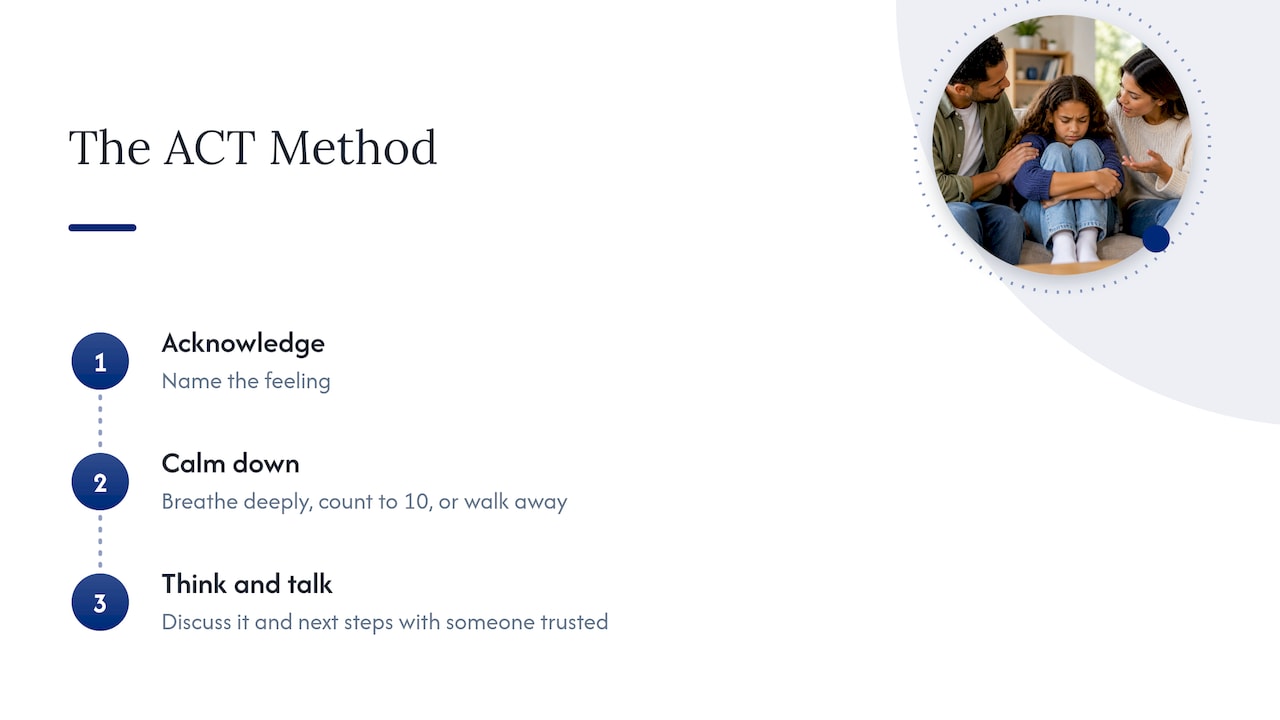
Here is how to turn that into a routine your child can remember.
Step 1: Name it
The child says, silently or out loud, “I’m angry.” Naming the feeling is the first step of ACT, and it takes the edge off a feeling that otherwise runs the show.
Step 2: Calm the body
Pick one or two of these and let your child choose which feel natural:
- Slow belly breathing. In through the nose for four counts, out through the mouth for six. A longer exhale tells the body to settle.
- Count to 10. Old advice, and still on the NHS list of simple tips for children, which also includes walking away and clenching and unclenching the fists to ease tension.
- Move. Nemours KidsHealth lists jumping jacks, other exercise or running outside among its “anger busters.”
- Grounding with the senses. Mind describes a 5-4-3-2-1 exercise: five things you see, four you touch, three you hear, two you smell, one you taste. It pulls attention out of the angry thoughts and into the room.
- Squeeze and release. Press the palms together hard for five seconds, then let go. It gives tense muscles a job.
Step 3: Step away
Walking away is a skill, not a retreat. Tell your child in advance that leaving the room to cool off is allowed, at home and at school. Agree on how they ask for it (“I need a minute”) so a teacher or sibling does not read it as rudeness.
Step 4: Think and talk
Only when the body has settled does the third part of ACT make sense. Your child can talk to you, a teacher or another trusted person about what happened and what to do next. Mind also notes that dwelling on what made you angry can make it worse and suggests distracting yourself for now and returning to the issue once you feel more in control. That is useful for a child who replays an argument in bed.
Skills to practice every week
In-the-moment tools only work if they have been rehearsed. The Kids Mental Health Foundation, a top-ranking guide, makes the same point, and it matches what we see in practice: the best time to learn a skill is when nothing is going wrong.
Try building one small habit at a time.
| Skill | How to practice | How often |
|---|---|---|
| Belly breathing | Five slow breaths before bed or at the start of homework | Daily |
| Feelings thermometer | Child rates mood at breakfast and dinner | Daily, 1 minute |
| Feelings guessing game | Act out or describe a feeling at the table; others guess | A few times a week |
| Role-play | Act out a tricky situation (a teasing classmate, a lost game) and try a calm response | Weekly, 10 minutes |
| Active play | Bike, soccer, basketball, swimming, a walk with the dog | Most days |
Tools For Your Child’s Success suggests feelings guessing games at meals to widen a child’s emotional vocabulary. The more precise words your child has (“embarrassed,” “left out,” “disappointed”), the less they need to say it all with a slammed door.
The NHS also encourages regular active play and exercise as part of helping a child with anger.
Move from aggressive to assertive
PBS Kids for Parents explains that children should learn to shift from aggressive anger to assertive anger, which means using words to solve the problem instead of fists, shouting or throwing things. Give your child sentence starters they can borrow: “I didn’t like it when you…”, “I need you to stop…”, “That doesn’t seem fair to me because…”. Role-play these until they feel normal.
Make a calm-down space
Tools For Your Child’s Success recommends creating a “safe base” at home, a place your child can go for comfort or to calm down. It is not a punishment corner. Let your child help decorate it: a beanbag, headphones, drawing paper, a stress ball, a feelings chart. Writing on how caregivers build boundaries and safe spaces for little ones shows the same principle at an earlier age: a child who has a predictable place and a calm adult learns to settle faster.
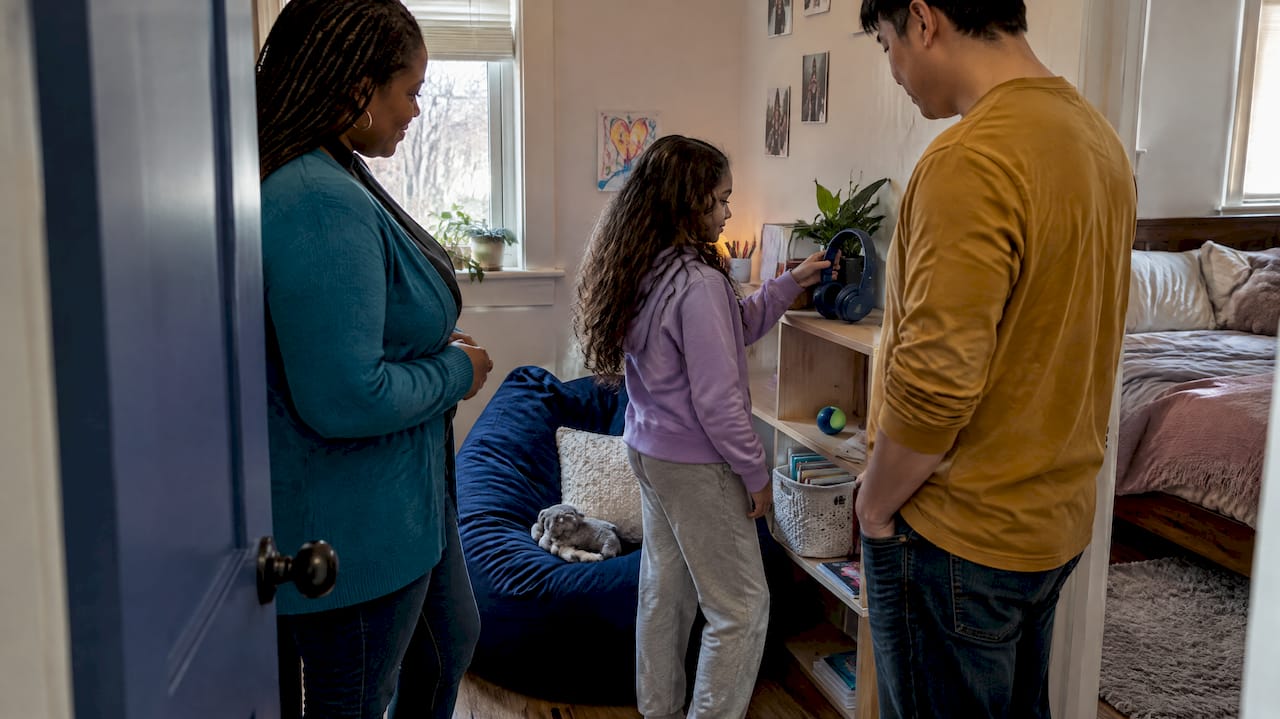
For more ideas to try at home, our guides to anger management activities for kids and quick emotional regulation activities include exercises you can pick from.
What parents can do during and after an outburst
Your response can lower the temperature or raise it. The Child Mind Institute’s guidance, one of the top results for this topic, tells parents to stay calm, hold their limits and praise appropriate behavior once the child has settled. We agree, and here is how that looks in practice.
During the outburst
- Lower your voice and slow your speech. A calm adult is the strongest regulator in the room.
- Say little. “I can see you’re furious. I’m here when you’re ready.”
- Keep everyone safe. Move objects or siblings if needed, without lectures.
- Do not negotiate or hand out consequences in the heat of it.
Earlier, at the first signs
The NHS trust booklet notes that the best time to step in is when the child begins to show signs of escalation, using humor, distraction or redirection. If you see the jaw tighten, suggest a snack, a walk or a quick job together before the meltdown.
After it has passed
- Wait until your child is fully calm, often 20 to 30 minutes or more.
- Ask what happened using the W5 questions, without blame.
- Look for the feeling under the anger: “Were you embarrassed? Disappointed?”
- Agree on one thing to try next time.
- Repair anything that was broken or hurtful, including an apology when it fits.
- Praise effort. The NHS advises that parents work with the child to find triggers and helpful strategies, and praise their efforts.
Make anger the problem, not your child
The NHS suggests teaming up with your child to name their anger, for example calling it a volcano, so the child understands that anger is the problem and they are not. “Let’s figure out how to keep the volcano from erupting” lands very differently from “What is wrong with you?”
Manage your own anger too
Children copy what they see. If you shout when you are overwhelmed, they learn that shouting is what adults do. Taking your own pause out loud (“I’m getting frustrated, so I’m going to take five breaths”) is some of the most effective teaching you can do. Our guide to managing anger in parenting offers five strategies for this, and our guide for parents on children’s anger outbursts goes deeper into common scenarios.
Perspective: why we teach skills, not suppression
When parents come to us about a ten-year-old, they often say, “He just explodes.” What we usually find is a child with very few tools and a nervous system that is running hot. The explosion is a signal, and our work is to decode it.
We build our approach on practical, evidence-based frameworks combined with clinical rigor. That means we do not just tell a child to “calm down.” We help the child find where anger lives in the body, what sits underneath it, and which two or three tools fit their personality. A child who loves to move needs different options than one who prefers to draw or talk.
We also look at the family system. Children’s anger rarely lives in a vacuum, and parents are often exhausted and frustrated themselves. When a parent learns to stay steady, the child’s progress tends to accelerate. That is why we work with children, teens, parents and couples, and why we offer both in-person and online options.
If you try the steps in this article for several weeks and still feel stuck, that is not failure. It is useful information that your child may benefit from a trained guide.
Carlos
When to get professional help
Most children have angry moments, and most learn to handle them with practice and patient adults. Consider talking to your child’s pediatrician, school counselor or a licensed child therapist when:
- Outbursts are frequent, very intense or last a long time.
- Your child hurts others, themselves, or destroys property.
- Anger is causing trouble at school, such as suspensions, or costing your child friendships.
- The home revolves around avoiding the next blowup.
- Your child seems persistently sad, anxious, withdrawn or hopeless, or you suspect bullying or something else underneath.
- The strategies above have not made a difference after several weeks of steady practice.
If your child threatens to harm themselves or someone else, or you fear for anyone’s safety right now, call 911 or go to the nearest emergency room. Start with your pediatrician when the concern is ongoing but not an emergency, since they can check for related issues such as sleep problems, attention difficulties or anxiety and refer you to a mental health professional.
Seeking help does not mean you have failed. A therapist can teach your child coping skills, coach you on responses, and address what is driving the anger.
How we can help
At Mastering Conflict, our licensed clinicians work with children, teens, parents and families on anger and conflict. You can see our counseling options, including anger management counseling, teen counseling and online therapy, on our clinical services page. We do not publish a price for these services, so reach out through the page to learn about availability and fees.

If you are a parent who also struggles with your own temper, our online anger management classes are listed on our classes page: the 1 Hour class is $24.99, the 6 Hour class is $79, and the 8 Hour class is $85. Working on your own responses is one of the most direct ways to help your child. If you would like to explore a place to start, visit our home page.
FAQ
What is the fastest way to calm an angry 10-year-old?
Stay calm yourself, speak softly and give the child space. Then guide them to a quick body reset: slow breathing, counting to 10, a brisk walk or a few jumping jacks. Save the talking for later, when they have settled.
Is it normal for a 10-year-old to have angry outbursts?
Occasional outbursts are common, since children this age deal with friendships, school pressure and early puberty changes. It becomes a concern when outbursts are frequent, intense, aggressive or interfere with daily life. In that case, speak with your pediatrician or a child therapist.
How can I help my child stop having anger issues long term?
Make practice routine: rehearse calm-down skills when things are quiet, find the triggers with the W5 questions, and praise effort. Keep your own responses steady. If you do not see progress after several weeks, professional support can speed things up.
Should I punish my child for an angry outburst?
Strong punishment in the heat of the moment usually adds fuel. Hold your limits calmly, wait until your child is relaxed, then talk about what happened, repair any damage and decide on a plan for next time. Praise the moments when your child handles anger well.
Sources
- Helping your child with anger issues, NHS
- Children and young people with anger issues, South West Yorkshire Partnership NHS Foundation Trust
- Taking Charge of Anger, Nemours KidsHealth
- Everybody Gets Mad: Helping Your Child Cope with Conflict, American Academy of Pediatrics
- How to cope with anger in the moment, Mind
- Anger, Tools for Your Child’s Success
- How to Help Kids Manage Their Anger, PBS Kids for Parents