
Stop an Angry Outburst Fast, Then Fix the Pattern

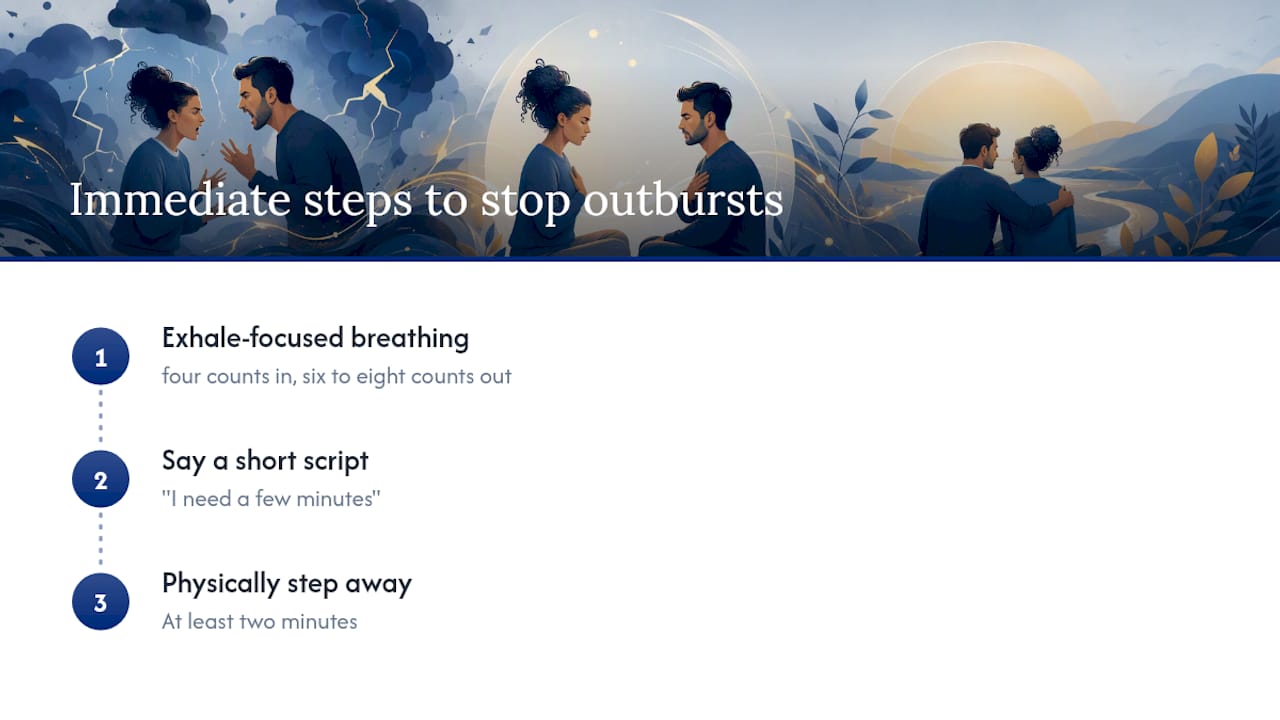
Breathe out longer than you breathe in, walk away from the trigger for at least two minutes, and say one sentence out loud: “I’m too angry to keep talking. I need a few minutes.” Those three moves, done in that order, stop most outbursts before they cause damage you’ll regret. The breathing slows your heart rate, the physical distance removes the fuel, and the script gives you an exit that doesn’t feel like defeat.
That’s the 90-second version. The rest of this guide covers what to do in the minutes and weeks after, because stopping one outburst is easy compared to changing the pattern that keeps producing them.
Here are three options depending on what your situation allows right now:
- Quiet breathing at your desk or in your car: Inhale for a count of four, hold briefly, exhale for a count of six to eight. Repeat five times. NHS guidance points out that people tend to breathe in more than they breathe out when angry, so deliberately lengthening the exhale corrects that imbalance.
- A brief physical exit: Say your one-line script, then walk to another room, the parking lot, or outside. Even two minutes changes the physiological state you’re in.
- A grounding micro-practice: Name five things you can see, four you can hear, three you can touch, two you can smell, one you can taste. It forces your brain out of the threat loop and back into the present room.
Pro Tip: Do the exhale-focused breathing before you try to think your way out of anger, not after. Trying to reason with yourself while your heart rate is still spiked usually fails, because the logical part of your brain is temporarily offline. Calm the body first, then the thinking gets easier.
Key Takeaways
Controlling anger requires an immediate physiological reset, daily habits that lower baseline reactivity, and cognitive tools practiced consistently between episodes.
| Point | Details |
|---|---|
| Use the exhale trick first | Breathe in for 4 counts, out for 6 to 8, before trying to reason your way out of anger. |
| Track your pattern for 2 to 3 weeks | An anger log reveals triggers you’d otherwise dismiss as random. |
| Build daily habits, not just crisis tools | Exercise, sleep, and daily relaxation practice make in-the-moment tactics work better. |
| Watch for the red flags | Physical harm, legal trouble, and repeated relationship damage mean it’s time for professional help. |
| Expect real movement in several weeks | Consistent work with a clinician can move someone toward a more moderate anger range over time. |
| Consider a clinical assessment | Masteringconflict offers anger assessments and CBT-informed therapy for readers who need more than self-directed tools. |
Table of Contents
- How to Control Anger Issues in the Moment It’s Rising
- Daily Habits That Lower Your Baseline Anger
- Changing the Thoughts That Fuel Your Anger
- Saying What You Mean Without Blowing Up the Conversation
- Tracking Your Triggers and Building an If-Then Plan
- When Anger Needs More Than Self-Help
- What the Research Actually Supports
- Anger Isn’t the Problem. Losing Control of It Is.
- Getting Professional Support Through Masteringconflict
- Where to Learn More
- Frequently Asked Questions
- Sources
How to Control Anger Issues in the Moment It’s Rising
Once you’ve bought yourself a few minutes, you need a sequence, not just a single trick. Anger has a physical signature: tight jaw, clenched fists, heat in the face, a racing pulse. Catching those signs early gives you more room to act before words come out that you can’t take back.
- Notice the body first. Scan for the physical markers, jaw, shoulders, stomach, before the thought even fully forms. This is usually your earliest warning system, faster than your conscious awareness of feeling angry.
- Breathe with a longer exhale. Use the 4 count in, 6 to 8 count out pattern. NHS guidance frames this as calming the nervous system directly, not just distracting you, because exhale-focused breathing triggers your parasympathetic response.
- Run a short grounding sequence. The five-senses method above works, or try a 30-second progressive muscle relaxation: clench your fists hard for five seconds, release, then do the same with your shoulders and jaw.
- Decide: stay or step away. If you can breathe through it and stay present without escalating, stay. If not, take the timeout.
If you must pause a conversation, the wording matters more than people expect. Try:
- “I care about this conversation, but I need ten minutes before I can talk about it well.”
- “I’m getting too heated to be fair right now. Let’s pick this back up after dinner.”
- “I don’t want to say something I regret. Give me a minute.”
A safety note matters here: if leaving the room isn’t possible, physically or situationally (driving, a work meeting, a crowded space), shift to the covert version. Exhale-focused breathing and a brief mental grounding exercise work even when you can’t move, which is exactly why Mental Health America recommends having quiet, private release options in your back pocket for moments you can’t just walk off.
Daily Habits That Lower Your Baseline Anger
Every tactic above works better on a nervous system that isn’t already running hot from bad sleep, no exercise, and three cups of coffee. This is the part people skip, and it’s the part that actually changes how often you get angry in the first place, not just how you handle it once you’re there.
- Regular aerobic exercise. Thirty minutes most days, even brisk walking, measurably lowers baseline stress reactivity over a few weeks.
- Sleep hygiene. Under six hours of sleep makes irritability worse the next day for almost everyone; consistent sleep and wake times matter more than total hours.
- Alcohol and caffeine check. Both lower your threshold for frustration and speed up escalation once you’re triggered. You don’t need to cut them entirely, but track whether your worst days line up with heavier use.
- A consistent relaxation practice. HelpGuide points to mindfulness, progressive muscle relaxation, and deep breathing practiced daily, not just during a crisis, as producing the deepest changes.
Here’s a sample week you can copy without overhauling your life:
- Monday, Wednesday, Friday: 20 to 30 minutes of walking, running, or cycling.
- Every morning: Five minutes of the exhale-focused breathing pattern before you check your phone.
- Tuesday and Thursday: Ten minutes of guided progressive muscle relaxation before bed.
- Saturday: A longer mindfulness session, 15 to 20 minutes, when you have more time.
- Sunday: Review your anger log (more on that below) and plan for the week ahead.
Pro Tip: Stack the new habit onto something you already do without fail. Do your breathing exercise while the coffee brews, not as a separate task competing for willpower. Habit-stacking beats adding a new item to your to-do list almost every time.
Changing the Thoughts That Fuel Your Anger
Changing how you think about a situation reduces anger because it interrupts the escalation loop before it builds momentum. Anger feeds on rigid, catastrophic interpretations, and the APA notes that this kind of distorted thinking, especially “always” and “never” framing, is one of the most reliable amplifiers of anger they see in clinical work.

Here’s what that shift looks like in practice:
| Automatic thought | Balanced alternative |
|---|---|
| “He always ignores me on purpose.” | “He might not have heard me, or he’s distracted right now.” |
| “This never works out for me.” | “This particular thing didn’t work out this time.” |
| “She’s doing this to make me look stupid.” | “She might not realize how this is landing.” |
| “I can’t stand this, it’s unbearable.” | “This is frustrating, and I can get through frustrating things.” |
Notice the pattern: absolute language (“always,” “never,” “can’t stand”) gets swapped for specific, limited language tied to this one moment. That’s the whole mechanism.
Try this three-field prompt right after an angry episode, while it’s still fresh:
- Trigger: What actually happened, just the facts, no interpretation.
- Thought: What you told yourself about it in the heat of the moment.
- Alternative: A more balanced version of that thought you could believe even 60% of the time.
Doing this consistently after episodes, not just once, is what makes reappraisal automatic under stress. The APA’s guidance on anger control frames cognitive restructuring as a skill built through repetition between episodes, not something you can only access mid crisis. The more reps you put in when you’re calm, the more available the balanced version becomes when you’re not.
Saying What You Mean Without Blowing Up the Conversation
Anger often shows up because something real needs to be said and hasn’t been. Learning how to deal with your anger productively usually means learning how to say the hard thing without attacking the person you’re saying it to.
“I” statements work because they describe your experience instead of accusing the other person of an intention you can’t actually verify.
- “I feel dismissed when I bring something up and the conversation changes topic.” (Instead of: “You never listen to me.”)
- “I get frustrated when plans change last minute without a heads up.” (Instead of: “You always do this.”)
- “I need a few minutes before we keep talking about this.” (Instead of: “Just leave me alone.”)
When the anger has a clear, solvable cause, not just an emotional flare, a structured problem-solving sequence works better than venting:
- Define the actual problem, in one sentence, without blame language.
- Brainstorm three or four possible responses, even bad ones, to loosen up rigid thinking.
- Choose the option that’s realistic given your actual constraints, not the ideal fantasy version.
- Test it for a set period, a week or two, then check whether it’s working.
If you’ve already had the outburst, a short repair script helps rebuild trust faster than silence or over-apologizing does: “I was too harsh earlier and I’m sorry. That’s not how I want to handle disagreements with you. Can we try again?” Keep it short. Long, defensive apologies often reopen the argument instead of closing it.
Tracking Your Triggers and Building an If-Then Plan
You can’t fix a pattern you haven’t measured. An anger log takes two minutes to fill out and turns vague frustration into a data set you can actually act on.
| Field | What to record |
|---|---|
| Situation | Where you were, who was involved, what triggered it |
| Thoughts | What went through your mind in the moment |
| Body signs | Physical symptoms: tight chest, clenched jaw, racing heart |
| Reaction | What you actually did or said |
| Outcome | What happened afterward, including how you felt an hour later |
Track frequency (how many episodes per week) and duration (how long each one lasts, from first trigger to feeling back to baseline) for two to three weeks. Most people are surprised by what shows up. A trigger they thought was random turns out to happen every Tuesday after a specific meeting, or every time a particular family member calls.
Once you see the pattern, build a simple if-then plan around it:
- If traffic makes me late for something important, then I do the exhale-breathing pattern at the next red light and remind myself that arriving five minutes late rarely has the consequences it feels like in the moment.
- If a coworker sends a curt email, then I wait 30 minutes before responding and reread it once more before hitting send.
Adapt the plan to context. Your driving trigger plan needs to work one-handed at a stoplight. Your work trigger plan needs to survive an open office where you can’t just walk out. Your home trigger plan can be more elaborate since you usually have more privacy and time.
When Anger Needs More Than Self-Help
Some situations call for professional support, not another breathing exercise. MedlinePlus recommends seeking classes or counseling specifically when anger starts affecting your relationships or safety, and that threshold is worth taking seriously rather than pushing past.
Get help now if any of these apply:
- You’ve hurt someone physically, or you’re afraid you might.
- Anger has caused legal trouble, a restraining order, an arrest, a workplace complaint.
- You’ve lost a job or a relationship specifically because of angry outbursts, more than once.
- You feel out of control during episodes, like you’re watching yourself from outside your body.
- Anger is paired with thoughts of harming yourself or someone else, which needs immediate crisis support, not a self-help plan.
If your situation involves an acute crisis or safety risk that goes beyond outpatient support, understanding what emergency and inpatient mental health coverage actually includes can matter before you need it, not during the worst moment.
For everyone else, help exists on a spectrum:
- Short CBT-informed anger management classes, usually structured, time-limited, and group-based.
- Individual therapy for anger tied to deeper patterns, past trauma, or co-occurring anxiety and depression.
- Psychiatric evaluation when anger is linked to a mood disorder, substance use, or another condition that needs medical treatment alongside therapy.
On timeline: the APA notes that counseling can move someone with high anger levels toward a more moderate range within a matter of weeks, depending on the techniques used and the person’s circumstances. Six to twelve weeks of consistent work, showing up, practicing between sessions, tracking your log, is a realistic window to expect real movement. Progress is often slower when anger is tangled up with unresolved trauma, active substance use, or a relationship that keeps re-triggering the same wound before it heals.
What the Research Actually Supports
Cognitive and behavioral techniques, combined with relaxation training, form the core of what actually works for anger, according to both the American Psychological Association and clinical reviews of anger management interventions. Neither single-strategy approach, breathing alone or thinking alone, tends to hold up as well over time as combining both.
Three specific pieces of evidence are worth knowing:
- Cognitive restructuring is repeatedly named by the APA as one of the most reliable defenses against anger, precisely because anger tends to amplify distorted “always/never” thinking patterns.
- Relaxation training, including progressive muscle relaxation and mindfulness, shows up consistently in HelpGuide’s recommendations as a foundation for longer-term change, not just an emergency tool.
- Combined approaches outperform single strategies. Programs that pair immediate physiological tools with cognitive work and lifestyle changes tend to produce more durable results than any one tactic used alone.
If you’re choosing a therapist for anger work, the APA’s guidance is specific here too: ask whether they use cognitive and behavioral interventions, not just expressive techniques. Therapy that only encourages venting or emotional expression can, in some highly aggressive clients, make things worse rather than better. A short checklist before you commit to someone:
- Do they have specific experience with anger, not just general talk therapy?
- Will you set measurable goals together, frequency, intensity, specific triggers?
- What’s the expected session length and format, individual, group, or both?
Anger Isn’t the Problem. Losing Control of It Is.
Everyone gets angry. It’s a normal, useful emotion that tells you something feels unfair, threatened, or wrong. The goal was never to eliminate anger, and any plan promising that is selling something that doesn’t exist. The goal is building the skills to feel it without it running the show.
What surprises people most in clinical work is how mechanical the fix actually is. It’s not about becoming a calmer person through sheer willpower. It’s about interrupting a physical and cognitive sequence at a specific, learnable point, the exhale, the pause, the reframed thought, before it runs its full course. Anyone can learn where that point is in their own pattern. Most people just haven’t looked for it yet.
Getting Professional Support Through Masteringconflict
If you’ve tried the tactics above and you’re still stuck, or you already know your situation needs more structure than a self-directed plan can offer, Masteringconflict gives you a clinical starting point instead of another list of tips to manage on your own. That’s the real difference: a licensed clinician assessing your specific pattern, not a generic program applied the same way to everyone.

Masteringconflict’s clinical services include a formal anger assessment, individual CBT-informed therapy, and targeted anger management classes built around the same evidence base covered in this guide. An initial assessment typically maps your specific triggers, patterns, and history before recommending a program length or format, so you’re not guessing which track fits your situation. If you’re unsure whether you need structured coaching or clinical therapy, the distinction is worth understanding before you pick a path; Masteringconflict’s coaching versus therapy breakdown can help you choose correctly the first time. Book an assessment to find out which program fits your pattern.
Where to Learn More
Reading directly from the clinical and public health organizations behind these recommendations helps you vet any class or clinician you’re considering:
- American Psychological Association: Control anger before it controls you
- MedlinePlus: Learn to manage your anger
- NHS inform: How to control your anger
- HelpGuide: Anger Management
- Mental Health America: 10 Healthy Ways to Release Rage
Use these sources as a baseline when you’re evaluating a local class or a potential therapist. Any legitimate anger management program should be able to explain how its methods line up with this kind of evidence-based guidance, not just promise results.
Frequently Asked Questions
How do you control your anger in the middle of a heated argument?
Use the exhale-focused breathing pattern first, four counts in, six to eight counts out, then state a short script like “I need a few minutes before we keep going” and physically step away for at least two minutes.
How long does it take to actually control anger issues?
Many people see measurable change within a matter of weeks of consistent practice, especially when working with a clinician, though progress can take longer if anger is tied to trauma, substance use, or an unresolved relationship conflict.
What’s the difference between anger management classes and individual therapy?
Classes are usually structured, group-based, and time-limited, focused on teaching a specific skill set. Individual therapy digs into personal patterns, history, and triggers that a group format can’t address in the same depth.
Can lifestyle changes alone control frequent anger?
Exercise, sleep, and reduced alcohol or caffeine intake lower your baseline irritability, but they work best combined with cognitive tools and, for frequent or intense anger, professional support rather than as a standalone fix.
When should someone stop trying self-help and see a professional?
If anger has led to physical harm, legal consequences, job loss, or repeated damage to relationships, or if you feel unable to control your reactions even when you want to, it’s time to seek a clinical assessment rather than continuing alone.
This article is general information, not a substitute for advice from a qualified doctor. Consult a qualified healthcare professional about your own circumstances before acting on anything here.
Sources
- Control anger before it controls you – American Psychological Association
- Learn to manage your anger: MedlinePlus Medical Encyclopedia
- How to control your anger | NHS inform
- Helpguide
- 10 Healthy Ways to Release Rage | Mental Health America