
How Do You Resolve Conflict: Practical Steps for Work and Home

To resolve a conflict, pause before reacting, name the issue without blame, and agree on one concrete next step together. Right now, you can: (1) write down what you actually need from this situation, not just what the other person did wrong; (2) request a calm, private conversation within the next 24 hours; (3) open that conversation with “I noticed…” instead of “You always…” Those three moves alone shift most disputes from a standoff to a working dialogue. The rest of this guide gives you the tools, scripts, and escalation rules to handle anything more complex.
Table of Contents
- Five fast ways to de-escalate a conflict right now
- Core communication skills that actually resolve conflicts
- The Thomas–Kilmann five conflict styles and when to use each
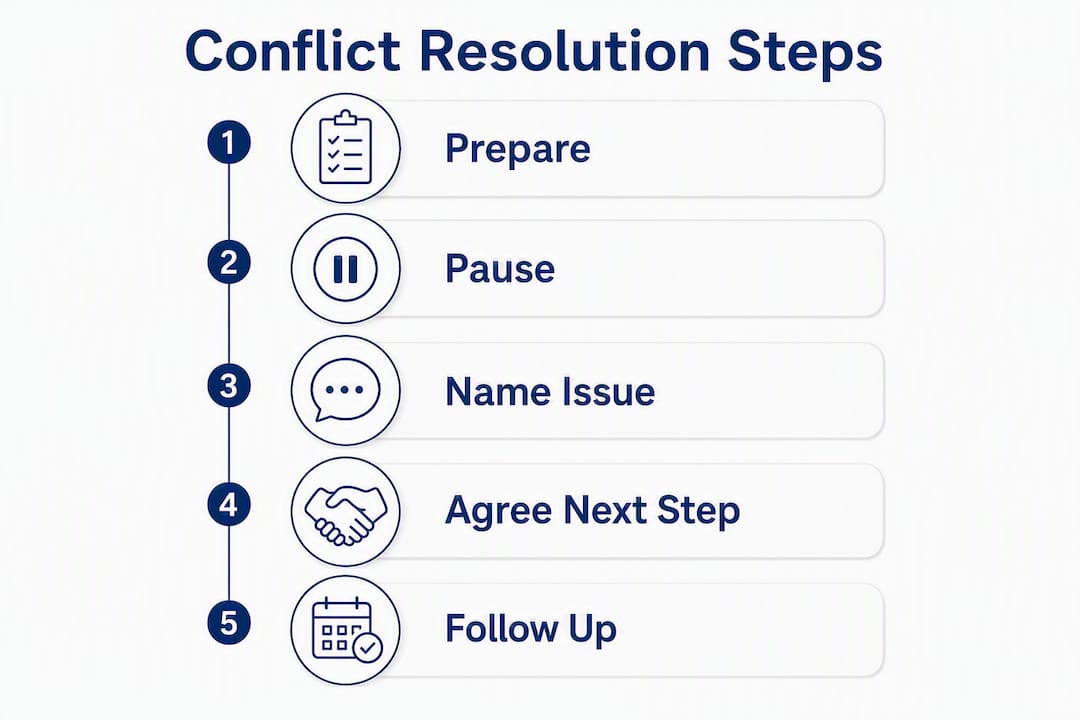
- A step-by-step process you can follow for any conflict
- When to bring in a neutral third party
- Sample scripts for common conflicts
- How to prevent the same conflicts from coming back
- When professional help is the right call
- Key Takeaways
- What most conflict advice gets wrong
- Masteringconflict offers clinical support when the conversation needs more than a script
- Useful sources
Five fast ways to de-escalate a conflict right now
When a disagreement is heating up, the instinct to keep talking usually makes things worse. These five tactics interrupt the cycle before it locks in.
- Pause and breathe. A 60-second physical pause lowers cortisol enough to restore rational thinking. Step away, breathe slowly, and return only when you can speak without your voice rising. Best for: any high-emotion moment, public or private.
- State observations, not judgments. Say “The report was submitted two days late” instead of “You’re irresponsible.” Observations are hard to argue with; judgments invite defensiveness. Best for: workplace disputes where facts matter.
- Validate before problem-solving. Acknowledge the other person’s experience before proposing solutions. “That sounds genuinely frustrating” costs you nothing and opens the door to real dialogue. Validation lowers defensiveness and increases willingness to negotiate far more reliably than trying to win the argument.
- Ask a clarifying question. “Help me understand what you were hoping for” shifts the conversation from positions to interests. Best for: any conflict where you suspect you’re arguing past each other.
- Propose one small next step. Don’t try to solve everything at once. “Can we agree to meet tomorrow and each bring two ideas?” gives both parties a low-stakes win and forward momentum.
Pro Tip: In a public or group setting, always move the conversation to a private space before attempting any of the above. Public confrontations trigger shame, and shame kills cooperation.

Core communication skills that actually resolve conflicts
Tactics work once. Skills work every time. The difference between someone who consistently resolves conflicts and someone who just survives them usually comes down to three practiced abilities.
Active listening
Most people listen to respond, not to understand. Active listening means holding your rebuttal until the other person has fully finished, then reflecting back what you heard before adding your own view.
A short practice loop: reflect, paraphrase, ask.
- Reflect the emotion: “It sounds like you felt left out of that decision.”
- Paraphrase the content: “So what I’m hearing is that you wanted to be consulted before the deadline was moved.”
- Ask to confirm: “Did I get that right?”
That third step is the one most people skip, and it’s the one that signals genuine interest.
Validation
Egocentrism shapes our sense of fairness; we naturally weight our own perspective more heavily than we realize. Validation is the deliberate corrective. It doesn’t mean agreeing. It means saying: “I can see why you’d feel that way given what you experienced.”
A short validation script: “I hear that this has been really difficult for you. That makes sense given the situation. I want to understand it better.”
Emotional regulation
You cannot listen, validate, or problem-solve when your nervous system is in threat mode. Grounding techniques that work in real time include:
- Box breathing: inhale 4 counts, hold 4, exhale 4, hold 4. Repeat three times.
- Name the feeling: research in affective labeling shows that simply naming an emotion (“I’m feeling defensive right now”) reduces its intensity.
- Request a structured pause: “I want to keep talking about this. Can we take 20 minutes and come back?” This is different from stonewalling. State the return time and keep it.
Pro Tip: Practice the reflect-paraphrase-ask loop with a friend on a low-stakes topic before you need it in a real conflict. The skill feels awkward the first few times and natural by the fifth.

The Thomas–Kilmann five conflict styles and when to use each
The Thomas–Kilmann Conflict Mode Instrument identifies five distinct ways people handle disagreement. None is universally right. Each fits specific situations, and mismatching style to situation is one of the most common reasons conflicts drag on.
- Avoiding (low assertiveness, low cooperation): You sidestep the issue entirely. Useful when the stakes are genuinely low or when emotions are too hot for a productive conversation right now. Harmful when used habitually on issues that matter, because unaddressed conflicts compound.
- Accommodating (low assertiveness, high cooperation): You give the other person what they want. Appropriate when you realize you’re wrong, when the relationship matters more than the outcome, or when you’re building goodwill for a future negotiation. Harmful when it becomes a pattern that signals you’ll always yield.
- Competing (high assertiveness, low cooperation): You push for your position. Justified in emergencies, when you need a fast decision, or when you’re certain you’re right on a matter of ethics or safety. Harmful in ongoing relationships where trust is the currency.
- Compromising (moderate assertiveness, moderate cooperation): Both parties give something up. Useful when a good-enough solution is better than no solution, and when time pressure is real. The risk: both parties leave partially dissatisfied, and the underlying interests stay unresolved.
- Collaborating (high assertiveness, high cooperation): You work together to find a solution that fully satisfies both parties’ interests. Research consistently identifies this as the most effective mode for durable, relationship-preserving agreements. It takes more time, but the outcomes stick.
Choosing your style: Ask three questions before a difficult conversation. How much do the stakes matter to me? How important is the ongoing relationship? How much time do I have? High stakes + important relationship + adequate time = collaborate. Low stakes + time pressure = compromise or accommodate.
Pro Tip: Most people have a default style they use regardless of context. If you tend to avoid, practice competing on small issues. If you tend to compete, practice one accommodating move per week. Flexibility is the actual skill.
A step-by-step process you can follow for any conflict
Improvising a difficult conversation rarely goes well. A repeatable structure removes the guesswork. This framework draws on widely recommended five-step approaches and the SHRM manager decision guide for workplace disputes.
Step 1: Prepare (before the conversation)
- Write down the specific behavior or situation, not your interpretation of it.
- Identify what you actually need from the outcome (your interest, not just your position).
- Clarify your fallback: what will you do if no agreement is reached?
- Choose a private, neutral time and place. Avoid ambushing someone at their desk or right before a deadline.
Step 2: Structure the opening
- Open with a shared goal: “I want us to find something that works for both of us.”
- State ground rules: one person speaks at a time, no interrupting, no personal attacks.
- Use an observation opener: “I noticed that in the last two team meetings, my suggestions weren’t included in the final summary. I’d like to understand what happened.”
Step 3: Problem-solve together
- Each person states their interests (what they need, not just what they want).
- Identify where interests overlap. That overlap is your starting point.
- Brainstorm at least three options before evaluating any of them.
- Agree on one specific action with a named owner and a deadline.
Step 4: Follow up
- Write down what was agreed, even informally. A brief email summary after a verbal agreement dramatically reduces “I thought we said…” disputes.
- Set a check-in date. Two weeks is a reasonable default for most workplace agreements.
- If the agreement breaks down, treat it as new information, not a betrayal. Return to Step 1.
Pro Tip: For conflict resolution steps in couples and family situations, the same structure applies, but the “follow-up” step matters even more. Relationship agreements without review dates quietly expire.
Preparation is the step most people skip, and it’s the one that most determines whether the conversation goes anywhere useful. Showing up with clarity about your own interests changes the entire dynamic.
When to bring in a neutral third party
Some conflicts genuinely cannot be resolved between the two parties alone. Knowing when to escalate is as important as knowing how to negotiate.
Escalate when you see:
- A significant power imbalance (supervisor vs. direct report, landlord vs. tenant) that prevents honest dialogue.
- The same conflict recurring despite multiple resolution attempts.
- Safety concerns, harassment, or threats of any kind.
- One or both parties are too emotionally activated to engage productively.
- The stakes are high enough that an unresolved outcome would cause lasting harm.
Mediation vs. arbitration vs. litigation
| Option | Process | Who decides | Binding? | Confidential? | Best for |
|---|---|---|---|---|---|
| Mediation | Facilitated dialogue | The parties | No (voluntary) | Usually yes | Relationship preservation, workplace disputes, family |
| Arbitration | Structured hearing | Neutral arbitrator | Usually yes | Usually yes | Contractual disputes, faster than court |
| Litigation | Court process | Judge or jury | Yes | No (public record) | When legal rights must be enforced |
Starting with less formal, lower-cost approaches like negotiation and mediation before moving to arbitration or litigation preserves relationships and is faster and more private than court. When relationships matter and both parties want control over the outcome, mediation is preferable because it is voluntary and nonbinding.
For workplace conflicts specifically, dispute system design offers a smarter long-term approach than handling each dispute case-by-case. Organizations that build clear escalation pathways (peer negotiation → HR mediation → formal arbitration) spend less time and money on each dispute and create a culture where people feel safe raising issues early.
Sample scripts for common conflicts
Scripts reduce the cognitive load in high-stress moments. These are starting points, not scripts to memorize word for word. Adapt the tone to the relationship and the stakes.
Workplace: peer disagreement
Workplace: giving feedback to a manager
Personal: partner or family disagreement
Personal: setting a boundary
Pro Tip: Before any difficult conversation, say the opening line out loud to yourself. Hearing your own voice say it once removes the shakiness when you say it for real.
For couples-specific language and repair scripts, conflict resolution strategies for couples covers the nuances of tone and timing that generic scripts miss.
How to prevent the same conflicts from coming back
Resolving a conflict once is a win. Resolving it and preventing recurrence is the actual goal. Constructive conflict protocols emphasize skill training, repair steps, and prevention planning as the elements that make resolution sustainable.
Document and review agreements
- After any significant conflict resolution, write a brief summary of what was agreed. It doesn’t need to be formal. A text message or email works.
- Set a review date. “Let’s check in on this in two weeks” converts a one-time agreement into an ongoing commitment.
- If the agreement breaks down, revisit it without blame. Ask: “What got in the way?” not “Why did you stop doing what you promised?”
Create if-then plans
If-then plans (also called implementation intentions) are simple relapse-prevention tools. Examples:
- “If I feel myself getting defensive in a meeting, then I’ll ask a clarifying question before responding.”
- “If we start arguing about money, then we’ll pause and schedule a dedicated money conversation for the weekend.”
- “If a team member misses a deadline, then I’ll ask what support they need before escalating.”
Use boundary language consistently
- State the boundary clearly: “I’m not available for work calls after 7 PM.”
- State the consequence: “If I get a call after that, I won’t answer, and I’ll follow up the next morning.”
- Follow through every time. A boundary stated once and then ignored teaches the other person it isn’t real.
Mapping the conflict loop — identifying your triggers, your automatic reactions, and the patterns that reinforce them — is one of the most practical prevention tools available. Once you can see the loop, you can interrupt it before it completes.
When professional help is the right call
Some conflicts signal something deeper than a communication breakdown. Recognizing those signs early saves months of circular arguments and real relationship damage.
Signs that suggest professional support:
- The same argument repeats on a cycle, with no lasting resolution.
- One or both people feel unsafe, controlled, or consistently dismissed.
- Emotional reactions feel disproportionate to the immediate trigger (often a sign of older wounds).
- Attempts at resolution consistently make things worse.
- The conflict is affecting sleep, work performance, or physical health.
What each type of support offers
- Individual therapy addresses the internal patterns, emotional history, and regulation skills that drive someone’s conflict behavior. Realistic goal: understanding your own triggers and changing your default responses over 8–16 sessions.
- Couples or family counseling works on the relational system, not just individual behavior. Realistic goal: new communication patterns and repaired trust over 3–6 months of consistent sessions.
- Conflict coaching is skills-focused and shorter-term. It’s appropriate when the relationship is functional but a specific skill gap (assertiveness, de-escalation, negotiation) is causing repeated friction. Conflict management skills training can meaningfully improve outcomes even without a full therapy commitment.
- Mediation is the right choice when both parties are willing to work toward a solution but cannot do it without a neutral facilitator.
Pro Tip: Choosing between coaching and therapy isn’t always obvious. A comparison of coaching vs. therapy can help you identify which fits your situation before you commit to a service.
When selecting a provider, look for someone with specific training in conflict resolution or relationship therapy, not just general counseling credentials. Ask in the first session: “What’s your approach to conflict, and what does progress look like?” A good clinician will answer that question directly.
Key Takeaways
Resolving conflict reliably requires three things working together: the right skills, a repeatable process, and the judgment to know when to escalate.
| Point | Details |
|---|---|
| Start with preparation | Clarify your interests and choose a private, calm setting before any difficult conversation. |
| Use the five TKI styles deliberately | Match your conflict style to the stakes, relationship, and time available — collaboration produces the most durable outcomes. |
| Validate before problem-solving | Acknowledging the other person’s experience lowers defensiveness and opens the door to real negotiation. |
| Know when to escalate | Repeated cycles, power imbalances, or safety concerns are clear signals to involve a neutral third party or professional. |
| Masteringconflict for professional support | Clinical services, couples counseling, and conflict coaching are available for conflicts that need more than a script. |
What most conflict advice gets wrong
The standard advice on conflict resolution is technically correct and practically incomplete. “Use I-statements.” “Listen actively.” “Find common ground.” All true. None of it accounts for the moment when you’re sitting across from someone who is furious, or someone who has more power than you, or someone you love and are genuinely afraid of losing.
What actually works in those moments isn’t a technique. It’s a practiced capacity to stay regulated enough to choose your response instead of just reacting. That’s not something you develop by reading a guide. It develops through repetition on low-stakes situations, through feedback from someone who can see your blind spots, and sometimes through working with a clinician who can help you understand why certain conflicts activate you so intensely.
The Thomas–Kilmann framework is genuinely useful, but the insight most people miss is this: your default style isn’t a personality trait. It’s a learned pattern, usually from early experiences with conflict in your family of origin. Competing, avoiding, accommodating — these aren’t fixed. They’re habits. And habits change with deliberate practice and the right kind of support.
The other thing worth saying plainly: some conflicts don’t resolve. Not because the people involved failed, but because the underlying interests are genuinely incompatible, or because one party isn’t willing to engage honestly. Knowing when to stop trying to fix a conflict and start managing your response to it is a form of wisdom, not defeat.
Masteringconflict offers clinical support when the conversation needs more than a script
Conflict coaching and self-help tools get you far. When the same patterns keep returning, or when the stakes are high enough that getting it wrong has real consequences, clinical support changes the outcome.
Masteringconflict provides individual therapy, couples counseling, family counseling, anger management, and conflict coaching, with teletherapy available for clients who need flexible access. Services are designed for people dealing with recurring relationship conflict, workplace tension, and the kind of chronic stress that builds when conflict goes unresolved for too long. The clinical team brings specific training in conflict resolution, not just general mental health support, which means the work is targeted and the goals are concrete.
If you’re unsure whether therapy or coaching fits your situation, the coaching vs. therapy comparison on the site walks through the distinction clearly. For immediate access to clinical services, book a session through the clinical services page and get matched with a provider who specializes in your specific situation.
Useful sources
These are the primary sources used to build this guide. Each one is worth reading directly if you want to go deeper on a specific area.
- Conflict management styles: Pitfalls and best practices — Program on Negotiation, Harvard Law School: Covers the Thomas–Kilmann five modes with practical guidance on when each style helps or harms.
- What is conflict resolution, and how does it work? — PON: Explains the full ADR spectrum from negotiation through litigation, with clear criteria for choosing each.
- Conflict resolution strategies — PON: Focuses on perspective-taking and interest-based negotiation as the core moves that break stalemates.
- How to manage conflict at work — PON: Introduces dispute system design as a workplace-level prevention strategy.
- The Five Steps to Conflict Resolution — AMA/AMANET: A concise, memorable five-step framework applicable to both personal and professional disputes.
- Manager’s Conflict Handling Decision Guide — SHRM: A stepwise decision guide for managers handling employee disputes, with checklists and conversation structure.
- Constructive conflict: A step-by-step communication protocol — PositivePsychology.com: Covers validation, conflict loop mapping, and skill-training exercises for sustainable resolution.
- Resolving Conflict Situations — UC Berkeley People & Culture: A practical HR-focused guide to workplace conflict resolution with clear escalation criteria.
- 5 Strategies for Conflict Resolution in the Workplace — Harvard Business School Online: Applies negotiation research to common workplace scenarios with concrete strategy recommendations.
Recommended
- Coping With Workplace Conflict: Practical Steps for Resolution – Mastering Conflict
- Effective Conflict Resolution Steps for Couples, Families, and Professionals 2025 – Mastering Conflict
- Master Conflict Resolution Skills for Real-Life Success – Mastering Conflict
- How to Argue Respectfully and Resolve Conflict Effectively – Mastering Conflict