
Best Anger Management Classes Near Me: 2026 Guide

TL;DR:
- Effective anger management classes use cognitive behavioral therapy to teach emotional regulation and communication skills. It is essential to verify provider credentials, legal acceptance, and detailed certification standards before enrollment. Different formats exist, including in-person, online, and court-mandated programs, which require active participation and proper documentation.
Anger management classes are structured, evidence-based programs that teach people to recognize emotional triggers and respond with constructive communication rather than reactive behavior. The best anger management classes near me and near you share one defining feature: a curriculum grounded in cognitive behavioral therapy (CBT), the gold standard for emotional regulation. CBT-based programs teach that anger itself is a natural emotion. The goal is never to eliminate it. The goal is to manage it. Whether you are attending voluntarily, fulfilling a court order, or supporting a relationship in crisis, the right class gives you practical tools that last beyond the final session.
1. What criteria define the best anger management classes near me?
The best local anger management programs share five measurable qualities. Understanding each one before you enroll saves time, money, and frustration.
Curriculum quality. A legitimate program uses CBT techniques such as cognitive restructuring, trigger identification, and de-escalation strategies. Evidence-based methods produce lasting behavioral change. Programs that rely on venting exercises or unstructured discussion rarely deliver the same results.
Provider credentials. The instructor should hold a license in counseling, social work, or psychology. Specialized training in anger management or conflict resolution adds another layer of credibility. Masteringconflict, for example, is led by Dr. Carlos Todd, a licensed clinical mental health counselor and psychologist with deep expertise in anger and conflict resolution.

Format and flexibility. Programs run in-person, online, or as hybrid options. In-person group sessions offer peer accountability. Online formats offer scheduling flexibility. Courts increasingly accept online programs that include timed modules, written reflections, and certificate verification portals. Passive video viewing does not count.
Cost and accessibility. Anger management programs cost between $50 and $500 depending on format and length. Intake fees run around $55, with per-class fees near $30, or flat rates such as $190 for an 8-hour course. Many providers offer sliding scale fees for those with financial constraints. Affordable anger management classes exist in most markets when you know where to look.
Certificate standards. A valid completion certificate must include your full name, completion dates, total hours, curriculum type, and provider contact information. Without those details, courts may not recognize completion.
Pro Tip: Before enrolling in any program, ask the provider to send you a sample certificate. If it lacks hours, curriculum type, and provider credentials, choose a different program.
2. Standard multi-week in-person classes
Multi-week in-person programs are the most widely recognized format. They typically run 8–12 weeks with weekly sessions of 60–90 minutes each. The group setting creates accountability and allows participants to practice communication skills in real time with peers. These programs work well for people who benefit from structure and face-to-face interaction.
3. Court-mandated anger management programs
Court-ordered programs follow a specific legal framework. Successful completion requires a 6-step process: verifying your court order, confirming provider acceptance with your probation officer, enrolling in an approved program, participating genuinely, submitting your certificate, and retaining all records. Skipping any step can result in repeating the entire program. Always get written confirmation, ideally by email, that your chosen provider satisfies your specific court requirement.
4. One-day workshops and intensive sessions
One-day workshops compress core anger management content into a single 6–8 hour session. These are best suited for people with mild anger concerns, tight schedules, or employer-mandated training rather than court orders. A flat-rate course of this type typically costs around $190. The tradeoff is depth. Skill-building takes repetition, and a single day rarely replaces a multi-week program for people dealing with chronic anger patterns.
5. Online self-paced programs with verification
Online anger management courses have grown significantly in acceptance. Legitimate programs require active engagement through timed modules, written reflections, and quizzes. They issue certificates through verification portals that courts and employers can check directly. Self-paced formats work well for people with irregular schedules or limited local options. Check with your court or employer before enrolling to confirm the specific platform meets their requirements.
Pro Tip: Search for “anger management classes near me” and then cross-reference each result against your court order or employer policy before paying any fees.
6. Group versus individual formats
Group classes are the standard format for most anger management programs. They cost less per session and provide social learning opportunities. Individual anger management therapy near me is a different option. It offers personalized attention and a faster pace of skill development. Individual sessions work best when a person has specific trauma history, co-occurring mental health concerns, or needs a more private setting. Many people combine both formats for the strongest outcome.
7. Specialized programs for different populations
Not all anger management workshops are designed for the same audience. Specialized programs exist for men, women, teens, children, and specific cultural communities. Masteringconflict offers programs tailored to Black and African American populations, women, men, and youth, recognizing that cultural context shapes how anger is expressed and managed. A program that reflects your lived experience produces better engagement and better results. Generic programs can miss the mark when cultural nuance matters.
8. How to find and verify local anger management programs
Finding a quality program starts with trusted sources. Your primary care doctor, therapist, or attorney can refer you to vetted providers. Local community mental health centers, hospital outreach programs, and bar association referral services are also reliable starting points. Online directories from licensed professional associations add another layer of credibility.
Verification is non-negotiable. Confirming legal acceptance beforehand prevents the costly mistake of repeating a program. Contact your probation officer or HR department in writing before you enroll. Keep every document: the court order, the written confirmation, your enrollment receipt, and your completion certificate.
Scheduling matters more than people expect. A program that meets at a time you cannot consistently attend sets you up to fail. Choose a format and schedule that you can realistically commit to for the full duration.
- Confirm the provider’s license and credentials before paying.
- Get written approval from your court or employer that the specific program qualifies.
- Ask about makeup policies if you miss a session.
- Request a sample certificate to verify it meets required standards.
- Save all documents in both digital and physical formats.
9. Common challenges and overlooked aspects
Several avoidable mistakes derail people who are otherwise motivated to complete a program. The most common is confusing program types.
| Program type | Purpose | Length | Legal standard |
|---|---|---|---|
| Anger management class | Skill-building for emotional regulation | 8–26 weeks typical | Accepted for most court orders |
| Batterer Intervention Program (BIP) | Domestic violence intervention | 26–52 weeks | Required for DV-specific orders |
| One-day workshop | General awareness or employer training | 1 day | Rarely accepted for court orders |
| Individual therapy | Personalized clinical treatment | Ongoing | Varies by court or employer |
Anger management programs must not be confused with Batterer Intervention Programs. BIPs are longer, legally stricter, and designed specifically for domestic violence cases. Enrolling in the wrong program can result in non-compliance with a court order.
Verbal approval from a probation officer is not enough. Written confirmation is required to protect yourself if questions arise later. Many people learn this lesson the hard way after completing a full program that was not accepted.
Superficial participation is another pitfall. Attending sessions without genuine engagement produces little change. The primary goal of anger management is skill-building, not attendance. Courts and employers can tell the difference between someone who completed a program and someone who grew from it.
Key takeaways
The most effective anger management class combines a CBT-based curriculum, a licensed provider, a format that fits your schedule, and written legal confirmation before you enroll.
| Point | Details |
|---|---|
| CBT is the foundation | Choose programs that teach trigger identification and constructive communication, not just anger suppression. |
| Verify legal acceptance first | Get written confirmation from your court or probation officer before paying any enrollment fees. |
| Certificates must be detailed | Valid certificates include your name, hours, curriculum type, completion dates, and provider contact information. |
| BIPs and anger classes are different | Enrolling in the wrong program type can result in court non-compliance and wasted time. |
| Format affects outcomes | In-person, online, and individual formats each serve different needs. Match the format to your situation. |
What I have learned from years of working with anger
People come to anger management expecting to be told their anger is the problem. That framing is wrong, and it sets people up to disengage before they even start. Anger is not the enemy. It is a signal. The real work is learning what that signal means and what to do with it before it damages your relationships or your legal standing.
The clients I have seen make the most progress are not the ones who were most motivated on day one. They are the ones who stayed curious throughout the process. They asked questions. They practiced the skills between sessions. They were honest about when the techniques were not working and why. That kind of active participation is what separates people who complete a program from people who are changed by one.
One thing I tell every person who comes through Masteringconflict: keep your records. Keep the court order, the written approval, the enrollment confirmation, and the certificate. Store them in two places. People who lose their documentation often have to repeat programs, and that is a preventable setback.
The right program does not just satisfy a legal requirement. It gives you a different way of moving through conflict, at home, at work, and in every relationship that matters to you. That is worth choosing carefully. Explore anger reduction techniques that reinforce what you learn in class, and consider whether individual therapy might deepen the work even further.
— Carlos
Clinical support that goes beyond the classroom
Anger management classes build the foundation. Clinical support builds the life.
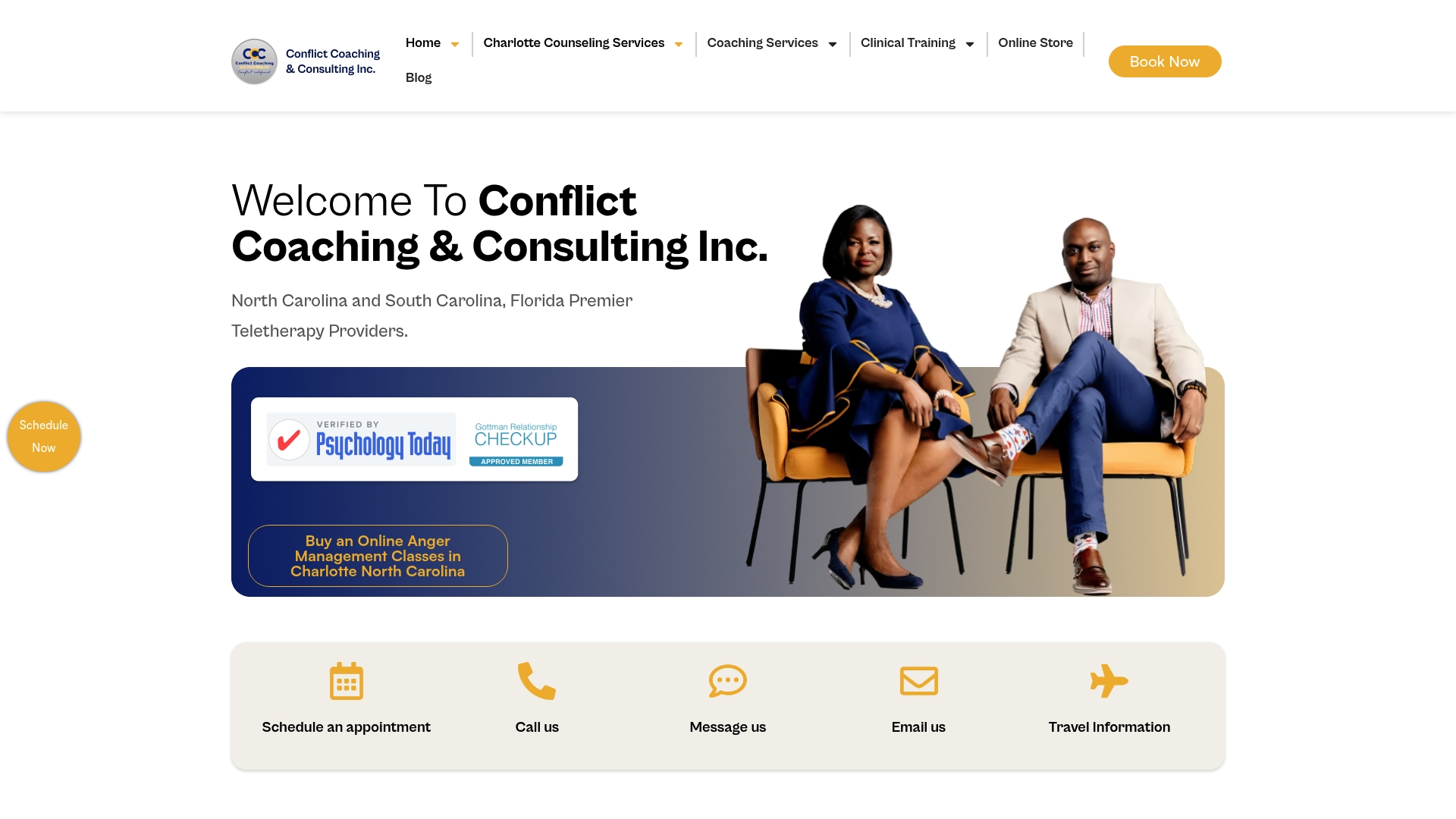
Masteringconflict offers clinical services that complement what you learn in any anger management program. Dr. Carlos Todd and the Masteringconflict team provide individual therapy, couples therapy, and specialized counseling for men, women, teens, and children across North Carolina, South Carolina, Florida, and online. If your anger is affecting your closest relationships, couples packages offer structured support designed specifically for partners working through conflict together. Booking is straightforward, and teletherapy options make access easy regardless of your location.
FAQ
What happens in an anger management class?
Anger management classes teach participants to identify triggers and respond with healthy communication strategies rather than reactive behavior. Sessions typically use CBT techniques including cognitive restructuring, de-escalation practice, and self-awareness exercises.
How do I find anger management classes near me that courts will accept?
Contact your probation officer or attorney and ask for a list of approved providers in writing before enrolling. Confirming acceptance beforehand prevents the common mistake of completing a program that does not satisfy your court order.
Are online anger management courses legitimate?
Yes, provided they include timed modules, written reflections, and a certificate verification portal. Courts increasingly accept online programs that enforce active participation rather than passive video viewing.
How much do anger management classes cost?
Costs range from $50 to $500 depending on format and length. Intake fees run around $55, per-class fees near $30, and flat-rate 8-hour courses around $190. Many providers offer sliding scale pricing for those with limited budgets.
What is the difference between anger management and a Batterer Intervention Program?
Anger management classes focus on emotional regulation and communication skills and typically run 8–26 weeks. Batterer Intervention Programs are legally stricter, longer in duration, and required specifically for domestic violence court orders. Enrolling in the wrong program type can result in non-compliance.
Recommended
- Anger Management Classes Near Me: Find Local & Online Options 2025 – Mastering Conflict
- Anger Management Meetings Near Me: A 2026 Guide – Mastering Conflict
- 7 Steps to Find Effective Group Anger Management Classes Near Me – Mastering Conflict
- 7 Key Tips for Choosing Anger Management Facilities Near Me – Mastering Conflict