
What Is Family Mediation: A Clear Guide for Families

TL;DR:
- Family mediation is a voluntary process where a neutral mediator helps families resolve disputes without court. It emphasizes future solutions, respect, and negotiation, but does not produce legally binding agreements until court approval. Proper preparation and legal consultation improve mediation outcomes, especially in complex or high-conflict cases.
Family mediation is defined as a voluntary, confidential process where a trained neutral third party helps families resolve disputes without going to court. It covers separation, divorce, child custody, parenting arrangements, and financial disagreements. Unlike litigation, mediation puts the decision-making power in your hands rather than a judge’s. The mediator does not take sides, give legal advice, or impose outcomes. Understanding how mediation works is the first step toward choosing the right path for your family.
What does a family mediator do?
A family mediator acts as an impartial facilitator, not a judge or legal advisor. Their job is to create a structured, respectful environment where both parties can speak, listen, and negotiate. They guide the conversation without steering it toward any particular outcome.
Sessions typically run approximately 2 hours each, with additional sessions scheduled based on how much progress the parties make. That structure matters because complex disputes like property division or parenting schedules rarely resolve in a single sitting.
Family mediators focus on future solutions rather than assigning blame for past behavior. Most people expect mediation to feel like a courtroom argument. It does not. The mediator redirects blame-focused conversations toward practical questions: What arrangement works best for the children? What financial split is realistic?
Mediators also use a technique called a caucus, which means meeting with each party separately. Caucus sessions allow the mediator to address sensitive topics, test whether a proposal is realistic, or manage strong emotions without the other party present. This technique often breaks deadlocks that joint sessions cannot.
At the end of the process, the mediator drafts a Memorandum of Understanding that summarizes what the parties agreed to. This document is not a legally binding contract on its own. It requires attorney review and court approval before it carries legal weight.
Key mediator responsibilities:
- Facilitate communication between both parties without taking sides
- Manage the pace and tone of each session
- Use caucus techniques when joint discussion becomes unproductive
- Provide general legal information, not personal legal advice
- Draft a Memorandum of Understanding to record agreed terms
Pro Tip: Ask your mediator upfront whether they use caucus sessions. Knowing this in advance reduces anxiety and helps you prepare for private conversations.
What is the family mediation process from start to finish?
The mediation process follows a clear sequence. Knowing each step removes uncertainty and helps you show up prepared.
- Initial assessment (MIAM). Many family courts require a Mediation Information and Assessment Meeting before any court proceedings begin. This meeting, often called a MIAM, screens whether your situation is suitable for mediation. It is typically held individually with each party.
- Application and scheduling. Once both parties agree to proceed, they submit applications and schedule sessions. Parties requesting in-person mediation must submit an application within 24 hours of receiving their scheduling email, with case managers following up within 24 hours.
- Joint mediation sessions. Both parties meet with the mediator to discuss the issues. The mediator uses structured conversation techniques to keep discussions productive and on track.
- Negotiation and reality testing. The mediator helps each party evaluate whether their proposals are realistic. This phase often involves caucus sessions to work through sticking points privately.
- Drafting the agreement. When the parties reach consensus, the mediator documents the terms in a Memorandum of Understanding.
- Legal review and court approval. An attorney reviews the agreement independently. The agreement becomes legally enforceable only after a court incorporates it into a formal order.
Many courts also require a good faith mediation attempt before a contested trial can be scheduled. This makes mediation a procedural step in many family law cases, not just an optional alternative.
| Stage | What happens | Who is involved |
|---|---|---|
| MIAM | Suitability screening | Mediator, each party separately |
| Scheduling | Applications submitted | Parties, case managers |
| Joint sessions | Structured negotiation | Mediator, both parties |
| Caucus | Private issue resolution | Mediator, one party at a time |
| Agreement drafting | Memorandum of Understanding created | Mediator |
| Legal finalization | Attorney review and court approval | Attorneys, court |
What are the benefits and limitations of family mediation?
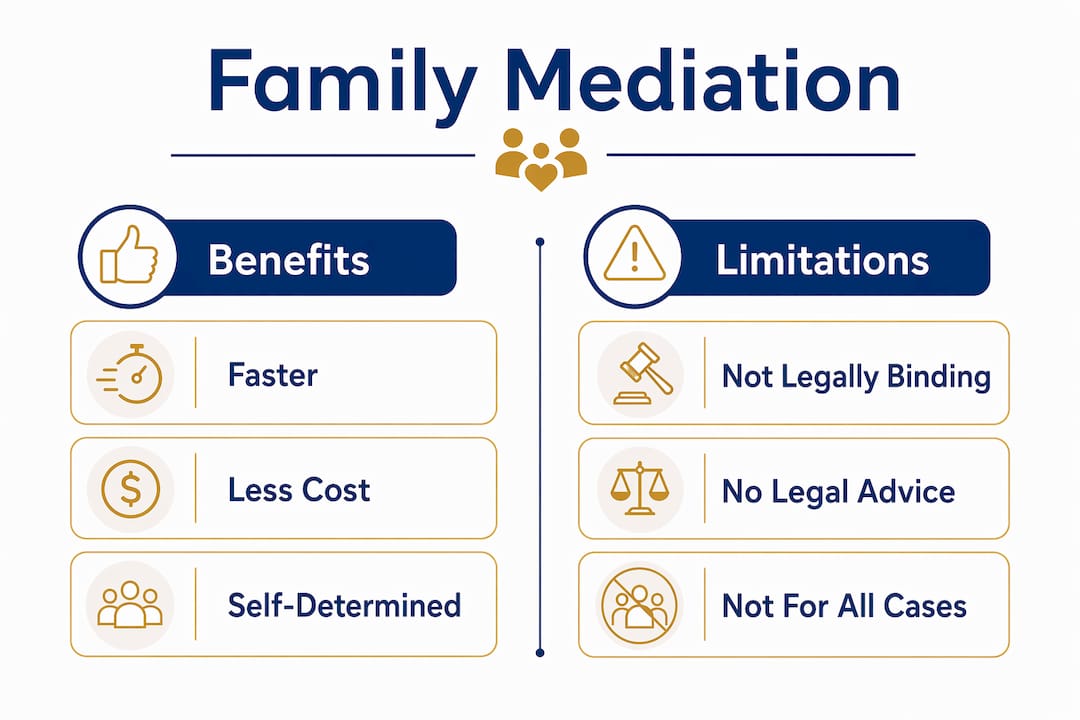
The primary benefit of mediation is self-determination. Mediation reinforces parents as decision-makers, avoiding court-imposed orders from a judge who does not know your family. That distinction matters enormously when children are involved.
Mediation is also faster and less expensive than litigation in most cases. Court proceedings can stretch over months or years. Mediation typically concludes in a handful of sessions. The cost savings are real, and so is the reduction in emotional strain on children and adults alike.
The process is forward-looking by design. Rather than relitigating who did what, mediation focuses on what arrangements will work going forward. Families who go through mediation often report better long-term cooperation, particularly on co-parenting issues, because they built the agreement themselves.
Mediation has real limitations, though. Mediation agreements are not legally binding until an attorney reviews them and a court approves them. Treating a Memorandum of Understanding as a final contract is a common and costly mistake.
Mediators also cannot provide legal advice. They can share general legal information, but they cannot tell you whether an agreement protects your specific rights. Independent legal counsel is not optional. It is necessary.
Mediation is also not appropriate in every situation. Cases involving domestic violence, significant power imbalances, or active substance abuse often require court intervention rather than negotiated settlement. A trained mediator will identify these situations during the MIAM screening.
Pro Tip: Consult an attorney before your first mediation session, not after. Understanding your legal rights in advance makes you a far more effective negotiator at the table.
| Factor | Mediation | Court litigation |
|---|---|---|
| Decision-maker | The parties themselves | A judge |
| Timeline | Weeks to months | Months to years |
| Cost | Generally lower | Generally higher |
| Privacy | Confidential | Public record |
| Binding status | Non-binding until court approval | Binding by court order |
| Suitability | Works best in cooperative cases | Necessary in high-conflict cases |
How to prepare for and participate effectively in mediation
Preparation is the single biggest factor in whether mediation succeeds. Showing up without relevant documents or a clear sense of your priorities wastes sessions and increases costs.

Bring all financial records, parenting schedules, property documents, and any prior court orders to your first session. The mediator cannot help you negotiate what they cannot see. Organized documentation shortens the process significantly.
Understand clearly what the mediator will and will not do. They will not give you legal advice, advocate for your position, or tell you whether the agreement is fair. That role belongs to your attorney. Confusing the two roles leads to disappointment and poor decisions.
You can learn more about resolving parenting disputes before entering mediation, which helps you arrive with realistic expectations and a clearer sense of what matters most to you.
Practical preparation checklist:
- Gather all relevant financial, legal, and parenting documents
- Consult an attorney before sessions begin to understand your rights
- Write down your priorities and non-negotiables in advance
- Practice staying calm and focused on solutions, not grievances
- Plan for multiple sessions rather than expecting a single-session resolution
- Know the 24-hour application window if requesting in-person sessions
The most effective mediation participants come in willing to negotiate in good faith. That does not mean giving up what matters most. It means being open to creative solutions you may not have considered on your own.
Key Takeaways
Family mediation is the most effective path to self-determined, cost-efficient family dispute resolution when both parties engage in good faith with proper legal support.
| Point | Details |
|---|---|
| Mediator role | A mediator facilitates negotiation but does not give legal advice or make binding decisions. |
| Session structure | Sessions typically last 2 hours, with caucus techniques used to resolve sensitive issues privately. |
| Process steps | The process runs from MIAM screening through joint sessions to attorney review and court approval. |
| Agreement status | A Memorandum of Understanding is not legally binding until reviewed by an attorney and approved by a court. |
| Preparation matters | Consulting an attorney and gathering documents before sessions significantly improves outcomes. |
What I have learned from watching families choose mediation
Families often arrive at mediation expecting it to feel like a softer version of court. It is not. It is a fundamentally different process, and that difference trips people up when they are not prepared for it.
The biggest misconception I see is that the mediator is secretly on someone’s side. They are not. A skilled mediator is genuinely neutral, and that neutrality can feel unsettling if you came in expecting an ally. The mediator’s job is to keep the conversation moving, not to validate your position.
What surprises people most is how much the forward-looking structure helps. When you stop relitigating the past and start asking “what does next year look like for our kids,” the conversation changes. I have seen families who could barely be in the same room reach workable parenting agreements because the mediator kept redirecting them toward the future.
Mediation is not a replacement for legal counsel, therapy, or in some cases, court. It is one tool in a larger toolkit. Families who treat it that way, using family conflict resolution services alongside mediation rather than instead of them, tend to reach better agreements and maintain them longer.
The families who struggle in mediation are usually the ones who arrive unprepared, emotionally dysregulated, or without any prior legal consultation. The process rewards preparation and good faith. If you bring both, mediation gives you something court almost never can: an agreement you actually built yourself.
— Carlos
How Masteringconflict supports families through conflict
Family mediation works best when both parties arrive emotionally prepared and clear about their goals. That preparation does not happen automatically.
Masteringconflict offers family counseling services in Charlotte, NC and online that help families manage conflict before, during, and after mediation. Dr. Carlos Todd, a licensed clinical mental health counselor and psychologist, works with couples, parents, and families to build the communication skills that make mediation more productive. Whether you need support processing a difficult separation or tools for co-parenting after an agreement, Masteringconflict provides evidence-based guidance tailored to your situation. Reach out to schedule a session and take the next step toward resolution.
FAQ
What is family mediation in simple terms?
Family mediation is a structured process where a trained neutral third party helps family members negotiate and resolve disputes, such as custody or finances, without going to court. The mediator guides the conversation but does not make decisions for the parties.
How long does the family mediation process take?
A single session typically lasts approximately 2 hours, and most cases require multiple sessions depending on the complexity of the issues. The full process from initial assessment to a finalized agreement can take several weeks to a few months.
Is a family mediation agreement legally binding?
A mediation agreement, recorded in a Memorandum of Understanding, is not legally binding on its own. It becomes enforceable only after an attorney reviews it and a court incorporates it into a formal order.
What is the difference between family mediation and therapy?
Family mediation focuses on reaching specific agreements about practical issues like custody, finances, and property. Therapy focuses on emotional healing, communication patterns, and mental health. The two serve different purposes and often work best together.
Who needs family mediation?
Any family facing disputes related to separation, divorce, child custody, or financial arrangements can benefit from mediation, provided there is no active domestic violence or severe power imbalance. Many courts now require a MIAM screening before contested proceedings can begin.
Recommended
- Family Conflict Resolution Services: Transforming Relationships – Mastering Conflict
- Navigating Family Conflict for Positive Relationships – Mastering Conflict
- Conflict Resolution for Families: Tools, Tips, and Teletherapy 2025 – Mastering Conflict
- Role of Mediation in Families – Building Peaceful Solutions – Mastering Conflict