
Conciliation Conflict Resolution: A Practical Guide

TL;DR:
- Conciliation is a voluntary process where a neutral third party guides disputing individuals toward mutually acceptable agreements through facilitated negotiation. It preserves relationships, provides expert guidance, and results in legally binding outcomes only after signing, making it suitable for personal and complex disputes. Success depends on thorough preparation, genuine willingness to resolve, and understanding the differences from mediation and arbitration.
Conciliation conflict resolution is defined as a voluntary process where a neutral third party helps disputing individuals reach a mutually acceptable agreement through facilitated negotiation and expert guidance. Unlike litigation, conciliation keeps disputes out of court entirely. The conciliator does not decide outcomes. Instead, they guide both parties toward a solution they build together. For couples and individuals dealing with personal conflict, this distinction matters enormously. Conciliation preserves the relationship while still producing agreements that carry real legal weight once signed.
How does the conciliation process work in conflict resolution?
Conciliation follows a structured sequence, but it stays flexible enough to adapt to the emotional realities of personal disputes. Understanding the steps removes the fear of the unknown and helps you show up prepared.
- Opening session. Both parties meet with the conciliator, who explains the ground rules, confirms the voluntary nature of the process, and sets a tone of mutual respect. This session establishes psychological safety before any difficult topics arise.
- Joint discussion. Each party shares their perspective without interruption. The conciliator listens actively and identifies the underlying interests beneath each stated position. This step shifts the conversation from “what I want” to “why I want it,” which is where real resolution begins.
- Private caucus sessions. The conciliator meets separately with each party. Private sessions allow candid conversation about priorities, fears, and flexibility. What someone will not say in front of their partner, they will often say privately. These sessions are where breakthroughs happen most often.
- Shuttle negotiation. The conciliator carries proposals back and forth between parties, refining terms without forcing direct confrontation. This technique is especially effective when emotions run high or when a significant power imbalance exists between the two sides.
- Evaluative input. Unlike a mediator, a conciliator can offer a professional opinion on the merits of each party’s position. The conciliator can suggest settlement terms directly, which helps parties assess whether their expectations are realistic.
- Agreement and signing. Once both parties reach terms they accept, the conciliator documents the agreement. Settlements become legally binding only after both parties sign and the conciliator authenticates the document. Either party can walk away at any point before that signature without legal consequence.
Pro Tip: Before your first session, write down your three most important underlying needs, not your demands. Sharing those needs with the conciliator in a private caucus gives them the information they need to find creative solutions you might not have considered.
Two techniques deserve special attention. Bracketing involves conditional proposals that shrink the gap between two positions without either party committing to a final number. Reality testing involves the conciliator privately challenging inflated claims or unrealistic expectations to guide each party toward a more practical view. Bracketing and reality testing together break deadlocks that direct conversation cannot.
What are the advantages and limitations of conciliation for couples?
Conciliation offers real advantages over adversarial dispute resolution methods, but it is not the right fit for every situation. Knowing both sides helps you decide with confidence.
The core advantages:
- Cost and time savings. Conciliation is cost-effective compared to litigation. Court costs, attorney fees, and months of waiting are replaced by a structured process that often resolves in days or weeks.
- Relationship preservation. The collaborative format keeps communication open. For couples, this is not a minor benefit. It is often the entire point.
- Expert guidance. The conciliator clarifies misunderstandings, identifies shared interests, and helps both parties see the situation more clearly. This guidance reduces the emotional noise that blocks resolution.
- Confidentiality. Conciliation sessions are private. Nothing said in the room becomes part of a public record, which matters deeply when personal or family matters are involved.
- Control over the outcome. Both parties shape the agreement. No judge imposes a decision. That sense of ownership makes agreements more durable.
The real limitations:
- The process relies entirely on party willingness to cooperate. If one person enters in bad faith, conciliation stalls.
- The agreement carries no legal weight until signed. Before that moment, either party can exit without consequence, which some people exploit.
- The conciliator holds no enforcement authority. They cannot compel anyone to accept terms, no matter how reasonable those terms are.
“The process emphasizes understanding underlying interests and emotional intelligence to foster reconciliation.” This is why conciliation in conflict resolution works best when both parties genuinely want resolution, not just a tactical advantage.
Conciliation is not a magic fix. It is a structured opportunity. Whether it succeeds depends largely on what both parties bring to the table.
How does conciliation differ from mediation and arbitration?
These three methods are often confused, but they operate very differently. The distinctions matter when you are choosing the right approach for your situation.
| Method | Third Party Role | Can Suggest Terms? | Outcome Binding? | Best For |
|---|---|---|---|---|
| Conciliation | Active facilitator and evaluator | Yes | Only after signing | Personal, couple, and complex disputes |
| Mediation | Neutral facilitator only | No | Only after signing | Disputes where parties want full control |
| Arbitration | Decision-maker | Yes, by ruling | Yes, automatically | Disputes requiring a definitive ruling |
The most important distinction is the conciliator’s evaluative role. A mediator facilitates dialogue but does not assess the merits of either position. A conciliator can offer a professional opinion and propose specific terms. Conciliators evaluate and propose settlement terms based on subject-matter expertise, which is especially valuable when one or both parties lack the knowledge to assess their own position accurately.
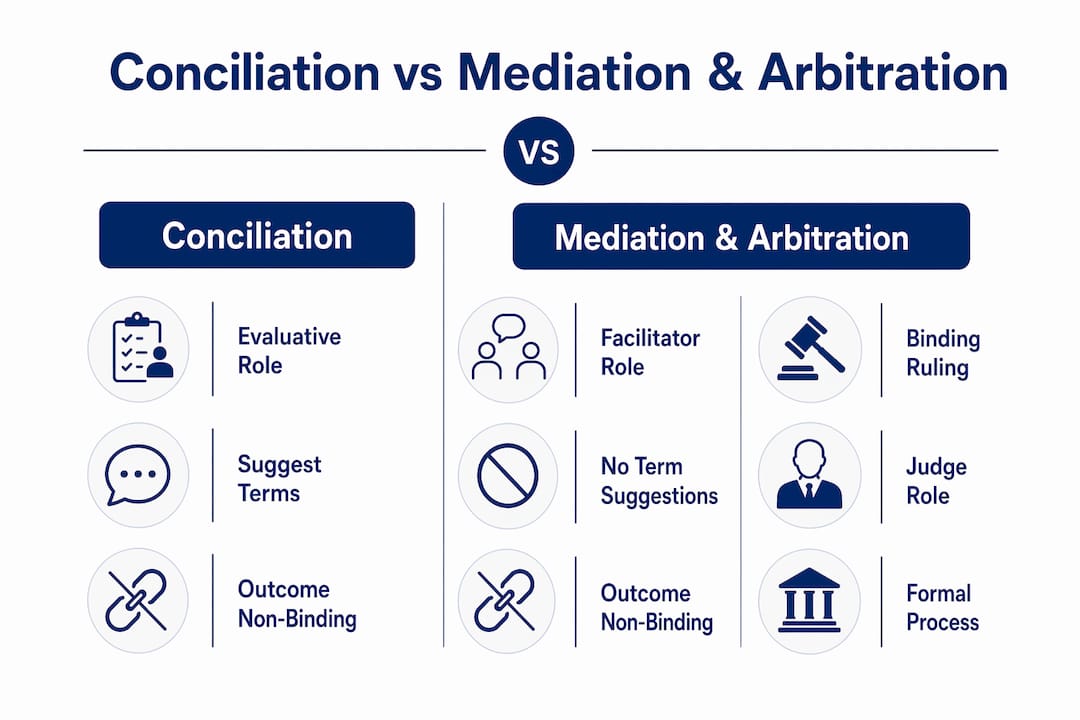
Arbitration sits at the opposite end of the spectrum. An arbitrator hears both sides and issues a binding ruling, much like a judge. The parties lose control of the outcome entirely. For couples or individuals trying to preserve a relationship, arbitration is rarely the right choice.
Mediation sits between the two. It gives parties full control but offers no expert guidance. If you and your partner are both reasonable and well-informed, mediation works well. If there is a significant knowledge gap, emotional volatility, or a power imbalance, the conciliator’s active role provides the structure you need.
Pro Tip: If you are unsure which method fits your situation, review the conflict resolution strategies that Masteringconflict outlines for different relationship dynamics. Matching the method to the conflict type is the single most important preparation decision you can make.
For couples specifically, conciliation often outperforms pure mediation because the evaluative input helps both partners reality-test their expectations without feeling attacked by the other person. The conciliator delivers the hard truth, not the partner.
What steps help individuals and couples succeed in conciliation?
Preparation determines outcomes in conciliation more than most people realize. Showing up without a clear sense of your own interests and limits is the most common reason sessions stall.
- Clarify your underlying interests before the first session. Know the difference between your position (“I want the house”) and your interest (“I need stability for the children”). Shifting from positions to interests through neutral facilitation increases the chance of mutually satisfying resolutions. Write your interests down and bring them.
- Set realistic expectations about the conciliator’s role. The conciliator is not your advocate. They are not there to prove you are right. They are there to help both of you find workable terms. Expecting them to take your side will frustrate you and slow the process.
- Commit to honest communication in private sessions. The caucus format exists precisely so you can speak candidly. Use it. Tell the conciliator what you actually need, what you fear, and where you have flexibility. That information is the raw material of resolution.
- Bring emotional support if you need it. A therapist, trusted friend, or counselor can help you process the emotional weight of the process outside the sessions. Conciliation works better when you are not managing a full emotional crisis inside the room. Masteringconflict’s couples conflict resolution resources offer practical frameworks for managing the emotional side of this process.
- Avoid the “winning” mindset. Conciliation is not a competition. Parties who enter focused on defeating the other side consistently reach worse outcomes than those who focus on solving the shared problem. The goal is a durable agreement, not a victory.
- Know your walk-away point. Before you begin, decide privately what terms you cannot accept. This clarity prevents you from agreeing to something under pressure that you will resent later. A signed conciliation agreement is legally binding. Take that seriously.
The conciliation process steps work best when both parties treat the process as a collaborative problem-solving exercise rather than a formal proceeding.
Key takeaways

Conciliation conflict resolution works because a neutral third party combines active facilitation with evaluative expertise, giving couples and individuals a structured path to durable, self-determined agreements.
| Point | Details |
|---|---|
| Conciliator’s active role | Unlike mediators, conciliators can suggest terms and assess positions, which helps parties reach realistic agreements faster. |
| Legal weight after signing | Agreements become legally binding only after both parties sign, so neither party is locked in until they choose to be. |
| Private caucus sessions | Separate meetings with the conciliator allow candid disclosure that joint sessions rarely produce. |
| Relationship preservation | The collaborative format keeps communication open, making conciliation the strongest choice for couples and personal disputes. |
| Preparation is decisive | Clarifying your underlying interests before the first session is the single most effective way to improve your outcome. |
Why i think conciliation gets underused in personal relationships
Most people I work with have never heard of conciliation before they come to me. They know about therapy, they know about court, and they have a vague sense that mediation exists. Conciliation sits in a gap that most people do not know is there.
What I have seen repeatedly is that couples in serious conflict need more than a neutral facilitator. They need someone who can gently challenge the story each person has been telling themselves. That is exactly what the conciliator’s evaluative role provides. Effective conciliation blends empathy and reality testing, and in my experience, that combination is what moves people from entrenched positions to genuine resolution.
The part that surprises most people is the private caucus. Couples often assume they need to say everything in front of each other to be fair. They do not. Some of the most important progress happens when each person can speak freely without performing for their partner. The conciliator holds that information carefully and uses it to find the overlap neither party could see from their own corner.
My honest advice to anyone considering this process: do not wait until the relationship is at a breaking point. Conciliation works best when both people still want it to work. The active fairness a skilled conciliator brings is not a substitute for goodwill. It is a way to channel goodwill that has gotten buried under conflict.
— Carlos
Ready to work through conflict with professional support?
Conciliation is most effective when it is paired with clinical support that addresses the emotional patterns driving the dispute.
Masteringconflict offers clinical services designed specifically for individuals and couples navigating conflict, including couples therapy, anger management assessments, and individual counseling. Dr. Carlos Todd brings licensed clinical expertise to every engagement, helping clients move from reactive conflict cycles to structured, lasting resolution. Whether you are preparing for a conciliation session or working through the aftermath of a difficult dispute, professional support makes the difference between a temporary truce and a genuine repair.
FAQ
What is conciliation in conflict resolution?
Conciliation is a voluntary dispute resolution process where a neutral third party facilitates negotiation between disputing parties and can suggest settlement terms. Agreements become legally binding only after both parties sign the document.
How is conciliation different from mediation?
A conciliator can evaluate each party’s position and propose specific settlement terms, while a mediator facilitates dialogue without offering opinions or recommendations. This evaluative role makes conciliation more directive and often faster for complex or emotionally charged disputes.
Is a conciliation agreement legally binding?
A conciliation agreement is legally binding only after both parties sign it and the conciliator authenticates it. Before signing, either party can exit the process without legal consequence.
When is conciliation the right choice for couples?
Conciliation works best for couples who want to preserve their relationship, need expert guidance to reality-test their expectations, or face a significant power imbalance that pure mediation cannot address. It is less effective when one party enters the process in bad faith.
What techniques do conciliators use to break deadlocks?
Conciliators use bracketing, which involves conditional proposals that narrow the gap between positions, and reality testing, which privately challenges unrealistic expectations. Both techniques help parties move toward practical, durable agreements without direct confrontation.
Recommended
- Master Conflict Resolution Skills for Real-Life Success – Mastering Conflict
- Mastering Empathy in Conflict Resolution: A Step-by-Step Guide – Mastering Conflict
- Coping With Workplace Conflict: Practical Steps for Resolution – Mastering Conflict
- Dealing With Difficult People: Proven Strategies for Resolution – Mastering Conflict