
Conflict in the Workplace: Strategies That Actually Work

TL;DR:
- Effective conflict management begins with understanding the different types—interpersonal, intrapersonal, intragroup, and intergroup—each requiring tailored strategies. Addressing conflicts early, directly, and calmly prevents escalation, promotes trust, and fosters a healthier workplace culture. Organizational structures like clear escalation pathways and ongoing training support sustainable conflict resolution and prevent issues from becoming entrenched.
Most people treat conflict in the workplace like a fire alarm: something has gone wrong, get everyone out, call the experts. But that instinct is exactly what turns small friction into full-blown dysfunction. Unresolved conflict drives stress, absenteeism, and turnover at rates that would alarm any leadership team. The good news is that conflict, when handled with skill and intention, is one of the most reliable signals that a team is engaged enough to disagree. This guide gives employees and managers practical, evidence-based tools to address workplace tension before it becomes a crisis.
Table of Contents
- Key takeaways
- Understanding conflict in the workplace
- Conflict resolution strategies and when to use them
- Practical communication skills for managing conflicts
- Creating effective conflict management systems
- My take on why avoidance is the most expensive choice
- How Masteringconflict can support your next step
- FAQ
Key takeaways
| Point | Details |
|---|---|
| Conflict is not automatically harmful | Managed well, disagreement surfaces better ideas and strengthens team communication. |
| Know your conflict type first | Interpersonal, intragroup, and superior-subordinate conflicts each require different resolution approaches. |
| Timing shapes outcomes | Starting a conversation while emotions are elevated produces worse results than waiting for calm. |
| Avoidance costs more than confrontation | Leaders who stay silent signal that unresolved tension is acceptable, which accelerates escalation. |
| Systems outlast individual fixes | Organizations that build formal conflict management structures see lasting cultural improvement, not just case-by-case relief. |
Understanding conflict in the workplace
Before you can resolve a conflict, you need to know what kind you are dealing with. Not all conflicts at work look the same, and treating them as if they do is one of the fastest routes to making things worse.
The four main types you will encounter:
- Interpersonal conflict happens between two individuals. It often shows up as clashing personalities, communication styles, or personal values. A project manager who communicates bluntly and a team member who reads that bluntness as disrespect is a classic example.
- Intrapersonal conflict is internal. An employee torn between loyalty to their team and a personal ethical concern is experiencing this type. It often goes unrecognized because it rarely surfaces visibly.
- Intragroup conflict occurs within a team, usually around roles, workload distribution, or decision-making authority. When two colleagues both believe they own a deliverable, the friction is intragroup.
- Intergroup conflict plays out between departments or teams. Sales blaming operations for missed delivery timelines is a textbook example of competing priorities creating intergroup tension.
The source of the conflict matters just as much as the type. Common causes include communication barriers, unequal workloads, competition for limited resources, and ambiguous role definitions. One source that deserves particular attention is the superior-subordinate relationship. Conflicts with superiors are linked to significantly higher rates of sick days and voluntary turnover, while conflicts with colleagues show far weaker associations. That asymmetry tells you something critical: employee conflict issues with management carry outsized organizational risk and need earlier, more deliberate intervention.
Recognizing the source also prevents misdiagnosis. What looks like a personality clash between two coworkers often traces back to a structural problem, such as unclear reporting lines or a manager who gives inconsistent direction. Solve the structural problem, and the interpersonal tension frequently dissolves on its own.
Conflict resolution strategies and when to use them
Not every conflict calls for the same response. The Thomas-Kilmann model gives you a practical way to think about your options, mapped across two dimensions: how assertive you are in pursuing your own interests, and how cooperative you are toward the other party’s interests.
| Strategy | Best used when | Watch out for |
|---|---|---|
| Avoiding | The issue is trivial or timing is poor | Becomes a default habit that lets problems fester |
| Competing | A quick, firm decision is needed | Damages relationships when overused |
| Accommodating | Preserving the relationship outweighs the outcome | Builds resentment if one party always yields |
| Compromising | Both parties need a workable middle ground fast | Neither party fully satisfied; may resurface |
| Collaborating | Long-term relationship and quality solution both matter | Time-intensive; requires mutual good faith |
Beyond the Thomas-Kilmann strategies, workplace dispute resolution also includes formal methods. Negotiation keeps parties in direct dialogue with a shared goal. Mediation brings in a neutral third party to facilitate, without imposing a decision. Arbitration hands the decision to a neutral authority. Most employee conflict issues are best resolved through negotiation or mediation before arbitration ever becomes necessary. Up to two weeks is the recommended window for informal resolution before escalating to formal channels.
Timing is a factor most guides overlook. Initiating talks while parties are emotionally activated almost guarantees a worse outcome, not a better one. Calm is a prerequisite for productive dialogue, not a sign that the conflict was never serious.
Pro Tip: Before deciding on a strategy, ask yourself one question: do I want to win this conversation, or do I want to solve this problem? That distinction determines which approach you should use.
When none of the above is sufficient, escalation to HR is appropriate. HR involvement works best as a structured last resort, not a first call. Most interpersonal communication issues are leadership responsibilities, and sending them to HR prematurely can actually undermine a manager’s credibility with their team.
Practical communication skills for managing conflicts
Knowing the right strategy is only half the equation. How you communicate within that strategy determines whether the conflict moves toward resolution or digs in deeper.
Here is a structured approach to working through interpersonal conflict at work:
- Choose the right moment. Wait until both parties have had time to cool down. Conflict conversations held immediately after an incident tend to be reactive, not productive. The goal is a conversation, not a confrontation.
- Start with curiosity, not conclusions. Open with a genuine question about the other person’s perspective before presenting your own. “Help me understand what happened from your side” is more disarming than any perfectly worded position statement.
- Use specific, observable language. Say “You interrupted me three times during the meeting” instead of “You never respect me.” Specific behaviors are discussable. Characterizations put people on the defensive instantly.
- Practice active listening. This means repeating back what you heard before responding. “So what I’m hearing is that you felt left out of the decision. Is that right?” It slows the conversation down in the best possible way.
- Name the impact without assigning intent. “When that happened, I felt sidelined” keeps the focus on your experience without accusing the other person of malicious motivation.
- Agree on a next step. A conflict conversation with no defined outcome tends to restart the same cycle. End with a clear, mutual commitment, even a small one.
Documenting grievances before talking to the other person hardens assumptions and makes resolution harder. Building a case in your head before opening a dialog reinforces an adversarial posture. The goal is understanding, and you can only get there if you go in without a predetermined verdict.
Pro Tip: Emotional intelligence is not about suppressing how you feel. It is about knowing when your feelings are driving the conversation in an unproductive direction, and pausing before they do.
Psychological safety matters here too. Teams where members feel safe raising concerns early have far fewer conflicts that escalate to formal processes. You can read more about building conflict management skills to strengthen your foundation. The earlier a tension is named, the cheaper it is to resolve.

Creating effective conflict management systems
Individual skills matter, but they only go so far without organizational structures that support conflict resolution. This is where conflict management in an organization shifts from being reactive to being genuinely preventive.
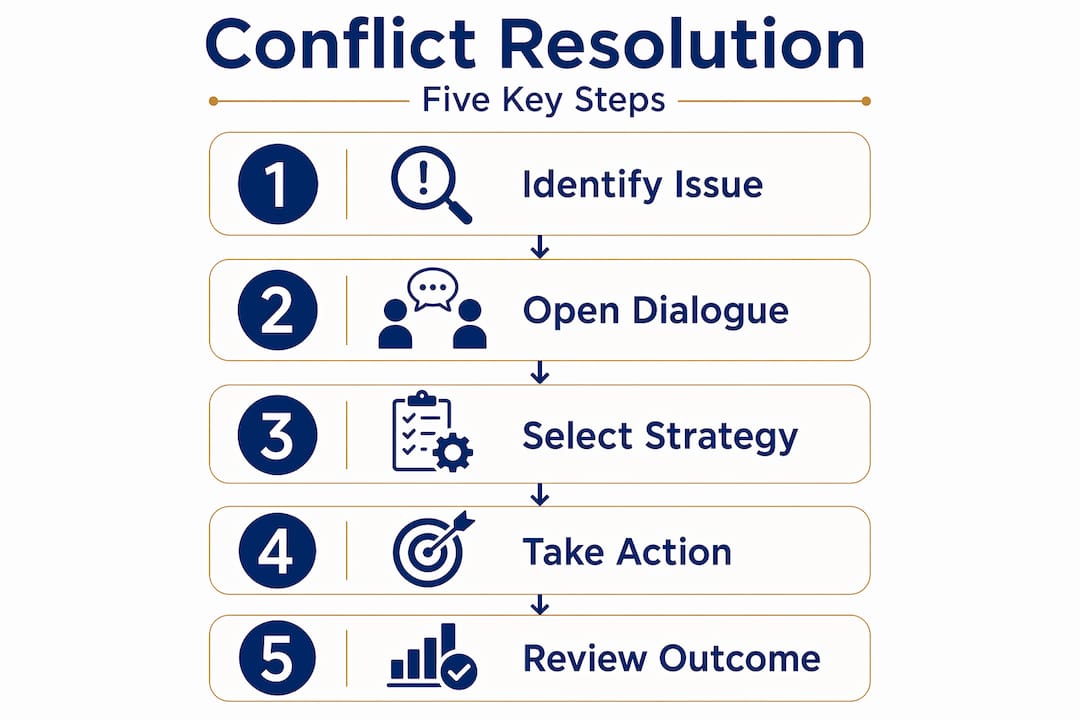
A well-designed dispute system does several things at once. It gives employees a clear path for raising concerns. It defines who handles what at which stage. It separates issues that belong to managers from those that belong to HR. And it tracks patterns so leadership can spot recurring problems before they become cultural norms.
Here is what strong conflict management systems include:
- Clear escalation pathways. Employees should know exactly what steps to take when a conflict cannot be resolved directly. Ambiguity about the process adds anxiety to an already tense situation.
- Manager-level training. Only 40% of leaders have formal conflict resolution training, despite half viewing it as a critical skill. That gap is a structural risk. Closing it requires integrating conflict scenarios into new manager onboarding and ongoing leadership development.
- Peer learning and practice opportunities. Skills built in a workshop erode fast without reinforcement. Peer learning circles, where managers debrief real conflict situations together, embed resolution practice into everyday culture rather than treating it as a one-time training event.
- Follow-up after resolution. A conflict declared resolved on day one is not necessarily resolved on day thirty. Check-ins with both parties two to four weeks after a formal resolution signal that the organization takes follow-through seriously.
- A neutral reporting mechanism. Employees who fear retaliation will not raise issues until they have no other choice. Anonymous or confidential reporting channels reduce that barrier significantly.
One counterintuitive finding from research on dispute system design: a robust conflict system often triggers an initial rise in reported conflicts. That is not a sign the system is failing. It is a sign that employees finally trust the process enough to use it. Organizations that misread this early increase as a problem sometimes dismantle the very structures that were working.
| System element | Manager’s role | HR’s role |
|---|---|---|
| Early intervention | Direct coaching and conversation facilitation | Available for consultation, not first responder |
| Formal mediation | Refers when direct efforts stall | Conducts or coordinates workplace conflict mediation |
| Policy enforcement | Applies relevant policies consistently | Investigates policy violations |
| Culture building | Models direct, respectful communication | Designs training and accountability frameworks |
My take on why avoidance is the most expensive choice
I have worked with hundreds of leaders over the years, and I can tell you that the most common mistake is not mishandling conflict. It is avoiding it entirely. I have seen managers let small tensions between team members sit for weeks, months, sometimes years, convinced that stepping in would make things worse. Almost without exception, the delayed intervention made things far worse than early engagement ever would have.
What I have learned is that avoiding conflict does not protect anyone. It tells the team that this is a place where difficult things go unaddressed. People read silence as permission. Then the conflict finds its own resolution, and those resolutions are almost never the ones leadership would choose.
The other mistake I see consistently is leaders who wait too long and then overcorrect. They let an issue simmer, and then one day they bring it to a formal disciplinary conversation that blindsides the employee. That is not discipline, that is accumulated avoidance disguised as action.
What actually works? Address it early, address it directly, and do it when both people are calm enough to actually hear each other. You do not need to have all the answers before you start the conversation. You just need to be willing to have it. Leaders who model direct communication build teams that do the same thing organically over time.
The hardest part is not the conversation itself. It is recognizing that your discomfort with conflict is not a good enough reason to let someone else absorb the cost of it.
— Carlos
How Masteringconflict can support your next step
If you have read this far and recognized patterns in your own workplace or leadership style, that recognition is worth acting on.
Masteringconflict offers professional services built for exactly these situations. Whether you are dealing with ongoing workplace tension that keeps cycling back, or you are a manager who wants to improve how you handle difficult conversations, the support is there. An anger management assessment can clarify whether unmanaged emotional responses are driving your conflict patterns. For those navigating stress that spills between personal and professional life, teletherapy counseling offers accessible, remote support from licensed professionals. Dr. Carlos Todd and the Masteringconflict team bring evidence-based approaches to both individual and organizational conflict challenges, with coaching programs designed for real-world application.
FAQ
What are the main types of conflict in the workplace?
The four core types are interpersonal, intrapersonal, intragroup, and intergroup conflict. Each has distinct causes and requires a different resolution approach.
How long should you try to resolve a conflict informally?
Research suggests allowing up to two weeks for informal resolution before escalating to formal processes, giving both parties time to work through the issue directly.
When should workplace conflict go to HR?
HR involvement is most appropriate when direct conversations and manager-level mediation have failed, or when the conflict involves policy violations, harassment, or a significant power imbalance.
Does having a conflict resolution system mean the workplace has more problems?
Not necessarily. Organizations with strong dispute systems often see an initial rise in reported conflicts because employees trust the process enough to use it. That is a healthy sign, not a failure.
What communication skill matters most in resolving workplace tension?
Active listening is the single most high-impact skill. Repeating back what the other person said before responding slows the conversation down and creates the mutual understanding that makes resolution possible.