
Multicultural family conflict: 5 evidence-based strategies

Conflict in multicultural families carries a reputation it doesn’t always deserve. Many people assume that when cultures, languages, and generations collide under one roof, damage is unavoidable. But the research tells a more nuanced story, and understanding that story is the first step toward real change. Whether you’re navigating intergenerational tension, value clashes, or communication breakdowns, there are evidence-based paths forward that respect your family’s unique cultural identity while building stronger, more connected relationships.
Table of Contents
- Understanding conflict in multicultural families
- Therapeutic frameworks for multicultural family conflict
- The role of cultural humility and competencies
- Strategies and tools for resolving multicultural family conflict
- Next steps and professional support
- Frequently asked questions
Key Takeaways
| Point | Details |
|---|---|
| Conflict is sometimes healthy | Multicultural family conflict can lead to positive growth and is not always harmful. |
| Therapy adapts to culture | Culturally grounded therapies enhance communication and address cultural differences in families. |
| Skills build resilience | Developing cultural humility, mediation, and boundary-setting skills helps families resolve conflicts effectively. |
| Language connects families | Translanguaging and shared language practices strengthen emotional bonds despite linguistic barriers. |
Understanding conflict in multicultural families
Multicultural family conflict refers to disagreements that arise when family members hold different cultural values, communication styles, or expectations shaped by different backgrounds. These conflicts often surface around education, career choices, independence, dating, and religious practice. The tension is real, but it’s rarely as simple as one culture being “right” and another being “wrong.”
One of the most common sources of friction is the acculturation gap, which is the difference in how quickly or deeply family members adopt the values and behaviors of a new culture. Acculturation gaps between parents and children frequently drive intergenerational tension over values, education, career, and independence. Children who grow up immersed in a new culture often adapt faster than their parents, creating a divide that can feel personal even when it’s structural.
Here’s what surprises most families: conflict doesn’t automatically mean harm. Over half of studies reviewed show no association between parent-child acculturation gaps and negative child, parenting, or family outcomes. That’s a significant finding. It means the presence of conflict is not a verdict on your family’s health.
Language plays a particularly layered role. When family members speak different languages or mix languages at home, language barriers in families can create emotional distance that goes beyond miscommunication. Yet many families develop creative workarounds, including shared phrases and emotional shorthand, that actually deepen connection over time.
Common sources of multicultural family conflict:
- Acculturation gaps between immigrant parents and children raised in a new country
- Intergenerational clashes over marriage, career, and lifestyle choices
- Language differences that limit emotional expression
- Conflicting expectations around gender roles and family obligations
- Religious or spiritual differences between generations
| Conflict source | Who it typically affects | Potential impact |
|---|---|---|
| Acculturation gap | Parents and children | Value misalignment, identity confusion |
| Language barriers | All family members | Emotional disconnection, misunderstanding |
| Gender role expectations | Couples and adult children | Resentment, power struggles |
| Religious differences | Multigenerational households | Isolation, boundary violations |
| Career and education pressure | Teens and young adults | Anxiety, estrangement |
“The goal is not to eliminate cultural difference but to build a family system where difference is a source of strength rather than division.”
Exploring family conflict resolution tools early can prevent small tensions from becoming entrenched patterns. And when families do the work, positive relationship outcomes are not just possible, they’re common.
Therapeutic frameworks for multicultural family conflict
Generic therapy often falls short for multicultural families because it assumes a cultural baseline that doesn’t fit everyone. A therapist trained in mainstream Western models may unintentionally pathologize behaviors that are culturally normal, like deference to elders or collective decision-making. That’s why culturally adapted frameworks matter so much.
Culturally adapted Structural Family Therapy enhances communication and reduces intergenerational conflict among immigrant families by examining the power structures and boundaries within the family system. It helps families reorganize roles in ways that honor both cultural heritage and current realities.

Several other models have been adapted specifically for multicultural couples and families. Emotionally Focused Therapy, Gottman Method, Integrative Behavioral Couple Therapy, and Narrative Therapy are all adapted to address emotional patterns and cultural differences in meaningful ways. Each takes a different angle, and the right fit depends on your family’s specific dynamics.
Comparison of therapeutic frameworks for multicultural families:
| Therapy model | Core focus | Cultural adaptation |
|---|---|---|
| Structural Family Therapy | Family roles and boundaries | Examines cultural hierarchy and power |
| Emotionally Focused Therapy (EFT) | Attachment and emotional bonds | Addresses culturally shaped emotional expression |
| Gottman Method | Communication and trust | Incorporates cultural conflict styles |
| Integrative Behavioral Couple Therapy (IBCT) | Acceptance and behavior change | Validates cultural differences as context |
| Narrative Therapy | Rewriting problem stories | Centers cultural identity and lived experience |
Intercultural couple research shows that personal growth and the ability to overcome cultural barriers are among the most reported benefits when couples engage in culturally informed therapy. This isn’t just about reducing conflict. It’s about expanding who you are as a family.
How to choose the right therapeutic approach:
- Identify whether the primary conflict is emotional, behavioral, or narrative in nature
- Ask potential therapists directly about their multicultural training and experience
- Consider whether individual, couples, or whole-family sessions are most appropriate
- Look for therapists who practice cultural humility, not just cultural awareness
- Reassess fit after three to five sessions if progress feels stalled
Pro Tip: Before your first session, write down three moments when your cultural background shaped how you responded in a family conflict. Sharing these with your therapist gives them a faster, more accurate picture of your family’s dynamics.
Our cultural couples therapy guide breaks down how to find a therapist who truly understands your background. And if you’re still weighing whether therapy is worth it, the benefits of couples therapy for multicultural families go well beyond conflict reduction.
The role of cultural humility and competencies
There’s an important distinction between cultural competence and cultural humility. Cultural competence is about acquiring knowledge of specific cultures. Cultural humility goes further. It’s an ongoing practice of self-reflection, openness, and recognizing that you will never fully know another person’s cultural experience. For therapists and families alike, humility is the more powerful tool.
Prioritizing cultural humility and competencies in awareness, knowledge, and skills for multicultural counseling fosters family cohesion and supports social justice. These aren’t abstract ideals. They translate into concrete behaviors: listening without assuming, asking instead of guessing, and staying curious about what a family member’s culture means to them personally.
Three core competencies for multicultural family health:
- Awareness: Recognizing your own cultural biases and how they shape your expectations of family members
- Knowledge: Learning about the specific cultural contexts that influence your family’s values and behaviors
- Skills: Applying communication strategies that bridge cultural differences without erasing them
“Cultural humility is not a destination. It’s a daily practice of choosing curiosity over assumption.”
For parents, this might mean asking your teenager what independence means to them before assuming they’re rejecting your values. For children of immigrants, it might mean learning more about the country your parents came from, not to agree with everything, but to understand the world that shaped them.
Pro Tip: Try a “cultural story” exercise at home. Each family member shares one value they hold and traces it back to a specific cultural experience or memory. This builds empathy faster than most structured conversations.
Families seeking culturally centered healing will find that this kind of work creates lasting change. Working with a skilled family counselor who practices cultural humility can accelerate the process significantly. The benefits of family counseling extend to every member of the household, not just the ones in the most visible conflict.
Strategies and tools for resolving multicultural family conflict
Knowing that conflict exists is one thing. Knowing what to do in the middle of it is another. The good news is that multicultural families have access to a growing toolkit of evidence-based strategies that are designed with cultural complexity in mind.
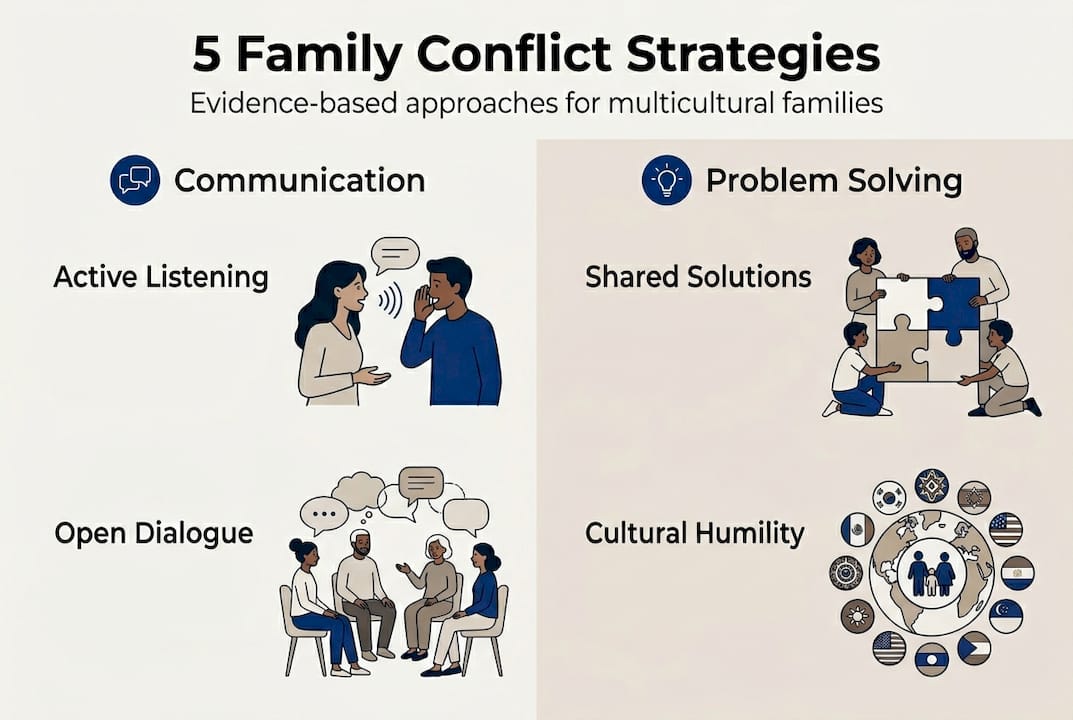
Intercultural mediation facilitates identity negotiation and conflict resolution by emphasizing equity, respect, and active listening. Unlike standard mediation, intercultural mediation explicitly accounts for the power dynamics and cultural assumptions that each party brings to the table. It’s not just about finding a compromise. It’s about making sure every voice is heard on its own cultural terms.
Narrative therapy is another powerful tool. It helps family members separate themselves from the problem by examining the stories they’ve been told, and tell themselves, about their cultural identity and family role. Culturally grounded narrative therapy, acceptance-based frameworks, and family boundary setting build resilience within family systems over time.
Step-by-step conflict resolution for multicultural families:
- Pause before reacting. Name the emotion you’re feeling without attaching it to blame.
- Ask a genuine question about the other person’s cultural perspective on the issue.
- Use “I” statements that describe your experience without generalizing about their culture.
- Identify one shared value that both parties hold, even if it’s expressed differently.
- Agree on a specific, small behavior change that honors both cultural perspectives.
- Follow up within one week to check in on how the change is working.
Additional tools that support multicultural family resilience:
- Family meetings with rotating facilitators to balance power and voice
- Bilingual journaling to process emotions in the language that feels most natural
- Cultural celebration rituals that honor each family member’s heritage
- Boundary-setting conversations guided by a neutral third party
- Regular check-ins using structured questions rather than open-ended arguments
For couples navigating this terrain, effective conflict resolution steps provide a practical framework you can return to repeatedly. Families with teenagers will find teen conflict resolution strategies especially useful during the years when identity formation and cultural belonging are most intense. And for parents managing conflict while also raising children, parenting conflict resolution resources can help you model the skills you want your kids to develop.
Next steps and professional support
You now have a clearer picture of what drives conflict in multicultural families and what actually works to resolve it. But reading about strategies and applying them under pressure are two very different things. That’s where professional support makes the biggest difference.
At Mastering Conflict, we offer clinical services that are specifically designed for families navigating cultural complexity, including couples therapy, family counseling, and individual therapy for children, teens, and adults. If you’re not sure whether therapy or coaching is the right fit, our coaching vs therapy comparison can help you decide. For families where anger is a significant factor in conflict, our anger assessment is a useful starting point for understanding what’s driving the intensity. You don’t have to figure this out alone, and you don’t have to wait until things get worse.
Frequently asked questions
Does multicultural family conflict always harm children?
No. Over half of reviewed studies show no association between parent-child acculturation gaps and negative child or family outcomes. Conflict exists, but harm is not inevitable.
What therapy works best for multicultural families?
Culturally adapted therapies are the strongest options. EFT, Gottman Method, IBCT, and Narrative Therapy address emotional patterns and cultural differences, while Structural Family Therapy targets intergenerational communication and roles.
How can multicultural families overcome language barriers?
Many families develop translanguaging practices and shared emotional shorthand, what researchers call familylect development, to maintain connection across language differences.
Are mediation and counseling effective for multicultural family conflict?
Yes. Intercultural mediation emphasizes equity, respect, and active listening, making it one of the most effective tools for resolving identity-based and cultural conflicts within families.
Recommended
- Navigating Family Conflict for Positive Relationships – Mastering Conflict
- Conflict Resolution for Kids: 5 Strategies Boosting Skills by 50% – Mastering Conflict
- Understanding Family Conflict Resolution Strategies – Mastering Conflict
- Effective Conflict Resolution Steps for Couples, Families, and Professionals 2025 – Mastering Conflict