
Your First Couples Therapy Session: What to Expect

Your first couples therapy session is mostly a conversation, not a verdict. A licensed therapist meets the two of you, learns what brought you in, asks how the relationship got here, and agrees with you on what you want to change. Nobody is expected to fix anything on day one. The couples who get the most from that hour are the ones who arrive knowing roughly what they want, and who are seeing a clinician trained to work with two people at once. At Mastering Conflict, couples sessions are led by licensed clinicians, and our founder, Dr. Carlos Todd, is a licensed clinical mental health counselor and psychologist.
TL;DR
- The first session is for history, goals and fit. Expect questions about how you met, what has changed, and what each of you wants.
- Prepare separately, then compare: each partner writes down one goal, one concern and one thing that still works.
- A good therapist does not take sides, and you do not have to share everything in the first hour.
- Ask about confidentiality, individual sessions and how often you will meet before you leave.
- Online sessions work well too. Plan for a quiet, private space and a quick technology check.
Table of Contents
- What actually happens in the first hour
- Questions the therapist may ask you
- How to prepare together
- Will the therapist take sides?
- Do you have to share everything?
- What if you want different things, or one of you is reluctant?
- Is it a good fit? Signs after session one
- First session by video
- What about the 2-2-2 and 5-5-5 “rules”?
- Is your first session the same as marriage counseling?
- Our perspective
- Booking your first session with us
- FAQ
- Sources
What actually happens in the first hour
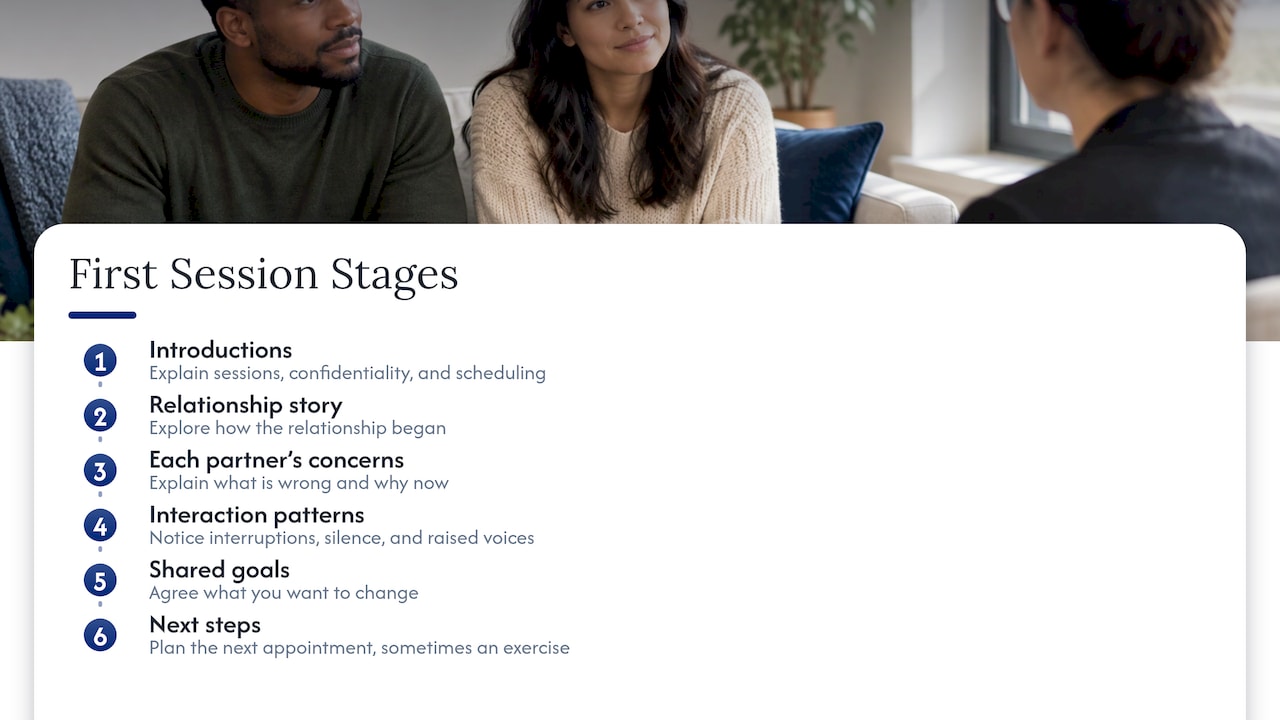
Sessions differ by therapist, but most first appointments follow the same arc.
Introductions and ground rules. The therapist explains how sessions work, how long they run, what is confidential and how scheduling works. You will usually sign consent paperwork before or at the start.
Your story. Expect questions like how long you have been together, whether you live together, whether you have children, how you met, and what first attracted you to each other. It can feel like small talk. It is not. The answers show the therapist what the relationship was built on, which is often what gets rebuilt later.
The reason you are here. Each partner gets to explain, in their own words, what is going wrong and why now. A trained couples therapist will keep the conversation moving so that one of you does not do all the talking, and will interrupt a spiral of blame before it takes over the hour.
Patterns, not verdicts. The therapist is watching how you talk to each other as much as what you say. Who interrupts, who goes quiet, who gets louder, who tries to smooth things over. These patterns tend to be the real subject of therapy, and noticing them in the room is part of the work.
Goals. Most sessions end with a rough agreement on what you want: fewer arguments, rebuilding trust after a betrayal, deciding about the future, learning to talk about money or parenting without a fight. These goals shape what the next sessions look like.
Next steps. You will leave with a plan for the next appointment, and sometimes a small exercise to try between sessions.
If you want a sense of the questions that come up in marriage counseling more broadly, our piece on common marriage counseling questions walks through them.
Questions the therapist may ask you
You do not need rehearsed answers. Honest and short beats polished. Common questions include:
- What made you decide to come in now?
- How would you describe the relationship at its best, and at its worst?
- What have you already tried?
- How do you each handle conflict? Do you argue, withdraw, or avoid?
- What does a good outcome look like in three months?
- Is there anything about safety, substance use or past betrayals I should know now?
That last question matters. If there is violence, fear or control in the relationship, tell the therapist when you can do so safely. Some situations call for individual attention first, and a clinician will explain what makes sense. If you are in immediate danger, call 911.
How to prepare together
Preparation does not mean winning your case before you arrive. It means getting out of the car, or onto the video call, with a little clarity. A few steps do most of the work.
- Agree on the goal of the first session. Something as simple as “let’s find out whether this therapist is a good fit and what we want to work on” lowers the pressure for both of you.
- Write three things each, separately. One thing you want to change, one thing you appreciate about your partner, one thing you are afraid to say. You do not have to share the third one out loud. It simply helps you know what is underneath.
- Pick the headline issue. Couples often arrive with ten grievances. Choose the one or two that matter most so the hour has a focus.
- Do not rehearse an argument. If you walk in with a list of your partner’s failures, the session turns into a trial. Describe what happens between you and how it affects you, rather than who is at fault.
- Sort out logistics. Childcare, work schedules and who is driving. Arriving rushed or arguing about parking sets a bad tone for the hour.
- Think about your own part. Therapists listen well to a partner who can say, “Here is what I do that makes this harder.”
For general advice on getting ready for any first therapy appointment, this guide to preparing for your first therapy session covers the practical side well, from paperwork to what to bring.
Will the therapist take sides?
A couples therapist’s client is the relationship, not one partner. Their job is to understand both experiences, name the pattern you are caught in, and help you both change your part in it. If you feel from the first session that the therapist consistently sides with one of you, say so, either in the session or at the start of the next. Good therapists welcome that conversation.
Do you have to share everything?
No. The first session is not a confession. You decide the pace, and a good therapist will not push you to unload your deepest hurts in the first hour. What you should ask is how the therapist handles information shared by one partner alone, because practices differ. Some therapists see partners individually for part of the process, and some do not. Ask these questions early:
- Will we ever meet separately, and if so, how is that information handled?
- What happens if one of us tells you something the other does not know?
- What are the limits of confidentiality?
Our guides on confidentiality in counseling and confidentiality in online therapy explain the basics in plain language, including how privacy works when sessions happen by video.
What if you want different things, or one of you is reluctant?
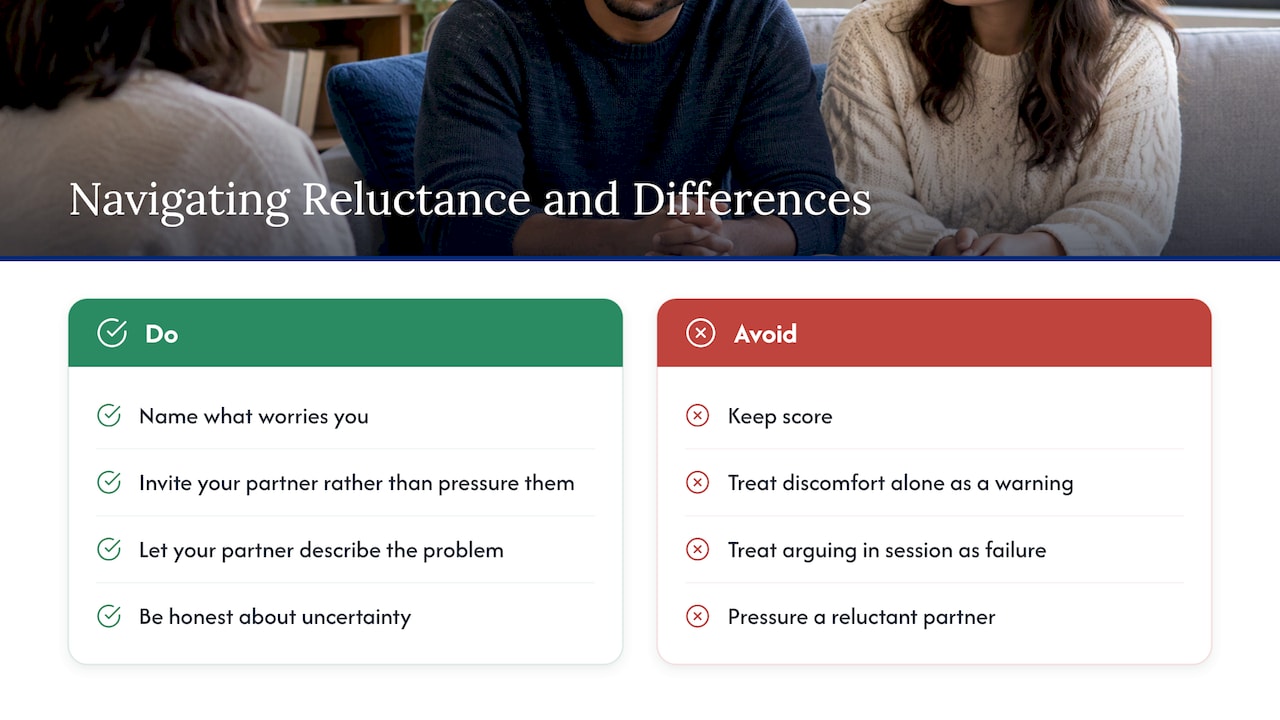
This is very common. One partner is often more ready to come than the other. Some practical ways through it:
If you are the reluctant one. Say what worries you. Fear of being blamed, fear of being outnumbered, fear that therapy means the relationship is failing. Naming it to the therapist early tends to take the edge off it. You do not have to commit to a long course. You can commit to the first session and decide afterward.
If you are the one who pushed. Resist the urge to keep score. Invite your partner rather than pressuring them, and let them describe the problem in their own terms. A partner who feels cornered usually shuts down.
If your goals differ. One of you wants to rebuild, the other is unsure. Therapists deal with this regularly. Honest uncertainty is a legitimate starting point, and the therapist can help you each be clear about what you are willing to try.
If the session gets heated. Arguing in the room is not a failure. It shows the therapist the pattern you are stuck in. If it escalates beyond what is productive, a competent therapist will slow things down and steer you back.
If it feels uncomfortable. It often will, at least a little. Discomfort alone does not mean it is the wrong therapist, though a lack of any sense of safety or respect is a good reason to talk to them about it.
Is it a good fit? Signs after session one
You do not have to love the therapist after one hour, but you should be able to answer yes to most of these:
- Did each of us get to speak without being cut off?
- Did the therapist describe the problem in a way that felt accurate?
- Do we have a rough idea of what we are working toward?
- Did we leave with a clear next step?
- Did we both feel treated with respect?
If the answers are mostly yes, book the second session. Couples therapy builds over several visits, and a first session is more about direction than relief.
First session by video
Many couples start online, especially when schedules, distance or childcare make an office visit hard. It works for a first session as well, with a bit of planning. A 2022 peer-reviewed article on conducting couple therapy via telehealth recommends planning for technology and privacy and setting clear expectations for how each person participates. The authors suggest allowing a 10 to 15 minute technology check, or some extra time in the initial appointment, so that connection problems do not eat into the conversation.
In practice:
- Sit together on one screen if you are in the same home, or make sure each of you has a private, quiet space if you are apart.
- Use headphones if you share a space with children or housemates.
- Test your camera, microphone and internet connection beforehand.
- Silence phones and close other tabs.
- Agree in advance what you will do if the connection drops.
For more on how it works, see our pages on online couples therapy and teletherapy best practices.
What about the 2-2-2 and 5-5-5 “rules”?
These show up in search results, and many couples wonder if they will be quizzed on them. They are rules of thumb that circulate online, typically about how often to schedule time together or how to structure a short check-in. You do not need to know any of them before your first session, and your therapist will build routines around your own schedule and goals rather than a formula.
Is your first session the same as marriage counseling?
The terms are used almost interchangeably. “Marriage counseling” is the older phrase and “couples therapy” is wider, covering married couples, partners who live together, and couples who are dating or engaged. The first session looks the same either way: history, goals, and getting to know the therapist. If you are engaged and planning ahead, our guide to premarital counseling covers what is different.
Our perspective
Most couples who call us wait too long and arrive believing the first session has to prove something. It does not. Its job is to give both of you a calmer, clearer picture of what is going on and to show you that someone is in the room who will not take a side.
What we care about most is that you leave the first session with a plan, not just relief. We pair clinical training with tools you can use that same week, because a good conversation in the office only matters if it changes what happens at the kitchen table.
We also know that not every couple looks the same, and that culture, faith, family and background shape how people talk about conflict. We work with diverse populations, including Black and African American couples, and with partners at very different stages, from a first tense conversation to rebuilding after infidelity. Whether you meet us in Charlotte or by video, the starting point is the same: bring what you have, as you are.
Carlos
Booking your first session with us
If you are ready to start, our couples counseling page lists the clinical services we offer, including couples counseling and infidelity recovery. Couples sessions are $175 per hour, and the options on our couples packages page range from single sessions to longer programs: the Relationship Renewal Starter Program at $1,100, the Weekend to Renewal Couples program at $2,000, and a 6 Hour Couples Intensive at $1,995. We offer online therapy as well as in-person sessions.
If you would rather get a longer block of work done at once, the 6 Hour Couples Intensive is one way to do it.
FAQ
How long is a first couples therapy session?
Most therapists schedule a standard session of around an hour, though some allow extra time for the first visit. Ask when you book so you can plan around it. For online sessions, build in a few extra minutes for a technology check.
Should we prepare separately or together?
Both help. Think separately about what you want to change and what you appreciate, then agree together on what you want from the first session. Avoid drafting a list of your partner’s faults. Aim to describe the pattern between you.
Can I go if my partner will not come?
Yes. Individual counseling can help you sort out your own goals and choices, and some partners join later once they see it is not a blame session. If you would like to start on your own, our counseling for men and women is one place to begin.
What if we are not sure we want to stay together?
That is a legitimate reason to come. A first session can help each of you say what you want and what you are willing to try, without forcing a decision about the relationship.