
What Happens at Mediation: A Step-by-Step Walkthrough

At mediation, you and the other side meet with a neutral person who helps you talk through the dispute and look for terms you can both accept. The mediator opens the session and explains the ground rules. Each side tells its story. Then you explore options, sometimes in private meetings with the mediator, and, if you agree, put the terms in writing. The mediator does not decide who is right, and nobody can force you to settle.
This guide walks through each stage in order, explains who speaks and when, covers confidentiality, and gives you a plain preparation plan. It applies to family, workplace, neighbor and business disputes, though local court rules differ, so check the court or program that is handling your case.
TL;DR
- Mediation is a facilitated conversation. A neutral mediator guides it, and you and the other party decide the outcome.
- A typical session runs in this order: introductions and ground rules, each side’s account, information gathering, private meetings if needed, option building, and a written agreement.
- Most of what is said is confidential, with exceptions, and the mediator cannot impose a settlement.
- Prepare by naming your key issues, thinking about how the other person sees them, and deciding what you can flex on.
- Speak in “I” statements, avoid “always” and “never,” and ask for a break if emotions climb.
Table of Contents
- What mediation is, and what the mediator does
- Before the session: what usually happens first
- The mediation process, step by step
- Private caucuses: what happens when the mediator meets you alone
- Do you have to speak? Who talks, and when
- Is mediation confidential, and can the mediator force a deal?
- How to prepare so the session goes well
- What to say and what not to say in mediation
- What about settlement amounts?
- Who wins at mediation?
- Build the skills before the session
- FAQ
- Sources
What mediation is, and what the mediator does
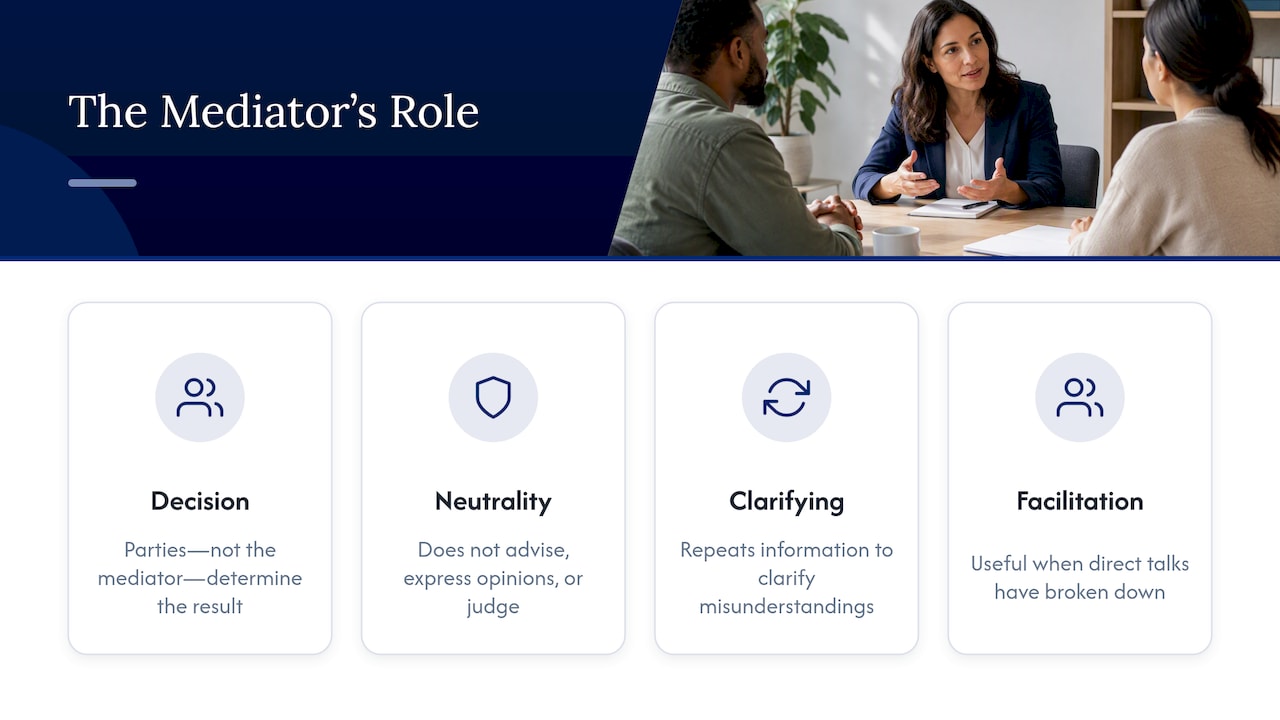
Mediation is a process in which a trained mediator helps disputants work together to craft a resolution each side values. The parties, not the mediator, determine the result. That single fact explains most of what happens in the room.
The mediator is not a judge and not your advocate. In New South Wales, Australia, for example, the local court describes a mediator as someone who does not give advice, express opinions or make judgments about the dispute. Their job is to help communication and help you explore settlement options. U.S. practice follows the same core idea, though some mediators are more hands-on than others. Canada’s Department of Justice notes that mediator involvement runs on a spectrum, from purely neutral facilitation to guidance that comes close to advice about evaluating your alternatives.
The Program on Negotiation at Harvard Law School compares mediators to translators: they repeat back information and clarify misunderstandings so each person understands what the other actually needs. The World Bank describes mediation as facilitated negotiation, useful when direct talks have broken down.
Before the session: what usually happens first
Most of the work starts before anyone sits down. Depending on the setting (a court program, a private mediator, an employer), you may:
- Receive a notice with the date, place or video link, and the name of the mediator.
- Complete an intake form or short phone call so the mediator understands the basics.
- Be told who needs to attend. If a decision requires a spouse, a manager or an insurer, that person usually has to be present or reachable.
- Be asked to send a short summary of your position, or to bring documents.
If you have a lawyer, they may attend with you, particularly in business and injury cases. In many family and community programs, people attend without one. Either way, ask the program what to bring before the day.
The mediation process, step by step
Formats vary, but most sessions follow the same arc.
1. Opening remarks and ground rules
In the joint session, the mediator outlines the goals, ground rules and process. Expect them to explain their neutral role, confirm that everyone is there voluntarily and has authority to settle, and set expectations such as no interrupting, no personal attacks, and respect for breaks. You may be asked to sign a confidentiality or participation agreement.
2. Each side tells its story
Next, each party presents its view of the dispute without interruption. This is the moment many people dread, but it is often the most useful part. You get to say what happened and what matters to you, and you hear the other person say it too. Take notes instead of interrupting. You will get your turn to respond.
If you have a lawyer, they may give a short opening statement. In personal disputes, you will usually speak for yourself.
3. Clarifying and gathering information
The mediator then asks questions, summarizes what they heard, and separates the facts that are agreed from those in dispute. Expect questions such as: What would a good outcome look like? What is the biggest concern? What information is missing? The goal is to move from positions (“I want the house”) toward interests (“I need stability for the kids”).
4. Private meetings (caucuses)
Often the mediator will split the group and meet with each side privately. We cover this in its own section below because it surprises people the most.
5. Building and testing options
Once the issues are clear, the mediator helps you brainstorm. Strong sessions generate several possible solutions, not one. You trade proposals, test them against what each person can live with, and narrow down. Offers and counteroffers move back and forth, either in the joint room or through the mediator carrying them between rooms.
6. Reaching, or not reaching, an agreement
If you find terms you can both accept, the mediator or the parties write them down. The American Bar Association notes that formalizing a settlement can take several hours so every contingency is addressed and the wording is unambiguous. Do not rush this part, and do not leave with only a verbal handshake on anything important.
If you do not reach agreement, you leave and keep your options. You can try another session, return to negotiation, or move forward with the formal process that brought you there.
Private caucuses: what happens when the mediator meets you alone
A caucus is a confidential meeting between the mediator and one side. According to the American Bar Association, private caucuses give people room to vent emotions, discuss sensitive information, or weigh the strengths and weaknesses of their case. The ABA also observes that letting people vent privately reduces the risk of destructive behavior or intimidation in the joint session.
In a caucus, the mediator may:
- Ask what you really need and where you could flex.
- Test your assumptions with questions such as “What happens if this does not settle?”
- Carry a proposal to the other room and bring back a response.
What you say in a caucus stays there. The New Mexico Courts’ mediation guide says information shared in a private session stays confidential from the other party unless you explicitly authorize the mediator to share it. If you want something passed along, say so clearly. If you do not, say that too.
Do you have to speak? Who talks, and when
Yes, in most formats you speak for yourself. The New South Wales court notes that parties are generally asked to talk directly to one another, and that they may also have separate sessions with the mediator and breaks to get advice or support. Lawyers, if present, often handle the legal framing and negotiation, while you describe what the dispute means to you.
Some court programs, particularly in family cases involving safety concerns, set up the process differently, for example with separate rooms or separate sessions. If you have any safety worry about being in the same room as the other person, tell the program before the day. They can adjust the format.
Is mediation confidential, and can the mediator force a deal?
There are two separate questions here.
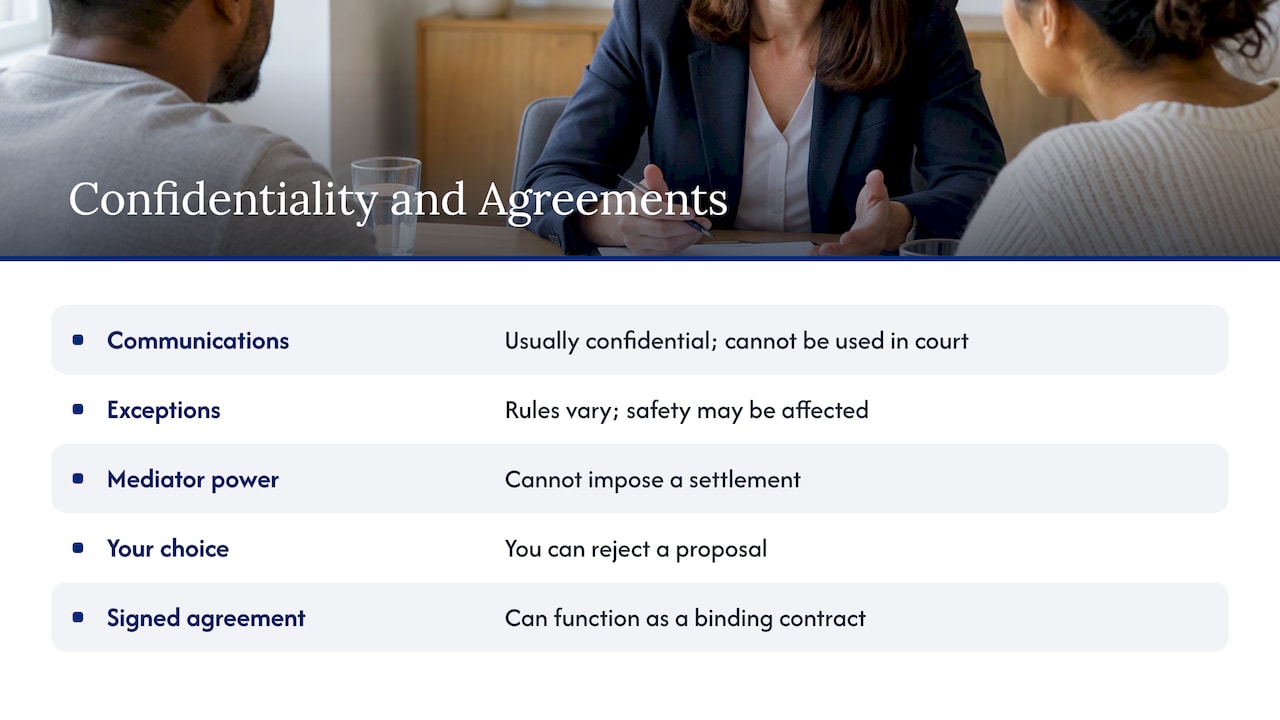
Confidentiality. The New Mexico Courts’ guide says that in most states, mediation communications are confidential and cannot be used in court, subject to exceptions. Legal Aid NSW in Australia gives the same general picture and adds that exceptions apply, especially when someone’s safety is affected. The rules differ by state and by the type of case, so ask your mediator or program what protections apply to you.
Forcing a deal. The mediator cannot. Canada’s Department of Justice states that mediators lack decision-making power and cannot impose a settlement. The outcome stays entirely in the hands of the disputing parties. If a proposal does not work for you, you can say no.
Once you sign a written settlement agreement, it can function as a binding contract, so read it closely first. If you are unsure of the legal effect, have a lawyer review it before you sign. That is especially wise for custody, property, employment and business matters.
How to prepare so the session goes well
Preparation changes the outcome more than most people expect. A university mediation guide from UC Irvine suggests you identify the important issues, consider how the other person sees and is affected by them, and think about changes you can make. Court guides add useful detail:
- The New Mexico Courts recommend reflecting on what the conflict is really about, where you agree and disagree, and what information is missing.
- Contra Costa County Superior Court in California suggests asking yourself what you need to settle, what matters most and least, and what different settlement methods might look like, rather than arriving with one rigid outcome.
A practical checklist:
- Write down your top three interests (not demands).
- Write down what you could give up without real cost.
- Write down what the other person likely needs.
- Gather the documents that support your key facts.
- Decide in advance who must approve a deal, and make sure they can be reached.
- Plan how you will calm down if the conversation heats up.
If conflict between you and the other person is mostly about how you talk to each other, our guide to the step-by-step conflict mediation process for couples and families shows how the stages play out in relationship disputes.
What to say and what not to say in mediation
The UC Irvine guide recommends that during mediation you listen without interrupting, follow ground rules, use neutral language and “I” statements, ask open-ended questions, and request a time-out if needed. It lists what to avoid: insults, negative labels, character judgments, attributing motives, “always” and “never” statements, impulsive retaliation, calling someone a liar, and deliberate button-pushing.
Legal Aid NSW adds a helpful framing: explain matters clearly and positively, and describe the arrangements you want instead of accusing the other person of deliberate misconduct.
Here is how that sounds in practice:
| Instead of | Try |
|---|---|
| “You never listen to me.” | “I felt unheard when the schedule changed without a conversation.” |
| “You are lying about the invoice.” | “My records show a different total. Can we go through them together?” |
| “You did this on purpose.” | “The effect on me was serious. Here is what I need to fix it.” |
| “That is ridiculous.” | “Help me understand how you arrived at that number.” |
If you feel your temper rising, ask for a break. Mediators expect that and would much rather you step out than say something that closes the door on a deal. For more phrasing you can use under pressure, see our guide to communication strategies to resolve conflict and the one on assertive communication skills.
What about settlement amounts?
Readers often ask about the “average” settlement offer. There is no reliable universal figure. Outcomes depend on the dispute, how each side values it, the opening offers and demands, risk assessments and the bargaining process.
Published studies show why numbers do not transfer. One analysis of more than 400 employment mediations handled by one mediator found the average settlement landed about 24% of the distance from the defendant’s opening offer toward the plaintiff’s opening demand. A separate Ohio analysis in the same research reported average settlements of roughly 32% to 37% of the plaintiff’s demand. Those are snapshots of particular case types, not benchmarks for your dispute. A better question is: what is my realistic range, given my evidence and my alternatives?
Who wins at mediation?
There is usually no winner or loser in the court sense, because no one rules on the dispute. A good result is one where both sides can live with the terms and neither feels forced. The Harvard Program on Negotiation frames the aim as a resolution each side values, and the mediator’s presence can help move people away from past blame and toward future-focused solutions.
Our perspective: mediation works best when you can stay steady in the room
We see the same pattern again and again with the people we work with: the legal or procedural side of a dispute is rarely what stalls a settlement. It is the moment one person feels attacked, shuts down or escalates. A mediator can structure the conversation, but you still have to be the person who shows up in it.
That is where our work fits. Our approach, developed by our founder Dr. Carlos Todd, a licensed clinical mental health counselor and psychologist, blends clinical rigor with practical tools you can use the same day. We design our anger management classes, couples therapy and individual counseling to help you recognize your triggers, slow down your reactions, say what you need without blame, and hear the other person’s side without losing your footing.
If you have a mediation coming up and you know conflict makes you flare up, freeze or give in too fast, building those skills beforehand is time well spent. And if the relationship itself is what is in dispute, talking it through in a therapy room first can make the mediation conversation shorter and calmer.
Carlos
Build the skills before the session
If a mediation is on your calendar, or you want to resolve a conflict before it gets that far, we can help you prepare. Our online anger management classes are priced at $24.99 for the 1 hour class, $79 for the 6 hour class and $85 for the 8 hour class. Couples sessions are $175 per hour, and you can see every couples option on our couples packages page. For individual, women’s, men’s or teen counseling, see our clinical services.
Not sure where to start? Visit Mastering Conflict and book an appointment.
FAQ
What should you not say in mediation?
Avoid insults, labels, judgments about someone’s character, guesses about their motives, and sweeping “always” or “never” statements. Do not call the other person a liar, and do not retaliate impulsively. Describe what you need and how the situation affected you instead.
Do the clients speak during a mediation?
Yes, in most formats. You describe your view of the dispute, usually without interruption, and you respond to the other side. Parties are generally asked to speak with one another directly, and you may also meet privately with the mediator. Lawyers, if present, often handle much of the negotiation.
How long does mediation take?
It depends on the case. Simple disputes may settle in a couple of hours, while complex ones can take a full day or several sessions. Writing up the agreement alone can take several hours so every term is clear. Ask the mediator or program for an estimate when you schedule.
What happens if mediation fails?
Nothing is lost. The mediator cannot impose a result, so you simply leave without an agreement. You can return for another session, keep negotiating, or continue with the court or formal process that brought you there. Ask your mediator or lawyer what the next step is in your type of case.
Sources
- How Mediation Works, Program on Negotiation, Harvard Law School
- Mediation, Local Court of New South Wales
- Dispute Prevention and Resolution Services, Department of Justice Canada
- Mediation Essentials, World Bank
- Stages of a Mediation, American Bar Association
- Mediation guide, New Mexico Courts
- Preparing for Your Mediation, UC Irvine
- Preparing for Mediation, Contra Costa County Superior Court
- Going to mediation, Legal Aid NSW
- Inside the Caucus: An Empirical Analysis of Mediation, USC Gould School of Law