
4 Evidence Based Conflict Mediation Techniques for Clinicians

The techniques that resolve conflict fastest are active listening, reframing, interest-based problem solving, and caucusing, used in that rough order. Skip straight to solutions and you’ll stall. Start instead by asking one open question about interests, then reflect back what you heard before proposing anything. That single move done well changes the tone of almost any dispute.
TL;DR:
- Active listening with open questions, summarizing, and reflection should be prioritized early to de-escalate conflicts before proposing solutions.
- Reframing positions into underlying interests helps lower tension by addressing the real needs behind demands.
- Objective standards and written agreements grounded in facts prevent misunderstandings and bad-faith negotiations.
- Managing emotions with limits on venting and using timeouts, along with balancing power through caucusing, enhances session effectiveness.
- Differentiating conflict styles and choosing appropriate approaches based on task, relationship, or power dynamics improves resolution outcomes.
Table of Contents
- Conflict Mediation Techniques You Can Use in Any Dispute
- How to Apply These Mediation Techniques Step by Step
- Choosing the Right Conflict Style: The Thomas-Kilmann Model
- Managing Emotions and Power Imbalances
- Scripts You Can Use in Your Next Difficult Conversation
- When You Need a Professional Mediator Instead of Doing It Yourself
- What the Research and Clinical Practice Say
- Ethical Considerations Every Mediator Should Take Seriously
- Common Challenges in Mediation and How to Handle Them
- Cultural Sensitivity and Diversity in Mediation
- What Happens After the Session Ends
- Tools and Technology That Support Modern Mediation
- A Practitioner’s View on What Actually Moves the Needle
- How Mastering Conflict Can Help When You Need More Than a Script
- Sources
Conflict Mediation Techniques You Can Use in Any Dispute
Most conflicts don’t fail because people disagree. They fail because nobody slows down long enough to find out what the disagreement is actually about. The core toolkit of mediation skills training exists to fix that, and it works whether you’re mediating a custody schedule, a sibling inheritance fight, or a shouting match between two department heads.
Active listening is the foundation, and it’s more specific than “let them talk.” It has three moving parts: open questions that invite explanation rather than yes/no answers, summarizing that proves you tracked the content, and reflection that names the emotion underneath it. A useful micro-phrase: “What matters most to you about how this gets resolved?” followed later by “So what I’m hearing is X. Did I get that right?” Prioritize this heavily in the first ten minutes of any session, before anyone has proposed a solution.
Reframing takes a hardened position and translates it into the interest hiding behind it. Someone says “I want full custody.” The interest might be “I need to know my kids are safe on school nights.” A mediator who reframes says something like, “It sounds like consistency during the week matters a lot to you. Is that fair to say?” That single sentence often lowers the temperature more than any argument about fairness could.
Brainstorming, sometimes called “what-if” generation, works only under specific rules: no evaluating ideas while they’re being generated, no ownership claims on suggestions, and a hard stop before anyone starts negotiating a specific option. PON’s conflict resolution research recommends this kind of active interest exploration paired with “what-if” option generation specifically because it unsticks parties who’ve convinced themselves there’s only one acceptable outcome. Once a few options exist, package them into trade-offs. “What if you get the car on weekdays and she gets it on weekends, but you cover the insurance?” is a packaged trade, not a single demand.
Caucusing means pulling one party aside for a private conversation. Use it when someone seems to be performing for the other side rather than negotiating honestly, when emotion is escalating faster than the process can absorb, or when you suspect one party knows something they won’t say in front of the other. Invite it neutrally: “I’d like to take a short break and speak with each of you separately. Same amount of time for both.” Confidentiality rules matter here. Decide up front whether caucus content stays private unless you get permission to share it, and say so out loud before the first caucus starts.
Objective standards cut through “he said, she said” disputes. If two coworkers disagree about whose turn it is to travel for a client, pull the travel log. If neighbors disagree about a fence line, pull the survey. Grounding disputes in external, verifiable facts removes the argument from personality and puts it on shared ground.
Before any of this works, set ground rules: what topics are in bounds, how long the session runs, and whether anything said is confidential. A few minutes spent on this upfront saves an hour of derailment later.
- Active listening: open questions, summarizing, reflection
- Reframing: positions become interests
- Brainstorming: no evaluation until options exist, then package trade-offs
- Caucusing: private sessions for de-escalation or sensitive information
- Objective standards: shared facts replace competing narratives
- Ground rules: agenda, time limits, confidentiality agreed before you start
How to Apply These Mediation Techniques Step by Step
A mediation session has a shape. Following it, even loosely, keeps you from wandering into unproductive territory or letting one person dominate.
- Prepare before anyone sits down. Know the basic issue and who’s involved, but don’t walk in with a full case history. A 2025 systematic guidance on conflict recommends identifying root causes across four domains (task, process, status, and relationship) rather than assuming you already know which one is driving the fight.
- Open with a short statement and ground rules. Something like: “We’re here to find something workable for both of you. Each person gets uninterrupted time to speak. What’s said here stays here unless we agree otherwise. Any questions before we start?”
- Facilitate the joint discussion. Ask each party an interests question, not a positions question: “What outcome would actually solve this for you?” Summarize after each turn. Confirm understanding before moving on: “Did I capture that correctly?”
- Switch to caucus when the joint session stalls. Signs it’s time: rising volume, one party going silent, or a private detail someone hints at but won’t state openly. Bring proposals back to the joint session only once they’ve been shaped enough to survive scrutiny.
- Draft an agreement in plain, checkable language. Specific actions, specific dates, specific follow-up point. “We’ll revisit this in three weeks” beats “we’ll see how it goes.”
Pro Tip: Don’t try to solve the whole conflict in one session. A partial agreement on the smallest, least controversial point often builds enough trust to tackle the harder issue next time.
Mediation manuals describe this sequence as entry, conflict analysis, planning, facilitation, and then contingent tactics like caucusing when the standard flow hits a wall. Beyond Intractability’s summary of Moore’s mediation process treats these contingent moves, caucus and power management especially, as the tools that separate a stuck session from a resolved one.
Choosing the Right Conflict Style: The Thomas-Kilmann Model
The five conflict styles identified by Kenneth Thomas and Ralph Kilmann aren’t ranked from worst to best. Each one fits certain situations and backfires in others.
- Avoiding: postpone or sidestep the conflict. Fits low-stakes issues or moments when emotions are too hot for productive talk.
- Competing: push for your outcome regardless of the other side. Fits emergencies or situations with a clear right answer, like safety violations.
- Accommodating: yield to preserve the relationship. Fits when the issue matters far more to the other person than to you.
- Compromising: split the difference. Fits when time is short and both sides can live with partial wins.
- Collaborating: work jointly toward a solution that satisfies both sets of interests. Fits high-stakes, ongoing relationships where a partial fix won’t hold.
Collaboration tends to produce the most durable agreements, but it’s also the slowest and most demanding style, which is exactly why rigid commitment to any single approach backfires. Research on conflict-management styles finds that flexible switching, matching style to context rather than defaulting to a favorite, produces better outcomes than sticking to one mode regardless of circumstance.
A quick way to decide which style fits: ask whether the conflict is about task (what to do), process (how decisions get made), status (who has authority), or relationship (how people feel treated). A task disagreement between strangers might call for compromise. A relationship rupture between long-term partners almost always needs collaboration, because anything less leaves the underlying hurt unaddressed.
Managing Emotions and Power Imbalances
High emotion and unequal power are the two things most likely to derail a session that otherwise had a shot at working.
For emotion, controlled venting has a place, but it needs limits. Let someone express frustration once, briefly, and validate the feeling without endorsing every claim inside it: “It makes sense you’re frustrated after waiting three weeks for an answer.” Then redirect: “Let’s talk about what would actually fix that going forward.” Unlimited venting rarely produces movement; it usually just re-triggers the other party.
Timeouts matter more than most people use them. If voices rise or someone shuts down, pause the session. Five minutes of silence beats twenty minutes of circular arguing.
Power imbalances need deliberate counterweights:
- Use separate caucuses to let a quieter party speak without being talked over.
- Ground disputed claims in objective standards rather than whoever argues loudest.
- Check in privately with the less powerful party about whether they feel able to speak freely.
- Watch for one person answering on behalf of the other, a common and easy-to-miss power signal.
Pro Tip: If you notice yourself feeling scared for someone’s safety, or if there’s any hint of threats or coercion, that’s your signal to stop mediating and refer the situation to a professional or appropriate authority instead.
Practitioner guidance from Moore’s mediation framework makes a point worth remembering: a mediator’s real power comes from controlling the process, not the content. You don’t need to be the smartest person in the room. You need to be the one keeping the structure intact.
Scripts You Can Use in Your Next Difficult Conversation
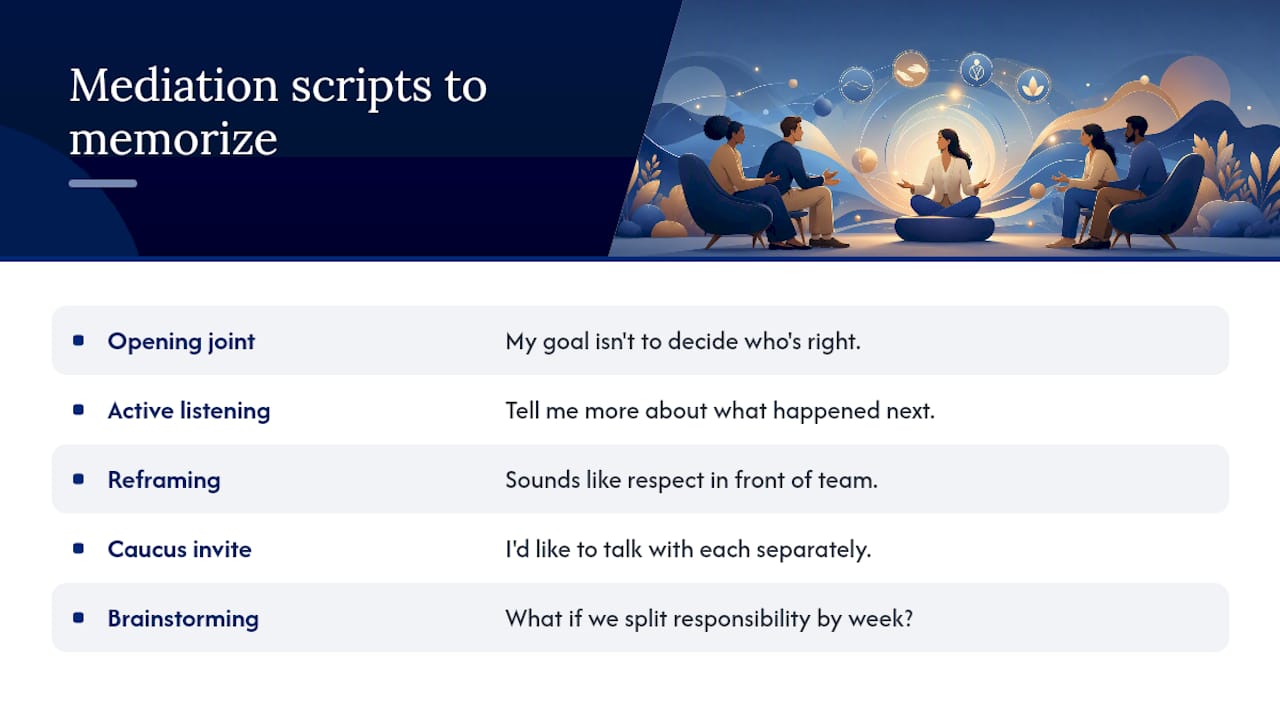
Having the right phrase ready in the moment matters more than knowing the theory behind it. Here are lines worth memorizing.
Opening a joint session: “Thanks for both being willing to sit down. My goal isn’t to decide who’s right. It’s to help you find something you can both live with. Each of you will get uninterrupted time, and I’ll ask questions to make sure I understand.”
Active listening in the moment: “What else is going on for you around this?” “So the timing is what’s frustrating you most, is that right?” “Tell me more about what happened next.”
Reframing a hard position: “It sounds like being treated with respect in front of your team matters a lot here.” “I hear that you want the apology public. What would that accomplish for you?”
Inviting a caucus: “I’d like to talk with each of you separately for a few minutes. Nothing said there goes back to the other person unless you tell me it’s okay.”
Brainstorming starters: “What if we tried splitting the responsibility by week instead of by task?” “What would it look like if neither of you had to give up the thing you care most about?”
Mediation succeeds most reliably when the conversation stays anchored in interests rather than positions, and settlements built that way tend to hold up because they’re forward-looking rather than a rehash of who did what. A Cloke mediation training manual frames this as the core mechanism behind lasting agreements: the settlement addresses what happens next, not just who was wrong. For more worked examples across couples, families, and workplace teams, Mastering Conflict’s conflict resolution examples walk through several full scenarios.
When You Need a Professional Mediator Instead of Doing It Yourself
Some conflicts are outside the range of what a well-meaning friend, manager, or family member should handle alone.
- The conflict keeps recurring despite repeated informal attempts to fix it. Recurrence usually means the root cause was never addressed, only the symptom.
- The stakes are high: custody, a business partnership dissolving, a workplace harassment complaint. Get someone trained for the specific terrain.
- There’s a real power imbalance, financial, physical, or organizational, that makes an “even playing field” conversation impossible without a neutral structuring it.
- Threats, coercion, or safety concerns are present. This is no longer a mediation situation; it may need law enforcement, a therapist, or both.
- DIY attempts have already failed. If two rounds of “let’s just talk it out” made things worse, a trained third party changes the dynamic.
Look for mediators with formal mediation training, and for emotionally loaded disputes, look for clinical experience specifically, someone comfortable with grief, anger, or trauma responses showing up mid-session. Ask directly: “What’s your training background? Have you handled conflicts like this one before? What’s your approach to confidentiality?” A vague answer to any of these is a red flag.
Not every situation needs a mediator. An ombudsperson fits organizational complaints where informal resolution channels exist. Individual or couples therapy fits when the “conflict” is really a symptom of a deeper relational pattern. Arbitration fits when parties want a binding decision rather than a facilitated agreement.
What the Research and Clinical Practice Say
The techniques in this guide aren’t guesswork. The Thomas-Kilmann model has anchored conflict-style research for decades, and PON’s ongoing conflict resolution strategies coverage consistently finds that resolutions built on managing perceptions and surfacing interests outperform resolutions built on winning an argument. The 2025 systematic guidance on root-cause domains adds a useful structural layer: task, process, status, and relationship are distinct categories, and misdiagnosing which one is driving a conflict wastes a session.
One clinical caveat matters more than people expect: don’t rush root-cause analysis in the first few minutes. Clinical practice favors restraint in early probing, building rapport and safety first, because deeper “why” questions asked too early often make people defensive instead of open. Entry-phase work is about letting people vent and feel heard, not extracting a diagnosis.
Ethical Considerations Every Mediator Should Take Seriously
Neutrality is the foundation, and it’s harder to maintain than it sounds. A mediator who unconsciously favors the more articulate, more confident, or more familiar party has already compromised the process, even without saying a word that shows it.
Confidentiality needs explicit terms, not assumed ones. Decide before the session starts what happens with caucus information, whether notes get kept, and who else might ever see them. Say this out loud to both parties rather than letting them guess.
Informed consent matters too. Every participant should understand that mediation is voluntary, that either party can stop at any time, and that the mediator isn’t a judge handing down a verdict. Confusing mediation with arbitration creates false expectations that poison the process halfway through.
Competence is an ethical issue as much as a practical one. Taking on a dispute involving domestic violence, active substance abuse, or severe power disparities without the training to handle it safely isn’t just risky, it can actively harm the more vulnerable party. Knowing when to refer out is part of doing the job well, not a failure to do it.
Finally, avoid dual roles. A manager who’s also mediating a dispute between two direct reports, or a parent mediating between siblings while also disciplining them, is not neutral no matter how fair they intend to be. Name that conflict of interest openly, or hand the session to someone without it.
Common Challenges in Mediation and How to Handle Them
One party won’t stop interrupting. Set the ground rule explicitly at the start, and enforce it early rather than late: “Let’s let each person finish before responding. I’ll make sure everyone gets equal time.”
Someone shuts down and stops participating. Silence usually signals feeling unsafe or unheard, not agreement. A caucus often surfaces what’s actually going on.
The conversation keeps circling back to the past. Acknowledge it once, then redirect firmly: “I hear that history matters here. Let’s focus the next part on what happens going forward.”
Emotions escalate faster than the process can absorb. This is what timeouts exist for. A short pause, even just stepping outside for two minutes, resets the room more than any clever phrase does.
One party negotiates in bad faith, agreeing to things they have no intention of doing. Objective standards and written, specific agreements make bad-faith commitments harder to hide behind vague language.
The mediator’s own biases creep in. This one is invisible from the inside. Regular self-check questions, “Am I giving both people equal airtime? Am I more patient with one person than the other?”, catch drift before it becomes a pattern.
None of these challenges disqualify mediation as an approach. They’re simply what happens when real people with real histories sit in a room together, and every one of them has a known countermove.
Cultural Sensitivity and Diversity in Mediation
Conflict styles aren’t culturally neutral. Directness that reads as honest in one context can read as disrespectful in another. Silence that signals discomfort in one culture can signal deep consideration in another. A mediator who assumes their own communication norms are universal will misread half the room.
Family structure matters too. In some cultures, an individual’s decision genuinely involves extended family or community elders, and treating that as a delay tactic rather than a legitimate process misunderstands what’s actually happening.
Language matters at a granular level. Even fluent speakers sometimes lose precision on emotionally loaded topics in a second language. Offering an interpreter, or simply asking, “Would it help to explain that in another way?”, isn’t a courtesy add-on. It’s part of making the process actually work.
The safest posture is curiosity over assumption. Ask rather than infer: “Is there anyone else who should be part of this conversation?” “Is there a way you’d prefer we structure this that would feel more comfortable?” Those two questions alone prevent a large share of cross-cultural missteps, because they hand the framing back to the people who actually know their own context.
What Happens After the Session Ends
An agreement reached in the room means little if nobody checks whether it’s holding up three weeks later.
Build a follow-up point into the agreement itself, a specific date, not a vague “let’s check in sometime.” “We’ll both confirm by email on the 15th whether the new schedule is working” is checkable. “We’ll see how it goes” is not.
Watch for early warning signs that an agreement is quietly failing: one party going silent again, small violations that get excused as one-offs, or renewed tension that mirrors the original conflict. Catching drift early is far easier than restarting mediation from scratch after a full relapse.
If the follow-up reveals the agreement isn’t working, that’s not a failure of the mediation, it’s information. A short follow-up session to adjust one term is far more efficient than letting frustration build until the whole thing collapses.
Tools and Technology That Support Modern Mediation
Video conferencing platforms have made remote mediation viable for parties who can’t or won’t sit in the same room, which matters more than it might seem. Physical distance sometimes lowers the emotional temperature enough to make progress possible.
Shared documents let both parties see draft agreement language in real time rather than relying on someone’s memory of what was discussed. Scheduling tools remove a surprisingly common friction point: disputes over “you said Tuesday” versus “I said Thursday” before the real conversation even starts.
For teams handling recurring workplace conflict, structured intake forms that gather basic information before the session (without requiring a full case history) save meaningful time. Mastering Conflict’s project management approach covers how clinical teams use structured intake specifically to keep first sessions focused rather than sprawling.
None of these tools replace the human skills. They just remove friction so more time in the room goes toward the actual conversation.
A Practitioner’s View on What Actually Moves the Needle
If I had to pick the one technique that changes outcomes more than any other, it’s reflection, not the fancy kind, just accurately restating what someone said before responding to it. People soften almost immediately once they realize they’ve actually been heard rather than just waited out.
I’ve watched sessions where two people arrived convinced the other side was acting in bad faith, and the entire dynamic shifted the moment one of them said, “Wait, is that really what you meant?” The conflict didn’t disappear. It just became solvable.
If you’re navigating something like this yourself, or training to help others through it, there’s more depth available through Mastering Conflict’s resources and clinical training programs.
— Carlos
How Mastering Conflict Can Help When You Need More Than a Script
Scripts and techniques take you far, but some conflicts, the ones tangled with anger, grief, or years of resentment, need a trained clinician in the room. Professional services include teletherapy sessions for individuals and couples, anger management classes, family counseling, and clinical mentoring for practitioners who want to build these skills professionally.
A first appointment typically starts with an assessment: what’s driving the conflict, what’s been tried already, and what a realistic resolution timeline looks like. If anger is a central factor, the anger management assessment is often the right entry point before deeper counseling begins. For couples or individuals who want to start from home, teletherapy sessions get you in front of a licensed counselor without adding a commute to an already stressful week. Full details on the range of services, from couples therapy to professional clinical supervision, are on the clinical services page, where you can book a first appointment directly.
Sources
- Systematic approach to conflict (2025) – PMC
- The mediation process: Practical strategies for resolving conflict – Beyond Intractability
One Response