
Therapy Ready Student Stress Activities: Dosing and 3 Session Templates

The activities that actually reduce student stress fall into five categories: CBT coping skills taught through play or worksheets, brief mindfulness and breathing practices, movement-based mind-body work like yoga, guided imagery, and expressive arts. None of them work well as a one-size-fits-all script. Age determines the format, and picking two or three practices to repeat consistently matters more than cycling through a dozen novel techniques. A five-year-old needs bubbles and a calm-down song. A sixteen-year-old needs a private breathing technique she can use in a bathroom stall between classes.
TL;DR:
- Short, consistent use of 30-minute moderate-to-vigorous movement sessions can significantly reduce stress, especially among adolescents and young adults.
- Building a menu of two or three preferred coping activities and scheduling them regularly improves compliance and effectiveness.
- Activities for young children should be simple, multisensory, and embedded in routine, while teens benefit from private, discreet techniques they can use independently.
- Environmental factors like school routines and peer support play a crucial role in the success of stress management, requiring systemic accommodations when possible.
- For persistent or severe symptoms, an assessment with a licensed clinician is recommended, especially if symptoms last beyond six weeks or include safety concerns.
Table of Contents
- Stress Management Activities for Students by Age Group
- What the Research Says About Dose and Frequency
- Three Session Templates You Can Use This Week
- Getting Kids and Teens to Actually Use These Tools
- When to Refer for Formal Assessment
- Incorporating Physical Activity Into a Stress Plan
- Building Resilience and Emotional Regulation Skills
- Apps and Technology for Student Stress Management
- Schools, Peers, and the Environment Around the Student
- A Clinician’s Take on Making This Stick
- How Mastering Conflict Supports Families and Clinicians
- Sources
Stress Management Activities for Students by Age Group
A three-year-old and a fifteen-year-old are not doing the same version of “deep breathing,” and treating them as if they are is the fastest way to lose a kid’s attention in session. Here’s what actually holds up across developmental stages, drawn in part from the Starr Centre’s mind-body practitioner toolkit.
Ages 3 to 5 (5 to 15 minutes):
- Bubble breathing: blowing bubbles slowly teaches exhale control without ever saying the word “breathing.”
- Pinwheel breath games that turn regulation into a visible, colorful game.
- Sensory grounding with soft toys, textured fabric, or a “calm jar” to shake and watch settle.
- Finger plays and simple calm-down songs paired with a consistent physical gesture.
- Clinical note: keep instructions to one step at a time; abstract concepts like “relax your body” mean nothing to a preschooler.
Ages 6 to 12 (10 to 30 minutes):
- Diaphragmatic breathing, often taught as “Cookie Breathing” (smell the cookie, blow out the candle).
- Progressive muscle relaxation using a tense-and-release script for major muscle groups.
- Guided imagery paired with drawing what the child pictured, which gives clinicians a window into what actually landed.
- CBT coping cards: simple, child-authored reminders of a go-to thought or action for stress spikes.
- Brief movement breaks between skill practice, since sitting still for a full session rarely works at this age.
- Clinical note: watch for kids who intellectualize the skill without using it; rehearsal under mild stress beats rehearsal in a calm office.
Ages 13 to 17 (15 to 45 minutes):
- Guided mindfulness recordings the teen can use independently, not just in session.
- Brief yoga sequences or vigorous movement, with sessions of a moderate duration showing stronger effects in Frontiers in Psychology’s research on exercise-based interventions.
- Cognitive coping worksheets that connect a specific stressor (a test, a social conflict) to a specific reframe.
- Expressive journaling or art therapy for teens who resist direct verbal processing.
- Clinical note: adolescents often need discreet, low-visibility versions of these tools. A technique that works only with eyes closed and a script read aloud will not survive a school hallway.
What the Research Says About Dose and Frequency
Clinicians don’t need more novelty. They need consistency. A cross-sectional study on mind-body practices in higher education found breathing and grounding rated as the most helpful and least burdensome strategies students actually reported using, and that consistent use of a small set of techniques correlated with lower mental health risk than sporadic use of many different ones.
The dose that matters: Movement-based interventions of 30 minutes or longer at moderate-to-vigorous intensity produced the strongest stress reductions in Frontiers in Psychology’s exercise-based research, while a meta-analysis in the International Journal of Environmental Research and Public Health found mind-body practices like yoga, qigong, and Tai Chi produced significant pooled reductions in heart rate, cortisol, and blood pressure, with stronger effects among older students.
Shorter interventions still work when they’re structured. A controlled trial of female university students found that four weeks of box breathing, guided imagery, and progressive muscle relaxation significantly reduced perceived stress and improved quality of life, even without the longer time commitment that movement-based work often requires.
A few caveats matter here. Most of the strongest exercise data comes from university-aged samples, not middle schoolers, so extrapolating “30 minutes minimum” down to a ten-year-old’s yoga session is a judgment call, not a proven protocol. The practical takeaway: build a two-to-three practice menu, schedule it rather than leaving it to chance, and expect relaxation techniques to show benefit faster than movement-based ones, even if movement wins on magnitude over time.
Three Session Templates You Can Use This Week
These aren’t theoretical protocols. They’re built to run as-is in a therapy room or adapted for home practice, drawing on structured relaxation guidance from the Kelty Mental Health stress management toolkit.
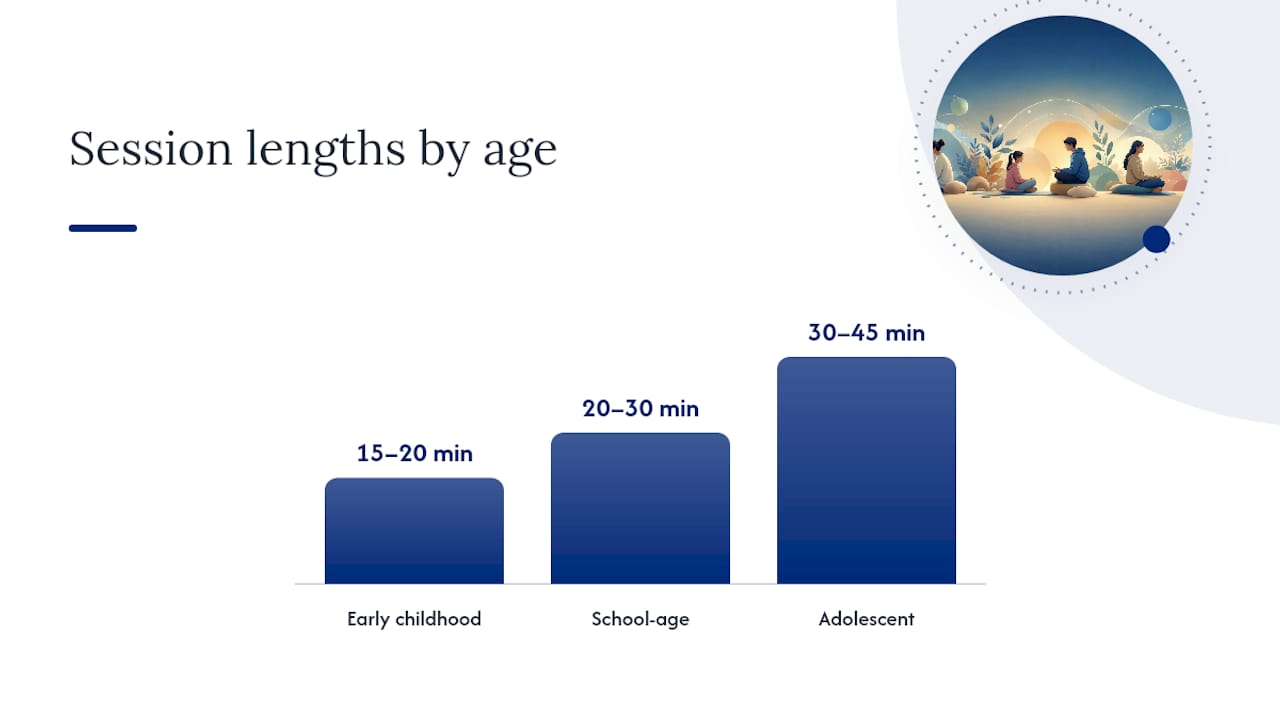
- Early childhood session (15 to 20 minutes). Start with two minutes of caregiver-coached bubble breathing. Move into five minutes of sensory grounding with a textured object or calm jar. Close with a five-minute calm-down song paired with a repeatable gesture the child can use outside session. Coach the caregiver in the room so the routine travels home intact.
- School-age session (20 to 30 minutes). Teach one skill directly for five to ten minutes, such as Cookie Breathing or a PMR script. Move into ten to fifteen minutes of guided practice, ideally paired with drawing or a brief guided imagery scene. Close with five minutes building a coping card the child keeps for homework, one thought or action tied to a specific stressor they named.
- Adolescent session (30 to 45 minutes). Open with a brief movement warm-up, five to ten minutes of stretching or light aerobic activity, to prime the body for regulation work. Spend 15 to 20 minutes on guided mindfulness or a longer yoga-based sequence. Close with reflection and a written, individualized practice plan the teen can execute privately during a stressful week.
For trauma-sensitive or highly anxious students, shorten each phase, keep the sequence identical from session to session, and offer sensory alternatives like a weighted lap pad or fidget tool instead of pushing through discomfort, an approach the Kelty toolkit specifically recommends for regulation without re-traumatization.
Pro Tip: Measure something small at the start and end of each session, a 1 to 10 stress rating works fine, so both you and the student can see the practice actually doing something. Kids buy into what they can measure.
Getting Kids and Teens to Actually Use These Tools
The activity a clinician picks matters less than whether the student will actually reach for it at 11 p.m. before a test. Start by assessing preference: some kids respond to tactile input, others to movement, others to verbal processing, and forcing a verbally-oriented kid into guided imagery wastes session time.
- Narrow the menu to two or three core practices rather than teaching everything you know; more options often means less follow-through.
- Frame skills as personal tools the student owns, letting them choose their own imagery, music, or movement style increases the odds they’ll actually use it outside session.
- For neurodivergent or trauma-sensitive students, keep routines short and predictable, and swap in sensory substitutions like fidgets or weighted items rather than insisting on a scripted version.
- Anchor practice to an existing daily habit, brushing teeth, the school bus ride, a locker stop, so the skill has a built-in cue instead of relying on willpower.
- Caregivers who practice the skill alongside the child, rather than just prompting it from the sidelines, see far better generalization.
Pro Tip: For teens especially, offer a “discreet version” of every skill, a subtle breath pattern, a posture shift, something they can do at a desk without anyone noticing. A technique that only works with eyes closed in a quiet room rarely survives contact with an actual school day.
When to Refer for Formal Assessment
Most stress responses respond well to the activities above. Some don’t, and knowing the difference matters more than any individual technique.
- Functional decline: grades dropping, withdrawal from friends, or a sudden change in sleep or appetite that lasts.
- Safety concerns of any kind, including self-harm statements or ideation, require immediate professional contact.
- Symptoms persisting beyond four to six weeks despite consistent practice of coping skills.
- Severe avoidance, school refusal, or a marked decline in academic performance.
If any of these appear, contact the child’s pediatrician and refer to a child or adolescent therapist. CDC guidance on treating children’s mental health notes that combined approaches, therapy plus caregiver involvement, tend to outperform therapy alone for common childhood conditions, which is part of why Mastering Conflict’s clinical services build family involvement into assessment from the start.
Incorporating Physical Activity Into a Stress Plan
Movement is not a bonus add-on to stress management. It’s one of the categories with the strongest research behind it. The pooled analysis of mind-body physical activity found significant reductions in heart rate, cortisol, and blood pressure across student samples, with the biggest effects showing up in older adolescents and young adults.
That doesn’t mean every student needs a formal yoga class. A 12-week randomized yoga trial reduced perceived stress and both state and trait anxiety in university students, but shorter, informal movement, a walk between classes, stretching before homework, a quick dance break, still counts as a legitimate stress-management activity for younger kids who won’t sit through a structured session.
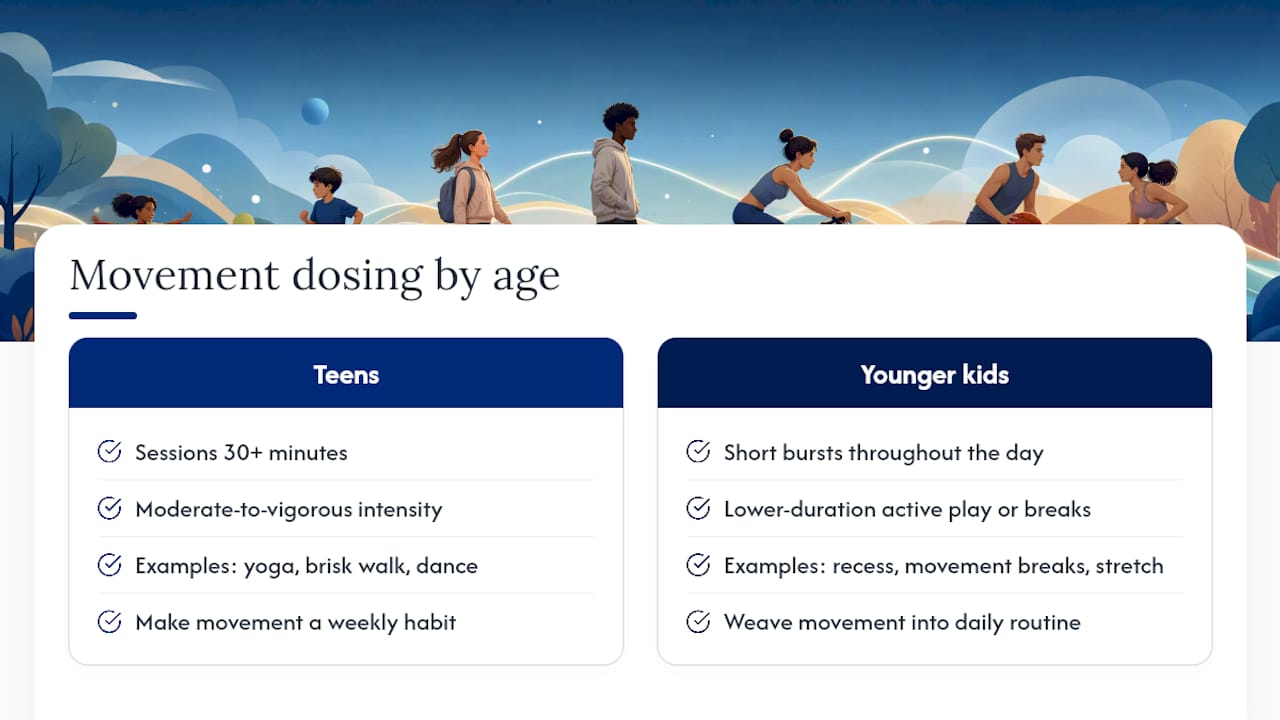
The practical rule: aim for sessions of 30 minutes or longer at moderate-to-vigorous intensity when the goal is measurable stress reduction, particularly with teens. For younger children, shorter bursts of movement woven into the day, recess, a movement break between homework subjects, active play, still contribute meaningfully even without hitting that 30-minute threshold. What matters is that movement becomes a regular part of the week rather than an occasional activity reserved for gym class. Pair it with a body-based coping strategy like progressive muscle relaxation and the physical and cognitive pieces reinforce each other.
Building Resilience and Emotional Regulation Skills
Stress management activities work best when they’re building a skill, not just providing a momentary escape. Emotional regulation is the capacity to notice a feeling, name it, and choose a response instead of reacting automatically, and it’s trainable in the same way a muscle is trainable.
CBT remains the most empirically supported framework for treating childhood and adolescent anxiety and stress, and its core mechanism, identifying a thought, testing it against evidence, and choosing a different response, is what turns a one-off breathing exercise into a durable coping skill. Play-based and creative activities function as delivery vehicles that make CBT developmentally appropriate for kids who can’t yet sit through a verbal cognitive restructuring exercise.
Resilience isn’t the absence of stress. It’s the accumulated experience of successfully coping with stress and coming out the other side, which means students need repeated, manageable exposure to challenge rather than protection from it. A coping card system, where a student writes down what worked after a stressful event, builds a personal evidence file that “I’ve handled this before.” Over time, that file becomes more persuasive than any adult’s reassurance. Family involvement matters here too: conflict management skills practiced at home give kids a chance to rehearse regulation in real relationships, not just in a therapy room.
Apps and Technology for Student Stress Management
Digital tools have a real, if limited, role in a student’s stress-management routine. Guided meditation apps, breathing pacers, and mood-tracking tools can extend what happens in session into the rest of the week, especially for teens who are more likely to open a phone than a workbook.
The strongest use case is reinforcement, not replacement. A guided imagery script recorded during a session and saved as an audio note gives a student something to return to without a clinician present. Breathing pacer apps that visually guide inhale and exhale timing can make the “Cookie Breathing” and box breathing techniques easier to practice independently, since the visual cue does some of the coaching work automatically.
The risk is treating an app as a substitute for the actual clinical relationship or for caregiver involvement. A mood-tracking app can flag a pattern, weeks of low ratings before a big test, but it can’t intervene the way a parent or clinician can. Technology also introduces a genuine tradeoff for anxious or overstimulated kids: another screen isn’t always a calming input, and for some students, a paper coping card in a backpack works better than anything on a phone. Match the tool to the student rather than defaulting to whatever’s trending.
Schools, Peers, and the Environment Around the Student
No coping skill survives long in a vacuum. A student practicing breathing exercises in a therapist’s office but returning to a chaotic classroom or an unsupportive peer group is fighting an uphill battle, and clinicians who ignore that context miss half the picture.
Supportive school environments share a few common features: predictable routines, staff trained to recognize stress signals rather than just behavioral symptoms, and low-barrier access to a quiet space when a student needs to reset. Peer support systems, whether formal peer mentoring programs or informal friend groups, give students a chance to practice social-emotional skills in real time rather than only in adult-supervised settings.
Clinicians and parents can’t redesign a school, but they can advocate for specific accommodations: a pass to a counselor’s office, extra time on high-stress assignments, or a check-in system with a trusted staff member. These small structural supports often do more for day-to-day stress than any individual coping technique, because they reduce the frequency and intensity of the stressor itself rather than just managing the response to it. Academic pressure, social conflict, and time management struggles are the three most common stressors students report, and each responds better to environmental adjustment paired with coping skills than to coping skills alone.
A Clinician’s Take on Making This Stick
Most stress-management plans fail from overload, not from bad technique selection. I’ve found the strongest predictor of follow-through isn’t which activity you choose, it’s whether you stop at two or three and actually coach the caregiver to practice alongside the child rather than just assigning homework… One small behavioral tip that changes outcomes: attach the practice to something that already happens every day, right before bed, right after the bus ride home, so it never depends on remembering.
— Carlos
How Mastering Conflict Supports Families and Clinicians
Reading about coping cards and guided imagery is one thing. Having a licensed clinician build a plan around your specific child is another. Masteringconflict offers direct clinical support for exactly the situations this guide covers: child and teen individual therapy, family counseling that brings caregivers into the skill-building process, and group class formats for older kids working on emotion regulation alongside peers.
An initial assessment typically covers the student’s specific stressors, current coping patterns, and any red flags that suggest a need for more structured intervention, then maps directly onto an activity plan tailored to the child’s age and preferences rather than a generic worksheet. For families outside the immediate service area, teletherapy makes that same assessment and ongoing therapy available virtually, so distance isn’t a barrier to getting a real clinical plan in place. If your child has been showing the red flags covered earlier, persistent symptoms, school avoidance, or a functional decline that hasn’t responded to home-based coping strategies, the next step is booking an assessment through Mastering Conflict’s Clinical Services rather than waiting to see if it resolves on its own.
Sources
This article is general information, not a substitute for advice from a qualified doctor. Consult a qualified healthcare professional about your own circumstances before acting on anything here.