
Improving Listening Skills for Work and Home

Six moves fix most listening problems immediately: set an intention before you speak, remove your phone or screen from view, mirror the speaker’s last few words, paraphrase what you heard, ask one open question, and let a silence sit for three seconds before responding. These aren’t abstract habits. They’re the exact techniques Harvard Business Review and Stanford communication researchers point to when they explain why some people leave conversations feeling truly heard and others don’t.
Your first 60 seconds, every conversation:
- Put the phone face down or out of sight
- Silently tell yourself: “I’m here to understand, not to respond yet”
- Make brief eye contact and drop your shoulders
- Let the other person finish their first full thought before you speak
Key Takeaways
Active listening improves relationships and work outcomes because it replaces assumption with verified understanding, one paraphrase at a time.
| Point | Details |
|---|---|
| Use the six core skills | Pay attention, withhold judgment, reflect, clarify, summarize, and share, in that order. |
| Suspend judgment first | Confirmation bias distorts what you hear until you deliberately delay your verdict. |
| Practice in short drills | Five minutes of mirroring or reflection daily builds the habit faster than occasional long sessions. |
| Adapt cues by setting | Eye contact matters notably on video calls; naming emotion is especially helpful in conflict. |
| Get structured feedback | Masteringconflict’s assessments and coaching help pinpoint specific listening breakdowns in relationships or teams. |
Table of Contents
- Why Improving Listening Skills Actually Pays Off
- What Are the Core Active-Listening Techniques?
- What Blocks People From Listening Well?
- What Exercises Actually Build Listening Skill?
- How Do You Adapt Listening for Different Settings?
- How Do You Turn This Into a Habit?
- A Clinician’s Note on Realistic Change
- Get Guided Support for Listening and Conflict Patterns
- Frequently Asked Questions
- Sources
Why Improving Listening Skills Actually Pays Off
Better listening changes outcomes, not just impressions. Teams that practice active listening reduce communication errors and catch problems before they become expensive mistakes. Couples who paraphrase during arguments de-escalate faster because the speaker stops repeating themselves to feel understood.
Three places this shows up fast:
- In a work meeting: you catch the one objection your colleague mentioned quietly, instead of steamrolling past it.
- In an argument with a partner: reflecting their words back (“So you felt dismissed when I checked my phone”) stops the fight from looping.
- In a coaching conversation: asking one good question gets someone to solve their own problem instead of waiting for your answer.
What Are the Core Active-Listening Techniques?
Six skills make up nearly every effective listening framework: pay attention, withhold judgment, reflect, clarify, summarize, and share. Leadership researchers at the Center for Creative Leadership teach this exact sequence to managers because it turns ordinary conversations into coaching moments.
- Pay attention. Close the laptop. Face the speaker. Notice when your mind starts drafting a reply instead of listening.
- Withhold judgment. Don’t decide who’s right in the first ten seconds. Confirmation bias makes you hear only what confirms what you already believe, according to Stanford researchers studying how people talk across disagreement.
- Reflect. Try: “So what I’m hearing is you felt left out of that decision.”
- Clarify. Try: “When you say ‘always,’ do you mean every time, or just recently?”
- Summarize. Try: “So the two things you need from me are patience and a heads up next time.”
- Share. Only after all the above, offer your view, briefly.
Pro Tip: Nonverbal cues carry real weight, but forced ones backfire. Nod when you mean it, hold eye contact for a substantial portion of the time, and skip the exaggerated head bobbing. A speaker can tell when nodding is performance, and it reads as manipulative rather than attentive.
When a conversation turns emotional, drop the reflex to fix or defend. A single line, “That sounds like it really hurt,” does more than five minutes of advice nobody asked for.
What Blocks People From Listening Well?
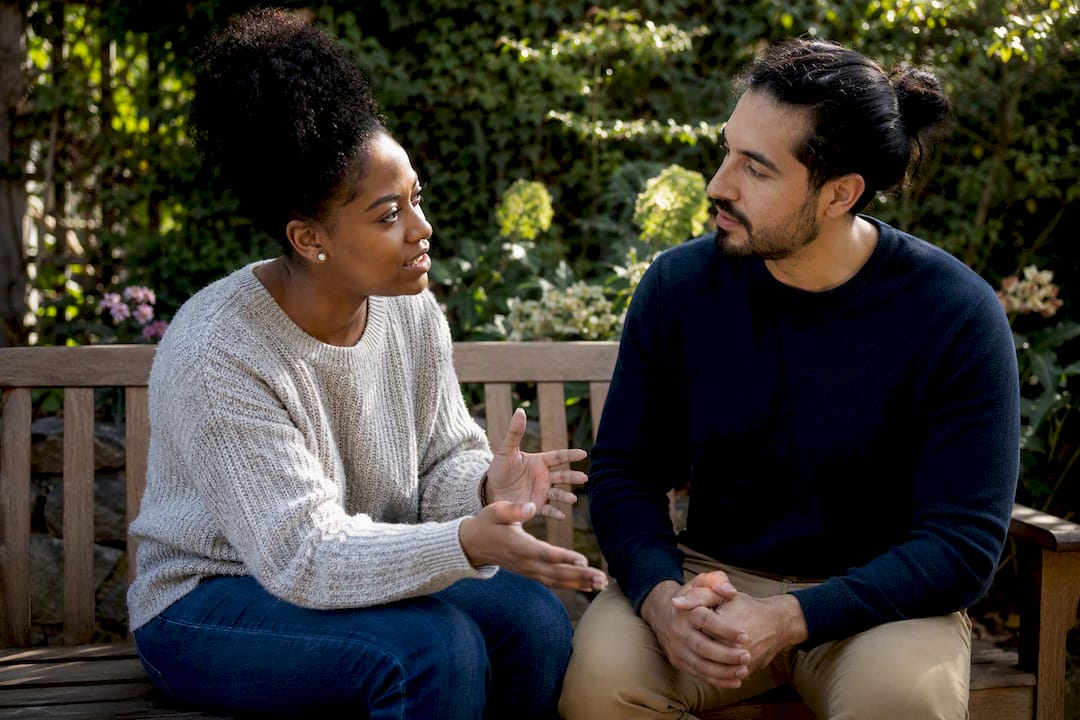
Four barriers wreck most conversations: mentally drafting a counterargument while the other person is still talking, judging too fast, getting bored, and glancing at a phone. Each has a fix that doesn’t require a personality overhaul.
- Forming counterarguments early → catch yourself mid-thought and return attention to their actual words, not your rebuttal.
- Premature judgment → suspend the verdict. Stanford’s research on divisive conversations found that people who delay judgment absorb more of what’s actually said instead of filtering it through what they expected to hear.
- Boredom → ask one specific follow-up question. Curiosity is a switch you can flip on purpose.
- Phones and notifications → put the device somewhere out of reach, not just face down. Visibility alone splits attention, per Mindtools’ breakdown of common listening barriers.
Pro Tip: You’ll know you’re slipping into a barrier when you feel the urge to interrupt. That urge is your signal to pause, not your cue to speak.
What Exercises Actually Build Listening Skill?
Five drills build listening the way reps build strength. None takes longer than a few minutes, and clinicians recommend practicing with a trusted partner who gives honest feedback.
- 60-second mirroring. Have a partner talk for a minute; repeat their key phrase back, word for word, before adding your own thoughts.
- 5-minute reflection drills. After a real conversation, spend five minutes writing what you think the other person actually meant, then check it against what they say next time you talk.
- Silence practice. In your next conversation, count three seconds of silence after someone finishes speaking before you respond. It feels long. It isn’t.
- Roleplay with feedback. Practice a hard conversation with a friend, then ask directly: “Did that reflection feel accurate, or forced?” Cleveland Clinic recommends this exact loop for spotting awkward habits you can’t see in yourself.
- Narrative visualization. If note-taking pulls your attention away, especially common for people with ADHD, mentally picture the speaker’s three main points instead, or ask them to summarize at the end.
Try one drill daily for two weeks. Five minutes on workdays, a longer roleplay session once on the weekend, is enough to notice a shift.
How Do You Adapt Listening for Different Settings?
The six core skills stay the same everywhere. What changes is which cue carries the most weight.
- Virtual meetings: Turn your camera on and look at the lens, not the thumbnail of your own face. Try: “Before I respond, let me make sure I’ve got this right…”
- Emotionally charged conversations: Name the tension instead of avoiding it. Try: “This feels like a hard thing to bring up. I want to hear all of it.” Keep your body open, not crossed.
- Everyday personal talks: Ask what they actually want from the conversation before offering advice. Try: “Are you looking for ideas, or do you just need me to listen?”
Setting that expectation up front avoids the single most common failure in personal relationships: someone wanted to vent, and got a solutions lecture instead.
How Do You Turn This Into a Habit?
Use a simple loop: cue, routine, reward. The cue is any conversation starting. The routine is your 60-second opener from the top of this article. The reward is noticing, out loud to yourself, when the other person visibly relaxes because they feel heard.
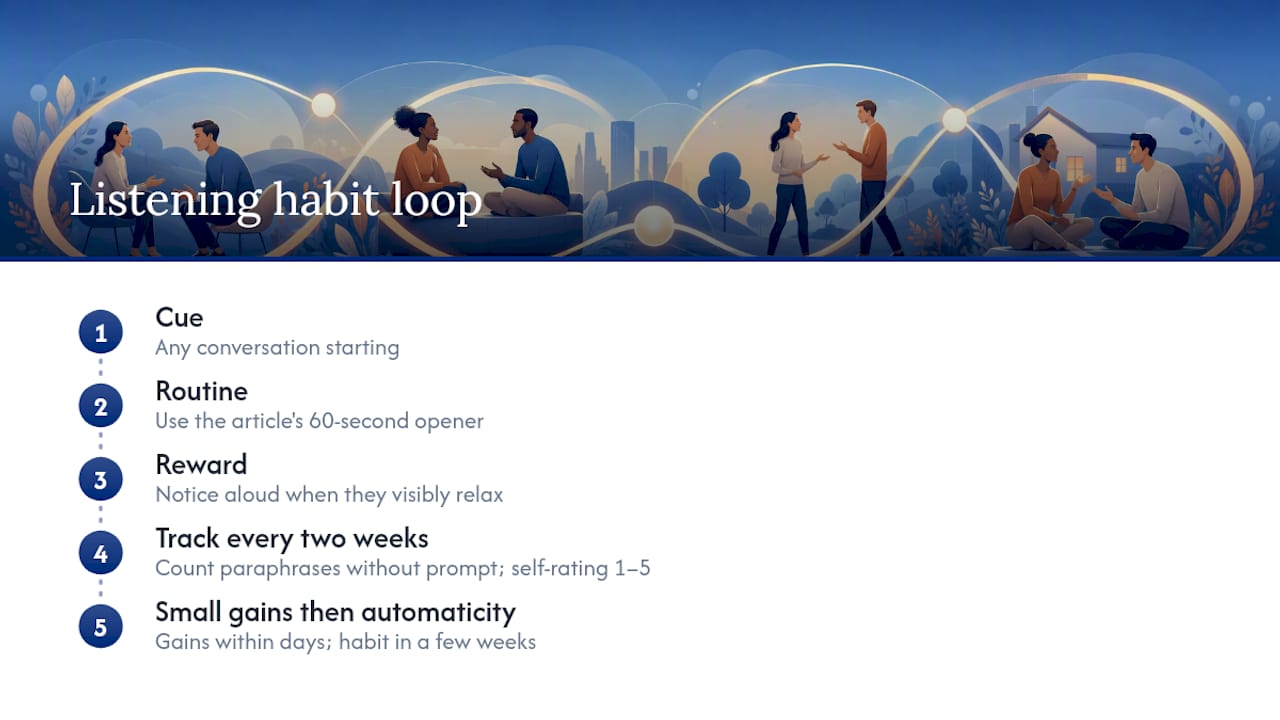
Track two things every two weeks: how often you paraphrased without being asked, and a quick self-rating (1 to 5) after hard conversations. Small gains show up within days. The habit itself takes a few weeks to feel automatic, consistent with what organizational research on active listening shows about skill-based communication training.
A Clinician’s Note on Realistic Change
Small shifts compound. In practice, one client who simply started repeating her partner’s last sentence back, nothing more, cut their weekly arguments in half within a month. If you want structured practice, Masteringconflict’s assertive communication resources go deeper into pairing listening with clear speaking.
Get Guided Support for Listening and Conflict Patterns
Reading techniques only gets you so far when the same argument keeps repeating with the same person. Masteringconflict’s clinical team works directly with couples, individuals, and professionals to identify exactly where listening breaks down, often in the first meeting, and builds a plan around it instead of generic advice. If tension keeps resurfacing at home or work, an anger management assessment in Charlotte, NC is a concrete first step: a short, structured evaluation that pinpoints your specific triggers and communication gaps before recommending a path forward. For clinicians who want to sharpen their own listening skills with peers, Masteringconflict also offers clinical supervision. Book an assessment to find out where your listening habits actually stand.
Frequently Asked Questions
How long does it take to improve listening skills?
Small improvements show up within a few days of practicing the core techniques. Building it into an automatic habit generally takes a few weeks of daily practice, similar to other communication-skill training.
What is the fastest way to improve active listening skills in one conversation?
Remove your phone, mirror the speaker’s last sentence, and wait three seconds before you respond. Those three moves alone shift most conversations noticeably.
Why do I keep interrupting even when I’m trying to listen?
Interrupting usually means you’re forming a counterargument instead of absorbing what’s said. Notice the urge to jump in and treat it as your cue to pause, not to speak.
Does active listening work the same way over video calls?
The core skills stay identical, but eye contact shifts to looking at the camera lens rather than the screen, and verbal paraphrasing matters more since body language reads less clearly over video.
What’s the difference between listening and active listening?
Listening is passively hearing words. Active listening adds deliberate steps, paying attention, withholding judgment, reflecting, clarifying, and summarizing, that confirm you understood correctly instead of assuming.
This article is general information, not a substitute for advice from a qualified doctor. Consult a qualified healthcare professional about your own circumstances before acting on anything here.
Sources
- Active Listening
- Steps to active listening — Stanford News
- Active Listening – StatPearls – NCBI Bookshelf
- What Is Active Listening? 7 Techniques
Recommended
- Master Assertive Communication Skills for Conflict Resolution – Mastering Conflict
- Master Conflict Resolution Skills for Real-Life Success – Mastering Conflict
- How to Practice Assertiveness for Confident Communication – Mastering Conflict
- Enhance Your Relationship: Couples Communication Exercises – Mastering Conflict