
Emotional Regulation Skills for Teens: A 2026 Parent Guide

TL;DR:
- Teen emotional regulation skills help adolescents manage emotions healthily and build resilience over time.
- Parents can support this growth through modeling calm communication, practicing emotion coaching, and reinforcing adaptive strategies during calm moments.
- Supportive interventions, including group programs and professional counseling, facilitate shifts from maladaptive to adaptive regulation profiles within several months.
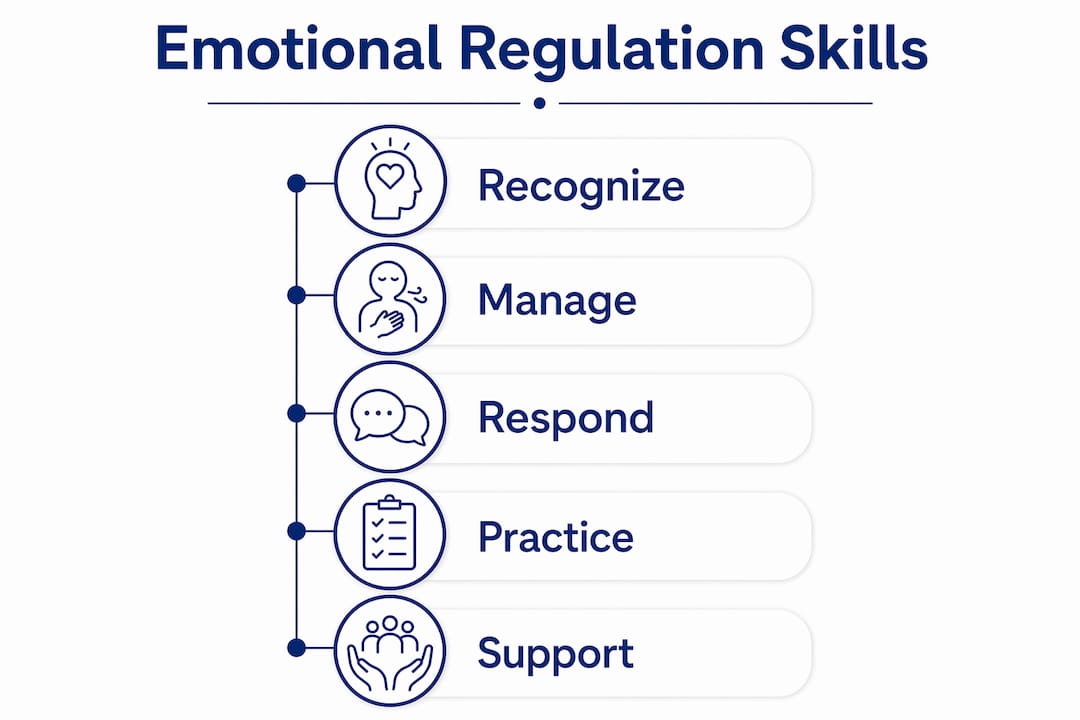
Emotional regulation skills for teens are the learned abilities to recognize, manage, and respond to emotions in healthy, constructive ways. These skills form the foundation of adolescent mental health, shaping how teens handle stress, conflict, and relationships. Emotion dysregulation underlies anxiety, depression, and social conflict, making these skills broadly protective rather than narrowly targeted. The good news for parents is that these abilities are not fixed traits. They develop through practice, modeling, and the right support at home and in clinical settings.
What are the key emotional regulation skills for teens?
Emotional regulation, known clinically as emotion regulation (ER), refers to the processes people use to influence which emotions they have, when they have them, and how they express them. For teens, the most effective skills fall into two categories: adaptive and maladaptive strategies.
Adaptive strategies move teens toward healthier outcomes. Maladaptive strategies, like rumination, suppression, and avoidance, create short-term relief but worsen emotional health over time. A study of 951 adolescents identified five distinct regulation profiles: hypo-regulated, hyper-regulated, adaptive, maladaptive, and normative. Teens with adaptive profiles showed the strongest resilience and well-being. That finding tells parents exactly where to aim.
The most effective adaptive strategies include:
- Mindfulness: Paying attention to the present moment without judgment. Teens learn to notice emotions without being controlled by them.
- Cognitive reappraisal: Reframing a situation to change its emotional impact. For example, viewing a failed test as feedback rather than failure.
- Deep breathing: Activating the parasympathetic nervous system to reduce physical arousal during stress.
- Acceptance: Acknowledging difficult emotions without fighting them. This is a core skill in Dialectical Behavior Therapy (DBT).
- Positive refocusing: Deliberately shifting attention toward something constructive when overwhelmed.
- Putting things in perspective: Comparing a current stressor to larger life events to reduce its perceived weight.
CBT and DBT-based interventions emphasize all of these strategies, and group-based programs show significant increases in their use after just a few sessions.
Pro Tip: Practice these strategies with your teen during calm, low-stress moments. Skills learned in a relaxed state transfer more reliably to high-stress situations.
How can parents support teens in developing emotional regulation?
Parents are the most consistent emotional coaches in a teen’s life. The way you respond to your teen’s emotional outbursts either builds or erodes their regulation capacity over time.

Emotion coaching, a model developed by psychologist John Gottman, teaches parents to treat emotions as opportunities for connection rather than problems to fix. The core steps are: notice the emotion, treat it as valid, listen with empathy, help the teen label the feeling, and then problem-solve together. This sequence matters because teens who feel understood are far more willing to engage in learning new skills.
Parental modeling of calm communication is one of the most underestimated factors in teen emotional development. When you regulate your own emotions visibly, your teen absorbs that pattern. When you escalate, they escalate too.
Here are concrete behaviors that support your teen’s growth:
- Pause before reacting. Take three seconds before responding to an emotional outburst. That pause signals safety.
- Validate first, advise second. Say “That sounds really frustrating” before offering any solution.
- Use open-ended questions. “What was the hardest part of that?” invites reflection rather than defensiveness.
- Name emotions without judgment. “It sounds like you felt embarrassed” helps teens build emotional vocabulary.
- Model your own regulation. Say out loud, “I’m feeling stressed right now, so I’m going to take a few deep breaths.”
Positive parental responses to teen rejection and strong communication strategies help maintain relationships and support emotional growth over time. The relationship itself is the vehicle for skill development.
Pro Tip: When your teen shuts down or pushes back, resist the urge to press harder. Stepping back and returning to the conversation later often produces better results than forcing it in the moment.
What challenges do teens face with emotional regulation?
Teen emotional regulation is harder than adult regulation for a biological reason. The prefrontal cortex, which governs impulse control and rational decision-making, does not fully mature until the mid-20s. That means teens are navigating intense emotional experiences with an underdeveloped regulatory system.
The five regulation profiles identified in research reflect the range of challenges teens face. Hypo-regulated teens appear emotionally flat or disengaged. Hyper-regulated teens are emotionally reactive and easily overwhelmed. Maladaptive teens rely on suppression or rumination. Normative teens show average regulation. Adaptive teens use flexible, healthy strategies consistently.
| Regulation profile | Key characteristics | Common outcomes |
|---|---|---|
| Adaptive | Flexible strategies, high emotional clarity | Strong resilience, positive well-being |
| Normative | Average strategy use, moderate clarity | Stable but limited growth |
| Maladaptive | Rumination, suppression, avoidance | Anxiety, depression, social conflict |
| Hypo-regulated | Low emotional engagement, flat affect | Social withdrawal, missed learning |
| Hyper-regulated | High reactivity, poor impulse control | Conflict, impulsivity, distress |
The most encouraging finding for parents comes from longitudinal data: maladaptive styles often shift toward adaptive patterns within about five months. That means a teen who struggles today is not locked into that pattern permanently. Consistent support and skill practice accelerate that shift.
Brief group-based ERST programs improve emotional clarity and reduce alexithymia, which is the difficulty identifying and describing one’s own feelings. These programs typically run about seven sessions and show benefits lasting at least three months. They do not replace longer therapies for complex psychiatric symptoms, but they build a critical foundation.
Emotional clarity is a specific skill worth targeting. Teens who can accurately name what they feel are better equipped to choose an appropriate response. Without that clarity, they react rather than respond.
Which activities build emotional regulation in teens?
Practical activities give teens a way to practice regulation skills outside of therapy or formal programs. The body and the mind both need training.
Progressive muscle relaxation, journaling, and physical exercise improve emotional regulation by building body awareness and reducing stress. Each activity targets a different pathway. Exercise reduces cortisol and improves mood through neurochemical changes. Journaling builds emotional clarity by externalizing internal states. Progressive muscle relaxation teaches teens to recognize and release physical tension before it escalates into emotional reactivity.
Activities proven to build teen emotional control include:
- Mindfulness meditation: Even five minutes daily reduces emotional reactivity over time. Apps like Headspace or Calm offer teen-friendly guided sessions.
- Breathing exercises: The 4-7-8 technique (inhale for 4 counts, hold for 7, exhale for 8) activates the body’s calming response quickly.
- Journaling: Writing about emotions without editing builds self-awareness and reduces the intensity of difficult feelings.
- Physical exercise: Running, swimming, or team sports lower stress hormones and improve mood regulation.
- Progressive muscle relaxation: Tensing and releasing muscle groups systematically teaches teens to recognize stress in the body before it peaks.
- Group skill sessions: Group-based interventions increase use of adaptive strategies like acceptance and positive refocusing, and the peer element adds accountability.
The key is consistency. Skills practiced regularly during calm periods become available during emotional crises. A teen who journals every evening is far better prepared to process a difficult social situation than one who only tries it when already overwhelmed. You can find a deeper breakdown of these approaches in this guide to building emotional resilience from Masteringconflict.
Key Takeaways
Teaching teens adaptive emotional regulation strategies, combined with consistent parental modeling and evidence-based practice, produces measurable gains in resilience and mental health within months.
| Point | Details |
|---|---|
| Skills are learned, not fixed | Teens can shift from maladaptive to adaptive regulation profiles within about five months with consistent support. |
| Parental modeling matters most | Visibly managing your own emotions teaches teens more than any direct instruction. |
| Target emotional clarity first | Teens who can name their feelings accurately make better choices about how to respond. |
| Group programs deliver results | Seven-session ERST programs improve emotional clarity and adaptive strategy use with benefits lasting at least three months. |
| Practice during calm times | Skills rehearsed in low-stress moments transfer reliably to high-stress situations. |
What I’ve learned about patience and teen emotional growth
Working with teens and families over many years, the pattern I see most often is this: parents come in expecting a quick fix, and teens come in convinced nothing will change. Both are wrong, and both need to hear that.
The research on regulation profiles shifting within five months is not just a statistic. It is a clinical reality I have watched play out repeatedly. A teen who seems locked in anger or shutdown is not broken. Their nervous system is still developing, and their environment is still shaping them. The parents who make the biggest difference are not the ones who read every parenting book. They are the ones who show up consistently, stay calm when their teen cannot, and refuse to label their child’s current behavior as a permanent identity.
The mistake I see most often is parents treating emotional outbursts as character flaws. “He’s just an angry kid.” “She’s always been dramatic.” Those labels stick, and teens begin to live into them. What I tell parents instead is this: your teen is not their worst moment. They are practicing, and they need you to model what mastery looks like.
Small, regular practices matter far more than occasional big interventions. A five-minute breathing exercise before school beats a two-hour therapy session once a month if the daily practice is missing. Consistency is the mechanism. Patience is the container. And your own emotional regulation, as the parent, is the most powerful teaching tool you have. For parents who want to go deeper on helping teens express feelings, the work starts with you.
— Carlos
How Masteringconflict supports teen emotional regulation
Masteringconflict offers professional counseling and therapy services designed to support both teens and the parents working alongside them.

If your teen is struggling with anger, emotional shutdown, or persistent conflict at home or school, professional support can accelerate the progress that daily practice alone may not reach. Masteringconflict provides teletherapy counseling for families across North Carolina, South Carolina, Florida, and beyond, making it accessible regardless of location. For parents who want a structured starting point, an anger management assessment can identify specific areas where your teen needs the most targeted support. The goal is not to fix your teen. It is to give them the tools and the clinical guidance to build lasting emotional resilience.
FAQ
What are emotional regulation skills for teens?
Emotional regulation skills are the learned abilities teens use to recognize, manage, and respond to their emotions in healthy ways. These include strategies like cognitive reappraisal, mindfulness, deep breathing, and acceptance.
How long does it take for teens to improve emotional regulation?
Research shows that maladaptive regulation styles can shift toward adaptive patterns within about five months with consistent support and practice. Brief group programs of around seven sessions also show lasting benefits.
Can parents really influence their teen’s emotional regulation?
Parental modeling of calm communication is one of the most significant factors in teen emotional development. When parents manage their own reactions and practice emotion coaching, teens develop stronger regulation skills over time.
What is the difference between adaptive and maladaptive regulation?
Adaptive regulation involves flexible strategies like reappraisal and acceptance that improve well-being. Maladaptive regulation involves rumination, suppression, or avoidance, which provide short-term relief but increase anxiety and depression over time.
When should a parent seek professional help for a teen’s emotional regulation?
Professional support is appropriate when emotional dysregulation is persistent, affects school or relationships, or involves signs of anxiety, depression, or aggression. A clinical assessment can identify the right level of intervention.