
Conciliation in Conflict Resolution: A Practical Guide

TL;DR:
- Conciliation is a voluntary, non-binding process where a neutral expert facilitates dialogue and helps parties reach an agreement. It is evaluative, faster, private, and maintains high party control, making it effective for disputes involving emotions, power imbalances, or ongoing relationships. Successful conciliation involves preparation, defined scope, and active fairness to produce durable, enforceable solutions.
Conciliation in conflict resolution is a voluntary, non-binding process where a neutral expert guides disputing parties toward a mutually acceptable settlement without imposing a decision. Unlike litigation or arbitration, conciliation keeps control firmly with the people involved. The conciliator does not act as a judge. Instead, they actively facilitate dialogue, propose settlement options, and help both sides reach an agreement they can live with. This approach works across personal relationships, workplace disputes, and community conflicts, making it one of the most flexible conflict resolution strategies available today.
How does conciliation differ from mediation and arbitration?
Conciliation, mediation, and arbitration are all forms of Alternative Dispute Resolution (ADR), but they operate very differently. Understanding those differences helps you choose the right tool for your situation.
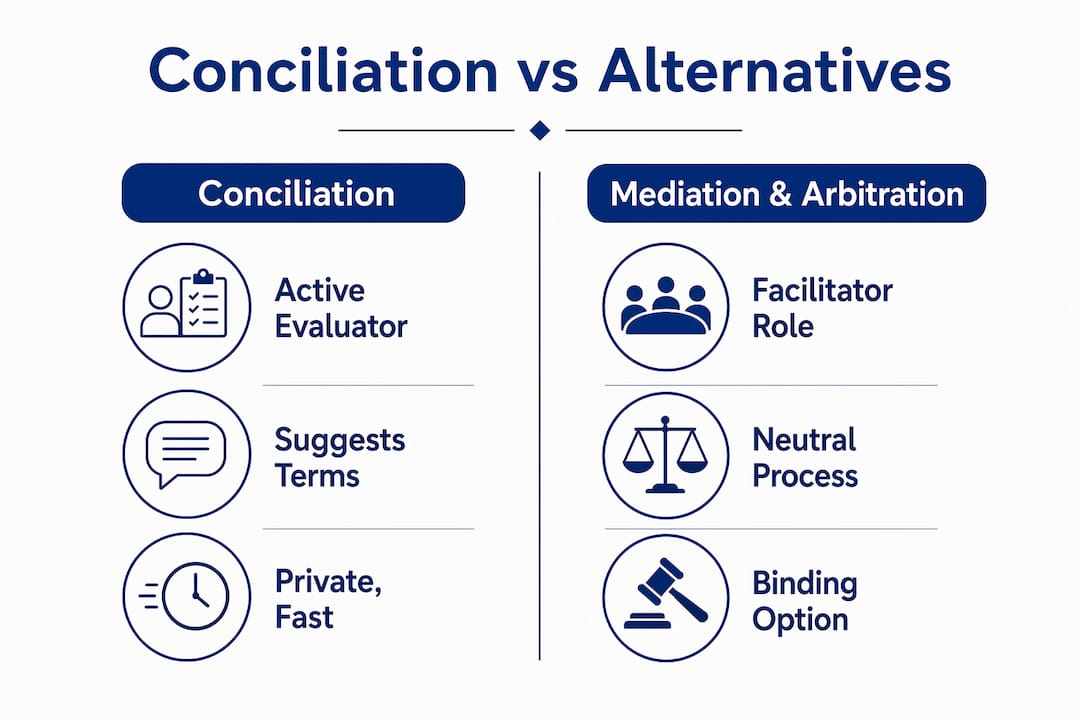
The clearest distinction is the conciliator’s role. Conciliators actively evaluate the legal and technical merits of a dispute, unlike mediators who focus purely on facilitating conversation. That evaluative function is what makes conciliation especially effective when talks have stalled or when one party holds significantly more power than the other. Arbitration, by contrast, produces a binding decision that the parties must accept whether they like it or not.
Here is how the three methods compare across the features that matter most:
| Feature | Conciliation | Mediation | Arbitration |
|---|---|---|---|
| Third-party role | Active evaluator and facilitator | Neutral facilitator only | Decision-maker |
| Binding outcome | No (unless agreement is signed) | No | Yes |
| Party control | High | High | Low |
| Speed | Fast | Fast | Slower |
| Cost | Low to moderate | Low to moderate | Higher |
| Privacy | Confidential | Confidential | Varies |
Conciliation’s speed and privacy advantages are significant. Conciliation is designed as a faster, private, and cost-effective alternative to litigation, suitable for commercial, employment, and contract disputes. That means you avoid public court records and the financial drain of prolonged legal battles.
One more critical point: conciliators can suggest specific settlement terms and meet with parties jointly or separately, giving the process a flexibility that mediation’s facilitative model does not always offer. That flexibility is what breaks deadlocks.
What does a conciliator actually do?
The conciliator is a neutral expert, not a passive observer. Their job is to move the dispute toward resolution through what practitioners now call active fairness.

Active fairness means managing power imbalances, reality testing each party’s position, and intervening when bad-faith behavior threatens a fair outcome. A conciliator who simply sits back and lets parties talk is not doing the job. They must challenge unrealistic demands, flag legally weak arguments, and push both sides toward positions that will actually hold up after the session ends.
Effective conciliators bring three core competencies to every session:
- Legal and technical literacy. They understand the subject matter well enough to assess the merits of each party’s claims.
- Emotional intelligence. They read the room, de-escalate tension, and create enough psychological safety for honest conversation.
- Structured process management. They define the scope of the dispute clearly at the start and keep sessions focused on resolution rather than grievance.
One area where conciliators add the most value is in preventing unfair agreements. Effective conciliators actively challenge unrealistic positions and may recommend independent legal advice to prevent one party from accepting terms they will later regret. That recommendation is a sign of professional integrity, not a failure of the process.
Pro Tip: Before your first conciliation session, prepare a one-page summary of your key facts, the outcome you want, and the minimum terms you would accept. Conciliators work faster when both parties arrive organized rather than emotional.
It is also worth noting that conciliation is not counseling. Participants often mistake conciliation for counseling, but it focuses on structured negotiation and problem-solving, not emotional processing. Preparing a clear timeline of events and your key issues before the session speeds resolution considerably.
When is conciliation the most effective choice?
Conciliation works best in specific situations. Knowing when to use it saves time and increases the likelihood of a durable agreement.
The method is particularly effective in these contexts:
- Technical and commercial disputes. Construction contracts, supplier disagreements, and intellectual property conflicts benefit from a conciliator who understands the technical details.
- Employment disputes. Collective conciliation in workplace disputes is a free, voluntary, and confidential service that resolves pay reviews, contract terms, and disciplinary issues, often preventing industrial action before it starts.
- When mediation has already failed. Conciliation is often recommended as the next step when mediation stalls, because the conciliator’s evaluative input can break the deadlock that pure facilitation could not.
- Disputes involving strong emotions or power imbalances. The conciliator’s active role protects the less powerful party from being pressured into a bad deal.
- Family and community conflicts. When ongoing relationships matter, conciliation’s collaborative structure preserves dignity on both sides.
The workplace context deserves special attention. ACAS in the UK runs a collective conciliation program that has resolved thousands of employment disputes without court involvement. Agreements reached through this process, documented as COT3 forms, carry legal weight. That model demonstrates what structured conciliation can achieve at scale.
Community disputes, such as neighbor conflicts, local planning disagreements, or disputes within religious or cultural organizations, are also well-suited to conciliation. The process respects the ongoing nature of those relationships in a way that litigation never can. For families navigating these challenges, Masteringconflict’s family conflict resolution tools offer practical support alongside formal conciliation processes.
What are the key steps in a successful conciliation process?
A well-run conciliation follows a clear sequence. Skipping steps is the most common reason agreements fall apart.
- Initiate voluntarily. Both parties must agree to participate. Conciliation cannot be forced. If one party enters reluctantly, the conciliator should address that resistance before proceeding.
- Define the scope. Draft a clear written agenda or Letter Before Action that identifies the specific issues to be resolved. Drafting clear scope documents helps set precise agendas and prevents sessions from drifting into unrelated grievances.
- Prepare your documentation. Gather contracts, correspondence, financial records, or any other evidence relevant to your claims. Organized parties move faster.
- Conduct joint and separate sessions. The conciliator will typically open with a joint session to establish ground rules, then move to separate meetings (called caucuses) to explore each party’s real interests privately.
- Negotiate settlement terms. The conciliator proposes options, tests reactions, and helps both sides move toward a workable agreement. This is where their evaluative expertise matters most.
- Formalize the agreement in writing. A verbal agreement is not enough. A written, signed settlement agreement carries legal weight equivalent to a court decree in many jurisdictions. Verbal agreements lack legal standing and often lead to further disputes.
- Know when to stop. Either party may terminate the process at any time. If the conciliator believes a fair agreement is not reachable, they will say so.
Pro Tip: Set a realistic goal before you walk in. Ask yourself: “What is the best outcome I can reasonably expect given the other party’s position?” Parties who enter conciliation demanding a perfect win almost always leave with nothing.
For couples navigating disputes, the conflict resolution steps for couples outlined by Masteringconflict complement the conciliation process by building the communication skills needed to make any agreement stick.
How does conciliation preserve relationships long-term?
Conciliation shifts the goal from winning to resolving. That shift is what makes it so effective for disputes where the relationship between parties must continue after the conflict ends.
Conciliation preserves relationships by replacing adversarial dispute resolution with collaborative agreement, which builds trust and long-term harmony. In family disputes, labor negotiations, and community conflicts, the ability to maintain a working relationship after resolution is often more valuable than any single settlement term.
The psychological safety built into the process matters too. Confidentiality means neither party fears that what they say in a session will be used against them in court. That protection encourages honesty, and honesty is what makes agreements durable. When both parties feel heard rather than defeated, they are far more likely to honor the terms they agreed to.
The legal enforceability of signed agreements adds another layer of security. Unlike informal conversations or handshake deals, a properly documented conciliation settlement is binding. Enforceability depends on proper formalization. Verbal or informal accords often fail to prevent further litigation, which is why written documentation is non-negotiable.
Key takeaways
Conciliation in conflict resolution works because it combines expert evaluation with party control, producing agreements that are both fair and durable.
| Point | Details |
|---|---|
| Conciliation is evaluative | Conciliators assess merits and suggest terms, unlike mediators who only facilitate. |
| Active fairness protects parties | Conciliators manage power imbalances and challenge unrealistic positions to prevent unfair outcomes. |
| Written agreements are binding | Signed settlement documents carry legal weight; verbal agreements do not. |
| Best fit for specific disputes | Employment, commercial, and relationship disputes with ongoing ties benefit most from conciliation. |
| Preparation drives success | Arriving with organized facts and realistic goals shortens the process and improves outcomes. |
Conciliation is more than a process. it is a discipline.
After years of working with individuals, couples, and families in conflict, I have seen one pattern repeat itself: people underestimate how much skill a good conciliation process requires from everyone in the room, not just the conciliator.
Most people arrive at conciliation thinking it is a softer version of going to court. They expect to present their case, wait for a ruling, and leave. When they realize the conciliator will not decide for them, some feel lost. That moment of discomfort is actually the most important part of the process. It forces both parties to take ownership of the outcome.
What I have found is that conciliation works best when participants treat it as a problem-solving session, not a performance. The parties who succeed are the ones who come prepared, stay curious about the other side’s position, and resist the urge to win every point. The ones who struggle are those who confuse being heard with being right.
The field is also evolving. Conciliators are moving from passive bystanders to active facilitators who apply ethical judgment and emotional intelligence alongside legal knowledge. That evolution is long overdue. A conciliator who lacks emotional literacy will miss the real source of a dispute every time, and no amount of legal expertise compensates for that blind spot.
My advice: view conciliation as a proactive opportunity, not a last resort. The earlier you engage with it, the more options you have. Waiting until a dispute has calcified into entrenched positions makes everyone’s job harder, including yours.
— Carlos
Ready to resolve your conflict with professional support?
Conflict does not resolve itself. The longer a dispute sits unaddressed, the more it costs in stress, damaged relationships, and lost productivity.
Masteringconflict offers clinical services designed to support individuals, couples, and families through exactly these challenges. Whether you are navigating a relationship breakdown, a workplace dispute, or a family conflict, Dr. Carlos Todd and the Masteringconflict team bring evidence-based approaches to every session. For couples specifically, the couples packages provide structured support that complements the conciliation process and builds the communication skills needed for lasting resolution. Reach out today to take the first concrete step toward a resolution that actually holds.
FAQ
What is conciliation in conflict resolution?
Conciliation is a voluntary, non-binding ADR process where a neutral expert facilitates dialogue and proposes settlement options without imposing a decision. Parties retain full control over the outcome throughout the process.
How is conciliation different from mediation?
Conciliation allows the third party to evaluate the merits of each side’s position and suggest specific settlement terms, while mediation relies on a purely facilitative approach. Conciliation is often recommended when mediation has already failed to break a deadlock.
Is a conciliation agreement legally binding?
A signed, written settlement agreement from conciliation carries legal weight equivalent to a court decree in many jurisdictions. Verbal agreements reached in conciliation do not have the same legal standing and should always be formalized in writing.
When should you choose conciliation over other dispute resolution methods?
Conciliation is most effective in employment disputes, commercial contract disagreements, and situations involving power imbalances or strong emotions. It is also the preferred next step when prior mediation has not produced a resolution.
Can lawyers participate in conciliation?
Yes. Conciliation is often a court-connected or required process in employment disputes, and lawyers and experts can participate to ensure comprehensive resolution. This differs from some mediation formats where legal representation varies.
Recommended
- Mastering Empathy in Conflict Resolution: A Step-by-Step Guide – Mastering Conflict
- Master Conflict Resolution Skills for Real-Life Success – Mastering Conflict
- Dealing With Difficult People: Proven Strategies for Resolution – Mastering Conflict
- Effective Conflict Resolution Steps for Couples, Families, and Professionals 2025 – Mastering Conflict