
Counseling Near Me for Depression and Anxiety: 2026 Guide

TL;DR:
- Seeking specialized mental health support provides evidence-based therapies like CBT to reduce depression and anxiety symptoms effectively.
- Finding qualified providers involves verifying licensure, understanding their treatment experience, and utilizing directories like Psychology Today.
- During the waiting period, accessing the 988 Crisis Lifeline offers immediate support while simultaneously building a shortlist of local therapists for ongoing care.
Counseling near you for depression and anxiety is specialized mental health support delivered by licensed professionals who use evidence-based therapies to reduce symptoms and improve your quality of life. The clinical term for this care is psychotherapy, and it covers a range of structured treatments including cognitive behavioral therapy (CBT), interpersonal therapy (IPT), and dialectical behavior therapy (DBT). Finding the right local provider means understanding who is qualified to help, how to locate them, and what treatment to expect. If you are in immediate distress, the 988 Lifeline offers 24/7 crisis support while you build your longer-term care plan.
What types of licensed professionals provide counseling for depression and anxiety?
Not every licensed therapist is equally equipped to treat depression and anxiety. The credential on a provider’s wall tells you their training path, but their specialization tells you whether they are the right fit for your specific symptoms.
The four most common provider types you will encounter include:
- Licensed Professional Counselor (LPC): Trained in talk therapy and behavioral interventions, with a master’s degree and supervised clinical hours. Common in private practice and community mental health centers.
- Licensed Mental Health Counselor (LMHC): The equivalent title used in states like New York and Florida. Same scope of practice as an LPC.
- Licensed Clinical Social Worker (LCSW): Combines clinical therapy skills with knowledge of community resources and social systems. Strong option if your depression connects to housing, financial, or family stressors.
- Licensed Marriage and Family Therapist (LMFT): Specializes in relational dynamics. Useful when anxiety or depression is significantly affecting your relationships.
Psychologists hold doctoral degrees (PhD or PsyD) and can provide psychological testing alongside therapy. Psychiatrists are medical doctors who primarily manage medication. Psychiatric mental health nurse practitioners (PMHNPs) also prescribe medication and often collaborate with therapists on combined treatment plans.
The Anxiety and Depression Association of America (ADAA) recommends verifying a provider’s education, licensure, and specific experience with anxiety and depression before booking a first appointment. A general license does not guarantee expertise in these conditions. A therapist who has treated hundreds of clients with generalized anxiety disorder will recognize symptom patterns and treatment-resistant presentations that a generalist may miss.

Pro Tip: Ask any potential therapist directly: “What percentage of your caseload involves anxiety or depression, and which treatment models do you use?” A confident, specific answer is a strong signal of genuine specialization.
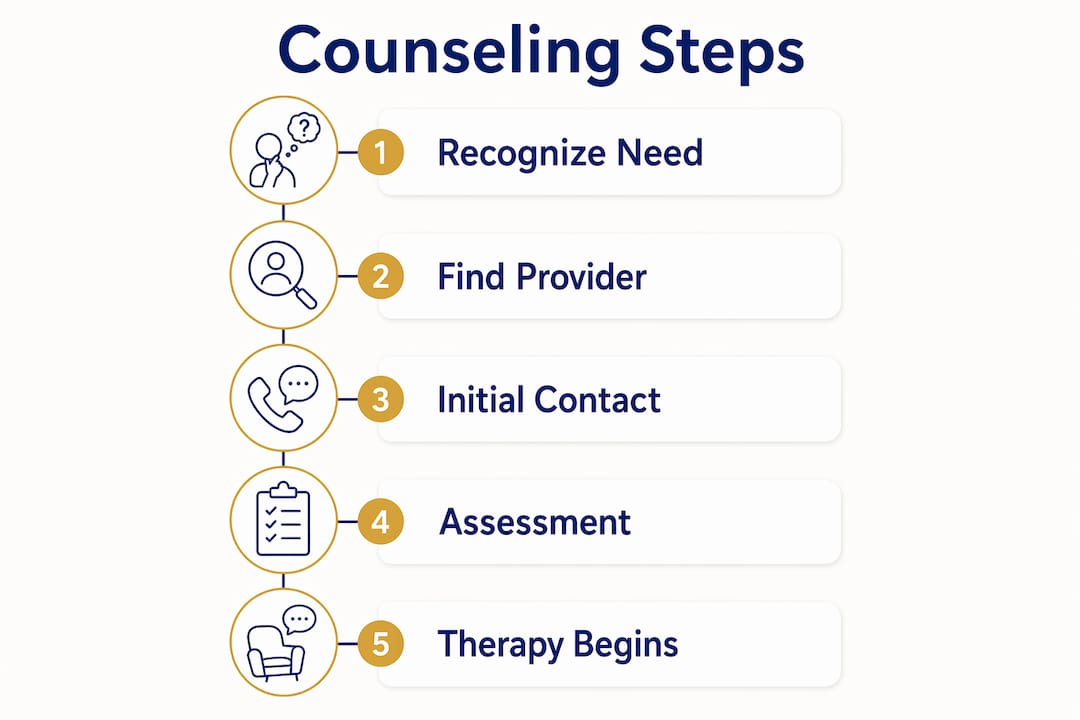
You can also learn more about therapy for anxiety and the distinctions between provider types before your first call.
How to find and evaluate local counseling options near you
Finding local depression counseling requires more than a quick Google search. You need a repeatable process that filters for quality, not just proximity.
- Start with Psychology Today’s therapist directory. The platform lets you filter by location, specialty (anxiety, depression), insurance, and session format (in-person or telehealth). Each profile lists licensure, years of experience, and accepted insurance plans.
- Verify the license independently. Every U.S. state has a licensing board with a public lookup tool. Confirm the provider’s license is active and in good standing before you invest time in a consultation.
- Read the profile for treatment modalities. Look for explicit mentions of CBT, ACT, or exposure therapy. Vague language like “supportive counseling” without named methods is a yellow flag.
- Check availability and format. Many top counselors for anxiety now offer teletherapy alongside in-person sessions. If your schedule or location limits access, teletherapy options can deliver the same evidence-based care without the commute.
- Book a brief consultation call. Most therapists offer a 15-minute phone screening at no charge. Use it to ask about their approach, typical session structure, and experience with your specific symptoms.
The ADAA notes that early direct contact with a clinician reduces mismatched referrals and speeds up treatment initiation. That 15-minute call is not a formality. It is diagnostic.
Pro Tip: Prepare two or three specific symptom descriptions before your consultation call. Saying “I have panic attacks every morning before work” gives a therapist far more to work with than “I feel anxious a lot.”
Here is a quick comparison of the most common ways to locate mental health services near you:
| Method | Best for | Limitation |
|---|---|---|
| Psychology Today directory | Filtering by specialty and insurance | Profiles are self-reported |
| State licensing board lookup | Verifying credentials | No specialty filtering |
| Insurance provider portal | Finding in-network therapists | May not list specializations |
| Community mental health centers | Affordable or sliding-scale care | Longer wait times possible |
| Teletherapy platforms | Immediate access, flexible scheduling | Less suited for severe presentations |
What evidence-based treatments are most effective for depression and anxiety?
CBT is the frontline treatment for both depression and anxiety disorders. Psychotherapies like CBT and interpersonal psychotherapy are among the most clinically validated options available, with decades of randomized controlled trial data behind them. This matters because it means you can enter treatment with a reasonable expectation of measurable improvement, not just hope.
Here is how the major evidence-based modalities differ in practice:
- Cognitive Behavioral Therapy (CBT): Targets the relationship between thoughts, feelings, and behaviors. You learn to identify distorted thinking patterns and replace them with more accurate, functional ones. Effective for generalized anxiety disorder, major depressive disorder, panic disorder, and social anxiety.
- Dialectical Behavior Therapy (DBT): Originally developed for borderline personality disorder, DBT is now widely used when depression involves emotional dysregulation or self-harm urges. It combines CBT with mindfulness and distress tolerance skills.
- Acceptance and Commitment Therapy (ACT): Focuses on psychological flexibility rather than symptom elimination. Particularly useful when clients have tried CBT without full relief.
- Exposure Therapy: The gold standard for phobias and PTSD-related anxiety. Involves gradual, structured confrontation of feared situations to reduce avoidance behavior.
- Interpersonal Therapy (IPT): Addresses how relationship patterns and life transitions contribute to depression. Typically delivered in 12 to 16 sessions.
Treatment duration varies. Brief CBT interventions of 6 to 8 sessions in primary care settings produce significant symptom improvement for depression. This is a critical finding for anyone worried about committing to long-term therapy. You can see real results in under two months of weekly sessions.
For moderate to severe presentations, the ADAA recommends combining psychotherapy with medication management. A therapist handles the behavioral and cognitive work; a psychiatrist or PMHNP manages pharmacological support. These two tracks work in parallel, not in sequence. You do not need to “try therapy first” before considering medication if your symptoms are significantly impairing your daily functioning.
Therapy approaches should match your symptom profile. CBT works for most people, but individual therapy techniques like DBT or ACT may produce better outcomes depending on your history and presentation.
What should I do if I need immediate support before starting counseling?
The gap between deciding to seek help and sitting in a first therapy session can be days or weeks. That gap is not empty time. It is a period when symptoms can intensify, and having a plan for it matters.
The 988 Suicide and Crisis Lifeline is your most accessible immediate resource. The 988 Lifeline provides 24/7 crisis support for mental health issues including anxiety and depression, connecting callers to local resources or crisis counselors. You do not need to be suicidal to call. SAMHSA confirms that 988 covers non-suicide crises including emotional distress, panic, and acute depressive episodes.
Here is how to use the waiting period productively:
- Call or text 988 if symptoms feel unmanageable. The counselors there can de-escalate acute distress and point you toward local resources.
- Build your therapist shortlist simultaneously. Use Psychology Today or your insurance portal to identify three to five candidates and send inquiry emails or book consultation calls.
- Contact community mental health centers in your area. Many offer same-week intake appointments and sliding-scale fees for affordable therapy for depression.
- If symptoms include thoughts of self-harm, go to your nearest emergency room or call 911. Therapy is not the right first step in a medical emergency.
Using 988 crisis support while simultaneously building a shortlist of local therapists is the fastest way to close the gap between distress and ongoing care.
The multi-track approach prevents treatment gaps during the most vulnerable period. You are not choosing between crisis support and ongoing therapy. You are using both, in parallel, to stay stable while you build a longer-term plan.
Key takeaways
Effective counseling for depression and anxiety requires matching your symptoms to a licensed, specialized provider who uses evidence-based methods like CBT, while using crisis resources like 988 to stay supported during the search.
| Point | Details |
|---|---|
| Verify specialization, not just licensure | Confirm a provider treats anxiety and depression specifically, not just holds a general license. |
| Use Psychology Today to filter candidates | Filter by specialty, insurance, and format to build a qualified shortlist quickly. |
| CBT is the frontline treatment | Brief CBT interventions of 6 to 8 sessions produce measurable symptom improvement. |
| Combine therapy and medication when needed | Moderate to severe cases benefit from concurrent psychotherapy and medication management. |
| Use 988 during the search period | The 988 Lifeline provides immediate support for anxiety and depression while you locate ongoing care. |
What I’ve learned after years of working with depression and anxiety
Most people spend too long searching for the “perfect” therapist before booking a single appointment. I understand the impulse. When you are already depleted by depression or anxiety, the idea of making the wrong choice feels like one more risk you cannot afford. But the research and my clinical experience both point in the same direction: a good-enough therapist you actually see beats a perfect therapist you never call.
The credential check matters. I have seen clients spend months with a well-meaning counselor who lacked specific training in anxiety disorders, and the lack of structured technique showed in their slow progress. Credentials and specialization are not bureaucratic details. They are predictors of outcome. That said, the therapeutic relationship is equally powerful. A technically skilled therapist you cannot connect with will not produce the results you need either.
One thing I rarely see discussed: the first session is not just for the therapist to assess you. It is for you to assess them. Come with questions. Notice whether they listen before they advise. Notice whether they explain their approach clearly or speak in vague reassurances. You are hiring a professional, and you have every right to be discerning.
Finally, do not wait until you are in crisis to start the search. The time to find a local therapist is before symptoms peak, not after. If you are reading this article, you already have enough self-awareness to act. That is the hardest part. The rest is process.
— Carlos
How Masteringconflict supports your path to better mental health
Masteringconflict offers clinical services designed for individuals dealing with depression, anxiety, and related mental health challenges. Founded by Dr. Carlos Todd, a licensed clinical mental health counselor and psychologist, the practice brings evidence-based individual therapy to clients in North Carolina, South Carolina, Florida, and beyond through online counseling for anxiety and depression. Whether you need structured individual therapy, a clinical assessment to clarify your diagnosis, or a provider who understands the intersection of conflict, stress, and mood disorders, Masteringconflict delivers professional care grounded in real clinical expertise. Practitioners seeking to strengthen their own skills can also explore clinical supervision and mentoring programs designed to improve therapy delivery.
FAQ
What is the difference between a counselor and a therapist for depression?
The terms are often used interchangeably, but “counselor” typically refers to a Licensed Professional Counselor (LPC) or Licensed Mental Health Counselor (LMHC), while “therapist” is a broader term covering any licensed provider who delivers psychotherapy. Both can effectively treat depression and anxiety when they hold the appropriate licensure and specialization.
How many therapy sessions does it take to see improvement?
Brief CBT interventions of 6 to 8 sessions in primary care settings produce significant symptom improvement for depression. More complex presentations may require longer treatment, but most clients notice measurable change within the first two months of consistent weekly sessions.
Can I use insurance to cover local depression counseling?
Most major insurance plans cover outpatient mental health services, including individual therapy for depression and anxiety. Use your insurer’s online provider portal to find in-network therapists, and confirm coverage details before your first appointment to avoid unexpected costs.
Is online counseling for anxiety as effective as in-person therapy?
Telehealth-delivered CBT and other evidence-based therapies produce outcomes comparable to in-person treatment for most anxiety and depressive disorders. It is a practical option if local providers have long wait times or if your schedule limits in-person access.
When should I call 988 instead of waiting for a therapy appointment?
Call or text 988 any time your symptoms feel unmanageable, including acute anxiety, panic, or depressive episodes that feel beyond your current coping capacity. The 988 Lifeline covers non-suicide mental health crises and can connect you to local resources while you continue searching for ongoing care.
Recommended
- Anger Management Classes Near Me: Find Local & Online Options 2025 – Mastering Conflict
- Counseling interventions for children: a parent’s guide – Mastering Conflict
- Online therapy for teens: parent’s guide to support 2026 – Mastering Conflict
- Finding a Family Counselor – Expert Comparison 2025 – Mastering Conflict