
Coaching and counseling difference: Which fits you?

TL;DR:
- Counseling focuses on healing past emotional wounds and understanding oneself, while coaching emphasizes achieving future goals and skill development. Selecting the right service depends on whether your needs are related to mental health support or personal growth through goal-oriented strategies. Both practices rely on self-inquiry rather than advice, fostering capability and lasting change.
Choosing between coaching and counseling feels harder than it should. The coaching and counselling difference is rarely explained in plain terms, which means many people either pick the wrong service or delay getting help altogether. Both involve conversation, a professional, and personal growth. But they operate from completely different foundations and serve different needs. This article explains exactly what each offers, where they diverge, and how to decide which one fits where you are right now.
Table of Contents
- What is counseling? Understanding its focus and methods
- What is coaching? A goal-focused approach to future change
- Coaching vs counseling: Key differences and when to choose each
- How counseling and coaching support conflict resolution differently
- A fresh look: Why self-inquiry outweighs advice in choosing coaching or counseling
- Explore coaching and therapy options suited to your needs
- Frequently asked questions
What is counseling? Understanding its focus and methods
Counseling is a confidential, therapeutic process focused on your emotional and psychological wellbeing. It gives you a protected space to explore thoughts, feelings, and experiences that may be causing pain, confusion, or disruption in your life. A trained counselor does not tell you what to do. Instead, they ask questions and listen in a way that helps you understand yourself more clearly.
Most people seek counseling when something feels stuck. Grief that will not lift. Patterns in relationships that keep repeating. Anxiety that shows up in ordinary moments. Counseling helps you trace those experiences back to their roots through mental health counseling and work through them at a pace that feels safe.
Here is what sets counseling apart as a practice:
- It is evidence-based. Counselors draw from proven models like Cognitive Behavioral Therapy (CBT), person-centered therapy, psychodynamic therapy, and integrative approaches tailored to the client.
- It is not advice-driven. A counselor will not hand you a five-step plan. They facilitate your own self-discovery, which creates more lasting change.
- It addresses the past and the present. If trauma, loss, or long-held emotional patterns are affecting your life now, counseling gives those experiences the attention they deserve.
- It supports diagnosed conditions. Counselors are clinically trained to work with depression, anxiety, PTSD, and relationship conflict in ways that coaching cannot.
When you are dealing with something that feels bigger than a goal-setting problem, counseling is the appropriate starting point. Understanding managing change in relationships also requires the emotional foundation that counseling builds first.
Pro Tip: If you notice that your reactions to everyday events feel disproportionately intense, or that past experiences keep surfacing in current relationships, those are strong signals that counseling, not coaching, is your next step.
What is coaching? A goal-focused approach to future change
Coaching is a structured, collaborative process built around your goals, action plans, and accountability. It assumes you are mentally well enough to move forward and focuses on where you want to go rather than why you got stuck in the past.

What is coaching in practical terms? It is a professional relationship where the coach helps you get clearer on what you want, identify what is in the way, and commit to specific steps. If counseling is excavation, coaching is construction. Both require work. They just operate on different terrain.
What coaching includes:
- Goal definition and planning. Coaches help you turn vague intentions into concrete targets with timelines and checkpoints.
- Accountability structures. Regular sessions track your progress and troubleshoot obstacles before they become setbacks.
- Communication and conflict skills. Many clients use coaching for conflict resolution to develop practical tools for navigating difficult relationships and workplace dynamics.
- No clinical diagnosis. Coaches do not diagnose mental health conditions or provide treatment. If those issues arise, a responsible coach refers clients to a therapist or counselor.
- Professional standards. Quality coaching operates within ethics frameworks and often includes clinical supervision, which holds the coach accountable to professional standards that protect the client.
The professional coaching standards field has grown considerably in the last two decades, with international bodies setting competency frameworks for credentialing. Common areas where coaching delivers real results include career transitions, leadership development, personal growth, and burnout recovery.
Pro Tip: Before hiring a coach, ask directly about their training, certification, and supervision arrangements. A well-trained coach welcomes that question and answers it without hesitation.
Coaching vs counseling: Key differences and when to choose each
The coaching and counseling differences span purpose, method, client readiness, credentials, and expected outcomes. Getting these wrong wastes time and money, and in some cases delays necessary mental health support.
Here is a direct comparison:
| Factor | Counseling | Coaching |
|---|---|---|
| Focus | Past and present emotional wellbeing | Future goals and action |
| Client need | Mental health support, healing | Personal growth, skill-building |
| Practitioner credentials | Licensed clinician, advanced degree | Certified coach, no clinical license |
| Addresses diagnosis | Yes | No |
| Session style | Therapeutic, reflective | Collaborative, action-oriented |
| Typical outcomes | Emotional stability, insight | Skill development, goal achievement |
| Duration | Open-ended based on progress | Often time-limited and structured |
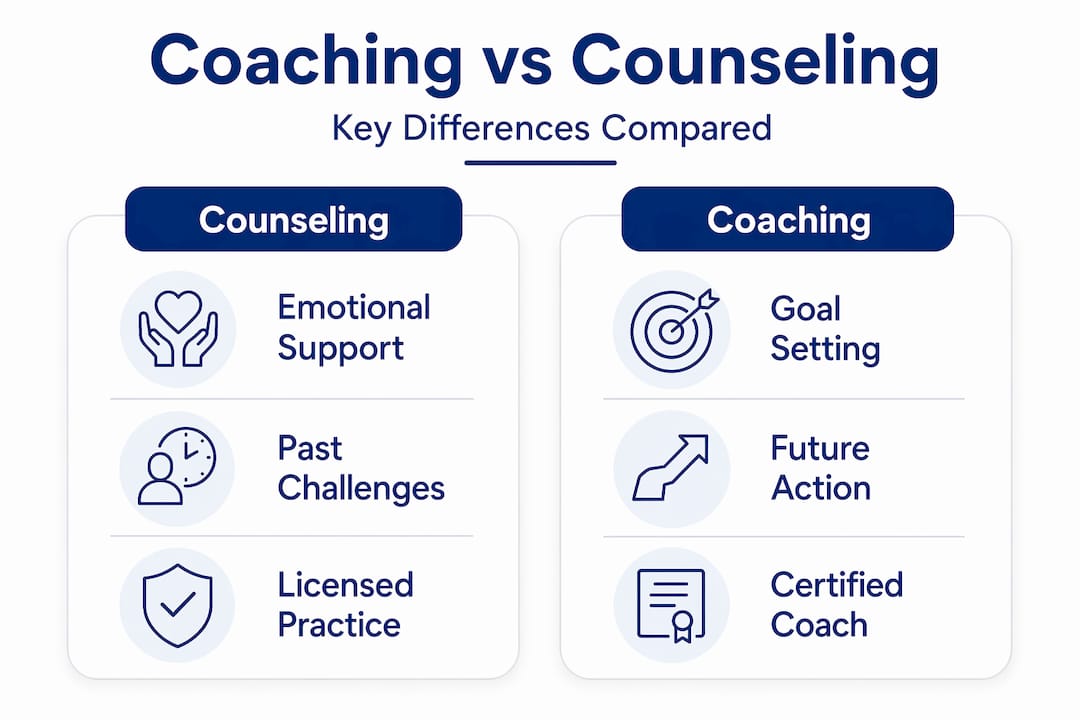
The counseling vs coaching differences become most critical when mental health is involved. Counselors carry legal and ethical obligations that coaches do not. They are licensed by state boards, carry malpractice insurance, and follow clinical practice guidelines. Coaches typically hold certifications from professional bodies but are not regulated the same way.
A few practical scenarios to clarify the choice:
- You are processing a divorce and feeling depressed. Counseling.
- You are newly divorced and want to rebuild your career and social life with clear goals. Coaching.
- You struggle with anger that damages your relationships. Counseling first, then possibly coaching to build communication skills.
- You want to become a more confident negotiator at work. Coaching.
Explore the full coaching vs therapy differences and how each professional role differs when you are ready to go deeper. The life coach vs therapist question has more nuance than most people expect, particularly around licensing, scope of practice, and what happens when emotional issues surface mid-session.
How counseling and coaching support conflict resolution differently
Conflict is one of the clearest situations where choosing the right support genuinely matters. Both disciplines help, but in very different ways.
Counseling uncovers emotional triggers and ingrained patterns that drive conflict, while coaching focuses on communication strategies, decision-making, and action planning for resolution.
Here is how each approach plays out in a conflict scenario:
- Counseling explores the emotional roots. If you consistently escalate in arguments or shut down completely, a counselor helps you trace that back to attachment patterns, past experiences, or unresolved wounds. Understanding why you react the way you do is the first step.
- Coaching builds the skills. Once you have enough emotional awareness, a conflict resolution coach teaches you specific communication tools, active listening techniques, and negotiating frameworks you can use immediately.
- Counseling works on self-awareness. You learn to recognize your triggers before they control your behavior.
- Coaching works on execution. You practice scripted responses, scenario planning, and follow-through strategies.
- Both require active participation. Neither discipline produces results for passive clients. You have to show up, be honest, and do the work between sessions.
“The most effective conflict resolution often begins in the counselor’s office and is sharpened in the coach’s.” This sequence is not about one being better. It is about sequencing support intelligently.
If your conflict patterns feel emotionally loaded and deeply personal, start with counseling for emotional processing and consider adding conflict resolution coaching once the emotional foundation is more stable. For those navigating relationship transitions, managing positive relationship change is a resource worth bookmarking.
Pro Tip: If you find yourself replaying conflicts in your head and looking for someone to validate your position, that is a counseling need. If you want scripts and strategies for your next difficult conversation, that is a coaching need.
A fresh look: Why self-inquiry outweighs advice in choosing coaching or counseling
Here is what most people misunderstand about both disciplines. They show up expecting to be told what to do. They want a professional to diagnose their situation, hand them a solution, and send them off fixed. Neither good counseling nor good coaching works that way, and that gap in expectation causes real frustration.
Conversations in both coaching and counselling should focus on self-inquiry rather than advice-giving. This is not a philosophical preference. It is the mechanism by which lasting change actually happens.
Advice creates dependency. Self-inquiry creates capability. When a skilled counselor asks you, “What do you think that feeling is trying to tell you?” they are not being evasive. They are handing you a tool you will carry long after the session ends. The same applies in coaching. A coach who simply tells you what to do produces a client who is lost the moment the coach is unavailable.
This changes how you should evaluate any practitioner you consider working with. The question is not “how much advice will they give me?” The question is “how well do they help you find your path?” The best practitioners, whether counselors or coaches, are skilled at asking the question you have not thought to ask yourself. They create discomfort in the best possible way, the kind that moves you forward.
People who approach support expecting answers often leave disappointed. People who approach it expecting better questions, and learn to sit with those questions, tend to transform. That shift in expectation is the most underrated element in choosing and benefiting from either service.
Explore coaching and therapy options suited to your needs
If this article clarified something important for you, the next step is finding the right support rather than just understanding it abstractly. At Mastering Conflict, we offer both clinical therapy and structured coaching programs designed around your specific situation and goals.
Whether you need emotional healing through evidence-based therapy or goal-driven accountability through conflict resolution coaching, our services are built to meet you where you are. Explore the full coaching vs therapy overview to see how we approach each differently, or review our clinical services if therapy is the right fit right now. Practitioners seeking professional development can also explore clinical supervision opportunities with our licensed clinical team. Book a session and start with the service that actually fits your needs.
Frequently asked questions
Can I use coaching and counseling at the same time?
Yes. Many clients benefit from concurrent coaching and counseling when their needs span both emotional support and active goal development, as long as both practitioners are aware of the arrangement.
How do I know if I need counseling or coaching?
If emotions, mental health struggles, or past experiences are affecting your daily life, counseling is appropriate. Coaching fits best when you are mentally stable and focused on building skills or achieving specific goals.
Are coaches licensed like counselors?
No. Counselors require state licensure and advanced clinical training, while coaches typically hold professional certifications without the clinical credentials or legal authority to diagnose or treat mental health conditions.
What happens during a typical counseling session?
A counseling session is a confidential conversation where the counselor uses open questions and active listening to help you explore your thoughts and feelings, without prescribing a solution or telling you what to think.
How does coaching support conflict resolution?
Conflict coaching emphasizes communication strategies and action planning to help you manage disputes practically, which is distinct from the emotional processing focus that characterizes counseling in conflict situations.