
How to find the right therapy in North Carolina

TL;DR:
- Starting therapy can feel overwhelming when you genuinely need support, especially amid relationship conflict or emotional pain. Knowing whether your concern is urgent or can wait helps you choose the appropriate pathway, with crisis options like 988 available for immediate danger. Finding the right therapist involves clarifying your needs, asking targeted questions, and assessing fit beyond credentials, ensuring steady progress over time.
Starting therapy feels different when you actually need it. The distance between “I should talk to someone” and sitting in a therapist’s office can feel impossibly wide, especially when you’re dealing with relationship conflict, anger that keeps escalating, or emotional pain that’s getting harder to manage. Whether you’re searching for yourself, your partner, or someone you love, knowing exactly where to start makes the difference between getting help and staying stuck. This guide walks you through every step, from understanding your needs to booking that first appointment.
Table of Contents
- Before you begin: Understanding your therapy needs
- What to do in a mental health crisis in North Carolina
- Where and how to find therapy services in North Carolina
- Steps to connect with the right therapist for you
- A realistic take: What most therapy guides won’t tell you
- Get specialized support with Mastering Conflict
- Frequently asked questions
Key Takeaways
| Point | Details |
|---|---|
| Clarify your needs | Identify if you require urgent help or scheduled therapy before searching for a provider. |
| Use crisis resources wisely | Contact 988 for 24/7 support or 911 for emergencies instead of waiting for outpatient appointments. |
| Explore all therapy options | Consider public, private, specialized, and online services to find the best fit for you. |
| Ask the right questions | Don’t hesitate to interview therapists to ensure they’re a strong match for your needs and goals. |
| Stay persistent | If your first option doesn’t work out, keep trying—success in therapy often takes more than one attempt. |
Before you begin: Understanding your therapy needs
Before you open a single browser tab, take five minutes to get clear on what you actually need. This one step saves you hours of confusion and keeps you from ending up with a provider who isn’t the right match.
Is this urgent or can it wait?
The most important distinction is whether you need immediate help or scheduled outpatient therapy. Outpatient therapy, which is the standard weekly or biweekly appointment model, is appropriate for most mental health concerns including depression, anxiety, relationship conflict, and anger management. However, if you or someone you love is in danger, experiencing suicidal thoughts, or in a mental health crisis, that’s a different pathway entirely. We’ll cover crisis resources in the next section.
For finding the right therapist in a non-urgent situation, think about these areas first:
- What kind of support do you need? Individual therapy, couples counseling, family therapy, anger management, or a combination
- What are your specific concerns? Describe them in plain language: “my partner and I fight constantly,” “I lose my temper at work,” or “I feel depressed and withdrawn”
- Do you have a preference for format? In-person sessions, teletherapy, or both
- What’s your insurance situation? Know your plan, your deductible, and whether you want to use insurance or pay privately
- Are there identity-related needs? Many people prefer a therapist who shares or understands their cultural background, gender, or lived experience
Taking an anger management assessment before your first appointment can also help you walk in with a clearer picture of what you’re dealing with, which saves time and leads to faster progress.
“When safety risk is present, use crisis pathways rather than waiting for outpatient therapy.” NCDHHS emphasizes 911 for life-threatening emergencies and provides 24/7 988 and crisis-team options.
Pro Tip: Write down three things you want to change as a result of therapy before you contact any provider. This helps therapists understand your goals immediately and ensures you leave your first session feeling like the process has already started.
What to do in a mental health crisis in North Carolina
If you or someone you know is in a mental health crisis right now, don’t wait for a scheduled appointment. North Carolina has several urgent pathways built specifically for this.
Here’s how to use each one:
- Call 911 if there is an immediate threat to life, a weapon is involved, or someone is unresponsive. This is for life-threatening emergencies only.
- Call or text 988 for mental health crises that don’t involve immediate physical danger. This line is free, available 24/7, and confidential. Spanish-language support is available.
- Contact the NC Peer Warmline at 1-855-277-4937 for non-crisis emotional support from trained peers who have lived mental health experience.
- Request a mobile crisis team through your local Community Mental Health Center. These teams come to you and can help de-escalate a situation without involving law enforcement.
- Visit a community crisis center in your area if you need face-to-face stabilization without going to a hospital emergency room.
For urgent mental health needs, the NCDHHS North Carolina Crisis Services page connects people directly to 988, NC Peer Warmline, and mobile crisis teams around the state.
988 is not the police. The 988 Lifeline is free, private, and available every hour of every day. Calling or texting 988 will not automatically dispatch law enforcement unless there is a clear and immediate risk to life.
A common misconception is that calling for mental health support will result in involuntary hospitalization. In reality, 988 counselors prioritize the least restrictive response that keeps you safe. Most calls end with safety planning and local referrals, not emergency rooms.
One more thing worth saying: If you’ve been putting off getting help because you’re worried about stigma, consider that culturally informed care exists specifically for you. Providers who work specifically with Black and African American therapists and populations understand the unique stressors and cultural dynamics that affect mental health in these communities, and seeking that kind of care is a sign of strength, not weakness.
Where and how to find therapy services in North Carolina
Once you’ve ruled out a crisis situation, it’s time to look at the full landscape of therapy options available across North Carolina.
| Therapy type | Best for | Format available | Typical cost range |
|---|---|---|---|
| Individual therapy | Personal mental health, depression, anxiety | In-person, online | $80 to $200 per session |
| Couples counseling | Relationship conflict, communication | In-person, online | $100 to $250 per session |
| Family therapy | Family dynamics, parent-child conflict | In-person, online | $100 to $200 per session |
| Anger management | Anger control, impulse regulation | Group, individual, online | $50 to $150 per session |
| Teletherapy | Convenience, rural access, busy schedules | Online only | $70 to $180 per session |
Teletherapy options have expanded dramatically in North Carolina, making it possible for people in rural counties, those with demanding work schedules, and individuals with mobility limitations to access quality care without commuting. Most licensed therapists in the state now offer at least some virtual sessions, and fully online practices have become well-established.
Here are the main ways to search for a provider:
- Psychology Today directory at psychologytoday.com/us/therapists: Filter by state, specialty, insurance, and identity. This is one of the most widely used directories.
- Open Path Collective: Offers reduced-cost sessions for people without insurance or with high deductibles.
- Your insurance company’s provider portal: Login to your health plan’s website and search in-network therapists in your ZIP code.
- Community Mental Health Centers: These are publicly funded and serve people regardless of ability to pay. Each county in North Carolina has one.
- Specialized private practices: These are practices like Mastering Conflict that focus on specific concerns like anger, conflict, and relationship repair.
When evaluating a provider, look beyond their degree. Consider whether they specialize in your specific concern, whether their communication style feels approachable during your first contact, and whether they offer a consultation call before you commit to a full session.
Family counseling services are especially worth researching carefully, because family dynamics require a therapist with specific training in systems theory (understanding how family members influence each other) rather than just general mental health credentials.
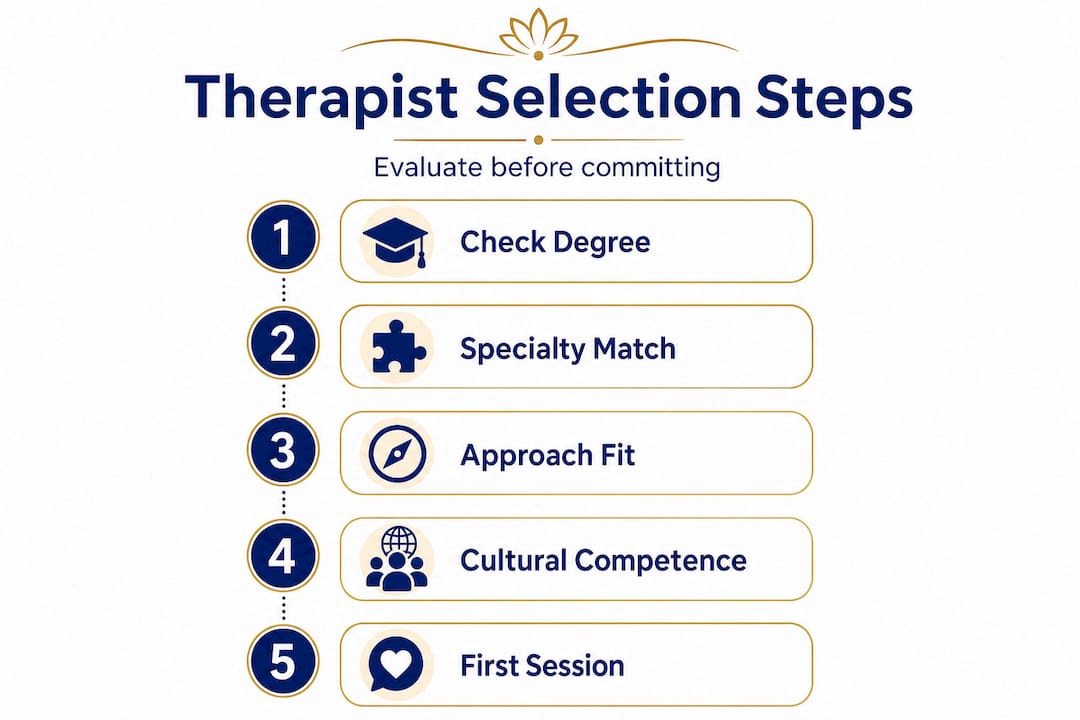
Pro Tip: Search for therapists who list your exact concern as a specialty, not just a secondary area. A therapist who specializes in anger management has different training and tools than a general therapist who occasionally sees clients with anger issues.
If you’re planning for intensive work or want to address relationship repair in a focused way, couples retreats offer an immersive alternative to weekly sessions that can compress months of progress into a single concentrated experience.
Steps to connect with the right therapist for you
You’ve identified your needs and found some potential options. Now it’s time to actually reach out and make a decision. Many people get stuck here because they’re unsure what to say or are afraid of being judged. Here’s a clear process to follow.
- Make your list. Narrow your options down to two or three therapists who seem like a good fit based on their specialty and profile.
- Send an email or make a call. You don’t need to explain everything. A short message like “I’m looking for support with anger management and relationship conflict. Do you have availability, and do you offer a consultation call?” is completely sufficient.
- Ask the right questions during a consultation. Good questions include: “What is your approach to anger management?” “How long do most of your clients work with you?” and “Have you worked with people in similar situations?”
- Evaluate the fit. After your first session, notice whether you felt heard, whether the therapist’s style felt comfortable, and whether their approach made sense to you.
- Don’t settle. If the first therapist isn’t right, try another one. Finding the right fit is not a failure; it’s part of the process.
Here’s a comparison to help you think about what different specialists bring to the table:
| Specialty | What they focus on | Good for |
|---|---|---|
| Anger management specialist | Emotional regulation, triggers, behavioral patterns | Individuals with persistent anger issues |
| Couples therapist | Communication, attachment, conflict patterns | Partners struggling to connect |
| Family therapist | Roles, boundaries, family-wide dynamics | Parent-child conflict, blended families |
| Individual counselor | Personal history, mental health, coping skills | Depression, anxiety, trauma |
Counseling office spaces in Charlotte and across North Carolina now reflect a much more welcoming and inclusive environment than the clinical settings many people imagine. That shift in environment matters more than people expect; feeling physically comfortable in a space affects how open you’re able to be.

Providers who work with specific populations bring real advantages. Women’s counseling options address concerns that are distinct from general therapy, including gender-based stress and identity-related experiences. Men’s counseling services help men work through emotion regulation and communication in ways that meet them where they are culturally. And counseling for teens requires a different skill set entirely since adolescents communicate differently and respond to different therapeutic models.
North Carolina crisis pathways remain available even if you’re in a standard therapy process. If things escalate between appointments, you don’t have to wait.
Pro Tip: After your first session, give yourself 24 hours before deciding whether to continue with that therapist. First sessions often feel uncomfortable simply because they’re new, and that discomfort is not the same as a bad fit.
A realistic take: What most therapy guides won’t tell you
Here’s something most step-by-step guides leave out: the therapist’s credentials are only one part of the equation. You can find a highly credentialed therapist with a beautiful office and a long waitlist who still isn’t the right person for you. Fit is the single most researched factor in therapy outcomes, and it matters more than any technique or certification.
We’ve worked with individuals and couples who tried therapy before and gave up, not because therapy doesn’t work, but because they never found the right fit. The conventional wisdom is to trust the professional’s expertise. Our experience says to trust your gut about the relationship and the professional’s expertise. Both things need to be true.
Another hard truth: therapy rarely fixes things quickly. The problems that bring most people through the door, repeated conflict cycles, deep-seated anger, broken trust in a relationship, took years to develop. Expecting them to resolve in six weeks is setting yourself up for frustration. Progress in therapy often looks like two steps forward and one step back before it looks like steady movement.
What actually leads to better outcomes? Consistent attendance, honest self-disclosure between sessions, and a willingness to sit with discomfort rather than avoid it. Assessment is also underused. An honest self-assessment before starting therapy, and periodically throughout it, helps you and your therapist adjust the work to what’s actually happening rather than what you assumed you needed at the start.
One myth worth addressing directly: therapy is not just for people in crisis or people who have “serious” problems. Some of the most productive therapy work happens with people who are functioning well but want to break patterns before they cause real damage. If you’re seeing signs of escalating conflict in your relationship, considering marriage counseling insights before things get critical is one of the highest-return investments you can make.
Finally, don’t confuse slow progress with no progress. Some of the most significant shifts happen quietly, in the space between sessions, when something a therapist said weeks ago suddenly makes sense in a new situation.
Get specialized support with Mastering Conflict
Taking the first step is the hardest part. If you’ve read this far, you already know what you need; now it’s about finding the right support to help you get there.
Mastering Conflict offers clinical therapy services designed for individuals, couples, and families dealing with real, complex conflict. Whether you’re working through personal anger, a relationship in crisis, or family tension that keeps resurfacing, Dr. Carlos Todd and the Mastering Conflict team bring evidence-based, culturally sensitive care to every session. Start with a Charlotte anger assessment to get a clear picture of where you stand, or explore family counseling support if the tension runs deeper than one person. Booking is straightforward, and first-session information is available directly on the site.
Frequently asked questions
What is the difference between 988 and 911 in North Carolina?
988 connects you to free, confidential mental health crisis support staffed by trained counselors, while 911 is for life-threatening physical emergencies requiring law enforcement or emergency medical services.
How do I find a culturally competent therapist in North Carolina?
Search specialized directories that allow you to filter by cultural background or identity experience, and look for practices with explicit commitments to culturally affirming care, including therapists with specific training in your community’s experiences.
Can I get therapy online in North Carolina?
Yes, teletherapy is widely available across North Carolina for most types of therapy, including individual counseling, couples work, and anger management, with licensing standards that ensure the same quality of care as in-person sessions.
What should I do if I need immediate help for a mental health crisis?
Call 988 for confidential, around-the-clock mental health support, or call 911 if the situation is life-threatening; North Carolina also has mobile crisis teams that can respond in person without involving law enforcement.
What types of therapy are most common in North Carolina?
The most common options include individual therapy, couples counseling, family therapy, anger management (both individual and group formats), and teletherapy, with many providers now offering a combination of in-person and online sessions to fit different schedules.