
Counseling for Black Families: Culturally Centered Healing

Every Black family in North Carolina or South Carolina knows the strength found in tight-knit communities and collective problem-solving. Yet, there are times when even trusted supports feel stretched thin. Defining counseling through a culturally grounded intervention connects your family’s wisdom to new tools for healing. This article explores what sets Black family counseling apart, highlights culturally competent therapists, and breaks down accessible online and local therapy options for meaningful support.
Table of Contents
- Defining Counseling For Black Families
- Unique Cultural And Family Dynamics
- Addressing Barriers And Stigma In Mental Health
- Benefits Of Culturally Competent Counselors
- Accessing Online And Local Therapy Options
Key Takeaways
| Point | Details |
|---|---|
| Culturally Grounded Counseling | Counseling for Black families recognizes unique cultural strengths and addresses systemic barriers, providing tailored support that mainstream approaches often overlook. |
| Addressing Stigma and Mistrust | Many Black families face barriers due to stigma surrounding mental health, making it essential to find counselors who acknowledge and address these concerns effectively. |
| Importance of Cultural Competence | Culturally competent counselors can affirm family values and enhance healing by understanding the specific dynamics and historical contexts of Black families. |
| Accessing Various Therapy Formats | Families have options for therapy through online, in-person, or hybrid models, allowing them to choose what best fits their needs and comfort levels. |
Defining Counseling for Black Families
Counseling for Black families isn’t just another mental health service. It’s a culturally grounded intervention that recognizes the unique experiences, strengths, and challenges Black families face in North and South Carolina and beyond.
At its core, counseling for Black families addresses moments when traditional supports reach their limits. Family networks, church communities, and close relationships form the backbone of Black family resilience, but sometimes professional guidance becomes necessary to work through complex conflicts and emotional wounds.
What Makes Counseling for Black Families Different
Counseling specifically designed for Black families acknowledges several critical realities:
- Historical trauma and systemic barriers shape family dynamics in ways mainstream counseling often overlooks
- Cultural strengths and values like spirituality, extended family bonds, and collective problem-solving become treatment assets
- Distrust of mental health systems stems from real experiences with discrimination and has legitimate roots
- Language and communication styles resonate more deeply when counselors understand Black cultural expressions
Research shows that African American women seeking counseling often arrive after exhausting traditional family and community resources. They describe the decision to seek professional help as transformative, leading to fresh perspectives on relationships and personal growth.
Why Definitions Matter for Your Family
Understanding what counseling actually means helps your family make informed decisions. When counselors use culturally centered definitions, they start from a place of respect for your family’s background rather than assumptions based on clinical models designed without your community in mind.
Counseling for Black families recognizes that conflict doesn’t happen in a vacuum. The pressures of navigating racism, economic stress, and systemic inequities directly impact how family members relate to each other.
Counseling becomes a bridge between the wisdom your family already possesses and the tools needed to heal wounds that traditional supports alone cannot reach.
This type of counseling also addresses the stigma surrounding mental health that many Black families grew up with. Older generations may view therapy as weakness or something only “crazy people” pursue. Modern counseling for Black families reframes mental health support as strength and self-care.
The Real-Life Impact
When your family engages with counseling specifically designed for family needs, you’re not starting from scratch explaining your background. The counselor understands code-switching, the weight of representation, and the specific communication patterns in Black households.
Your counselor becomes a guide who honors your family’s resilience while helping you develop new ways to handle conflict, communicate across generational differences, and heal from past hurts.
Pro tip: When looking for family counseling, ask potential counselors directly about their experience working with Black families and their understanding of cultural factors that influence family dynamics—this filters for genuinely culturally centered practitioners.
Unique Cultural and Family Dynamics
Black families navigate a world that mainstream family counseling rarely acknowledges. Your family doesn’t exist in isolation—it exists within the context of race, history, and the constant navigation between African American and broader American cultures.

This dual consciousness shapes everything: how parents communicate with children, how conflicts arise, and what healing actually looks like for your family.
The Talk: Racial Socialization in Black Families
One of the most significant family conversations happens in Black households across North and South Carolina: “The Talk” about race and safety. This conversation has no equivalent in many other families, yet it fundamentally shapes how Black children understand themselves and the world.
Racial socialization and cultural identity development isn’t just parenting—it’s preparation for navigating systemic barriers. Parents teach children about their worth, their heritage, and how to stay safe in spaces where their Blackness may be questioned or devalued.
Counseling that ignores this reality misses a core family dynamic:
- Parents carry the weight of preparing children for realities other families don’t face
- Children process complex emotions about identity, belonging, and safety earlier than peers
- Extended family plays a crucial role in reinforcing cultural identity and values
- Spirituality and faith communities provide both support and identity anchoring
Living Between Two Worlds
Your family likely code-switches constantly. At work, school, or in professional settings, family members adopt different communication styles, energy levels, and ways of being. Then they come home and shift back.
This isn’t inauthentic—it’s survival and adaptation. But it can create confusion, especially across generations. Younger family members might internalize the message that their home culture is less valuable than mainstream culture.
Effective counseling recognizes code-switching as intelligent adaptation, not as a sign of family dysfunction or cultural shame.
When counselors understand these dynamics, they help families process the emotional toll of constant navigation without pathologizing the strategy itself.
Systemic Stress and Family Conflict
Family conflict doesn’t exist in a vacuum. Cultural differences that create relationship conflict include the broader systemic pressures families face.
Experiences with discrimination, economic inequity, and racial trauma accumulate. Sometimes conflicts between family members actually reflect collective stress:
- A parent’s frustration about workplace discrimination gets directed at a child
- A teenager’s anger about racial injustice manifests as disrespect at home
- Financial stress tied to systemic barriers creates tension between partners
- Intergenerational trauma influences parenting approaches and family expectations
Counseling needs to address these layers, not just the surface conflict.
Resilience and Cultural Strengths
Black families possess deep wells of resilience. Your family’s ability to survive, adapt, and thrive despite systemic challenges is remarkable—and it’s a treatment asset, not a problem to fix.
Counseling that works recognizes:
- Spiritual faith as a legitimate healing resource
- Family interdependence as strength, not codependency
- Cultural pride as protective factor against mental health challenges
- Extended kinship networks as real support systems
Pro tip: Ask your counselor how they’ll incorporate your family’s cultural strengths and spiritual values into treatment—this signals whether they understand Black family dynamics beyond clinical textbooks.
Addressing Barriers and Stigma in Mental Health
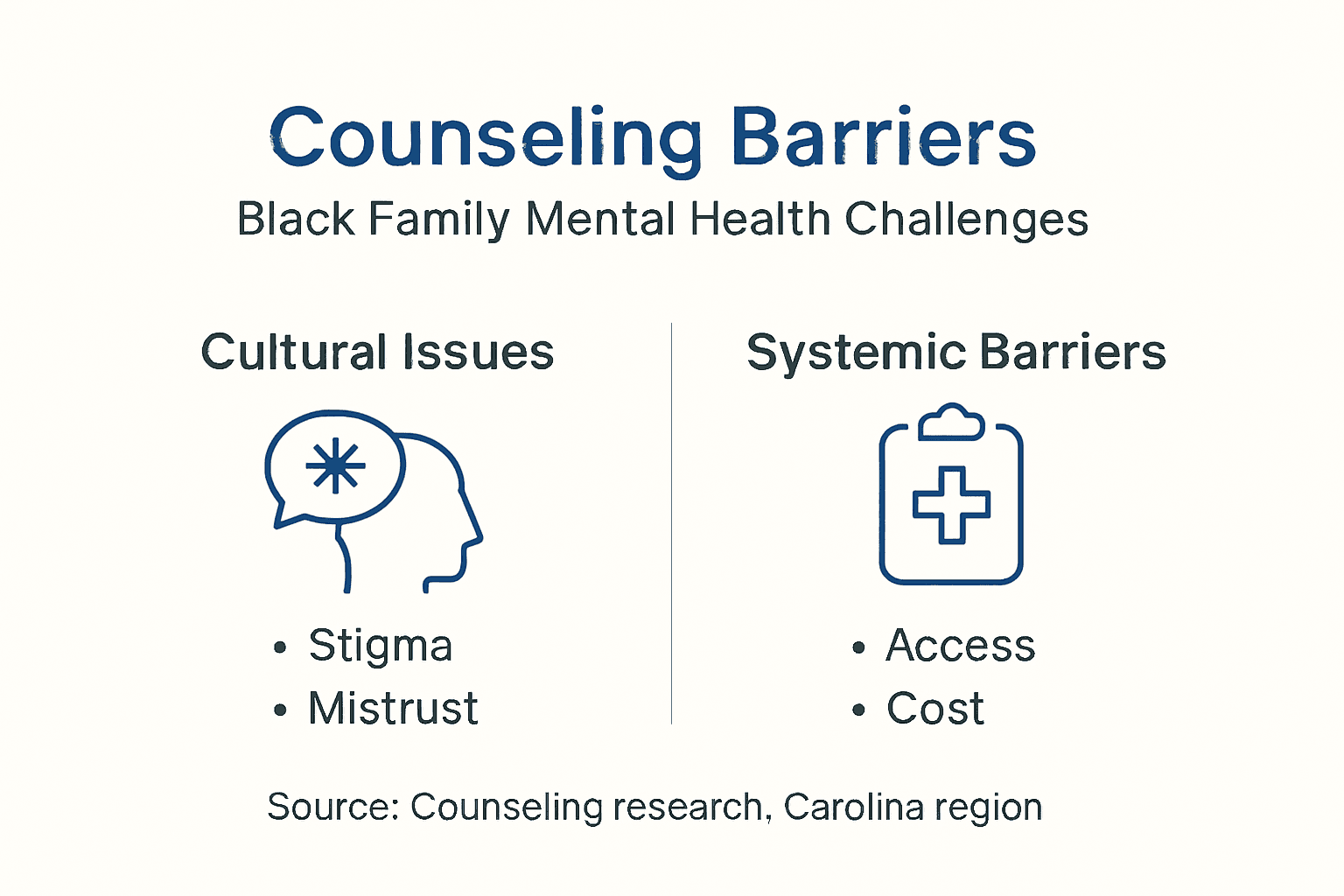
Your family likely knows the feeling: mental health counseling exists, but reaching for it feels risky. Not because therapy doesn’t work, but because historical and systemic barriers make Black families hesitant to trust mental health systems.
These barriers are real, rooted in actual experiences, and they deserve acknowledgment before healing can begin.
The Weight of Cultural Stigma
In many Black households, mental health conversations carried shame. Older generations grew up with messages like “we don’t air our dirty laundry” or “just pray about it.” Seeking counseling wasn’t seen as strength—it was viewed as weakness, family betrayal, or admitting failure.
That messaging doesn’t disappear overnight. It echoes through family systems, creating internal conflict when someone considers therapy.
Stigma and cultural mistrust in mental health prevent many Black women and families from accessing care even when they desperately need it. The decision to seek counseling often comes only after exhausting every other option.
Common stigma-related barriers include:
- Fear of judgment from family if they discover you’re in therapy
- Belief that counseling is only for “crazy people” with severe mental illness
- Concern about confidentiality and whether a counselor will respect your privacy
- Worry that disclosing problems to a stranger violates family loyalty
- Distrust of the mental health system rooted in historical medical racism
Systemic Barriers and Inequitable Access
Stigma isn’t the only obstacle. Black families in North and South Carolina face tangible barriers that limit access to quality counseling.
These include limited insurance coverage, geographic distance to culturally competent therapists, and financial constraints. But the deeper issue is that mainstream mental health systems weren’t designed with Black families in mind.
Mental health counseling explained through evidence-based approaches often relies on clinical models that don’t account for Black cultural values, communication styles, or family structures. A counselor trained exclusively in mainstream approaches may misinterpret your family’s strengths as problems.
Systemic barriers your family might encounter:
- Long wait times for appointments with culturally competent providers
- High costs with limited insurance coverage for mental health services
- Counselors who lack training in racial trauma and systemic racism impacts
- Previous negative experiences with healthcare providers
- Difficulty accessing online therapy options with flexible scheduling
Historical Medical Racism and Mistrust
Your family’s caution around mental health systems isn’t paranoia—it’s informed by history. Black Americans have experienced unethical medical treatment, forced sterilization, and exploitation in research studies.
This legacy creates reasonable skepticism about whether a mental health system will treat your family with respect and honesty.
Overcoming mistrust requires counselors who acknowledge this history, demonstrate cultural humility, and prove through their actions that your family’s wellbeing comes first.
Counseling that works for Black families directly addresses these historical wounds rather than pretending they don’t exist.
Moving Past Barriers
Recognizing these barriers is the first step. Seeking culturally centered counseling means finding providers who understand what your family has overcome and the legitimate reasons for caution.
Your family’s hesitation isn’t a character flaw. It’s an intelligent response to real systemic problems.
Pro tip: During an initial consultation with a counselor, ask directly how they address cultural mistrust and what specific training they have working with Black families—their answer reveals whether they take these barriers seriously.
Benefits of Culturally Competent Counselors
Not all counselors are created equal. A counselor who understands Black family systems, cultural values, and the impact of racism brings something fundamentally different to your healing journey.
Culturally competent counselors don’t just listen—they affirm, validate, and build treatment around your family’s actual lived experience.
Understanding Your Family’s Real Context
A culturally competent counselor knows that your family’s communication style isn’t “dysfunctional.” The way your grandmother disciplines your children reflects cultural values, not abuse. Your reliance on faith and spirituality is a healing resource, not denial.
Culturally grounded counselors affirm positive values while addressing legitimate challenges. This dual capacity—honoring strengths and addressing pain—transforms what therapy can accomplish.
When counselors understand Black family culture, they recognize:
- Matriarchal leadership structures as sources of family stability
- Extended family involvement as adaptive strength, not boundary problems
- Spiritual and faith-based coping as legitimate healing methods
- Direct communication styles as clarity, not rudeness
- Collective problem-solving as wisdom, not inability to individuate
Supporting Racial Identity Development
Your children are growing up navigating race in ways previous generations didn’t. A culturally competent counselor actively supports their racial identity development rather than pretending race doesn’t matter.
This means helping your teenager process racist experiences, celebrating their Blackness, and building pride in cultural heritage. It means helping younger children understand “The Talk” without absorbing shame or hypervigilance.
A counselor grounded in African American culture helps your family transform racial stress into racial resilience.
This isn’t just about feeling good. Research shows that strong racial identity protects mental health across the lifespan.
Addressing Race-Related Stress
Race-related stress is real, documented, and impacts family relationships. Your teenager’s anger after experiencing discrimination isn’t attitude—it’s a reasonable response to injustice.
A culturally competent counselor helps your family distinguish between individual dysfunction and collective trauma. They address how systemic racism reverberates through family dynamics without pathologizing your family’s response to oppression.
They validate experiences like:
- Navigating predominantly white workplaces and schools
- Code-switching exhaustion and identity fragmentation
- Worry about safety in interactions with police
- Grief about ongoing racial injustice
- Anger at systems designed to exclude Black families
Building Genuine Therapeutic Connection
Finding a family counselor who matches your needs matters tremendously. When counselors share cultural understanding, families engage more fully in treatment.
You don’t have to spend session time explaining your background or defending your family’s choices. The counselor already understands the context. This efficiency means faster progress and deeper healing.
Cultural competence also means the counselor takes responsibility for their own learning and accountability. They ask about your experiences rather than assuming. They admit when they don’t know something. They center your family’s expertise about your own life.
Better Outcomes for Your Family
Culturally competent counseling improves therapeutic outcomes measurably. Families stay engaged longer, report greater satisfaction, and experience more substantial healing.
Your family feels respected. Heard. Understood. That foundation changes everything about what becomes possible in treatment.
Pro tip: Ask potential counselors: “How do you integrate knowledge of systemic racism and cultural values into treatment?” Their specific answer reveals whether they have actual cultural competence or just surface-level awareness.
Here’s a quick reference for evaluating cultural competence in family counselors:
| Evaluation Factor | Why It Matters | What To Ask |
|---|---|---|
| Cultural Training | Ensures understanding of racial trauma | “What trainings have you completed?” |
| Experience With Black Families | Signals relevant practical insight | “Have you worked with similar families?” |
| Integration of Cultural Strengths | Affirms family values and traditions | “How do you use cultural assets in therapy?” |
| Approach to Systemic Racism | Validates real-world impacts | “How is systemic stress addressed in sessions?” |
Accessing Online and Local Therapy Options
Your family has choices. Whether you live in Charlotte, Raleigh, or a rural area of North or South Carolina, counseling options exist in formats that fit your schedule and comfort level.
Understanding what’s available helps you take the first step toward healing without unnecessary barriers.
Online Therapy: Flexibility Meets Access
Online counseling removes geography as an obstacle. You don’t need to find a culturally competent Black therapist in your immediate area—you can connect with skilled providers across the region or nationally.
Accessing culturally relevant and affordable mental health care through telehealth options increases accessibility significantly for Black families. Video sessions happen from your home, reducing commute time and scheduling pressure.
Online therapy benefits your family in several ways:
- Flexible scheduling with evening and weekend appointments
- Access to specialists in cultural competence and Black family dynamics
- Lower costs compared to traditional in-person sessions
- Privacy and discretion within your own home
- Reduced travel time for busy parents and working families
Your family can try teletherapy best practices for effective online counseling to maximize the experience. Test your technology beforehand, find a quiet space, and commit to showing up consistently.
In-Person Counseling: Community Connection
Some families prefer the human connection of face-to-face counseling. Sitting with a counselor you can see, building that personal relationship, creates a different therapeutic dynamic.
In-person counseling in North and South Carolina offers the benefit of community rootedness. Your counselor may understand local systems, navigate local resources, and know your community’s specific challenges.
When seeking local options:
- Ask for referrals from your church, doctor, or trusted community members
- Search for Black therapists and counselors in your city
- Contact community mental health centers about sliding scale fees
- Verify insurance acceptance and payment options upfront
- Ask about their specific experience with Black families
Hybrid Approaches and Specialized Programs
Many providers now offer hybrid models combining online and in-person sessions. Start online for convenience, then transition to in-person when you’re ready. Or do in-person monthly check-ins with weekly online sessions.
Enhancing access to mental health services involves leveraging telehealth and community resources tailored to African American families. Specialized programs address racial trauma, cultural identity, and family conflict specifically.
Specialized options include:
- Family counseling programs addressing Black family dynamics
- Anger management classes with cultural relevance
- Youth and adolescent counseling for navigating race and identity
- Couples therapy centered on Black relationship experiences
- Individual therapy for processing systemic trauma
The best therapy option is the one your family will actually use consistently.
Choose based on what fits your schedule, budget, and comfort level—not what sounds ideal in theory.
To better understand accessible therapy formats, here’s a comparison of online, in-person, and hybrid counseling for Black families:
| Counseling Format | Accessibility | Community Connection | Flexibility |
|---|---|---|---|
| Online Therapy | Nationwide access, less travel | Lower, but can find culturally competent providers | High, evenings/weekends available |
| In-Person | Limited to local area | Strong, direct community insights | Often less flexible, fixed hours |
| Hybrid Model | Combines local and online options | Moderate, balances community and wider reach | Variable, customized to family |
Making Your Selection
Compare your options systematically. How to find a therapist for effective support involves considering practical factors alongside cultural fit.
Consider cost, scheduling, location, therapist credentials, and cultural competence equally. Your family deserves access that works for your actual life.
Pro tip: Many therapists offer free 15-minute consultation calls—use this to ask about their experience with Black families, their approach to cultural factors, and how they handle scheduling before committing to paid sessions.
Embrace Culturally Centered Healing for Your Family Today
Navigating the unique challenges faced by Black families requires more than traditional counseling. Understanding the impact of systemic barriers, racial socialization, and cultural strengths is essential for true healing. If your family is seeking compassionate support that honors your heritage and lived experiences with deep respect and cultural competence explore how family counseling at Mastering Conflict can bridge those gaps. Our services focus on conflict resolution, anger management, and mental health tailored specifically to Black families in North and South Carolina and beyond.
Take the crucial next step toward healing by choosing culturally attuned therapy with experienced providers who understand your world. Visit Mastering Conflict now to schedule a consultation and discover personalized approaches that validate your family’s strengths while addressing systemic stress and stigma. Don’t wait to transform conflict into connection and resilience with trusted support designed for your family’s unique journey.
Frequently Asked Questions
What is counseling for Black families?
Counseling for Black families is a culturally grounded intervention that recognizes the unique experiences, strengths, and challenges faced by Black families. It addresses emotional wounds and conflicts that traditional supports may not fully resolve.
How does counseling for Black families differ from mainstream therapy?
Counseling for Black families specifically acknowledges historical trauma, cultural strengths, and the impact of systemic barriers. It employs culturally centered definitions and practices that respect and integrate Black cultural values into the therapeutic process.
Why is cultural competence important in family counseling?
Cultural competence in family counseling ensures that therapists understand the specific dynamics, communication styles, and challenges Black families face. This leads to more effective treatment, as the counselor can validate experiences rather than misinterpret them through a mainstream lens.
What barriers do Black families face in accessing mental health counseling?
Black families often encounter stigma, fear of judgment, limited access to culturally competent therapists, and historical mistrust of mental health systems. These barriers can make it challenging to seek the necessary support, even when needed.
Recommended
- Family Counseling Benefits: Support, Healing, and Connection 2025 – Mastering Conflict
- Finding a Family Counselor – Expert Comparison 2025 – Mastering Conflict
- African American and Black Therapists in Charlotte, NC
- Therapy Versus Coaching: Choose the Right Support for 2025 – Mastering Conflict
- What Is Kintsugi and Its Healing Power
- Role 4 Inspiration Brings Role-Play To Therapy – 1985 Games