
Anger in Relationships: Why It Happens and How to Handle It

Anger in a relationship is not the problem by itself. The trouble starts when it becomes frequent, grows more intense, or shows up as yelling, contempt or punishment, because then both partners start protecting themselves instead of talking. The good news is that anger responds well to skills and structured support. You can learn to slow down, take a break that works, repair after an outburst, and get help when it keeps coming back. If you want guided support, our anger management classes and counseling are built for exactly this.
TL;DR
- Anger usually points to something that feels unfair, threatening or disrespected. Learn what it is pointing to, rather than only trying to suppress it.
- During a fight, take a break of at least 20 minutes, use a code word to signal it, and come back to the topic once you are calm.
- After an outburst, repair matters as much as prevention: name what happened, own your part, and agree on a plan for next time.
- Frequent, escalating or physical anger is a reason to see a professional. If you feel afraid of your partner, safety comes first.
- Our anger management classes start at $24.99, and couples sessions are $175 per hour.
Table of Contents
- What anger is really telling you
- Anger, relational aggression and abuse are not the same thing
- Signs that anger is hurting your relationship
- Stop the escalation: what to do in the moment
- Repair after an outburst
- Anger can signal something else
- When to get professional help
- Our perspective
- Where we can help
- FAQ
- Sources
What anger is really telling you
Most couples treat anger as something their partner does to them. The Australian Psychological Society makes a more useful point: no one can make you angry. Anger is shaped by your thoughts, how you interpret events, your coping skills and the support you have. It adds that anger tends to be triggered when you believe you have been wronged, that something unfair has happened, or that your wellbeing or standing is not being respected.
That sounds abstract until you see it at home. A partner forgets to call, and the thought underneath is “I don’t matter to you.” A partner leaves dishes again, and the thought is “I’m doing this alone.” The anger is real, but the interpretation is what gives it its heat.
NHS inform lists several common anger triggers that map neatly onto relationships:
- Being treated unfairly, such as being blamed for something you did not do.
- Someone acting against your values or beliefs.
- Feeling threatened or attacked, for example when someone shouts at you.
- Being let down, such as a broken promise.
The Australian Psychological Society also names risk factors that explain why two people react so differently to the same event: memories of anger-related trauma, the way anger was modeled in your family and culture, rigid standards about how things “should” be, and a partly inherited tendency to respond to stress with anger or hostility. This is why one partner can shrug off a late arrival while the other feels disrespected. Neither is simply being dramatic.
Anger, relational aggression and abuse are not the same thing
A raised voice in a heated moment is different from a pattern designed to hurt. The University of Florida’s SMART Couples program describes relational aggression: intentionally ignoring a partner, or withholding affection or sex, to punish them. In the study it reports, 96% of wives and 88% of husbands admitted to this “love withdrawal” at least sometimes. About half of husbands and nearly two-thirds of wives reported social sabotage, such as talking trash about a partner or spreading rumors.
Those numbers matter for a practical reason. Many couples think anger only counts when it is loud. Silent treatment, withholding and put-downs are anger too, and they wear down trust just as surely. If you recognize yourself in this list, you are in very common company, and these habits can be changed.
There is a harder line to draw. NHS inform is clear that its anger guidance is for people struggling with their own anger and cannot help with preventing or escaping violence. If someone close to you is causing harm or making you afraid because of their anger, reach out for help elsewhere. In the US, the National Domestic Violence Hotline is 1-800-799-SAFE (7233), the number NAMI’s HelpLine also gives to people who are taking anger out on loved ones. Couples work is not the right first step when one partner is afraid of the other. Safety planning comes first.
Signs that anger is hurting your relationship
The Department of Defense’s Psychological Health Center of Excellence lists signs that anger may be affecting your relationship:
- You are angry frequently, or with increasing intensity.
- You are easily frustrated or feel you overreact to minor events.
- You cannot control your anger and become physically violent toward yourself, others or objects.
- You respond aggressively with words, such as yelling or cursing.
If two or more fit, treat it as a signal to act now rather than waiting for a crisis. The same source notes that rising frequency or intensity can be linked to concerns such as depression or PTSD.
Stop the escalation: what to do in the moment
The American Psychological Association describes three ways people deal with anger: expressing it, suppressing it and calming it. Expressing it assertively, meaning respectfully for yourself and the other person rather than pushy or demanding, is healthy. Exploding or stuffing it down are the two that damage relationships. Its practical advice is to slow down before responding, think through what you want to say, and listen for what is underneath the anger.
Take a real break
Utah State University Extension recommends that when you or your partner feel overwhelmed or “flooded,” you take a break of at least 20 minutes, about the time it takes for calming hormones to slow runaway emotions. It suggests agreeing on a code word as the break signal. Calming activities it lists include ten slow deep breaths, positive imagery, a short walk, progressive muscle relaxation, calming music or repeating a calm word.
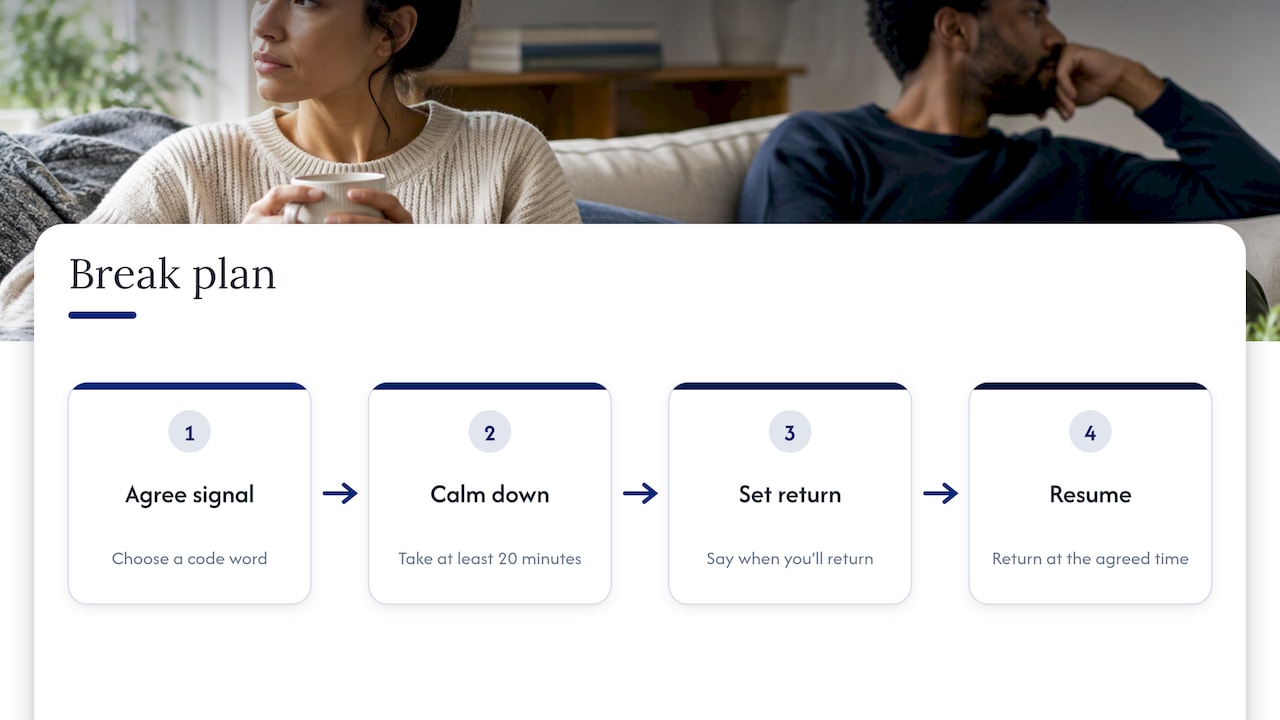
The key is what a break is not. It is not storming out, and it is not a way to win. It works when the person calling it says when they will return, and when the other person lets them go. Agree on the code word and the return plan while you are both calm, not in the middle of a fight.
Plan the conversation, not just the break
The Psychological Health Center of Excellence suggests building a communication plan together: schedule hard discussions for when emotions have settled, practice active listening (repeating back what you heard before you respond), set boundaries in advance, and agree to use “I” statements. Its example is “I feel frustrated when we are not equally sharing household tasks like taking out the trash.” Compare that to “You never help,” which invites a defense instead of a solution.
A worked example
Imagine one partner comes home to find the plans for Saturday were changed without a word. Voices rise. One says, “Let’s pause. Code word, 30 minutes.” Each takes a walk or breathes slowly. At the agreed time, they sit down. One starts: “I felt dismissed when the plans changed without me. I’d like us to check with each other first.” The other repeats it back before answering. Nothing about the situation was magically easy, but the argument became a request.
We go deeper on this in our guides to controlling anger issues in a relationship and communication skills for couples.
Repair after an outburst
Even couples with good skills lose their temper sometimes. What separates stable relationships from fragile ones is what happens in the hours afterward. Silence and pretending it did not happen leave the hurt in place, and it comes back as the next fight.
A repair conversation that works usually has five parts:
- Wait until you are calm. Use the same 20-minute rule. Repair attempted while still flooded becomes round two.
- Name what you did, specifically. “I yelled and called you lazy” is repair. “I’m sorry you took it that way” is not.
- Own your part without a “but.” Explain your trigger, but do not use it as an excuse.
- Ask what it was like for your partner, and listen without correcting the details.
- Agree on one change. A shorter fuse signal, an earlier break, a different time for money talks. One concrete change beats a vow to “never get angry again.”
If you were the one on the receiving end, you can also help repair by saying what you need to hear and what you are not ready to hear yet. Repair is a two-person job, even when the outburst came from one.
When the same fight repeats weekly, repair alone is not enough, because the pattern itself needs to change. That is where anger management in relationships work, with a trained professional, tends to make the difference.
Anger can signal something else
Chronic anger and irritability can be symptoms of other conditions. NAMI’s HelpLine says they can accompany depression, bipolar disorder and borderline personality disorder, and recommends connecting with help if anger feels out of control or comes with sadness or impulsivity. Australia’s healthdirect notes that unmanaged anger can lead to depression, anxiety, high blood pressure and heart problems, and that people with a mental health condition may be more likely to feel anger. The two feed each other.
Life transitions matter too. New parents, for instance, often feel short-tempered from exhaustion, and it is worth knowing the postpartum mental health signs that call for attention rather than willpower. If your anger arrived together with a major change, low mood or sleeplessness, mention all of it to a professional.
When to get professional help
NHS Borders describes anger as a problem when it happens often, becomes too strong, affects relationships, work, study or home life, or leads to aggression or violence. It advises seeing a GP as soon as possible if you have thoughts of harming yourself or someone else. In the US, the Psychological Health Resource Center offers 24/7 support at 866-966-1020, and for any immediate danger you should call 911.
What does support look like? The Australian Psychological Society says the most common therapies for problem anger are cognitive behavioural therapy, relaxation-skills training and life-skills training. Family or relationship therapy can improve communication, conflict resolution and problem-solving, break cycles of anger and aggression, and increase the sharing of positive emotions instead of anger. The APA notes that in counseling, a highly angry person can move toward a middle range of anger in about 8 to 10 weeks, depending on circumstances and techniques. It also suggests telling a prospective therapist about your anger and asking about their approach.
That last point is practical. Ask any provider how they work with anger, whether they see couples together, and whether sessions can happen online if your schedule is tight.
Which kind of help fits you
| Situation | Good starting point |
|---|---|
| You want practical skills at your own pace | An online anger management class |
| Anger shows up mostly in one person | Individual anger management counseling |
| The fights are a pattern between you | Couples counseling or a couples program |
| Anger affects the whole household, including teens | Family or teen counseling |
| Your schedule or location makes visits hard | Teletherapy |
Our perspective
We see anger in relationships as information first and a character flaw never. When someone comes to us angry, the work is to find what the anger is protecting, whether that is respect, safety, fairness or closeness, and then build the skills to say it so the other person can hear it.
Our approach rests on doctoral-level clinical training and frameworks I developed, combined with tools you can use the same evening. We work with individuals, couples, families, teens and professionals, and we pay particular attention to women, men and Black and African American clients, because anger is shaped by culture, family and lived experience, and a one-size-fits-all script rarely lands.
If you are not sure where to start, start small. A short class can give you a shared vocabulary. Counseling lets you work on your own patterns. Couples work lets you change the cycle together. All of it is available online as well as in person, so distance does not have to be the obstacle.
Carlos
Where we can help
If you are ready to work on this, we offer several routes. Our online anger management classes are $24.99 for the 1-hour class, $79 for the 6-hour class and $85 for the 8-hour class, all one-time payments. For a more structured option, our 4-hour and 8-hour anger management programs are $149 and $249.
For partners working on this together, couples sessions are $175 per hour. We also offer a Relationship Renewal Starter Program at $1,100, a Weekend to Renewal program at $2,000, and a 6-hour couples intensive at $1,995. Individual counseling, teen counseling and teletherapy are described on our clinical services page.
FAQ
How do I control my emotions in a relationship?
Slow down before you respond, and work out what you want to say. The APA advises listening to what lies beneath the anger and expressing it assertively, not aggressively. Agree with your partner on a break signal and a return time, then use a break of at least 20 minutes when either of you is flooded.
Is it normal to be angry at my partner?
Yes, occasional anger between partners is common, because closeness raises the stakes when we feel treated unfairly or let down. It becomes a concern when it is frequent, increasingly intense, or comes with yelling, threats, punishing silence or physical aggression. At that point, professional support is worth pursuing.
What is the relationship between anger and depression?
The two can feed each other. NAMI says chronic anger and irritability can be symptoms of depression, and healthdirect says unmanaged anger can lead to depression and anxiety. If your anger comes with sadness, hopelessness or impulsivity, tell a doctor or mental health professional about all of it.
Can couples fix anger problems together?
Often, yes, when both partners are willing and everyone is safe. Relationship-based therapy can improve communication and break cycles of anger, according to the Australian Psychological Society. If one partner is afraid of the other, contact the National Domestic Violence Hotline at 1-800-799-SAFE (7233) before starting couples work.
Sources
- Control anger before it controls you, American Psychological Association
- Anger, Australian Psychological Society
- Problems with anger self-help guide, NHS inform
- What is Relational Aggression, SMART Couples, University of Florida
- Managing Anger in Your Relationship, Health.mil
- Cooling Hot Heads, Utah State University Extension
- Anger management, healthdirect
- Anger and getting help, NAMI HelpLine
- Postpartum mental health signs