
Trauma-Informed Care Techniques: 9 Practices for Counseling

Trauma-informed care is not a single therapy. It is a way of running every session, and it comes down to a handful of repeatable techniques: assume anyone may carry trauma, create predictable safety, ask permission, offer real choices, regulate before you reason, and never force disclosure. Done well, these habits change how a client experiences counseling from the first minute, whether the work is individual, couples or family therapy. At Mastering Conflict, our clinicians work this way across anger management, couples counseling and individual care, and this guide lays out the practices in the order you would use them.
TL;DR
- Trauma-informed care is a framework for how care is delivered, built on six principles: safety, trustworthiness and transparency, peer support, collaboration, empowerment and choice, and humility.
- The core techniques are simple: treat everyone as someone who may have experienced trauma, explain what will happen, ask permission, offer choices and watch for distress.
- Clients are never required to disclose their trauma. Disclosure is their choice, and care works without it.
- Retraumatization often comes from controlling, confrontational or conditional approaches, not from the topics discussed.
- Culture, age, gender and personal history shape what “safe” feels like, so the techniques must be adapted to the person.
Table of Contents
- What trauma-informed care means in practice
- The six principles behind the techniques
- Nine trauma-informed care techniques
- How these techniques work in couples, family and individual counseling
- A quick checklist for your next session
- Where Mastering Conflict fits
- Our perspective
- FAQ
- Sources
What trauma-informed care means in practice
The federal behavioral health guidance on this topic, SAMHSA’s Treatment Improvement Protocol 57, frames trauma-informed treatment around a few ideas. Promote awareness and understanding of trauma. Recognize that trauma-related symptoms and behaviors often began as ways of adapting to traumatic experiences. View trauma in the context of a person’s environment. Minimize the risk of retraumatization. Create a safe environment.
The shift is captured in a question. A government working definition of trauma-informed practice describes asking “What does this person need?” rather than “What is wrong with this person?” That reframing alone changes how a clinician hears an angry outburst, a missed appointment or a client who goes quiet when a subject comes up.
Trauma-informed care versus trauma-focused therapy
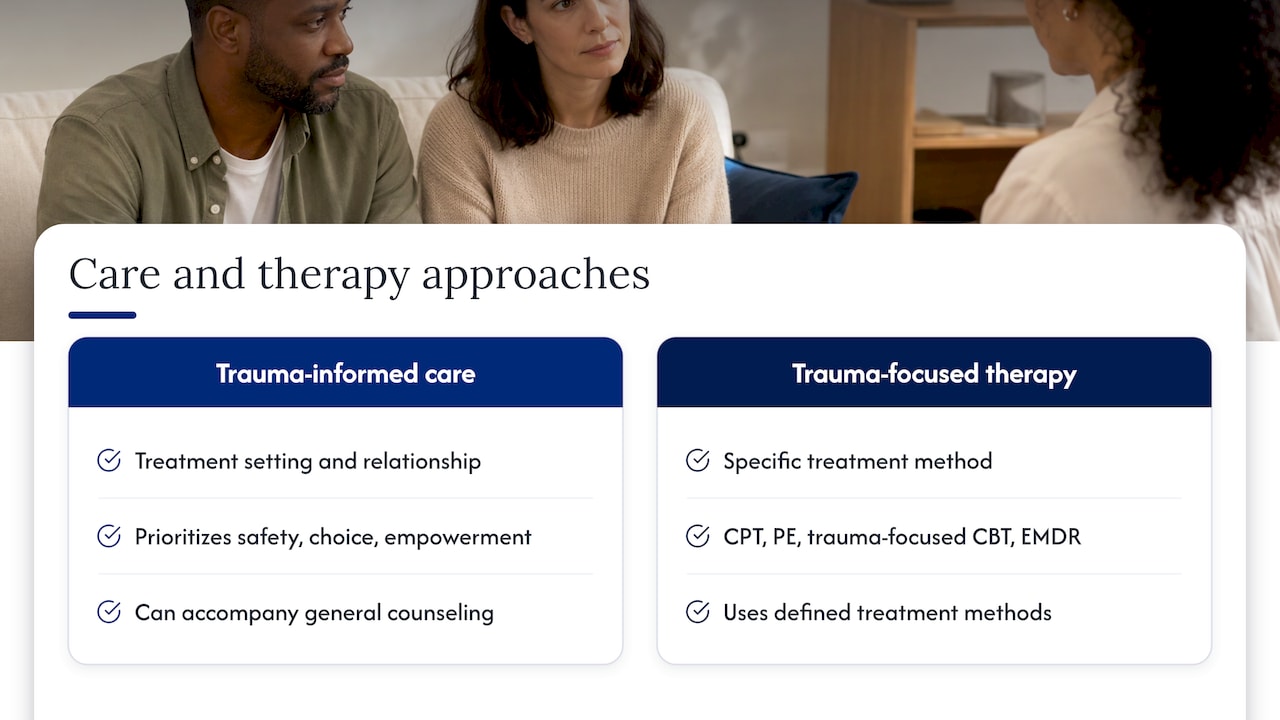
People often mix these up. Trauma-focused therapies are specific treatments with defined methods, such as Cognitive Processing Therapy, Prolonged Exposure, trauma-focused CBT and EMDR. Trauma-informed care is the setting around the treatment. A practice guide for working with families puts it well: trauma-informed practice is about the way of being in the relationship more than a specific method, prioritizing safety, choice, empowerment and connection.
So a client in anger management, couples work or general counseling can receive trauma-informed care without ever doing a trauma-processing protocol. And a client who does begin trauma-focused treatment benefits most when it happens inside a trauma-informed relationship.
The six principles behind the techniques
The most commonly cited answer to “what are the six principles?” comes from the Texas Health and Human Services guide: safety; trustworthiness and transparency; peer support; collaboration and mutuality; empowerment and choice; and humility. A professional summary from the Center for Health Care Strategies lists the same set.
Here is how each translates into something a counselor actually does.
| Principle | What it looks like in a session |
|---|---|
| Safety | Predictable room, schedule and structure; no surprises; attention to how the client is feeling in the moment |
| Trustworthiness and transparency | Explaining what will happen, why you are asking, and what happens with the information |
| Peer support | Connecting clients to groups and shared experience where appropriate |
| Collaboration and mutuality | Setting goals together; the clinician is a partner, not an authority issuing orders |
| Empowerment and choice | Offering options on pace, topics, format and breaks |
| Humility | Recognizing the limits of your own perspective, including cultural bias |
Nine trauma-informed care techniques
1. Assume trauma is possible, and never require disclosure
The Clinician Guide for Trauma-Informed Care recommends approaching all patients as though they may have experienced trauma. The same guide states that trauma-informed care does not require clinicians to ask for disclosures of trauma. The principles apply to every interaction to build trust and help people feel empowered.
This matters most in counseling, where intake forms and first sessions can feel like an interrogation. A clinical review in BJPsych Advances describes discussing trauma in respectful, sensitive, timely and appropriate ways, giving the person a clear choice about whether to disclose and responding without pressing for details.
Where it goes wrong: a clinician who probes for the “what happened” in the first session to complete a history. The client may feel exposed before any trust exists.
2. Explain before you act
Transparency lowers threat. Tell the client what the session will involve, how long it will last, what you will write down and what confidentiality covers. Psychological First Aid guidance emphasizes giving accurate, age-appropriate information, and learning the facts when you cannot answer a question rather than guessing.
Where it goes wrong: vague answers, or rules that appear mid-process. Surprises are exactly what a nervous system on alert reads as danger.
3. Ask permission at every step
The clinician guide recommends explaining procedures and asking permission throughout. In counseling, that can be as small as “Would it be okay if we looked at what happened last week?” or “I’d like to take notes. Is that all right?” Medicine has a long tradition of this kind of consent, and informed consent in medical care shows the same idea in a very different setting: the person decides, with full information.
The VA National Center for PTSD gives examples of practices that can trigger or retraumatize: touching without asking, being overly directive, or entering a room without knocking. Each is fixed with a simple request before acting.
4. Offer real choices
Empowerment is not a slogan. It is whether the client picks the topic, the pace, where to sit, whether to pause or whether to move to an online session. The clinician guide suggests reminding clients they may pause or stop at any time. Choices have to be real, though: offering options the clinician will override teaches the client that choice is an illusion.
5. Use open-ended, patient-centered questions
The same guide recommends open-ended questions and patient-centered communication. Compare “Why did you react like that?” with “What was happening for you just before that moment?” The first invites defensiveness and shame. The second invites description. In couples and family work, where each person may feel blamed, this difference often decides whether the session stays productive.
6. Watch for distress and ground early
Providers can watch for signs of distress and offer grounding, such as water or a cool cloth, according to the clinician guide. A 2023 review of trauma and the perinatal period describes using breathing focus and a soothing tone of voice to help someone return to a regulated state when activation occurs, and notes that safety and trust require constant attention.
LA County Public Health describes grounding exercises as short activities that help manage intrusive thoughts when reminded of traumatic experiences. In practice: slow the pace, lower your voice, name what is in the room, breathe together. Only after the client is regulated does it make sense to return to the topic. Our own framework, covered in The 3 R’s of Trauma-Informed Care: Regulate, Relate, Reason, follows that order.
7. Be consistent and follow through
TIP 57 advises adapting the environment to support physical and emotional safety, maintaining consistency, following through on agreements and communicating honestly and compassionately. Start on time. Do what you said you would do. Keep the structure of sessions recognizable. For clients whose past involved unpredictable adults or partners, reliability is itself an intervention.
8. Avoid control, humiliation and conditional care
TIP 57 names practices that can retraumatize: seclusion or restraint, humiliating assignments, overly authoritative or confrontational approaches, making treatment conditional on conformity, discounting reports of abuse, and allowing abusive behavior among clients to continue. It also advises that efforts to control and contain behavior can produce abnormal reactions, particularly for survivors for whom being trapped was part of the trauma.
It further advises counselors to be sensitive to behaviors in the treatment setting that might trigger trauma memories, and not to ignore symptoms or demands when a client acts out in response to a triggered memory. In anger management, this is especially relevant: an outburst in a group is information about what the person needs, and it deserves a response that is firm about safety without being humiliating.
9. Adapt to culture, age and identity
There is no universal feeling of safety. Government guidance says trauma-informed services should be culturally sensitive and account for biases related to gender, sexual orientation, age, religion, disability, geography, race or ethnicity. The RANZCP guidance adds holistic assessment that considers physical, psychological, sociocultural, religious and spiritual needs, and respect for traditional healing practices where appropriate.
For children and teens, that means language and pacing suited to their age; our guide to counseling interventions for children covers what parents can expect. For Black families, it means care that understands history and context, which we discuss in Counseling for Black Families: Culturally Centered Healing.
How these techniques work in couples, family and individual counseling
In individual counseling, the techniques show up as pacing. The client decides how fast to go, and the clinician tracks the body as well as the story.
In couples counseling, safety has two layers: safety from the clinician, and safety between partners. A trauma-informed couples clinician sets ground rules early, interrupts escalation before it becomes contempt, and treats each partner’s reactivity as an adaptation rather than a character flaw. Our overview of conflict management techniques for couples, families and clinicians shows how this plays out.
In family counseling, the point from the family practice guide holds: the relationship is the intervention. Parents who feel judged will not bring their children back. A clinician who treats the family as a system under strain gives everyone room to change. See family counseling benefits for more.
For a deeper look at the clinical side, our posts on trauma-informed counseling and client support and trauma recovery frameworks go further.
A quick checklist for your next session
- Did I explain what we would do and how long it would take?
- Did I ask before any new topic, exercise or note-taking?
- Did the client have at least one real choice?
- Did I notice signs of distress, such as going quiet, shallow breathing or sudden anger, and respond before pushing on?
- Did I do what I said I would do?
- Did I avoid confrontation, ultimatums and conditions on care?
- Did I consider how culture, age and identity shape this client’s sense of safety?
Where Mastering Conflict fits
If you are looking for counseling that applies these practices, our clinical team offers couples counseling, counseling for women and men, teen counseling, anger management counseling and infidelity recovery. Our anger management options include online classes: the 1 Hour class is $24.99, the 6 Hour class is $79 and the 8 Hour class is $85, all on our classes page. Couples sessions are $175 per hour, and our couples packages include the Relationship Renewal Starter Program at $1,100.
Clinicians who want to build these skills can also look at our clinical mentoring and supervision, listed with the other services on the clinical services page.
Our perspective
Trauma-informed care is often taught as a list of principles. We think it is better understood as a discipline of small choices: the tone of the first greeting, whether you ask before you probe, whether you stay steady when a client escalates.
Our work with anger, couples conflict and family stress has a common thread. Behavior that looks like aggression or withdrawal usually has a history, and when you respond to the history instead of the behavior, people stay in treatment and begin to change. Our frameworks are designed to blend clinical rigor with tools clients can use at home, and to serve diverse populations, including women, men, teens and Black and African American clients.
That is why we pair evidence-based structure with a relationship that feels safe, and why we offer online options for people who are far away or simply need to start from their own living room.
Carlos
FAQ
What are the 6 principles of trauma-informed care?
They are safety; trustworthiness and transparency; peer support; collaboration and mutuality; empowerment and choice; and humility. Different agencies phrase them slightly differently, but these six are the most widely cited set.
What are the basics of trauma-informed counseling?
The basics are assuming trauma may be present, creating safety, explaining what will happen, asking permission, offering choices and letting clients decide whether to disclose. The relationship, not a specific method, is the foundation.
Does trauma-informed counseling mean we have to talk about trauma?
No. Clinical guidance states that trauma-informed care does not require clinicians to ask for disclosures, and clients keep the choice about what to share and when. Care can be effective without revisiting details.
What can retraumatize a client in counseling?
Federal guidance lists overly authoritative or confrontational approaches, humiliating assignments, making treatment conditional on conformity and ignoring reports of abuse. Even small acts such as touching without asking can trigger a reaction.
Sources
- SAMHSA, Trauma-Informed Care in Behavioral Health Services (TIP 57)
- SAMHSA, TIP 57 full text
- GOV.UK, Working definition of trauma-informed practice
- Healing Families, Helping Systems practice guide
- Texas Health and Human Services, Six Principles of Trauma-Informed Care Guide
- Center for Health Care Strategies, What is Trauma-Informed Care?
- Clinician Guide for Trauma-Informed Care
- BJPsych Advances, relationships in trauma-informed mental health services
- Psychological First Aid, NCTSN
- Trauma and the perinatal period, PMC
- VA National Center for PTSD, Trauma-informed Care for Health Care Workers
- RANZCP, Trauma-informed practice
- LA County Public Health, Trauma-Informed Care resources